Buried Risk — Apr 19, 2026

Photo: lyceumnews.com
Past 2 Weeks — April 19, 2026
The Big Picture
Spring is doing what spring always does to buried pipe: breaking it. But the stories this fortnight aren't really about pipe — they're about the paperwork, permits, and premiums wrapped around the pipe. A state of emergency in upstate New York, a flooded Main Street in Salt Lake City, a 72-inch sewer in Washington that's been fixed for a month without anyone publicly saying why it failed — each one points at the same uncomfortable truth: we've built an infrastructure accountability system that captures less and less of what's actually going wrong underground.
This Week's Stories
A Single Break Left 11,000 People Without Water in Elma, New York
On April 8, a water main break in Elma, New York — a Buffalo suburb — triggered a state of emergency after nearly 11,000 residents lost service. Pipe material, diameter, and age went unreported, which is the norm for local coverage and exactly the problem.
The interesting number is 11,000. A single break that knocks out service to that many households implies either a large transmission main feeding an entire pressure zone or a critical interconnect with no redundancy. Either one is a system-design flaw, not just a pipe flaw — and it's the kind of detail that should make a municipal risk manager pricing this account ask follow-up questions before renewal. If Erie County or the New York State Department of Health issues a boil-water advisory, that's the signal pressure loss was severe enough to raise contamination risk. If neither does, the question becomes why a system this brittle doesn't have a documented failure mode.
Main Street Flooded on a Saturday Afternoon in Downtown Salt Lake City
At roughly 3:30 p.m. on Saturday, April 11, a large water main gave way under downtown Salt Lake City, sending a surge of water down Main Street. Crews from the Salt Lake City Department of Public Utilities arrived within the hour.
The timing is the story. A 3 a.m. break in a residential neighborhood is a repair ticket; a Saturday-afternoon break through a commercial core is a business-interruption event — and those claims land on commercial property policies, not utility liability lines. Salt Lake City's downtown distribution system carries a significant inventory of mid-20th-century cast iron and asbestos cement, sitting in a seismically active corridor that piles soil movement on top of ordinary corrosion fatigue. If the Department of Public Utilities' post-incident report names cast iron installed before 1960, that's confirmation of a deferred-replacement pattern in the downtown core. If the report never comes — and it often doesn't — that's its own signal about what underwriters are allowed to see.
The Potomac Interceptor Is Now an Environmental Remediation Story — and the Cause Still Isn't Public
● Washington DC, USA
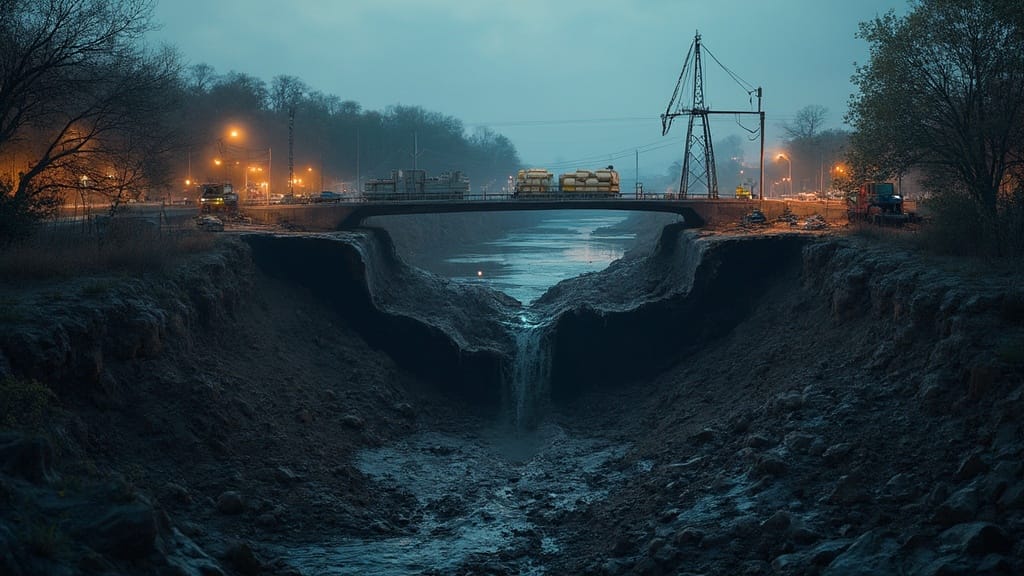
Three months after one of the largest sanitary sewer collapses in recent U.S. history, the pipe is patched, the sewage has stopped pouring into the Potomac, and nobody has publicly said why it failed.
On January 19, a section of DC Water's 54-mile Potomac Interceptor collapsed along Clara Barton Parkway, spilling hundreds of millions of gallons of untreated sewage toward the Potomac River and the C&O Canal National Historical Park, per DC Water. The interceptor carries up to 60 million gallons a day from as far as Dulles Airport to the Blue Plains treatment plant. Emergency repairs were completed and flow restored on March 14, according to DC Water; the utility has moved into rehabilitation and environmental restoration, hauling contaminated debris out of the collapse zone under a Special Use Permit from the National Park Service issued February 28. EPA was designated federal lead, with Administrator Lee Zeldin naming Assistant Administrator for Water Jessica Kramer as Senior Response Officer, according to EPA.
What nobody has said publicly is why. Sanitary sewers aren't regulated by PHMSA, and a 72-inch interceptor can collapse with no mandatory federal investigation, no required root-cause disclosure, and no public record beyond what the utility chooses to release. Then, on April 2, The Washington Post reported that DC Water had planned to reinforce the failed section years earlier but repeatedly delayed construction while federal officials studied environmental impacts — including risks to a blue wildflower and an endangered bat. If that reporting holds up, the permitting process designed to protect the Potomac may have helped delay the repair that could have prevented a sewage discharge into the Potomac. Watch for whether EPA issues a consent order; that would be the first public accounting of what actually went wrong.
A 30-Inch Sewer Main Collapsed in Germantown, and the Real Story Is How Fast the Bypass Appeared
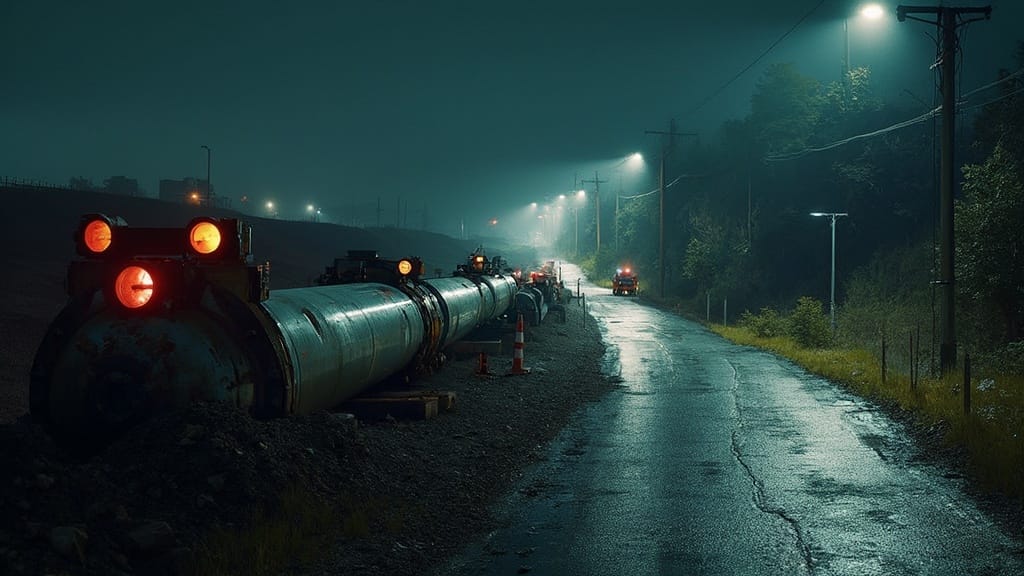
WSSC Water crews built a full bypass around a collapsed 30-inch sewer main on Liberty Mill Road in Germantown, Maryland, running about 1,000 feet of 18-inch bypass pipe and high-capacity pumps so permanent replacement of roughly 110 feet of failed pipe could begin. WSSC also asked the public not to flush wipes or grease, because either could clog the bypass pumps and turn a contained emergency into an overflow.
The lesson here isn't the pipe — it's the plumbing around the pipe. Sewer collapses immediately generate exposure across overflow, traffic control, pump reliability, odor complaints, contractor mobilization, and environmental response. Emergency bypass capability, pre-negotiated contractor agreements, and pump redundancy are direct loss-control variables, which means a utility's contingency capacity is now its own insurable infrastructure class. If WSSC eventually names corrosion or soil loss as the cause, Mid-Atlantic sewer emergency work starts to look like a repeatable pattern rather than a run of bad luck — and the utilities without a tested bypass plan become the ones to reprice.
The $630 Billion Wastewater Gap Is Getting Harder to Close
EPA's 2024 Clean Watersheds Needs Survey pegged national wastewater infrastructure needs at $630 billion over 20 years — a roughly 70% jump from the 2016 estimate to the 2024 figure. Between 1998 and 2024, household water and sewer payments climbed at roughly twice the pace of the consumer price index, and EPA estimates somewhere between 12.1 million and 19.2 million U.S. households now face unaffordable water bills, per the Congressional Research Service.
Into that arithmetic drops the FY27 budget proposal, which would cut State Revolving Fund appropriations — the low-cost federal loan pool most small and mid-size utilities rely on for capital projects — by roughly 90%. The SRF is the financing backbone for sewer rehab, main replacement, and treatment upgrades across the country. A utility that loses SRF access either defers maintenance (raising failure probability) or raises rates (raising affordability stress and political pressure to defer maintenance anyway). Both paths end at more breaks, more overflows, and more claims. If the SRF cut survives the Senate Appropriations Committee's full committee markup, expect accelerated rate-case filings at state utility commissions within 60 days as utilities model market-rate financing. EPA's WIFIA loan announcements are the counter-signal worth tracking: they show where federal capital is still flowing, and by extension which utilities can still finance a credible capital program and which cannot.
⚡ What Most People Missed
- The PHMSA reporting threshold has a math problem. The agency's own incident reporting page puts the gas pipeline property-damage threshold at $149,700 effective July 1, 2025 — not the $153,600 figure that's been circulating. A $4,300 gap in a single inflation-adjusted number is small in dollars and large in principle. The threshold rises annually, and every rise is a distribution incident that disappears from the federal record.
- Massachusetts quietly assessed $15.4 million in excavation penalties in 2025. The Massachusetts Department of Public Utilities investigated 2,645 excavation-related incidents last year and collected more than $15.4 million in civil penalties, per the DPU. $15.4 million in one state is a floor, not a ceiling, on what dig-in enforcement looks like when a regulator actually runs the program. Most states are not Massachusetts.
- An undercovered Atlanta water main break shows how uneven national aggregation is. An early-morning April 11 break in southeast Atlanta received almost no coverage outside local outlets. Spring freeze-thaw stress is peaking right now, and nobody is aggregating these events into a national picture.
- NTSB found Atmos Energy knew about the Jackson leaks for eight weeks. The board's final report on the January 2024 Jackson, Mississippi explosions found the operator had detected leaks at least eight weeks in advance, classified them nonhazardous, and never returned to fix them — and also lacked complete records for many service lines. Known leaks plus incomplete asset records is the organizational failure mode underwriters should be highlighting.
- Leaking pipes waste $4.1 billion in electricity a year. North American utilities lose roughly 2.6 trillion gallons of treated drinking water annually to leaks — about 17% of everything pumped, per the Utah State University data compiled at watermainbreakclock.com. That's electricity paid for, pumped, and never billed. It almost never shows up in rate cases. It should.
📅 What to Watch
- If EPA issues a consent order or formal enforcement action tied to the Potomac Interceptor collapse, it will be the first public accounting of cause — and the first test of whether sanitary sewer failures get anything resembling federal investigative treatment.
- If the Salt Lake City Department of Public Utilities' post-incident report names pre-1960 cast iron, expect downtown commercial carriers to reopen pricing conversations mid-policy.
- If PHMSA follows its January plastic-pipe advisory bulletin with actual inspections or enforcement, it signals the agency is shifting from reminding operators about plastic failure modes to building a record against them.
- If the FY27 SRF cut survives the Senate Appropriations Committee's full committee markup, the second-order effect isn't rate shock — it's a repricing of utility revenue bonds as market-rate financing replaces subsidized loans on capital programs already baked into 10-year plans.
- If a state utility commission cites the NTSB Jackson findings in a live gas-safety docket, leak reclassification and mandatory recheck intervals move from recommendation to expectation for every distribution operator in that state.
- If Phase 2 water systems miss the June–July filing deadlines against the $13.6 billion 3M and DuPont PFAS settlements, the capital cost of EPA-mandated filtration lands entirely on local ratepayers — and the credit stress shows up in the next bond cycle.
The Closer
A bat is being credited with delaying a repair that preceded the Potomac discharge; a Saturday-afternoon geyser down Main Street in Salt Lake City; a threshold inching up by $4,300 a year, quietly erasing incidents from the only federal ledger we have. Somewhere a wildflower is being credited with more environmental protection work than it did, and a backhoe operator who didn't call 811 is responsible for more 911 outages than any cyberattack this year.
Until next break.
Forward this to the person on your team who still thinks "buried" means "out of mind."