Buried Risk — Jul 15, 2026

Photo: lyceumnews.com
Week of July 15, 2026
The Big Picture
This week's failures didn't look like the movies. No fireballs, no craters — just a pressurized sewer pipe emptying into a New England river, a Nashville crew closing five valves to stop one break, and federal regulators quietly rewriting the rules for when old pipe has to come out of the ground. The through-line: systems built for one world are running in another, and the people who mark, monitor, and price that risk are starting to say the arrangement is broken — out loud.
This Week's Stories
Haverhill's 42-Inch Force Main Failure Is Still Unfolding — and the Merrimack River Paid the Price
A sewer force main is a pressurized pipe that pushes wastewater uphill or across distance. When it fails, there's no graceful degradation. Just sewage going somewhere it shouldn't. (Haverhill's 42-Inch Force Main Failure Is Still Unfolding — and the Merrimack Ri)
Around 9:00 p.m. on June 26, during a torrential rainstorm, a 42-inch force main near the South Mill Street Pumping Station in Haverhill, Massachusetts broke — the pipe carrying most of the city's wastewater to treatment. Heavy rain surged flows past what the line could handle. Because the break sat next to the pumping station, everything arriving there discharged straight into the Merrimack River instead of the plant. (Haverhill's 42-Inch Force Main Failure Is Still Unfolding — and the Merrimack Ri)
The downstream reach was wide. Merrimac warned residents off the river, Newburyport closed Plum Island beaches, and the state posted precautionary notices at Salisbury Beach. Discharge into the river stopped July 1 — but only after an emergency bypass rated at roughly 30 million gallons a day went in, coordinated with Xylem, DeFelice Corporation, and Wright-Pierce. Crews are now excavating both break locations and evaluating the pipe. (Haverhill's 42-Inch Force Main Failure Is Still Unfolding — and the Merrimack Ri)
Here's what should keep municipal underwriters up: a single pipe with no redundancy shut down beaches across three communities, and there's no public permanent-repair timeline. If Massachusetts DEP and EPA's root cause analysis points to material degradation rather than storm surge alone, this stops being a Haverhill story and becomes a template question for every similarly-sized force main in the Northeast. Watch for a formal sanitary sewer overflow enforcement notice as the investigation matures. (Haverhill's 42-Inch Force Main Failure Is Still Unfolding — and the Merrimack Ri)
Texas Has Had 4,800 Pipeline Dig-Ins in 2026. A Dallas Explosion May Be One of Them.
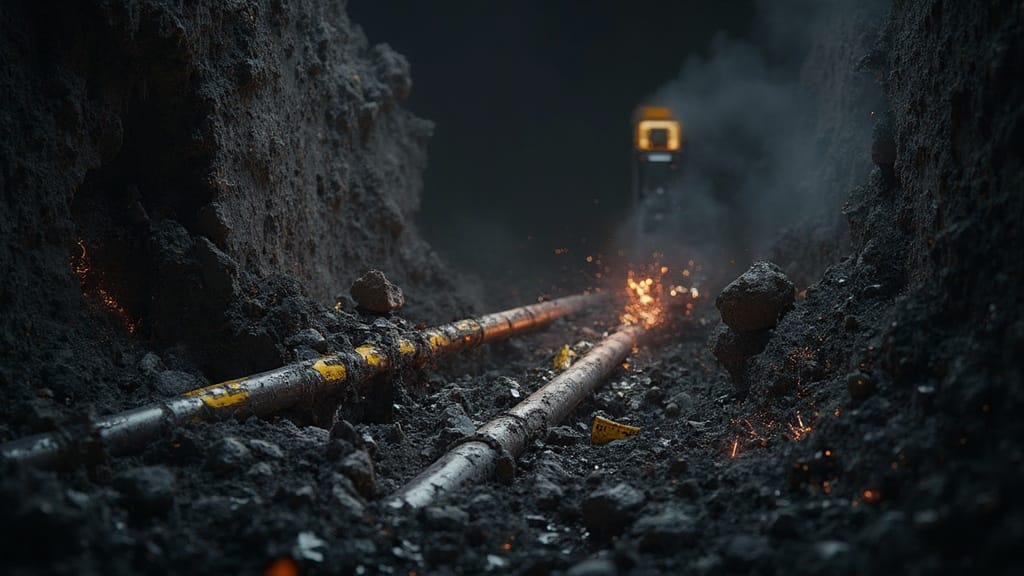
If you want to understand why excavation damage is systemic and not a run of bad luck, Texas is the case study.
More than 4,800 excavation-related pipeline strikes have been reported statewide in 2026, per Texas Railroad Commission data, with over 1,000 in the Dallas–Fort Worth region alone. That number gained weight after a deadly Oak Cliff apartment explosion in Dallas on May 28 killed three people. The NTSB's preliminary report — a Tier 1 document — found that Barba Drilling, contracted by Engineering and Consulting Services, was running a drill rig for soil sampling near the building before a gas leak was reported; Dallas Fire-Rescue notified Atmos Energy of a "cut line" at 12:51, and Atmos arrived around 1:20 p.m., shortly after the blast. A final report assigning probable cause could take over a year. (Texas Has Had 4,800 Pipeline Dig-Ins in 2026. A Dallas Explosion May Be One of T)
The compliance picture is the alarming part. Texas requires excavators to call the One-Call center 48 hours before digging, but Railroad Commission records reviewed by KERA found that roughly one-third of excavators in reported strikes this year never contacted the system at all. Even when 811 works, aging infrastructure, incomplete maps, and hard-to-locate non-metallic pipe undercut it. (Texas Has Had 4,800 Pipeline Dig-Ins in 2026. A Dallas Explosion May Be One of T)
For contractor-liability and gas-distribution underwriters in Texas, one-third of strikers skipping the call isn't a frequency problem — it's a severity problem waiting to happen. Watch whether the Railroad Commission faces legislative pressure on enforcement authority once the Dallas investigation concludes. Corroborated across KERA, Texas Public Radio, and Pipeline & Gas Journal. (Texas Has Had 4,800 Pipeline Dig-Ins in 2026. A Dallas Explosion May Be One of T)
Nashville's 12-Inch Water Main Rupture: Five Valves, One Tank, and a Night Crew
Water main breaks don't make this newsletter unless they tell us something past "pipe broke, crews fixed it." This one does. (Nashville's 12-Inch Water Main Rupture: Five Valves, One Tank, and a Night Crew)
On July 14, Old Hickory and Hermitage lost water after Metro Water Services reported a major break on a 12-inch main under Barnwell Court. To isolate it, crews had to close five separate valves. In a well-segmented system, you close one or two. Closing five means valve spacing is wider than it should be — or some valves weren't operable. Either way, the outage's blast radius grows with each valve. The break also drained a storage tank in the Roxborough neighborhood, per councilwoman Erin Evans, and crews worked through the night to restore service. (Nashville's 12-Inch Water Main Rupture: Five Valves, One Tank, and a Night Crew)
Material type and install decade haven't been reported, so cause is still open. But a depleted tank plus five valve closures on a single 12-inch break is a distribution-system resilience story, not a maintenance footnote. If you're pricing Nashville's water system, flag this as a valve inventory and operability question — the next break tells you whether Barnwell Court was an outlier or a pattern. (Nashville's 12-Inch Water Main Rupture: Five Valves, One Tank, and a Night Crew)
PHMSA Just Rewrote the Rules on When Pipelines Need to Be Fixed

For twenty years, federal pipeline repair rules worked like a speed limit: if a defect exceeded a set size, you fixed it by a set date. PHMSA just proposed replacing that with something closer to clinical judgment — and the implications cut both ways. (PHMSA Just Rewrote the Rules on When Pipelines Need to Be Fixed)
Published July 8 in the Federal Register, the Notice of Proposed Rulemaking would swap prescriptive repair timelines for a risk-based framework leaning on modern inline inspection, engineering analysis, and integrity assessments. PHMSA estimates it would save industry about $390 million annually while improving safety, and it extends engineering-based criteria already used for gas transmission to hazardous-liquid lines. The law firm Beatty & Wozniak notes the rule doesn't eliminate repair criteria — it expands operator options, with engineering analysis playing a bigger role and demanding stronger technical support and documentation. (PHMSA Just Rewrote the Rules on When Pipelines Need to Be Fixed)
The logic is sound: inspection tech has leapt since the early 2000s, and rigid size rules can force repairs on low-risk anomalies while missing high-risk ones. The risk isn't that the rule is wrong — it's that documentation discipline will vary wildly across operators. Comments close September 8. Insurers writing pipeline integrity coverage should read the comment record like a tell: the operators pushing hardest against documentation requirements are the ones to underwrite most carefully. (PHMSA Just Rewrote the Rules on When Pipelines Need to Be Fixed)
The Damage Prevention System Is "Designed to Fail" — and Locators Are Finally Saying So Out Loud
The people who physically mark buried utilities before crews dig have been the quiet middle of damage prevention for decades. They don't call 811, and they don't swing the backhoe. They've had enough. (The Damage Prevention System Is "Designed to Fail" — and Locators Are Finally Sa)
The National Utility Locating Contractors Association released a position paper describing the process as a system "designed to fail," calling for systemic reform. Locators recount marks placed exactly where records indicated, only for digging to reveal infrastructure somewhere else entirely. Per the Common Ground Alliance's DIRT report, excavators have only a 50-percent chance of starting on time because facilities are unmarked or mismarked. The human cost NULCA points to: the Lexington, Missouri explosion that killed a five-year-old after a fiber crew struck a gas line — where, according to NULCA, the subcontractor had called 811 five days before breaking ground. (The Damage Prevention System Is "Designed to Fail" — and Locators Are Finally Sa)
That's the whole argument in one sentence: the call was made, and the child still died. When the system is used correctly and the tragedy still happens, the problem is structural, not behavioral. This is the kind of document that ends up in congressional testimony and rulemaking comments — watch for it to surface in the PIPELINE Safety Act debate. (The Damage Prevention System Is "Designed to Fail" — and Locators Are Finally Sa)
⚡ What Most People Missed
EPA's Keystone settlement turns one rupture into a maintenance precedent: On July 10, EPA, the Justice Department, and Kansas announced a proposed settlement with South Bow (USA) LP and South Bow Infrastructure Operations over the December 2022 Keystone rupture that released nearly 13,000 barrels into Mill Creek — more than $26.8 million in civil penalties, roughly $40 million in preventive work, and $3 million to Kansas. The signal: maintenance is becoming enforceable narrative, with future underground failures framed less as bad luck and more as preventable asset-management lapses with penalty math attached.
A Kentucky gas release drew federal investigators before the paper trail caught up: A July 7 natural gas leak in Boyd County, Kentucky triggered evacuations, and by July 8 WSAZ reported NTSB and EPA investigating alongside line owner Kinder Morgan, with the fire chief citing a 12.3-million-cubic-foot release. The tell for anyone tracking gas risk: the investigation moved faster than the visible database, since formal PHMSA reports can lag up to 30 days.
Baltimore's sewer-overflow decree adds pressure on cities treating buried wastewater as a budgeting problem: EPA posted and updated Baltimore's consent decree page around July 1 — a formal federal enforcement action on sewer overflows, landing as EPA expands public overflow and bypass data through its ECHO compliance database. Once overflows are legible in federal systems, cities deferring collection-system work lose the obscurity they've leaned on — the sewer equivalent of going from a paper chart to a live flight tracker.
PHMSA quietly updated its external corrosion assessment standard: Via direct final rule effective January 1, 2027, PHMSA incorporated an updated edition of NACE SP0502, the industry standard for external corrosion direct assessment. Nobody's writing about it, but external corrosion is the leading cause of gas transmission failures — and how operators document those decisions matters enormously under the new repair-rule framework.
PHMSA opened a comment window on revising its core incident-reporting forms — including gas distribution: Docket PHMSA-2026-0529 covers proposed revisions to incident, accident, and annual report forms for gas and hazardous-liquid pipelines, with comments due August 17. It arrives the same quarter the property-damage reporting threshold rose to $153,600 — meaning fewer incidents trigger a federal report at the exact moment the forms themselves are being redesigned, and the net effect on data coverage could go either way.
📅 What to Watch
- If Haverhill's root cause analysis blames material degradation over storm surge, every similarly-sized force main in New England inherits the same open question — and the bypass system, rated only for dry weather, becomes a live public-health risk if a major storm hits before permanent repairs finish.
- If an operator files comments against documentation requirements for engineering-based repair deferrals under the new PHMSA rule, that operator is telling you exactly how it runs its integrity program.
- If PHMSA's July class-location reaffirmation nudges operators toward integrity management over pipe replacement, capital for wholesale main replacement slides further out on the calendar — and pressure-monitoring vendors, not steel suppliers, are the ones to watch.
- If PHMSA posts another month of $0 proposed fines — June logged one Corrective Action Order and zero civil penalties — the reduced-enforcement pattern is confirmed, and more risk shifts onto operators' own documentation and the insurers who trust it.
The Closer
This week: a New England river doing a sewage plant's job for five days, a Nashville night crew turning five valves like a submarine emergency, and a five-year-old's death that happened because someone followed the rules and called 811. Somewhere in Texas, one in three excavators is still skipping that call — and the reporting threshold for gas incidents just quietly went up, so fewer of the next ones will ever make the federal record at all. (The Damage Prevention System Is "Designed to Fail" — and Locators Are Finally Sa)
Stay above ground.
Know someone who prices, insures, or patches this stuff for a living? Forward it — they'll want the Haverhill number before their next renewal. (The Damage Prevention System Is "Designed to Fail" — and Locators Are Finally Sa)