Buried Risk — Jul 31, 2026

Photo: lyceumnews.com
Week of July 31, 2026
The Big Picture
This was a week when systems ran out of room to maneuver. Los Angeles pulled a 2031 replacement forward, Halifax shut down an entire water network after pressure swings triggered a second break, and Chicago’s largest stormwater reservoir reached 92% full on the session. The common problem was not simply old pipe. It was what happened when storage, isolation, repair access or regulatory patience ran thin.
This Week's Stories
Los Angeles Had a Pipe Scheduled for 2031. The Pipe Declined to Wait.
On July 24, the Los Angeles Department of Water and Power announced an alternate operating plan to restore service around the damaged 36-inch transmission line beneath West Hollywood. Recurring leaks had complicated repairs, so LADWP isolated the troublesome section instead of continuing to repressurize it. The agency also said Sunset Boulevard was expected to reopen July 25. (A “catastrophic” penstock failure in Yuba County shows what buried water can do )
The larger decision concerned the capital plan. LADWP moved forward the line’s full replacement, previously scheduled to begin in 2031. Design is about 60% complete, and the agency expects construction to take roughly four years. (ladwpnews.com)
That acceleration is the real story. A long-range project has become a near-term obligation, bringing traffic, permitting, claims and financing consequences with it. If LADWP can isolate the segment without degrading pressure elsewhere, it buys time for an orderly replacement. If service problems recur, the city may have to compress the schedule further and reshuffle other work.
Watch the failure analysis. Corrosion, joint failure or a repeatable material defect would turn one expedited project into a screening question for comparable trunk lines across Los Angeles.
Halifax’s First Break Found a Second One
A second main failure forced Halifax, Massachusetts, to shut off water to every resident and business on July 27. The break occurred on Lingan Street. The town said “excessive water pressure fluctuations” required the shutdown to prevent additional damage, and it activated an emergency interconnection with Brockton. Service returned that evening, with customers warned to expect air and discoloration during repressurization.
The critical failure was hydraulic control—the ability to manage pressure and flow across the network—not merely the broken pipe. One break altered system pressure. The changed conditions exposed another weak point. The town then chose a complete shutdown rather than risk a wider cascade.
If Halifax’s Brockton connection can reliably support emergency demand, the event remains painful but containable. If another break appears during routine operation or repressurization, the town may be looking at a cluster of pressure-sensitive assets rather than two isolated failures.
Halifax has not disclosed the mains’ material, diameter or initiating cause. Those details—and evidence that the interconnection has been flow-tested under realistic demand—will tell risk managers whether the emergency plan worked by design or by luck.
Scranton’s Water-Main Repair Clock Started at 68 Hours
Pennsylvania American Water put Scranton on a 68-hour repair clock after reporting a main break at 4:15 p.m. on July 27. At the time of the alert, the utility warned of low pressure and service interruptions, issued a boil-water advisory and positioned drinking-water tankers at two downtown intersections.
A multi-day estimate changes the loss profile. The broken pipe may be the smallest line item once government offices, roads, restaurants and other water-dependent operations begin counting interruption costs. It also followed a separate downtown break earlier in July that closed Scranton City Hall, the Lackawanna County Courthouse and other buildings, according to WVIA.
The operating test is whether Pennsylvania American Water can restore the area without another prolonged interruption. The political test is harder: Pennsylvania regulators approved a smaller-than-requested water and wastewater rate increase on July 17, so the utility’s next capital case will need to connect higher bills to visible reductions in repeat failures. (Scranton’s Latest Main Break Came With a 68-Hour Repair Estimate)
Watch for the failed main’s age and material—and for a block-level replacement plan. Another isolated repair announcement would suggest the utility is still treating an accumulation problem one hole at a time.
Chicago’s Underground Reservoir Had Almost No Elbow Room
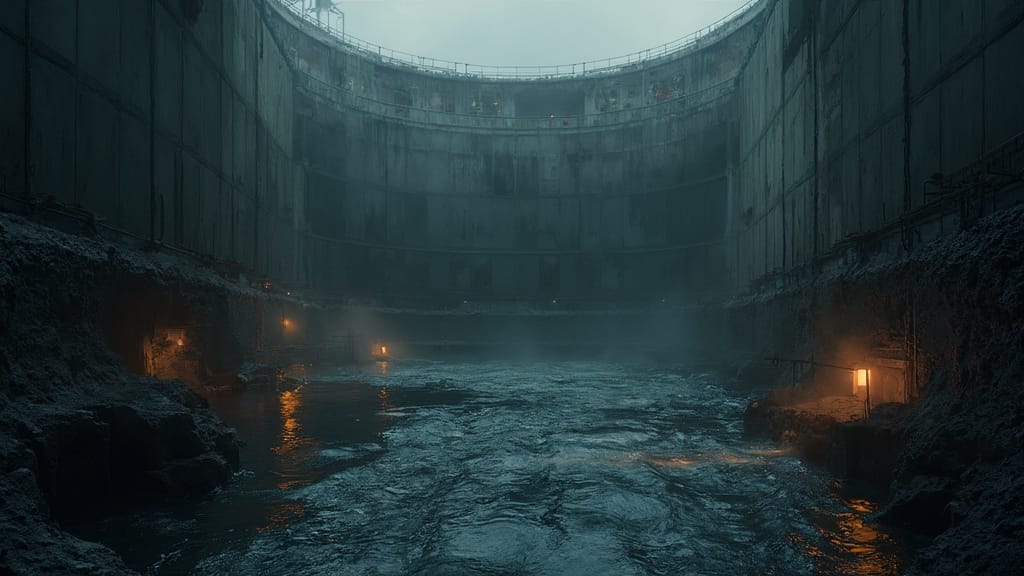
Chicago’s underground stormwater system had almost no room left after the July 27 storms. The city received 569 flooded-street reports and 540 basement-water complaints. WTTW reported that the region’s Deep Tunnel reservoirs held a combined six billion gallons of stormwater and wastewater by the morning of July 28.
McCook Reservoir—the system’s largest storage basin—was about 92% full, holding 3.2 billion gallons. According to WTTW, it has reached capacity six times in 2026, compared with five times in total from 2021 through 2025. Water from storms earlier in July was still being processed when the new rain arrived.
The exposure is no longer one extraordinary downpour. It is insufficient recovery time between storms. If the Metropolitan Water Reclamation District of Greater Chicago can drain and treat stored water before the next major rainfall, Deep Tunnel keeps functioning as intended. If not, the region enters the next event with part of its protection already consumed.
For insurers and municipal risk managers, available storage matters more than nameplate capacity. The tell is McCook’s drawdown rate—not the impressive number engraved on the system’s brochure.
Maryland Approved the Pipe Spending—and Rejected the Black Box

Maryland approved pipe spending, but it rejected a black-box rationale for it. On July 27, the Maryland Public Service Commission approved a $38.1 million annual revenue increase for Washington Gas Light Company, less than half the $82.5 million originally requested. The order authorizes a 9.4% return on equity and raises the average residential heating bill by approximately $4.01 per month.
Washington Gas presented $342.9 million in capital investment, including $143 million associated with its Strategic Infrastructure Development and Enhancement program, or STRIDE, which replaces higher-risk gas infrastructure. The commission allowed certain STRIDE costs to remain in the separate surcharge but declined to move them into base rates for now.
The commission did not question whether replacement work occurred. Washington Gas reported replacing 20.88 miles of higher-risk main and remediating 6,395 higher-risk service lines. It questioned whether the utility had retained enough evidence to explain its risk-model assumptions, project rankings, customer benefits and alternatives such as leak detection or pipe lining. (Maryland Told Washington Gas to Show Its Work)
If Washington Gas responds with project-level, auditable risk reduction, Maryland’s order could become a template for defensible replacement spending. If the documentation remains thin, utilities may discover that “the model says so” no longer converts automatically into rate recovery. For underwriters, that same documentation gap is worth finding before a loss does. (Maryland Told Washington Gas to Show Its Work)
⚡ What Most People Missed
- Waterbury’s missing fitting: A July 28 transmission-main failure disrupted service to more than 5,100 Waterbury homes and businesses, prevented the Clough Road storage tank from replenishing and forced crews to obtain a specialized fitting that was not stocked locally, according to the News-Times. The weak link was not only the pipe—it was storage topology and spare-parts readiness.
- A pipe 40 feet underground: Winston-Salem/Forsyth County Utilities found its failed main beneath a man-made pond in a remote area, roughly 40 feet down. Service was restored, but the location turned an ordinary asset-register entry into a difficult excavation with limited repair and bypass options.
- Two utilities, one apparent lightning strike: WPBF reported that North Palm Beach Fire Rescue found both a small gas leak and a broken six-inch water main near a tree apparently struck by lightning on July 26. No engineering report has established the electrical path, but the response shows how closely placed buried systems can turn one localized hazard into a multi-utility emergency.
- Hopewell’s half-million-gallon problem: Underground Infrastructure, citing Hopewell Water Renewal and the Virginia Department of Health, reported that a ruptured sewer force main was releasing an estimated 400,000 to 500,000 gallons of sewage per day into Cattail Creek. Repairs were still expected “next week” as of the utility’s July 29 update, and the recreational-water advisory for Bailey Bay remained the public-health marker to watch.
- The storm sewer became the storm: Two contractors were trapped in a Downers Grove, Illinois, storm-sewer work area as severe weather crossed DuPage County on July 27. The village’s update said one worker was rescued about 200 feet from the entrance and the search for the second had shifted from rescue to recovery, making real-time weather monitoring a life-safety control rather than a scheduling tool.
📅 What to Watch
- If LADWP identifies a repeatable defect in the Sunset Boulevard trunk line, it means comparable segments may move from long-range capital planning into immediate inspection and replacement queues.
- If Halifax records another break under normal pressure, it means the July 27 shutdown exposed a network-level vulnerability rather than an unlucky pair of failures.
- If McCook Reservoir drains slowly before Chicago’s next major storm, it means insurers should treat remaining storage as a depleted catastrophe limit, not a fully reset protection system.
- If Maryland gas utilities begin filing project-level risk-reduction calculations, it means auditable capital prioritization is becoming a de facto underwriting standard as well as a regulatory one.
- If Hopewell’s repair extends beyond the utility’s “next week” expectation, it means environmental exposure is being driven less by the initial rupture than by access, bypass capacity and repair logistics.
The Closer
A Los Angeles pipe ripped 2031 off the calendar. Halifax borrowed water from Brockton after pressure went feral. Chicago’s underground bathtub stopped just short of the rim. Infrastructure planning had a very literal week.
Somewhere in Waterbury, 5,100 customers learned that resilience is occasionally a specialized fitting sitting on the wrong warehouse shelf.
Mind the pressure gauge.
Forward this to the person who still thinks “buried” means “out of sight, out of risk.” (A “catastrophic” penstock failure in Yuba County shows what buried water can do )