Buried Risk — May 10, 2026

Photo: lyceumnews.com
Sunday, May 10, 2026
The Big Picture
No new spectacular breaks broke into the news cycle overnight, but three quieter things did: PHMSA scheduled the first public hearing in five years on a rule that would actually regulate the gas line under your street, S&P Global Ratings downgraded the New Orleans Sewerage and Water Board mid-sewage-crisis, and the American Water Works Association published the sentence "household drinking water bills are likely to more than double." If you price utility risk for a living, this is the week to read the fine print rather than the headlines.
Today's Stories
The Gas Distribution Rule Finally Gets Its Hearing — May 28
PHMSA published a Federal Register notice scheduling its Gas Pipeline Advisory Committee to meet May 28 on the long-pending notice of proposed rulemaking titled "Safety of Gas Distribution Pipelines and Other Pipeline Safety Initiatives" (Docket PHMSA-2021-0046). Verbal public comment is not allowed at the meeting; written comments are due by June 29, 2026.
This rule matters because gas distribution pipelines — the smaller-diameter lines branching off transmission mains into homes and businesses — have operated under markedly lighter federal requirements than their bigger cousins for decades. The 2021 NPRM has been gathering dust; getting it in front of GPAC is the first concrete procedural step toward a final rule.
If GPAC recommends moving the rule forward roughly as written, expect the federal incident record to widen considerably over the next 24 months — surfacing distribution failures that currently live only in scattered state PUC filings or nowhere at all. If GPAC asks for substantial revisions, the timeline slips another year and the data gap stays open. The signal to watch is whether the committee's recommendations land before or after the comment window closes.
PHMSA Quietly Made Corrosion Standards Mandatory
Pipeline & Gas Journal reported on May 5 that PHMSA has incorporated updated AMPP (Association for Materials Protection and Performance) corrosion management standards — including revised editions of NACE SP0206 and NACE SP0502 — into 49 CFR Parts 192 and 195. Translation: the protocols operators use to find corrosion without digging up the entire pipe are no longer best-practice suggestions. They're federal compliance requirements covering natural gas, hazardous liquids, carbon dioxide, and LNG infrastructure.
"Standards are increasingly part of the regulatory framework, not just guidance," AMPP Vice President Tim Gonzalez told the journal. That's the polite version. The blunt version: an operator who skipped a now-required corrosion assessment before a pipe failed has a regulatory violation stacked on top of the physical failure — and a much harder argument with their environmental impairment carrier.
If enforcement actions in the next inspection cycle cite these standards, the rule has teeth. If PHMSA receives adverse comments before the June 23, 2026, deadline, the direct final rule gets withdrawn and restarted as a full NPRM — pushing mandatory corrosion compliance back 18 to 24 months.
New Orleans Plugged the Industrial Canal — After 50 Million Gallons and a Credit Downgrade
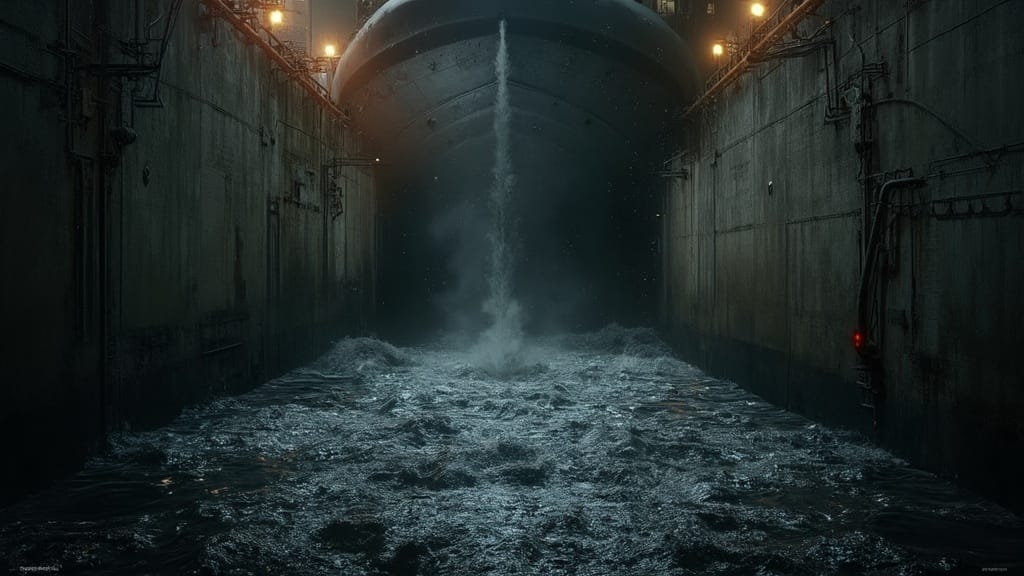
The Sewerage and Water Board of New Orleans confirmed crews plugged the 54-inch sewer force main in the Industrial Canal after it released an estimated 40 to 50 million gallons of raw sewage over roughly two weeks. The U.S. Coast Guard identified the vessel involved in the incident that damaged the pipe as the ITV Assault; authorities have not released ownership details. SWBNO Executive Director Randy Hayman called this "an external accident, not a failure of the system's infrastructure" and said the agency will pursue full reimbursement from responsible parties. Construction is expected to continue several more weeks while crews decide between underwater welding and replacing an entire pipe section.
The complication: SWBNO's homepage now acknowledges S&P Global Ratings lowered its Water and Sewer system credit ratings to A- and A. A downgrade in the A range isn't catastrophic, but it raises borrowing costs for the exact capital projects the utility needs to finance — at the exact moment political appetite for a rate increase is thinnest.
The vessel-strike liability assignment is the variable that determines whether SWBNO recovers its costs or eats them. Watch the Coast Guard investigation docket on the ITV Assault; that's where this story actually gets decided.
AWWA Says Household Water Bills Could More Than Double

The American Water Works Association — the principal trade group for U.S. drinking water utilities — released Beyond the Replacement Era, pegging national drinking water infrastructure needs at $2.1 trillion and stating that household drinking water bills could more than double in coming years. AWWA's parallel State of the Water Industry report puts the five-year sector outlook at its lowest level in nearly a decade. Fewer than half of utilities can fully cover operating costs through rates and fees.
The compounding problem arrives in September 2026: the Infrastructure Investment and Jobs Act provides about $8 billion a year for water infrastructure through 2026, and reauthorization is in doubt. If IIJA water funding lapses without a successor, utilities that have been using federal dollars to defer rate increases face a binary choice: raise rates sharply or defer capital further. Both choices feed the next decade of failures we'll be writing about.
For public entity liability underwriters, this is a leading indicator. Financially stressed utilities defer maintenance; deferred maintenance produces claims. The signal to watch is the September reauthorization fight — and which utilities file accelerated rate cases before it resolves.
PHMSA Raises the Reportable-Incident Threshold July 1, 2026
A small administrative move with a meaningful downstream effect: the property damage threshold defining a reportable gas pipeline incident under 49 CFR § 191.3 rises from $149,700 to $153,600 effective July 1, 2026. It's an inflation adjustment, not a policy reversal — but every time the threshold rises, a slice of real-world incidents falls below the federal record.
PHMSA's incident database is already structured around specific reporting thresholds and a reporting cadence that gives operators up to 30 days to file written reports. That reporting lag is exactly why the federal database is not a real-time situational awareness tool — the earliest public signals on a developing incident almost always come from local fire, utility outage pages, or state regulators. A higher threshold widens that gap further and makes voluntary DIRT (Damage Information Reporting Tool) data more important as a cross-check.
If the broader April 24 rulemaking package — which also proposes allowing remote sensing for rights-of-way patrols and extending valve inspection intervals — survives the comment period intact, the federal record gets thinner just as the AWWA-flagged maintenance crisis gets thicker. That's the trajectory to track.
⚡ What Most People Missed
- A Memphis family was denied compensation for car damage from an underground main break: Memphis Light, Gas and Water cited state law that doesn't require payment absent evidence of human error. Watch this category — as utility budgets tighten and breaks multiply, denial-by-default becomes the path of least resistance and the seed of the next round of municipal liability litigation.
- Auburn Hills and Orion residents were warned overnight of an imminent 42-inch transmission break: The leaking GLWA main in River Woods Park is being treated as an emergency-level event before failure, with bypass pumping and contingency distribution planning already activated. Pre-failure emergency declarations on large-diameter transmission mains are becoming more common — a quiet shift in how operators communicate cascade risk.
- Philadelphia launched a real-time flood monitoring network in Eastwick on May 9: Sensors and cameras feed rainfall, water level, and flood-risk data directly to residents' phones, paired with FEMA HESCO barriers and voluntary buyouts in the highest-risk zones. It's a confirmed example of a city investing in localized observation infrastructure even with federal funding under a cloud — and a useful template for parametric municipal coverage products.
- A West Virginia legislator is drafting a bill requiring data centers to disclose water sources before certification: Delegate Evan Hansen is working on state-level disclosure requirements designed to force data centers to reveal their water sources before receiving certification. At Water Week 2026, WSSC Water CEO Kishia Powell told Inside Climate News that Virginia data centers are "sucking up" energy and driving up costs for water infrastructure facilities — the cost pass-through, not just water consumption, is the underwriting story.
- A fiber construction program in Longwood, Florida keeps hitting water mains: Repeat losses on a single contractor program are a frequency signal that almost never makes the federal incident database. As broadband buildouts accelerate nationwide, the Longwood pattern is the early shape of where excavation-strike claims cluster.
📅 What to Watch
- If GPAC asks for substantial revisions to the gas distribution NPRM on May 28, the federal data gap on residential-street gas line failures stays open for at least another year — meaning state PUC dockets remain the only consistent source for small-diameter distribution failure data.
- If the Coast Guard investigation assigns primary liability to the ITV Assault operator rather than SWBNO, it will set a precedent that shifts recovery risk onto vessel operators and their insurers, increasing port operators' vigilance and potentially raising marine liability premiums tied to submerged utility infrastructure.
- If IIJA water reauthorization fails in September 2026, expect a wave of accelerated rate cases at utilities that have been deferring increases on federal dollars — and expect intensified political resistance to those cases, which would increase the likelihood utilities turn to short-term borrowing or scaled-back capital programs.
- If S&P Global Ratings moves on a second large municipal water utility within 90 days of the SWBNO downgrade, the agency's posture on the sector will be read as directional and the muni utility insurance market will likely reprice ahead of the bond market.
- If PHMSA receives adverse comments on the AMPP corrosion direct final rule before June 23, 2026, the rule gets withdrawn and restarted, delaying mandatory compliance by 18 to 24 months — a meaningful gift to operators who haven't yet updated their procedures.
The Closer
A vessel called the ITV Assault was involved in the incident that damaged a sewer main, S&P Global Ratings downgraded the utility holding the patch, and a trade association warned household water bills could more than double in coming years — all on the same weekend the federal government raised the dollar amount of damage required to count as a reportable incident. Somewhere in Memphis, a family is being told the law does not require anyone to pay for the car the water broke. Stay dry.
Forward this to the friend who keeps asking why their water bill went up.