Buried Risk — May 11, 2026

Photo: lyceumnews.com
Monday, May 11, 2026
The Big Picture
A 42-inch transmission main that Great Lakes Water Authority knew was leaking on May 6 ruptured at 1:30 a.m. Sunday, taking out water service across four Oakland County communities and forcing Governor Gretchen Whitmer to declare a state of emergency. The repair window is now expected to be 10 to 14 days, the boil-water advisory geography is bigger than the outage geography, and the operational decision chain — wait to reroute, hope the pipe holds — is exactly the kind of record that ends up Bates-stamped in a business-interruption complaint. Everything else on the desk today is the context that makes Auburn Hills not an accident but a forecast.
Today's Stories
Michigan's Governor Declared a Water Emergency — Because the Utility Knew the Pipe Was Leaking Five Days Earlier
The most important sentence in the entire Auburn Hills water emergency isn't about the break. It's buried in Great Lakes Water Authority's (GLWA) own statement: the 42-inch transmission main had been leaking since May 6.
The line ruptured at approximately 1:30 a.m. Sunday in River Woods Park on Squirrel Road, south of M-59. GLWA crews had spent the previous five days trying to reroute flow so they could isolate the leaking segment without dropping pressure across northern Oakland County. According to ClickOnDetroit's reporting, officials said isolating the line earlier would have caused water loss within hours in Orion Township and parts of Auburn Hills. So they waited. The pipe didn't.
Governor Gretchen Whitmer declared a state of emergency and activated the State Emergency Operations Center. Auburn Hills, Orion Township, Lake Orion, Rochester Hills, and parts of Oakland Township are under restricted-use orders, with a boil-water advisory layered on top. Stellantis NV's Chrysler Technology Center, Lapeer Road Marshalling Center, and Chrysler Office Building all sit inside the affected zone, per The Detroit News. Oakland County's official emergency page tells residents and businesses to be prepared to be without water for a minimum of 14 days — and that's after the pipe is replaced, because the system still has to be disinfected, flushed, sampled, and cleared.
What changes if this becomes a liability case: The five-day window between leak detection and rupture is the operational record a plaintiff's attorney will build a complaint around. The DC Water Potomac Interceptor litigation — which we've been tracking since April — established the template: known defect, delayed response, foreseeable harm. GLWA's facts are softer (they were actively working the problem) but the structure is identical.
What to watch: GLWA's post-incident materials should disclose the pipe's age, material, and installation decade. If it's mid-20th-century cast iron, this is a signal about the broader GLWA transmission backbone, not an isolated failure. A useful data point in the other direction: GLWA's May 8 project update confirms the agency completed a $12.8 million renewal on a separate 42-inch segment and installed acoustic fiber-optic monitoring on it. The replacement program exists. It just didn't reach this pipe first.
PHMSA's New Reporting Rule Quietly Admits the Federal Incident Record Has a Hole In It

A housekeeping rule in the April 24 Federal Register deserves a second read, because it accidentally tells you something about how the federal pipeline incident dataset actually gets built.
Under 49 CFR § 191.5, operators of gas pipeline facilities must provide immediate notice of certain incidents to the National Response Center. The regulation has long said they could do this by phone or electronically. The new final rule — effective August 3, 2026 — strikes the electronic option, because, per PHMSA's own language, the NRC no longer accepts electronic notifications. The agency says the change will "reflect existing practice."
That phrase is doing heavy lifting. It means the regulation has been out of sync with operational reality for some period of time, during which operators filing electronically were filing into a system that wasn't receiving them.
Why an underwriter should care: PHMSA incident data is a primary input into operator risk scoring, inspection targeting, and increasingly into pricing models for pipeline liability and environmental impairment coverage. If the intake plumbing has been quietly broken, the confidence interval on that dataset is wider than the models assume. Combine that with the July 1, 2026 inflation adjustment that raises the reportable property-damage threshold under § 191.3 from $149,700 to $153,600 — a small slice of incidents that would have crossed the federal floor at the old number now won't — and you have two simultaneous mechanisms shaving the federal record. The $30 billion annual excavation damage figure PHMSA itself published in 2025 sits on top of that thinning data.
The next observable signal is the May 28 Gas Pipeline Advisory Committee meeting. If PHMSA moves to expand distribution incident reporting below the property-damage threshold, the voluntary-data era ends. If it doesn't, the gap keeps widening.
AWWA's Five-Year Sector Outlook Just Hit Its Lowest Point in Nearly a Decade
● United States
The American Water Works Association's 2026 State of the Water Industry report — the trade group's annual survey of utility operators — contains a number worth more than the attention it's getting. The five-year outlook from the operators themselves has declined to its lowest level in nearly a decade. AWWA flags aging infrastructure as the top concern, followed by sustainable funding, with many utilities struggling to fully recover costs through rates.
Utility managers don't mark down their own sector's prospects lightly. This is the population that writes the rate cases and signs the capital plans. When they tell their trade association the outlook is the worst in ten years, they're describing what the deferred-replacement queue looks like from the inside.
What changes if AWWA is right: The IIJA (Infrastructure Investment and Jobs Act) water funding that has backstopped a generation of utility capital programs expires in September 2026, with reauthorization in doubt, per Governing. If that lapses against an already-pessimistic operator outlook, the deferral curve steepens. Auburn Hills is what deferral looks like when a 42-inch pipe is on the wrong side of the curve.
The observable signal: watch for bond-rating actions in the second half of 2026. Which brings us to the next story.
Central Alabama Water's Bond Downgrade Is the Template for What Comes Next Elsewhere
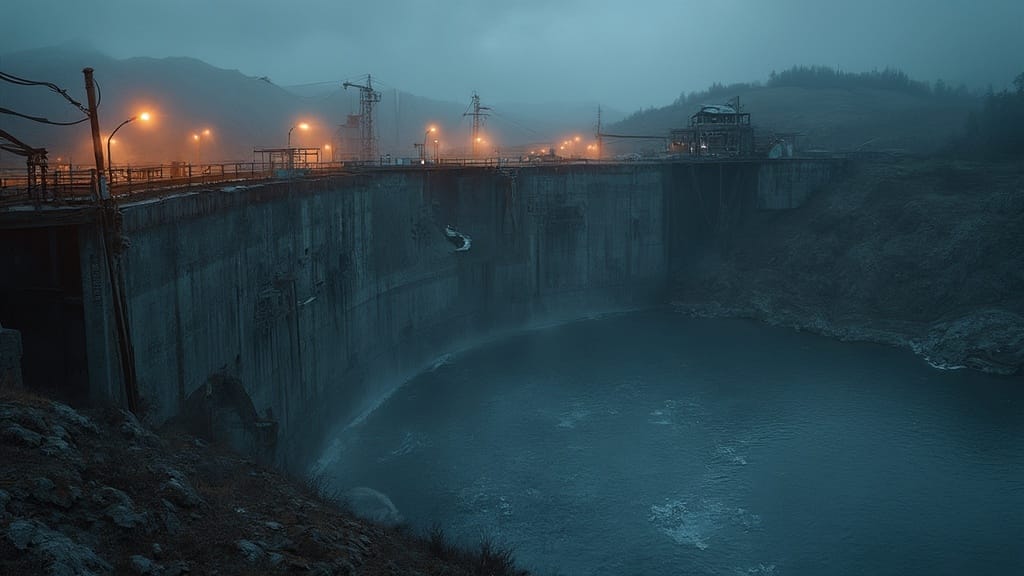
Central Alabama Water (CAW) — the successor entity to Birmingham Water Works after Alabama restructured it by statute — took an S&P downgrade earlier this year. BirminghamWatch reported the 2026 budget allocates $20.1 million for main pipeline replacement, the same figure as 2025, and CAW's chief executive suggested in December that spending could decrease when managers present a revised budget. Capital expenses were cut 25% in the 2026 budget. Work on stabilizing the 116-year-old Lake Purdy Dam — which supports a reservoir serving a significant portion of CAW customers, and which engineers have said is not safe enough — has stopped.
This is the doom loop in slow motion: downgrade raises borrowing costs, which compresses capex, which defers the replacements that would prevent the failure that drives the next downgrade. CAW is running it in public.
What changes if this is the template: AWWA's outlook data suggests CAW is an early mover, not an outlier. Utilities with weak coverage ratios and IIJA-dependent capital plans are the next candidates. For municipal bond investors and the insurers writing public-entity liability behind them, the screening question is no longer "what's the rating?" — it's "what's the gap between the rate case and the actual replacement need, and who's closing it?"
The signal to watch: any utility that publicly cuts capital spending in a downgrade response cycle while a known critical asset — a dam, a transmission main, a treatment plant — sits on a deferred list. That's the public footprint of the loop.
PHMSA Dropped 40 Rulemakings in One Day — and the August 3 Effective Date Is Closer Than the Industry Thinks
We flagged this on May 9, but it belongs in today's read because the calendar is now the story. On April 24, PHMSA issued 40 notices of proposed rulemakings, final rules, and direct final rules updating Parts 191, 192, and 195 of the federal pipeline safety regulations, plus direct final rules incorporating updated industry standards by reference. Thirteen of those final rules — editorial and technical revisions — take effect August 3, 2026, per the National Law Review's tracking.
Forty simultaneous rulemakings is not a normal cadence. It's a backlog clearance. The practical risk is that operators and their compliance counsel are still parsing the package while the effective date approaches.
What changes if operators miss the date: the editorial and technical revisions look benign in isolation, but several touch incident reporting taxonomies, cause-coding, and incorporation-by-reference of AMPP corrosion management standards that PHMSA quietly made mandatory last week (Pipeline & Gas Journal, May 5). An operator running a 2025-vintage compliance program against an August 2026 regulatory text is, by definition, out of compliance the day the music stops.
The observable signal: watch the PRIMIS enforcement docket in Q4 2026 for a wave of probable-violation letters citing the new parts. That's how PHMSA tells you who didn't read the package.
⚡ What Most People Missed
- Harker Heights' SCADA went down and 726,250 gallons of wastewater went into South Nolan Creek: A May 1 power surge knocked the Texas city's treatment-plant SCADA (the supervisory control and data acquisition system that monitors and alerts staff) offline, disabling operator alerts until the next morning. The pipes were fine. The telemetry wasn't. Buried-asset loss increasingly starts as a controls problem.
- PHMSA quietly updated the incident-reporting instructions for gas transmission, gathering, and underground storage: Revised instructions for Form PHMSA F 7100.2 (rev 1-2026) tighten cause-coding for excavation-related releases and underground facility details. Not a rulemaking — just a taxonomy change — but the national dataset will look different on the other side of it.
- Texas is making excavation damage a first-class enforcement lane: The Railroad Commission of Texas now runs public-facing reporting pathways for both excavators and operators under its Pipeline Damage Prevention program. The statutory obligations didn't change; the administrative gravity did. Texas events will be more visible in the state record.
- GLWA had the replacement pipe staged at the break site before the rupture: Per Oakland County Times, contractors were mobilized and a replacement segment was on-site when the main let go. And the outage is still expected to last about 14 days. The bottleneck isn't logistics — it's the disinfection, flushing, and bacteriological sampling protocol that follows any large-diameter repair. The downtime clock runs on chemistry, not construction.
- The boil-water advisory geography is larger than the outage geography: Per Oakland County's emergency notice, parts of Rochester Hills, southwest Oakland Township, and Auburn Hills north of Cross Creek Parkway are under advisory even where pressure was maintained. Boil-water advisories trigger Safe Drinking Water Act notification clocks that run independent of repair timelines. Lift one early and the EPA notice arrives in the mail.
📅 What to Watch
- If GLWA's post-incident report names the failed pipe's installation decade and material, and it matches the dominant vintage in the rest of the transmission backbone, expect rating-agency questions on GLWA's next debt issuance — not a downgrade, but the kind of footnote that prices itself in.
- If Stellantis NV files a contingent business-interruption claim tied to the Auburn Hills outage, it becomes an early test of whether standard commercial property policies treat regional transmission failure as a covered cause of loss without a specific utility-services endorsement — most don't.
- If the May 28 PHMSA Gas Pipeline Advisory Committee recommends expanding distribution incident reporting below the § 191.3 property-damage threshold, every loss model built on twenty years of PHMSA data needs to be recalibrated upward, not because the world got more dangerous but because the measurement floor moved.
- If any Oakland County community files a cost-recovery claim against GLWA, the legal theory will likely mirror the DC Water Potomac Interceptor complaints — and that means the "known defect, delayed isolation" framing is now a reusable template across the country.
- If a second mid-sized water utility takes a downgrade citing deferred capital and IIJA uncertainty before September 30, the CAW story stops being Alabama's problem and starts being a sector signal.
The Closer
A 42-inch pipe that everyone watched leak for five days, a federal incident-reporting form that was being filed into a system that wasn't receiving it, and a Texas wastewater plant whose alarms were silenced by a power surge while three-quarters of a million gallons headed for the creek. Three different ways to be blind to a problem you technically already knew about.
Stay dry out there.
Forward this to the underwriter on your call list who still thinks "known defect" is a defense.