Buried Risk — May 14, 2026

Photo: lyceumnews.com
Thursday, May 14, 2026
The Big Picture
The Auburn Hills crisis is technically over — Stellantis is back at work, schools are reopening — but four Oakland County communities still can't drink their tap water, and the pipe that failed was only halfway through its rated life. That's the through-line today: water back on doesn't mean safe; gas pipe is "newer" until it isn't; a contractor can rupture a sewer main and not notice until a creek changes color. The federal machinery is catching up to all of it — slowly, and in ways that will quietly shrink what the public dataset shows starting July 1.
Today's Stories
Auburn Hills Is "Back" — Except for the Part Where Nobody Can Drink the Water
Stellantis is resuming operations at its Auburn Hills headquarters Thursday, and the Great Lakes Water Authority has restored pressure to Auburn Hills, Orion Township, the village of Lake Orion, and Rochester Hills. Schools are reopening. The crisis, as it will be reported, is over.
Except Orion Township Supervisor Chris Barnett told residents not to drink the water yet — boil-water advisories remain in effect across the affected service area. Restoring pressure and restoring potability are two different problems. Once a pressurized system loses head, every joint, valve, and service connection becomes a potential intrusion point, and utilities have to flush, sample, and run multi-day bacteriological tests before the advisory comes off. Every hour the advisory stays up is an hour of documented exposure risk for anyone who didn't get the message.
The forensic question is the more important one. The failed 42-inch transmission main was installed in 1975 and rated for 100 years. It made it to 50. GLWA CEO Suzanne Coffey attributed the failure to a "manufacturing anomaly" — a phrase doing significant legal work, as it shifts the failure from an age-related event (which an asset management program is supposed to anticipate) to a latent defect (which it can't). If that framing holds, subrogation may focus on manufacturing liability. If it doesn't, it may focus on GLWA's inspection program.
What to watch: whether GLWA commissions a systematic electromagnetic inspection of similar-vintage prestressed concrete cylinder pipe across its 80-mile transmission network — and whether that program shows up in a rate case. If yes, the "anomaly" framing is already over. If no, expect the next failure to make it over for them.
A Contractor Damaged an 8-Inch Gas Line in Matthews — and Turned a Routine Pole Job Into an Underwriting Case Study
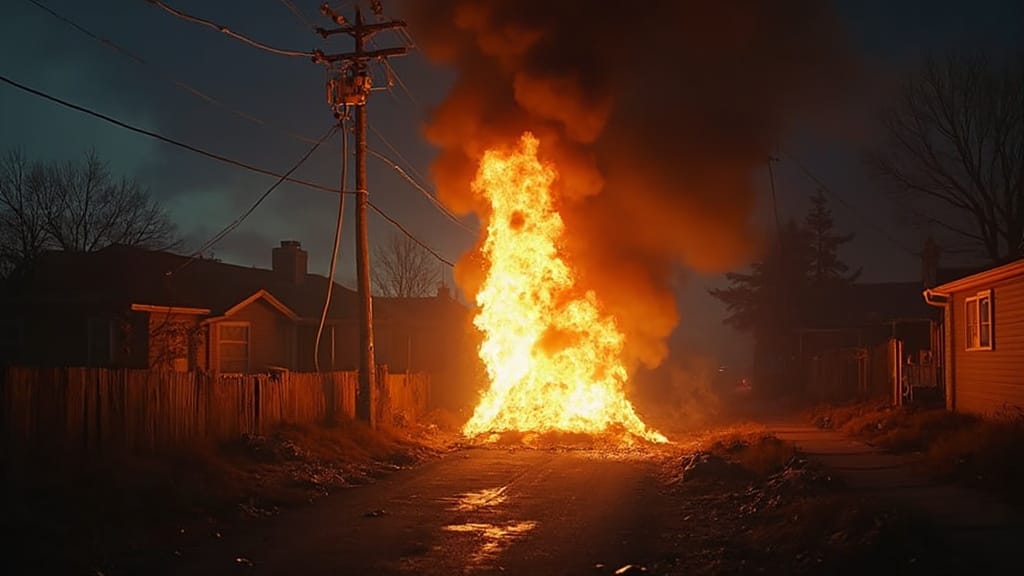
A crew working a utility pole job in Matthews, North Carolina damaged an 8-inch natural gas distribution line on May 13, triggering a major fire, evacuations, road closures, and damage to nearby homes. Initial reporting indicates no injuries. Local outlets are split on the ignition source — some citing the damage itself, others citing sparks from nearby power lines — and that distinction matters, because it determines whether subrogation runs through the excavator's general liability tower or the electric utility's.
This is the failure mode PHMSA formally named three weeks ago (see next item). For underwriters, the Matthews fire is a data point inside a pattern the regulator is now treating as systemic: dense underground corridors, high 811 ticket volumes, locating capacity stretched thin, and excavation strikes converting into property losses with a regularity that's getting harder to call random.
The signal to watch is whether North Carolina's 811 program or the state Utilities Commission opens a docket on locate accuracy in Mecklenburg County. If it does, the Matthews fire becomes precedent. If it doesn't, it becomes a loss run entry.
PHMSA's Excavation-Damage Advisory Is the Rare Government Document That Says the Quiet Part Out Loud

On April 21, the Pipeline and Hazardous Materials Safety Administration published a Federal Register advisory on preventing excavation damage that did something federal advisories rarely do: it named the problem in plain language. PHMSA warned that fiber and other underground buildouts are creating "congested corridors," that rising 811 ticket volumes can overwhelm local locating capacity, and that the resulting inaccurate markings are now a measurable contributor to strike risk.
This is not a rule. It's an advisory. But it's the regulator formally tying the underground broadband boom to the gas distribution strike rate — which is the analytical link insurers and state PUCs have been waiting for. Once that link is in the Federal Register, it can be cited in state rulemakings, enforcement complaints, and (eventually) consent decrees.
The compounding signal: PHMSA's inflation-adjusted property-damage threshold for reportable gas pipeline incidents rises from $149,700 to $153,600 on July 1, 2026, under 49 CFR § 191.3. A small number, but it removes a measurable slice of lower-cost distribution events from the national dataset right as the agency is publicly acknowledging that strike risk is rising. Federal data will get later and narrower precisely when underwriters need it to get earlier and wider.
Failure mode to watch: if states begin citing the April 21 advisory in their own rulemakings within 90 days, excavation-damage prevention is moving from guidance to enforcement. If they don't, the advisory becomes shelf-ware and the loss runs do the work instead.
The Pipe That Killed Seven People Just Got Its Day in Court — Three Years Later
The Pennsylvania Public Utility Commission's Bureau of Investigation and Enforcement filed a formal complaint against UGI Utilities in March, seeking $2,576,627 in civil penalties — the statutory maximum — for the March 2023 explosion at the R.M. Palmer chocolate factory in West Reading that killed seven workers and injured ten. The complaint was filed weeks ago, but it's worth rereading now because the corrective action framework inside it is becoming a template.
The investigation determined that natural gas leaked from a retired plastic service tee connected to a vintage Aldyl-A plastic pipeline beneath Cherry Street. Aldyl-A is a first-generation polyethylene pipe manufactured between the late 1960s and early 1980s — the same material family the NTSB is now examining in the Centreville, Virginia explosion. The PUC is demanding that UGI establish new procedures for retiring aging Aldyl-A service tees with Delrin inserts, increase leak survey frequency for older plastic pipelines in dense urban areas, and improve tracking, mapping, and risk analysis for vintage plastic assets installed prior to 1983.
Here's what makes this a national story: federal Distribution Integrity Management Program rules don't require retirement of specific legacy fittings. A state PUC demanding it through enforcement is a separate legal pathway, and one that other commissions can cite without waiting for PHMSA. Every gas distribution operator with pre-1983 plastic pipe just received a preview of what a state PUC will demand after the next fatality.
The observable signal: if any other state PUC cites the UGI corrective action framework in a docket within 90 days, the Aldyl-A retirement question stops being Pennsylvania-specific and becomes a national compliance variable.
The Sewer Stress Index Just Put a Number on What Everyone Already Knew
A new 2026 Sewer Stress Index published this week by Nationwide Waste Service, covered by Contractor Magazine, puts hard numbers behind the American Society of Civil Engineers' D+ grade for U.S. wastewater infrastructure: system failure rates have risen from 2 to 3.3 per 100 miles of pipe over the past decade — a 65% increase over the past decade. The EPA estimates $690 billion in needed investment over the next 20 years. Water and sewer bills have risen at roughly twice the rate of overall inflation since 1998.
The coastal angle is the one underwriters haven't priced. Miami, St. Petersburg, and other coastal cities are experiencing sunny-day flooding — saltwater pushing into sewer systems even in dry conditions, corroding concrete pipe from the outside in. Standard CCTV camera inspection looks for visible internal defects; it doesn't catch external corrosion until the pipe is structurally compromised. By the time the camera sees the problem, the replacement decision has already been made for you.
A confirmed real-world example: Macomb County, Michigan announced an $11.5 million trenchless rehabilitation of a 1.5-mile section of its 15 Mile Interceptor, a 5-foot-diameter concrete line being relined with a steel-ribbed spiral-wound PVC system to address hydrogen-sulfide corrosion. That's the inland version of the same chemistry problem. The coastal version is worse because the corrosive agent never stops arriving.
The signal: if Florida's state revolving fund — the low-interest federal loan program for water and sewer projects — begins prioritizing coastal corrosion remediation in its next funding cycle, the Sewer Stress Index has officially crossed from analytical framework into capital allocation.
⚡ What Most People Missed
- The Farragut sewer break nobody saw happen: First Utility District in Farragut, Tennessee confirmed Monday that a contractor damaged a sewer main, the damage didn't happen during excavation, and the contractor didn't detect it — sewage reached North Fork Turkey Creek before anyone noticed. The Fort Loudon Reservoir is downstream. This is exactly the failure mode the locating profession flagged last week: no 811 moment, no surface disruption, no self-report, just a creek that changed color.
- The DOJ's "enhanced O&M plan for each sewer line" demand is a consent decree being built in real time: The April 20 federal lawsuit against DC Water over the January Potomac Interceptor collapse — which dumped an estimated 240 to 300 million gallons of raw sewage into the Potomac — asks the utility to develop a documented operations and maintenance plan for every sewer line in its system. If that language becomes standard EPA enforcement boilerplate, every large wastewater utility in the country will need to defend its asset management documentation under a new implied standard.
- PHMSA put plastic distribution pipe back in the spotlight: A PHMSA advisory bulletin tied to NTSB Safety Recommendation P-25-1 (the West Reading recommendation) tells operators to reassess how plastic distribution pipe threats are weighted inside Distribution Integrity Management Programs. Plastic pipe has historically been treated as the lower-risk portion of the network relative to cast iron and bare steel. That assumption is now under regulatory pressure.
- USIBWC's Minute 333 puts binational capital behind border wastewater: The U.S. International Boundary and Water Commission, under Commissioner McIntosh, highlighted progress this week on Minute 333 — a binational agreement with Mexico covering wastewater management and border infrastructure modernization, plus odor-reduction pilots and force-main replacements. Binational infrastructure agreements are rare and slow; when one gets signed, it usually means the Tijuana River-scale problem has become politically unignorable on both sides.
📅 What to Watch
- If GLWA commissions a network-wide electromagnetic inspection of similar-vintage prestressed concrete cylinder pipe, the "manufacturing anomaly" framing is already over — and a much larger capital program than the Auburn Hills repair is coming.
- If any state PUC cites the Pennsylvania UGI corrective action framework in a docket within 90 days, the Aldyl-A retirement question becomes a national compliance variable without PHMSA ever issuing a rule.
- If EPA's DC Water consent decree includes third-party inspection verification for large-diameter interceptors, every major wastewater utility just got a new implied audit standard — and a new line item.
- If a state pipeline safety program cites PHMSA's April 21 excavation-damage advisory in a rulemaking, "congested corridors" moves from regulator vocabulary into enforceable language.
- If Florida's state revolving fund prioritizes coastal saltwater-corrosion remediation in its next cycle, the Sewer Stress Index has crossed from framework into capital allocation — and standard age-based actuarial models are officially behind.
The Closer
A 1975 water pipe ruled a "manufacturing anomaly," a chocolate factory whose killer was a plastic tee installed before the Carter administration, and a Tennessee creek that turned brown before anyone realized the contractor had hit anything. The federal dataset gets later and narrower on July 1, which is convenient, because the boil-water advisory in Orion Township will probably still be in effect.
Stay dry up there.
Forward this to the person on your team who keeps asking why the asset management model didn't catch it.