Buried Risk — May 22, 2026

Photo: lyceumnews.com
Friday, May 22, 2026
The Big Picture
Today is the deadline for nearly $100 million in PHMSA gas pipeline modernization grants — the final round of a five-year federal push to pull leak-prone mains out of the ground. The same week the program closes, a federal appeals court told PHMSA its enforcement reasoning on legacy seam-weld pipe doesn't hold up, a 20-inch main split open under a Bethesda arterial, Atlanta officials admitted the storm drains can no longer keep pace with the rain, and EPA put $103 million on the table for New Jersey lead-line work that will translate into a lot more pavement cuts. The infrastructure is failing on a clock the regulatory machinery can't quite match — and today is one of those rare days where the deadline, the ruling, and the broken pipe all land in the same news cycle.
Today's Stories
Today Is the Last Day to Apply for PHMSA's $98 Million Pipeline Replacement Fund
If you run a municipally owned gas distribution utility and haven't filed your paperwork yet, the window closes today. The $98 million allocation is the final year of a roughly five-year, nearly $1 billion federal initiative under the Infrastructure Investment and Jobs Act, targeted at community-owned systems repairing or replacing leak-prone mains and the locating and detection equipment that supports that work. PHMSA Administrator Paul Roberti has framed the goal as modernizing distribution to save lives and lower energy costs.
What changes if this works: operators who applied aggressively across all five rounds will have replaced a meaningful share of their pre-1970 cast iron and bare steel, and that progress will show up in PHMSA's annual operator reports over the next several years. What failure looks like: the same handful of sophisticated municipal utilities win again, while smaller systems with the worst pipe and the thinnest grant-writing capacity sit out the final round entirely. The observable signal comes 60 to 90 days from today, when PHMSA publishes the award list — every name on it is an operator who just self-identified its worst pipe in writing, which is one of the most useful disclosures the federal government produces all year.
The Fifth Circuit Just Told PHMSA Its Inspection-Adequacy Logic Doesn't Hold
We flagged the headline yesterday. The reasoning is what matters now. On May 20, the U.S. Court of Appeals for the Fifth Circuit vacated PHMSA's enforcement order against Florida Gas Transmission tied to a stress-corrosion cracking rupture on the Sanford Lateral — a 1959 line built from low-frequency electric-resistance-welded (LF-ERW) steel pipe. Stress-corrosion cracking is a failure mode where microscopic cracks open under the combined load of internal pressure and a corrosive environment; LF-ERW is a manufacturing process the industry abandoned around 1970 precisely because its longitudinal seams were vulnerable to exactly this kind of degradation. PHMSA had argued Florida Gas relied on inspection tools that weren't sensitive enough to the seam-related anomalies that caused the failure. The court disagreed.
What changes: any transmission operator with legacy LF-ERW pipe in the ground — and there is a lot of it across Texas, Louisiana, and Mississippi, the Fifth Circuit's jurisdiction — now has a published appellate opinion they can wave at PHMSA the next time the agency challenges their inspection-tool selection. What failure of the agency's deterrence posture looks like: another operator cites this ruling in a contested enforcement action within six months, and PHMSA either narrows its theory or loses again. For the insurance side, SCC on pre-1970 ERW transmission pipe is one of the higher-severity failure modes in the system. If the federal enforcement backstop thins, the implicit risk floor underwriters have been pricing against thins with it.
PHMSA Is Quietly Building the Framework to Regulate Plastic and Composite Pipelines
On May 18, PHMSA published a Statement of Policy on transporting hazardous liquids and carbon dioxide in non-steel pipelines. A policy statement isn't a rule and doesn't carry the force of law, but it tells operators where the agency's enforcement gaze is moving. The current pipeline safety regulations were written for steel — the corrosion models, the pressure-testing protocols, the integrity management frameworks all assume metal. High-density polyethylene, fiberglass-reinforced pipe, and composite materials have been expanding quietly into gathering lines, CO₂ transport, and newer distribution builds for years without a regulatory framework built around their failure physics.
What changes if PHMSA follows through: a notice of proposed rulemaking within 18 to 24 months that materially shifts the compliance baseline for any operator running non-steel systems. What it looks like if this stalls: the policy statement sits on the website as agency intent and nothing more, and the gap between what's in the ground and what's regulated keeps widening. The timing also rhymes uncomfortably with the Fifth Circuit ruling — PHMSA is losing ground on legacy steel enforcement the same week it tries to stake out new authority over the materials replacing it.
A 20-Inch Water Main Cracked Open Under a Bethesda Arterial — and the Cluster Is the Story
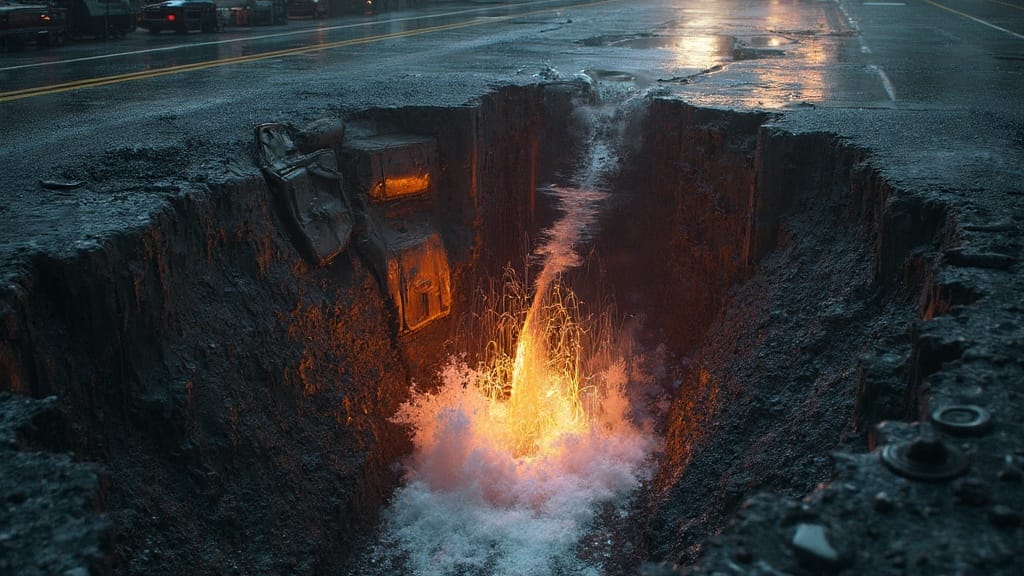
WSSC Water's Tuesday night was loud. A 20-inch main — distribution backbone, not a service line, not a regional transmission main — broke near Bradley Boulevard and Arlington Road in Bethesda on May 19, flooded the road, forced a police closure, and was repaired by Wednesday morning rush hour, with road restoration carrying into the day. The utility serves roughly 1.9 million people across Montgomery and Prince George's counties, and a meaningful share of its system was put in the ground in the 1950s and 1960s.
This is the fourth significant buried-water failure or enforcement event in the DC–Maryland–Virginia corridor since January — the Potomac Interceptor collapse on Clara Barton Parkway, the DOJ's lawsuit against DC Water, DC Water's emergency shotcrete work on a 140-year-old sewer tunnel, and now a Bethesda distribution main. All within roughly fifteen miles of each other. What to watch: whether WSSC discloses the material type and installation decade of the failed segment. A 1960s cast iron failure tells one story about the corridor; a 1990s ductile iron joint failure tells a much more uncomfortable one.
Atlanta's Flooded Restaurants Are a Stormwater Balance Sheet, Not a Weather Story

Footage of customers wading out of downtown Atlanta restaurants looks like a weather problem on television. The Atlanta Department of Watershed Management told WSB-TV it isn't. Officials described the drainage network as outdated and overmatched, said cleared inlets would still have struggled with rainfall of that intensity, and acknowledged the city needs more storm drains and new infrastructure over the long term. That's a capacity mismatch admission, not a clogged-grate explanation.
Stormwater is increasingly a frequency problem rather than a severity one — lots of mid-size repeatable events instead of one headline catastrophe — and that's exactly the loss profile that erodes property insurance margins and municipal operating budgets simultaneously. What failure of the response looks like: this gets absorbed into the familiar category of "everyone agrees it's a problem, nobody funds the fix." The observable signal is whether Atlanta puts a named stormwater capital package on the table in the next budget cycle, or lets the footage cycle out of the news.
⚡ What Most People Missed
- EPA's $103 million for New Jersey lead lines is also an excavation-risk story: Every service line replacement is a pavement cut, a locate, and an interaction with whatever else is buried on that street. In systems already carrying heavy main-replacement backlogs, that's more dig-ins, more shutoffs, and more chances for a compliance project to take out the 80-year-old main next to it. Watch whether New Jersey utilities pair these funds with accelerated main replacement or leave the mains for later.
- PHMSA is rewiring how operators call in gas incidents, effective August 3: Docket PHMSA-2026-1540, Amendment 191-38, published April 24. The rule clarifies that electronic notifications to the National Response Center don't satisfy the one-hour incident reporting requirement — it has to be a phone call. PHMSA frames it as housekeeping. In practice, any operator whose incident management software has been quietly handling NRC notifications needs a phone-based workflow in place before summer ends.
- South Carolina's updated Underground Facility Damage Prevention Act took effect today: SC H3571 adds a "large project" framework, a facility location agreement process, quarterly excavation damage reporting, and an immediate-notification requirement to both the notification center and the facility operator. SC811 said its systems were temporarily offline starting the night of May 21 to migrate existing tickets into the new structure. The database logic itself changed today, not just the statute.
- The AWWA's $2.1 trillion number has a sharper figure buried inside it: Fewer than half of utilities can fully cover operating costs through rates and fees, according to the association's 2026 State of the Water Industry report. A utility in operating deficit isn't deferring capital — it's already past the point where capital deferral is even a meaningful framing. That's where the failure clock accelerates.
- PHMSA's incident data is always at least a month behind reality: The structural reporting lag means this week's Lawrenceville, Georgia dig-in and the Bethesda main break won't appear in the federal record until late June. Any model running on "current" PHMSA data is running on data from a month ago. That gap is baked into the system, not accidental.
📅 What to Watch
- If the Fifth Circuit's Florida Gas reasoning is cited by another operator contesting a PHMSA action on pre-1970 ERW pipe within six months, it means the SCC enforcement framework is being systematically tested rather than absorbed as a one-off.
- If PHMSA's grant award list, when published, skews toward already-sophisticated municipal operators, it means institutional capacity — not asset condition — is deciding who gets federal risk-reduction capital.
- If WSSC Water discloses the material and installation decade of the failed Bethesda main, the mid-Atlantic aging-pipe narrative either tightens or fractures depending on the answer.
- If Congress doesn't extend IIJA water infrastructure funding before the September cliff, the replacement programs municipal utilities built around federal dollars stall on exactly the systems that most need them.
- If a PHMSA notice of proposed rulemaking on non-steel pipelines lands within 18 months, the regulatory baseline underwriters use for HDPE and composite gathering accounts shifts before existing coverage forms catch up.
- If Atlanta names a stormwater capital package in its next budget, it means local officials have moved the loss pattern from "weather noise" to "structural exposure" — which is the precondition for rate increases and bond activity.
The Closer
A 1959 pipe with cracked seams won in federal court, a 1950s pipe under Bradley Boulevard lost its composure on a Tuesday night, and a downtown Atlanta restaurant turned into a wading pool while officials explained that the drains were never going to catch up anyway. Somewhere in PHMSA's office, someone is filing the last $98 million application of a five-year program and someone else is drafting a rule that says you cannot, in fact, email the federal government to tell it your pipeline is on fire.
Stay above grade.
If you know someone who prices buried risk for a living — forward this. They'll thank you the next time a 20-inch main goes.