Chinese planes have stopped flying over/near Taiwan for nearly 2 weeks. What's going on?
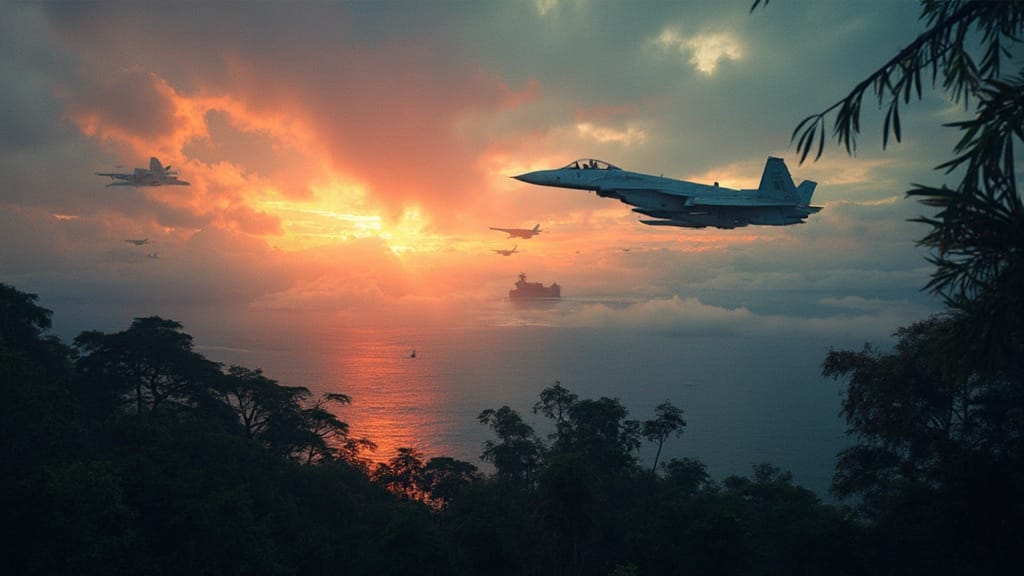
Photo: lyceumnews.com
For thirteen consecutive days starting February 27, Chinese warplanes stopped flying near Taiwan — the longest aerial pause since Taipei began publishing daily military tracking data in 2020. Then, today, five aircraft showed up and barely made a fuss. The silence was louder than the return. What makes this story worth going deep on isn't the mystery of why the planes stopped — it's what kept going while they were gone: warships, coast guard vessels, drones broadcasting fake identities, and a measurable spike in cyberattacks against Taiwanese infrastructure. The thesis: China isn't pulling back from Taiwan — it's shifting the pressure into domains that don't show up on the daily jet count, and that shift may be more dangerous than the provocation it replaced.
The full story
The baseline that broke
If you follow the Taiwan Strait, you know the rhythm. Since Taiwan's Ministry of National Defense began publishing daily reports on People's Liberation Army activity in 2020, the trend line for Chinese military aircraft operating near the island has moved in one direction: up. Fighter jets, bombers, surveillance planes, and drones entered Taiwan's Air Defense Identification Zone — a buffer zone beyond sovereign airspace where approaching aircraft must identify themselves — with such regularity that it became geopolitical wallpaper. "Since Taiwan's defense ministry began releasing this data in 2020 the trend has been up, up, up," said Ben Lewis, founder of PLATracker, an open-data platform that tracks Chinese military movements. "And now this lull… represents a very significant change in the pattern."
The numbers bear that out. In February 2026, Taiwan recorded just 147 PLA sorties into its ADIZ — the lowest monthly total since President Lai Ching-te took office in May 2024. PLA incursions had averaged over 300 per month since Lai's inauguration but dropped below 200 in both January and February for the first time since April 2024. Then came the hard stop: beginning February 27, Taiwan logged thirteen consecutive days with zero Chinese warplanes detected. One brief exception came on March 6, when two aircraft appeared in the far southwestern corner of the ADIZ. Lewis called it "frankly unlike anything we've seen in recent history."
That streak ended today. Taiwan's defense ministry reported five PLA aircraft and six naval vessels operating around the island over the previous 24 hours. The flights coincided with a U.S. Navy P-8 surveillance aircraft transiting the Taiwan Strait — the kind of event that in previous years triggered a conspicuous Chinese response. This time, the response was muted. Analysts say the limited number of aircraft detected may not signal a full return to normal activity.
So far this month, Taiwan's MND tracked Chinese military aircraft only twice — but ships 67 times. On March 11, the ministry specifically noted: "6 PLAN vessels operating around Taiwan were detected. ROC Armed Forces have monitored the situation and responded. No flight path illustration is provided, as we did not detect PLA aircraft operating around Taiwan during this timeframe." The ships never left. Only the planes did.
The domain shift nobody photographed
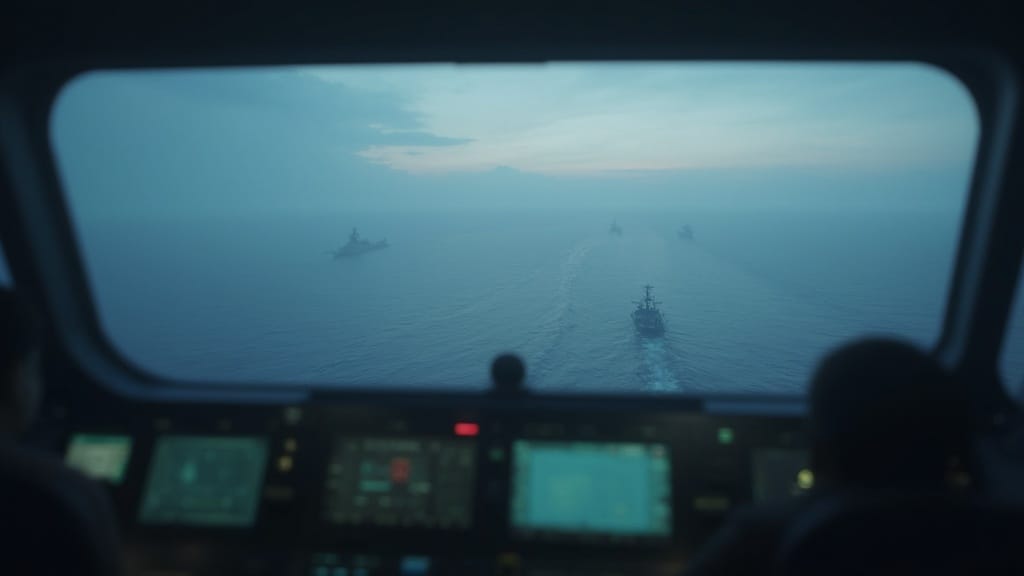
This is the detail most coverage buried in the last paragraph, and it's the most important one. The aerial pause was air force only. China's maritime presence — naval vessels, coast guard ships — never slowed down. Researchers at George Mason University's Schar School of Policy and Government, writing for the Taiwan Security Monitor, documented the pattern in detail: Japan's Ministry of Foreign Affairs noted that Chinese government vessels, mainly from the China Coast Guard, continued to enter Japan's contiguous zone near the Senkaku Islands almost daily. On February 28, Japan's Joint Staff reported two PLA intelligence aircraft flew from the East China Sea toward the Pacific, prompting Japanese Air Self-Defense Force scrambles.
Reuters and multiple open-source intelligence accounts picked up an observable naval uptick during the lull: satellite imagery showed a larger number of destroyers, frigates, and auxiliary vessels operating near the median line and in the East China Sea — a pattern that fits pressure-by-sea rather than simple de-escalation. Ships impose logistics strain, blockade risk, and constant sensor pressure even when jets aren't visible.
The maritime posture connects to a longer-term pattern. Coast guard and naval vessels have increasingly operated inside 12 nautical miles of Taiwan-held islands like Kinmen and Matsu, and there's been a documented uptick in cyber activity targeting logistics and maritime systems — pressure applied in ways that are deniable or incremental rather than visually dramatic.
The cyber dimension is especially telling. Breaking Defense documented waves of phishing campaigns, distributed denial-of-service attacks, and probes aimed at Taiwanese government and critical infrastructure networks coinciding with the halt in air activity. That pattern is consistent with a redistribution of activity into domains that complicate attribution: hybrid moves that deny easy attribution, degrade systems, and complicate response options without creating headline-generating kinetic incidents.
And then there's space. Both sides appear to be elevating the contest into orbit and the data layer. Taiwan officials at recent international space-defense forums highlighted investments in commercial satellite constellations and a new monitoring system designed to stitch air and sea domain awareness into a space backbone. Asia Times reported that Taipei is accelerating these programs amid concerns that the visible "jet count" is becoming a less reliable indicator of overall pressure as both sides invest in sensors and attacks above and below the physical battlespace.
The drone wearing a fake ID
While analysts debated empty skies, a Chinese drone was busy pretending to be someone else entirely. The AEI-ISW China & Taiwan Update revealed that a long-endurance PLA Wing Loong 2 drone made at least 23 flights over the South China Sea since August 2025 while transmitting a variety of false transponder signals to disguise its identity. Transponders are the devices military and civilian aircraft use to broadcast who they are — the equivalent of a name tag on a radar screen. The drone transmitted registration numbers for aircraft of multiple types and countries of origin, flying missions from Hainan Island toward the Paracel Islands, along the Vietnamese coastline, eastward toward the Philippines, and near Taiwan's Pratas Island.
Think of it as a military drone wearing stolen license plates. The ISW-AEI team flagged this as part of a broader pattern: they had previously detected the PRC using similar deceptive tactics at sea, including fishing boats broadcasting fake signals of a Russian warship, a French warship, and PRC coast guard vessels within Taiwan's exclusive economic zone since at least August 2025. Reuters confirmed the flight data via Flightradar24.
The tactical implication is direct. If you can't trust what a radar return says it is, every sensor reading becomes a question mark. The conflict-management hotlines that are supposed to prevent accidental war depend on both sides knowing what they're tracking. Transponder spoofing breaks that assumption. And it connects back to the aerial pause: if China is investing in drones that can operate invisibly or deceptively, the daily jet count becomes an even thinner signal of actual military pressure.
Vision Times reported on the spoofing operations in early March, noting that the capability represents a form of cognitive warfare — an attempt to degrade an adversary's ability to make sense of the battlespace, not by destroying sensors but by poisoning the data they collect.
The nuclear carrier in the background
One more piece of the structural picture: satellite imagery released in mid-February from U.S. company SkyFi showed China's Type 004 aircraft carrier under construction at Dalian Shipyard, revealing two large openings in the hull positioned similarly to nuclear reactor containment units on U.S. nuclear carriers. China's current carrier fleet — three conventionally powered ships — has limited ability to operate far from home because of the need to refuel. A nuclear-powered carrier doesn't stop for gas. It goes where America's carriers go. Construction timelines for carriers routinely slip by years, but the engineering direction is now visible from orbit.
Who's saying what
The absence of an official Chinese explanation is itself a data point — Beijing usually says something when it takes positive steps. That silence has produced a landscape of competing theories, and the disagreements among analysts are real.
The summit theory is the most widely cited. Retired Navy Captain Carl Schuster told the Washington Times bluntly: "The sorties will pick up again about 30 days after Trump returns to the U.S." He argued the reductions are based on Beijing's calculations that now is not the time to risk provoking the American president ahead of the March 31–April 2, 2026 visit. Several observers note the timing aligns with the Chinese National People's Congress annual "Two Sessions" plenary meetings, which run in early March and conclude in mid-March 2026, making the lull look like calibrated noise reduction before a diplomatic set piece.
Taiwan's own security establishment takes a sharply different view. A senior Taiwan security official told Reuters: "Beijing might be trying to create a false impression: I am peaceful, I am moving toward peace, so you should stop selling weapons to Taiwan." In that reading, the pause itself is the weapon — a diplomatic maneuver designed to weaken the case for U.S. arms transfers.
The purge theory gets less airtime but may be the most structurally significant. Su Tzu-yun, a research fellow at Taiwan's Institute for National Defense and Security Research, told Reuters the pause may be related to China's ongoing anti-corruption purge, as reforms to command structures could temporarily weaken overall combat readiness. Analysts have reported the removal or sidelining of senior figures such as Zhang Youxia and Liu Zhenli in January 2026 as part of a larger purge that began in mid-2023. CSIS analysis found that the Central Military Commission's decision-making has been altered by the sweep, and Breaking Defense reported that commanders in networks under investigation are likely to avoid drawing attention to themselves — adhering to regulations, with training less flexible and decision space more restricted. The PRC Leader Monitor documented the purge's continuing breadth.
The energy and logistics theory is weaker but was raised publicly. ASPI's Strategist noted that the pause coincided with heightened Iran-related tensions and concerns about the Strait of Hormuz, through which a substantial share of China's oil transits. But RealClearDefense reported that Chinese air force planes were spotted near Japan's southwestern islands and training in the South China Sea during the same period, making fuel conservation an unlikely explanation for a Taiwan-specific lull.
The scariest theory — that the pause is a prelude to a larger exercise or even an attack on an outlying island — was flagged by RealClearDefense: "By scaling back flights, they can do necessary maintenance and come out in force. The U.S. is distracted in Iran, so the timing would be perfect." But the same analysts noted that a large-scale exercise or attack would be preceded by naval asset movements, material gathering, and logistical preparations — and none of these has been observed at the scale required.
The most analytically rigorous framing comes from George Mason's Taiwan Security Monitor, which argues the real story is the domain shift itself — not which single theory explains the aerial pause, but the fact that pressure continued through maritime, cyber, and space channels regardless. That framing rejects the binary of "escalation vs. de-escalation" and replaces it with something harder to track and harder to counter.
One underappreciated analytical point: a detailed look at 2025 patterns found that PLA exercise tempo often maps to Chinese political cycles and holidays more than to speeches in Taipei or Washington. If that holds in 2026, reading every quiet week as "diplomacy" or every surge as "crisis" risks misdiagnosing what are essentially schedule-driven training rhythms. The AEI-ISW team noted that a seasonal decline in PLA activity each winter since 2023 is consistent with the broader February dip, and that incursions are expected to increase in the spring after the CCP's Two Sessions national political meetings conclude.
The honest answer is that nobody knows — and the competing explanations aren't mutually exclusive. A purge-weakened command structure, a diplomatic calculation, and a seasonal maintenance cycle can all be true simultaneously. The question is which factor dominates, and the answer will only become clear in the weeks after the March 31–April 2, 2026 Trump-Xi summit.
Capital and positioning
The domain shift playing out over the Taiwan Strait is reshaping where money flows in the defense technology ecosystem. If the visible threat migrates from jets to ships, drones, cyber operations, and space-based surveillance, the investment logic follows.
Taiwan is accelerating spending on space-based maritime awareness and commercial satellite constellations, a bet that the island's defense increasingly depends on seeing threats that don't announce themselves. On the American side, Anduril's acquisition of ExoAnalytic Solutions — a company operating a global network of over 400 telescopes dedicated to tracking satellites, debris, and missile launches — consolidates private-sector control over a significant chunk of the world's optical space-domain awareness capacity. Folded into Anduril's Lattice AI platform, that sensor layer shortens the timeline from detection to decision. It also means a single venture-backed firm now owns hard infrastructure that was traditionally a government function — a structural fact that will shape procurement, alliance data-sharing, and what information is available to whom in a crisis.
China's own investments tell a parallel story. The Type 004 nuclear carrier under construction at Dalian represents a multi-billion-dollar bet on power projection beyond the first island chain. The Wing Loong 2 transponder-spoofing program is cheap by comparison but strategically potent — it degrades the value of every sensor system that relies on cooperative identification. And the PLA's investment in unmanned surface vessels and long-endurance drones suggests a force structure designed to maintain pressure at lower cost and lower escalation risk than manned fighter sorties.
The structural advantage belongs to whoever can fuse data across domains fastest. China's pressure campaign now spans air, sea, cyber, and space simultaneously. Defending against it requires not just sensors in each domain but the ability to stitch those feeds into a coherent picture — which is why programs like the U.S. Army's Lower Tier Air and Missile Defense Sensor (a 360-degree radar tested at White Sands designed to feed fused command systems) and Shield AI's Hivemind autonomy software matter beyond their individual capabilities. The race isn't for the best single sensor or the fastest single missile. It's for the architecture that connects them.
What this changes
The most immediate structural change is epistemic: the daily jet count — Taiwan's most visible, most reported metric of Chinese military pressure — is now demonstrably incomplete as a measure of threat. For years, the ADIZ incursion number served as a rough barometer for cross-strait tension. Journalists cited it, policymakers referenced it, and markets occasionally reacted to it. The thirteen-day pause revealed that this number can go to zero while the actual pressure campaign continues undiminished through maritime, cyber, drone, and space channels. That doesn't make the jet count useless, but it means anyone relying on it alone is looking through a keyhole.
Second, the transponder-spoofing capability changes the rules of identification in contested airspace. International aviation law requires aircraft to accurately identify themselves. China has been testing how far it can push that norm — and the answer, after 23 documented flights over six months, appears to be: very far, with no meaningful pushback. If this capability proliferates, the entire framework of cooperative air traffic management in the Western Pacific degrades. Every radar return becomes a question, and the crisis-management hotlines that are supposed to prevent accidental escalation lose their foundation of shared situational awareness.
Third, the purge's operational effects may be more significant than the diplomatic theories. If Xi Jinping's anti-corruption campaign has hollowed out the PLA's command structure to the point where theater commanders are reluctant to authorize routine provocations, that's a capability variable — not just a political one. A military whose officers are afraid to act without explicit top-level authorization is a military that's slower to respond, less adaptable in a crisis, and potentially more dangerous when it does act, because decisions bottleneck at the top. The pause may have revealed not restraint but rigidity.
Finally, the domain shift has procurement implications that will play out over years. If China's gray-zone pressure increasingly comes through unmanned systems, cyber operations, and maritime presence rather than manned aircraft, the defensive investments Taiwan and its partners need look different: more counter-drone systems, more cyber resilience, more undersea and space-based sensing, and less emphasis on the fighter-jet parity that has dominated cross-strait defense debates for decades.
What comes next
The Trump-Xi summit window from March 31 to April 2, 2026 is the first real test. If Chinese air activity surges back to historical levels before the meeting, Beijing is signaling the pause was tactical — a brief courtesy, not a policy change. If it stays muted through the summit and beyond, watch for whether Washington treats the quiet as a concession worth rewarding, potentially slowing arms sales to Taiwan. That's exactly the outcome Taipei's security officials fear: the pause as a weapon aimed not at Taiwan's military but at its supply chain.
The CCP's Two Sessions political meetings wrap up in mid-March 2026, and analysts expect PLA ADIZ incursions to increase in the spring once the domestic political calendar clears. If the planes come back hard the week after Two Sessions close, the entire episode was a domestic political pause — not a diplomatic one — and the analytical community will have spent two weeks reading tea leaves that were really just a scheduling artifact.
The transponder-spoofing story has further to run. Expect U.S. Indo-Pacific Command to invest in non-transponder-based detection — radar-cross-section analysis, acoustic profiles, satellite-based visual confirmation — to compensate for the degraded trust in cooperative identification. If those investments don't materialize visibly, it will suggest either that the capability isn't being taken seriously enough or that the response is happening in classified channels. Either way, the Wing Loong 2's 23-flight demonstration has established a new normal: in the South China Sea, what a drone says it is may have nothing to do with what it actually is.
The deeper question is whether the domain shift becomes permanent. If Beijing discovers that maritime pressure, cyber harassment, and drone operations achieve the same coercive effect as daily fighter sorties at lower cost, lower escalation risk, and lower international visibility, there's no reason to go back to the old playbook. The jets may return — they probably will — but they'll be one instrument in an orchestra that now includes ships that never stopped sailing, drones that lie about their names, and code that probes Taiwan's networks while the world watches the sky. The most consequential change in the Taiwan Strait this month wasn't the silence. It was what filled it.