Chinese planes have stopped flying over/near Taiwan for nearly 2 weeks. What's going on?
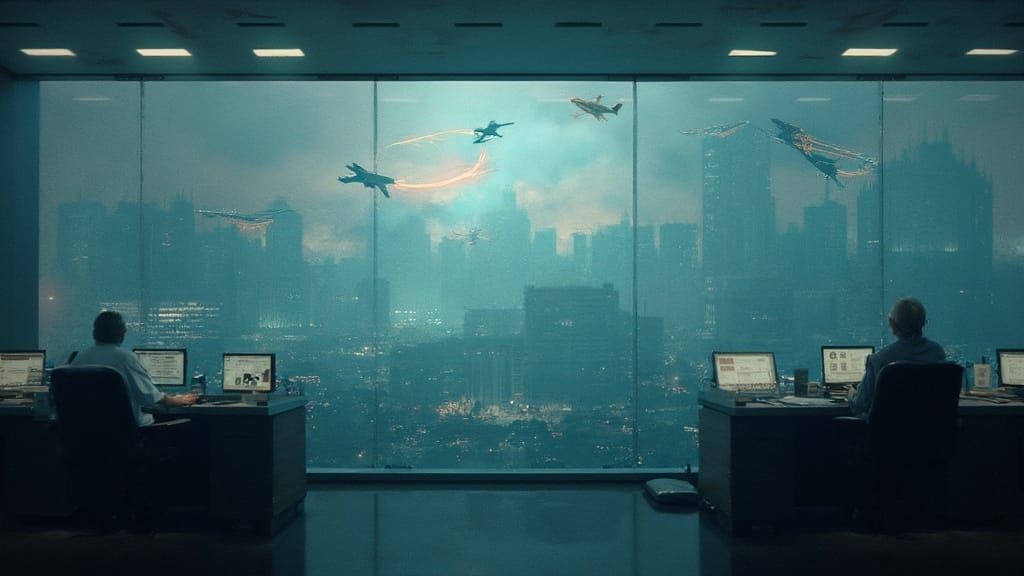
Photo: lyceumnews.com
For nearly two weeks, China's air force stopped doing the one thing it had done almost every single day for years: flying warplanes into the airspace around Taiwan. The flights had become so routine — hundreds per month, trending relentlessly upward — that they functioned as a kind of geopolitical metronome, a constant pulse of pressure that defense analysts, journalists, and Taiwanese military planners had learned to read like a heartbeat. Then the heartbeat flatlined. No announcement, no explanation, no diplomatic communiqué. Just silence. And the silence, it turns out, is harder to interpret than the noise ever was.
The thesis: China's sudden halt of military flights near Taiwan isn't a de-escalation — it's a demonstration that Beijing now controls the tempo of tension in the Taiwan Strait, and the most dangerous phase may be what comes after the quiet ends.
The full story
The pattern that broke
To understand why the absence of Chinese planes matters, you first need to understand how relentless their presence had become. Since Taiwan's Ministry of National Defense began publicly releasing daily data on People's Liberation Army (PLA) air activity in 2020, the trend line moved in only one direction: up. Monthly sortie counts — individual flights by individual aircraft — climbed from dozens to hundreds. By the time Taiwan's President William Lai took office in May 2024, the PLA was averaging over 300 sorties per month into Taiwan's Air Defense Identification Zone, or ADIZ. (An ADIZ isn't sovereign airspace — it's the larger buffer zone a country monitors to give itself early warning of incoming threats. Crossing into it isn't technically illegal, but it's deliberately provocative.)
Then, starting around February 27, the flights effectively stopped. February's total came in at just 147 sorties — the lowest monthly figure since Lai's inauguration. But the real shock was the stretch of near-total silence that followed. For thirteen consecutive days, with only one minor exception, no PLA warplanes were detected in the zones Taiwan tracks. Ben Lewis, founder of PLATracker — an open-source data platform that aggregates Chinese military flight information — told CNN that it was "the longest pause since Taiwan's defense ministry began releasing this data" and represented "a very significant change in the pattern."
The pause technically ended on Thursday, March 12, when Taiwan's defense ministry reported five PLA aircraft detected — a trickle so small it barely registers against the old baseline. Five planes, after years of daily double-digit incursions, is not a resumption. It's a whisper.
What makes this genuinely unsettling is the lack of any credible, singular explanation. The PLA didn't announce a stand-down. Beijing's Ministry of National Defense didn't issue a statement. The Chinese state media apparatus, which normally amplifies every display of military power, said nothing about pulling back. The silence about the silence has been total.
Three theories, none satisfying
The analytical community has coalesced around three possible explanations, each with significant holes.
Theory one: diplomatic signaling ahead of the Xi-Trump summit. CCP General Secretary Xi Jinping is scheduled to meet with US President Donald Trump between March 31 and April 2 in Beijing. Trade, technology export controls, and Taiwan are all expected to feature prominently. The logic here is straightforward: Beijing dials down military provocations to create a favorable atmosphere for negotiations. This theory gained weight when reports emerged that the Trump administration is delaying a multibillion-dollar arms sale to Taiwan to ensure the visit goes smoothly. If both sides are making quiet concessions to set the table, the flight pause could be Beijing's contribution to the pre-summit choreography.
The problem with this theory is one of proportionality. China has held summits with US presidents before without grounding its air force near Taiwan. The flights continued through multiple rounds of high-level diplomacy in 2023 and 2024. Why would this summit be different? And if it is diplomatic signaling, it's remarkably opaque — effective signaling usually involves making sure the other side knows you're signaling.
Theory two: the "Two Sessions" parliamentary meetings. China's National People's Congress and Chinese People's Political Consultative Conference — collectively known as the Two Sessions — were concluding this week. These are the most important annual political gatherings in China, and there's historical precedent for modest reductions in military activity during the sessions, when the leadership's attention is focused inward. But "modest reductions" is not "near-total cessation." The Two Sessions have never before produced a pause of this length or completeness. The timing overlaps, but the scale doesn't match.
Theory three: the PLA purge. This is the explanation that worries analysts most. Since January 25, when Beijing announced that two of the most senior officers in China's military — Vice Chairman of the Central Military Commission Zhang Youxia and Chief of the Joint Staff Department Liu Zhenli — are under investigation, there have been 21 days with zero PLA flights around Taiwan. These aren't mid-level bureaucrats. Zhang Youxia was the second-highest-ranking military official in China, directly below Xi Jinping in the command structure. Liu Zhenli ran the operational nerve center of the entire PLA. Their removal follows a broader anti-corruption purge that has swept through the PLA's senior ranks over the past two years, including the disappearance and presumed removal of former Defense Minister Li Shangfu and former Rocket Force commanders.
The implication is stark: the flight pause may not be a deliberate strategic choice at all. It may be the visible symptom of a military whose command structure is in turmoil. If the officers who authorize and coordinate large-scale air operations are being investigated, detained, or replaced, the operations themselves might simply stop — not because someone ordered a stand-down, but because the people who would give the order are gone. As one analyst wrote, the lack of a rational explanation "is what's genuinely disconcerting. Perhaps that is what Beijing is aiming for: uncertainty."
The sea didn't stop
Here is the detail that should reframe the entire conversation: while the planes stayed home, the ships did not.
Taiwan's defense minister Wellington Koo urged caution about reading too much into the flight pause, noting that Chinese naval activity around Taiwan continued throughout the period. Surface vessels and submarines maintained their presence. The stand-down was domain-specific — limited to the air force — not a general military withdrawal.
This matters enormously for interpretation. A genuine de-escalation would involve pulling back across all domains. A domain-specific pause suggests something more deliberate: either a rotation of resources, a shift in training priorities, or a calculated decision to maintain pressure through one channel while relieving it through another.
Tristan Tang, a nonresident fellow at the Pacific Forum in Honolulu, told the Taipei Times that the absence of PLA aircraft "aligned with a long-term shift toward more joint operations training that began last year." Joint operations — the coordinated use of air, sea, land, space, and cyber capabilities in a single campaign — are the gold standard of modern military power, and the PLA has been investing heavily in developing them. You don't practice complex multi-domain coordination by running the same single-service harassment flights every day. You stand down the routine activity and work on the harder integration problem.
If this theory is correct, the pause isn't a retreat. It's a rehearsal break — the military equivalent of a theater company going dark between shows while they rebuild the set for something bigger.
The drone wearing a disguise
While the world debated empty skies over the Taiwan Strait, a Chinese drone was running a very different kind of operation over the South China Sea — one that may tell us more about the future of conflict than the flight pause itself.
A PLA Wing Loong 2 drone, flying under call sign YILO4200, has been transmitting false ADS-B registration codes on at least 23 flights from Hainan's Qionghai Boao Airport. ADS-B — Automatic Dependent Surveillance-Broadcast — is the digital identification signal that virtually every aircraft in the world transmits continuously. It broadcasts the plane's identity, position, altitude, and speed. It's what allows civilian flight tracking websites like Flightradar24 to show you every plane in the sky in real time. It's also what air traffic controllers and military radar operators use to distinguish friend from foe.
The Wing Loong 2 wasn't hiding. It was lying. On different flights, it impersonated a Rada Airlines Ilyushin-62 — a Belarusian cargo carrier on the US Treasury's sanctions list — a Royal Air Force Typhoon fighter jet, a North Korean passenger aircraft, and an anonymous Gulfstream business jet. Each false identity is calibrated to trigger a different response: a British fighter appearing over the South China Sea would cause one kind of alarm; a sanctioned Belarusian freighter would cause another; a North Korean civilian plane would cause yet another. On one flight, the drone switched identities three times in roughly twenty minutes. On another occasion, the drone was airborne posing as the Belarusian Il-62 while the actual Rada aircraft simultaneously took off near Belarus — meaning both planes appeared on tracking systems at the same time, in two different parts of the world.
This is transponder spoofing — the aerial equivalent of identity theft — and military attachés and security analysts say the flights represent a step-change in China's gray-zone tactics. The strategic applications are obvious: in a conflict scenario, fake signals could trick Taiwan and its partners into scrambling jets against phantom threats, flood radar screens with noise to mask real attack formations, or inflate the apparent size of an incoming air armada. The American Enterprise Institute's China-Taiwan tracker noted that this aerial spoofing mirrors similar signal deception already practiced by PRC naval vessels around Taiwan — meaning the tactic is being systematically extended from sea to air.
The critical unknown is whether the technique works against military-grade radar and identification systems, not just civilian trackers. There's no public evidence either way. But the fact that China is openly testing it — on dozens of flights, with deliberately provocative false identities — suggests confidence that the capability has operational value beyond embarrassing Flightradar24.
The carrier in the background
Zoom out from the daily tactical picture and a slower, larger story comes into focus. Satellite imagery released in mid-February by US company SkyFi showed China's Type 004 aircraft carrier under construction at the Dalian Shipyard — the same facility that built the Shandong and Fujian carriers. The imagery revealed two large openings in the hull positioned similarly to nuclear reactor containment units on US carriers, strongly suggesting the Type 004 will be nuclear-powered.
If confirmed, this would place China in an exclusive club. Only two nations currently operate nuclear-powered aircraft carriers: the United States, with eleven, and France, with one. Nuclear propulsion eliminates the need to return to port for refueling, allowing a carrier to stay deployed indefinitely — a capability that fundamentally changes the math of power projection.
Analysts believe the Type 004 would displace between 110,000 and 120,000 tons, making it 10 to 20 percent more massive than the USS Gerald R. Ford, currently the world's largest warship. The US Department of Defense revealed in December 2025 that China was planning to construct six Type 004 carriers by 2035, which would give China a total of nine aircraft carriers — outnumbering the six currently deployed in the US Pacific Fleet. Newsweek reported that the vessel would represent a direct challenge to American sea power in the Western Pacific.
This is the structural backdrop against which the flight pause should be understood. China isn't stepping back from military competition around Taiwan. It's investing in the platforms that would make that competition far more consequential in the 2030s. The daily harassment flights were always a sideshow compared to the shipyard activity. The pause just made the sideshow go quiet long enough for people to notice the main event.
Who's saying what
The analytical community is genuinely split, and the fault lines are revealing.
The diplomacy camp sees the pause as pre-summit signaling. This view is most common among analysts focused on US-China relations rather than military operations. Their evidence: the timing aligns with the upcoming Xi-Trump summit, and Washington's simultaneous decision to delay Taiwan arms sales suggests both sides are managing the atmosphere. The implication is relatively benign — the flights will return after the summit, and the pause is a temporary, transactional gesture.
The doctrinal evolution camp, represented by analysts like the Pacific Forum's Tristan Tang, argues the pause reflects a genuine shift in PLA training priorities toward joint operations. This view treats the daily ADIZ incursions as a relatively unsophisticated form of pressure that the PLA may be outgrowing as it develops more complex warfighting capabilities. The implication is that the flights may return at lower frequency but be replaced by more integrated, multi-domain exercises that are actually more threatening.
The internal disruption camp is the most alarmed. Analysts like Drew Thompson, whose Substack analysis of the pause has circulated widely in defense circles, point to the investigation of Zhang Youxia and Liu Zhenli as the most parsimonious explanation. If the PLA's command structure is fractured by Xi's purge, the operational implications could extend far beyond flight schedules. Thompson's core concern is that a military in internal turmoil is harder to predict, harder to deter, and more prone to miscalculation.
Taiwan's own defense establishment is being notably cautious. Defense Minister Wellington Koo has publicly warned against over-interpreting the pause, emphasizing that naval activity never stopped. Ben Lewis of PLATracker acknowledged the significance but stopped short of endorsing any single theory. The institutional posture in Taipei appears to be: don't relax, don't overreact, and don't assume this is good news.
The most honest position belongs to those willing to say they simply don't know. The absence of any public explanation from Beijing means every theory is, to some degree, projection. And that ambiguity may itself be the point.
Capital and positioning
The flight pause is a military story, but the money flows around it tell a parallel tale about who is structurally advantaged and who is exposed.
Start with the arms sale Washington put on hold. The Trump administration's decision to delay a multibillion-dollar weapons package to Taiwan ahead of the Xi summit creates a cascading problem. Taiwan's opposition Kuomintang (KMT) party released a special defense budget of 350 billion New Taiwan Dollars — roughly $11 billion USD — less than one-third of the Lai administration's proposal. The KMT explicitly conditioned any increase on US approval of additional arms sales. So Taiwan's ability to fund its own defense modernization is now partly contingent on a US decision that Washington is deliberately postponing to accommodate Beijing. The weapons hold gives China something it has never been able to achieve through military pressure alone: a pause in Taiwan's defense procurement timeline, granted by Washington itself.
The pipeline hasn't completely dried up. Taiwan is scheduled to receive deliveries this year of 18 M142 HIMARS rocket systems (mobile launchers that fire precision-guided missiles), 14 M136 Volcano remote mining systems (which can rapidly deploy anti-vehicle minefields), and ALTIUS-600 attack drones — all systems already under contract. The gap isn't in what's already been approved. It's in the next tranche. Every month the new package sits on a desk in Washington is a month Taiwan doesn't have those systems on order.
Meanwhile, China's shipbuilding industrial base continues to operate at a pace the United States cannot match. China already possesses the world's largest navy by hull count and is launching major warships at roughly three times the rate of the United States. The Dalian Shipyard's work on the Type 004 carrier is just the most visible element of a broader naval construction program that includes destroyers, frigates, submarines, and amphibious assault ships. The structural advantage here is industrial capacity: China's shipyards can build faster and cheaper than their American counterparts, and the gap is widening.
The transponder spoofing story also has a capital dimension, though it's harder to trace. The Wing Loong 2 drone is manufactured by the Chengdu Aircraft Corporation, a subsidiary of the state-owned Aviation Industry Corporation of China (AVIC). The spoofing capability likely involves modifications to commercially available ADS-B transponder hardware — relatively inexpensive technology being repurposed for military deception. The asymmetry is striking: the cost of equipping a drone with a fake identity is trivial compared to the cost of the air defense systems and scrambled fighter jets an adversary must deploy in response. This is the economic logic of gray-zone warfare — cheap offense, expensive defense — and China is systematically exploiting it.
For defense technology companies in the US and allied nations, the implications cut two ways. Demand for counter-spoofing technology, advanced identification friend-or-foe (IFF) systems, and AI-powered radar discrimination tools is likely to increase. But the fundamental challenge — distinguishing real threats from fake ones in real time — is a problem that favors the attacker. The defender has to get it right every time. The spoofer just has to create enough doubt to slow the response.
What this changes
Three structural shifts emerge from this episode, and none of them are temporary.
First, the information asymmetry around Taiwan just got worse. For years, Taiwan's daily publication of PLA flight data created a kind of transparency — imperfect, but useful. Analysts, journalists, and governments could track Chinese military behavior in near-real-time and draw conclusions about Beijing's intentions. The flight pause breaks that model. If China can turn the pressure on and off without explanation, the data stream becomes harder to interpret. A day with no flights could mean de-escalation, internal turmoil, preparation for a larger exercise, or diplomatic maneuvering — and there's no way to tell from the outside. The signal-to-noise ratio of Taiwan Strait monitoring just degraded significantly.
Second, the spoofing capability changes the calculus of air defense. Taiwan's military has spent years and billions of dollars building an air defense network designed to detect, track, and respond to incoming aircraft. That network relies, in part, on electronic identification — knowing what's coming at you based on the signals it broadcasts. If China can systematically spoof those signals, Taiwan's defenders face a new problem: not just detecting threats, but authenticating them. Every false alarm wastes fuel, flight hours, and pilot endurance. Every missed real threat could be catastrophic. The extension of spoofing from naval vessels to aerial drones suggests China is building a comprehensive deception capability across domains, not just experimenting in one.
Third, the US-Taiwan defense relationship is being quietly restructured. The arms sale delay isn't an isolated incident — it's a data point in a pattern. When Washington conditions its support for Taiwan on the diplomatic calendar with Beijing, it transforms arms sales from a security commitment into a bargaining chip. Taipei has noticed. The question is whether Taiwan begins to diversify its defense procurement away from near-total dependence on the United States. Former Japanese Defense Minister Satoshi Morimoto said this week that whether Japan would help defend Taiwan in a cross-strait conflict would depend on the US and the extent of Japan's role under the US-Japan Security Treaty. If Washington's commitment appears conditional, Tokyo's calculus shifts too — and so does Seoul's, Canberra's, and every other capital that has been quietly planning for a Taiwan contingency.
The deeper structural change is about tempo and control. For years, the conventional wisdom held that China was the revisionist power trying to change the status quo, and the US and Taiwan were the defenders trying to preserve it. The flight pause complicates that framing. Beijing has demonstrated that it can modulate the level of military pressure with precision — ramping up to create crises, dialing down to create diplomatic space, and leaving everyone guessing about which mode comes next. That kind of tempo control is a strategic advantage in itself, independent of any specific military capability. It means Beijing sets the rhythm, and everyone else reacts.
What comes next
The immediate focus is the Xi-Trump summit at the end of March. If PLA flights resume at full intensity before the summit, the diplomatic signaling theory collapses — and the more unsettling explanations gain credibility. If they resume after the summit, the key variable is the level. A gradual return to something like the old baseline would suggest the pause was transactional, a temporary concession traded for diplomatic access. A surge — flights returning at higher intensity than before — would suggest the pause was operational, a period of rest and preparation before a new phase of pressure. And if the flights don't fully resume at all, it may confirm the doctrinal evolution theory: that the PLA has moved past daily harassment flights toward something more sophisticated and, ultimately, more dangerous.
The spoofing story has its own trajectory. If the Wing Loong 2 drone designated YILO4200 resumes flights with false transponder codes, analysts will treat it as confirmation of an active, ongoing test program rather than a one-off experiment. The next evolution to watch for is whether the technique migrates from the South China Sea to the Taiwan Strait itself — and whether it's applied not just to drones but to manned aircraft. A fleet of fighters broadcasting false identities during an actual military exercise would represent a qualitative escalation in China's deception capabilities.
Taiwan's defense budget vote will be a concrete indicator of how seriously Taipei is taking the shifting threat environment. The gap between the KMT's $11 billion proposal and the Lai administration's much larger request isn't just a budgetary dispute — it's a debate about the nature of the threat. If the final number comes in low, Taiwan's near-term procurement timeline slips, and the gap created by Washington's arms sale delay widens further.
The carrier program operates on a longer timeline but sets the terms for everything else. When the Type 004 enters service — likely in the early 2030s — it will fundamentally alter the military geometry of the Western Pacific. A nuclear-powered supercarrier can project air power far beyond the first island chain, the string of archipelagos running from Japan through Taiwan to the Philippines that currently constrains China's naval reach. Six such carriers, as the Pentagon projects China intends to build, would give Beijing the ability to sustain air operations over vast stretches of ocean without land-based support — a capability that only the United States currently possesses.
The quiet skies over Taiwan were never really quiet. They were a different kind of signal — one that communicated capability, control, and the willingness to keep everyone guessing. The planes will come back. The question that matters is what they'll be practicing for when they do.