Cybersecurity Weekly — Mar 10, 2026

Photo: lyceumnews.com
Week of March 10, 2026
The Big Picture
The people we hired to stop ransomware were running it, an AI found security holes that human experts missed for 28 years, and law enforcement dismantled a phishing empire that was responsible for most of the MFA-bypass attacks Microsoft blocked last year. This was the week the inside-out nature of modern cybersecurity became impossible to ignore — the threats are coming from trusted professionals, trusted tools, and trusted code that nobody thought to re-examine until a machine did it for them.
This Week's Stories
The Cybersecurity Pros Who Were Running the Ransomware
Two U.S. cybersecurity professionals pleaded guilty this week to conspiracy charges for deploying BlackCat/ALPHV ransomware — one of the most destructive ransomware operations of the past few years. One defendant, Ryan Goldberg, worked as an incident response manager at cybersecurity firm Sygnia. His literal job was to show up after ransomware attacks and help clean them up. Instead, he and his co-conspirators were hacking into company systems, stealing data, and deploying the same ransomware he was paid to fight — operating as affiliates who kicked 20% of every ransom back to the gang's administrators. In one case, they collected $1.2 million in Bitcoin from a single victim.
The insider threat angle here is genuinely chilling. These weren't outsiders guessing at how corporate defenses work — they knew exactly where to look, which alerts to avoid, and how incident response timelines unfold. Sentencing is scheduled for Thursday, March 12, 2026. Both face up to 20 years. If the judge hands down anything close to maximum sentences, it will signal that courts are treating cybersecurity professionals who weaponize their access as a distinct and more serious category of defendant. Watch for it.
An AI Found 12 Security Holes in the Code That Secures the Entire Internet
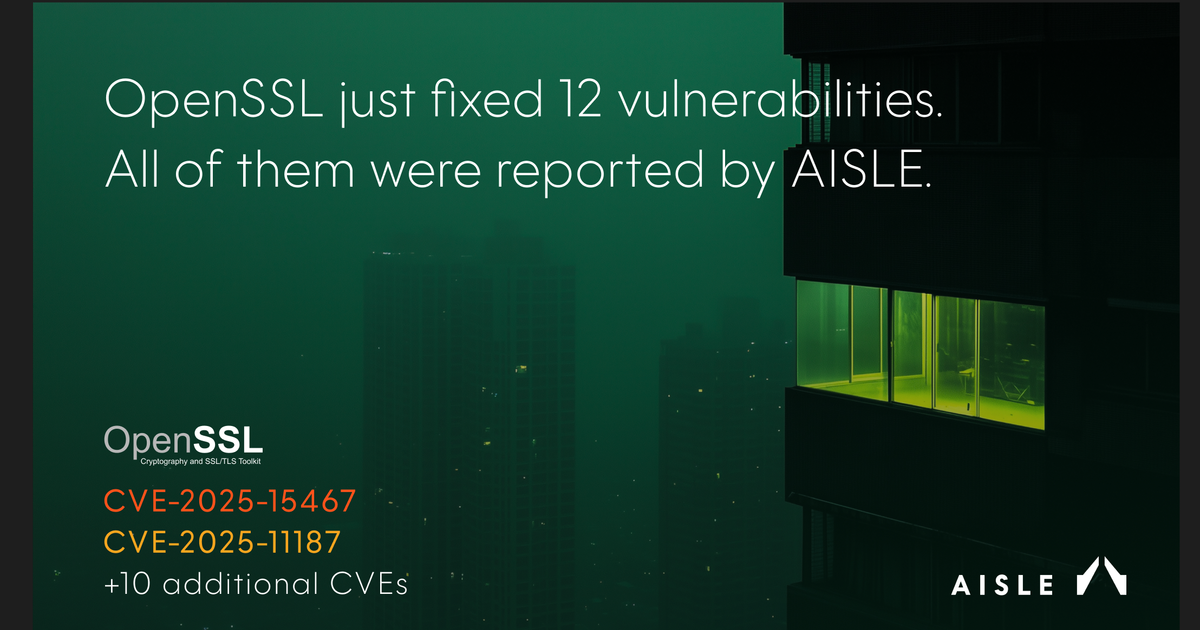
OpenSSL is the unsung hero protecting almost every secure connection on the internet — your banking website, your email, your company's VPN. It's been reviewed by expert eyes for decades. That wasn't enough.
AISLE's autonomous AI analyzer found all 12 vulnerabilities in OpenSSL's January 2026 coordinated release. Several of those flaws had existed in the code for years — one dating back to 1998, meaning a security hole sat in the world's most critical encryption library for 28 years before a machine caught it. The most serious, CVE-2025-15467, was a stack buffer overflow that could allow remote code execution, rated 9.8 out of 10 in severity.
Then AISLE turned its scanner on Amazon's own cryptographic stack — the libraries Amazon uses across AWS, Python, NGINX, and HAProxy — and reported 13 more issues, two receiving formal CVE designations. Amazon confirmed all issues were addressed; no AWS services were impacted. Meanwhile, Anthropic reported its Claude model found 22 vulnerabilities in Mozilla Firefox in two weeks, 14 of them high-severity, and Mozilla validated and patched most of them.
The headline isn't "AI found bugs." It's "AI found bugs that armies of human experts missed for nearly three decades." Expect every foundational open-source library — the kind of code nobody audits because everyone assumes someone else already did — to come under similar AI scrutiny next.
A Cisco Network Flaw With a Perfect Severity Score Is Being Used Against You Right Now
A CVSS score of 10.0 out of 10 is the cybersecurity equivalent of a five-alarm fire. This week, one of those fires is burning in software that quietly runs the networks of thousands of organizations.
A critical authentication bypass flaw in Cisco Catalyst SD-WAN — tracked as CVE-2026-20127 — has been actively exploited since at least 2023 by a threat actor designated UAT-8616. SD-WAN is the technology large companies use to connect their offices, retail locations, and cloud services into a single managed network. An attacker with unauthenticated admin access to SD-WAN infrastructure has, functionally, a skeleton key to distributed enterprise environments. CISA issued Emergency Directive 26-03 on March 9, 2026, instructing all federal agencies to patch and inventory affected systems within a near-term deadline.
The fact that this flaw was exploited silently for over two years is what makes it alarming. Organizations that deployed SD-WAN as part of "zero-trust transformation" initiatives may have inadvertently centralized their attack surface. If your employer uses Cisco SD-WAN, this patch conversation shouldn't wait for a quarterly review meeting.
International Takedown Dismantles a Massive Phishing Empire
![Law enforcement seizes phishing infrastructure and domains — USS Rentz confiscates cocaine. (9789043406) / Official U.S. Navy Page from United States of America
A coordinated global operation led by Europol, with help from Microsoft, Cloudflare, and multiple national law enforcement agencies, shuttered a large phishing-as-a-service platform that intercepted two-factor authentication codes and session cookies — the digital tokens that prove you're logged in. Authorities seized over 300 web domains. Microsoft said the service, commonly referenced as Tycoon 2FA, accounted for roughly 62% of the phishing attempts Microsoft blocked at the service's peak.
Phishing-as-a-service works like any other subscription business: criminals pay a monthly fee and get access to ready-made phishing kits, hosting infrastructure, and tools to intercept the one-time codes your bank sends to your phone. This takedown disrupts the supply chain of mass phishing operations and makes MFA-bypass attacks more expensive — at least temporarily. But expect copycats and splinter services to emerge. This is a window of reduced capability, not a permanent fix.
Hackers Are Messaging Your Coworkers on Microsoft Teams — and Deploying Malware
Everyone knows not to click a suspicious link in email. Fewer people have been trained to distrust a message from "IT Support" on their company's internal chat platform.
Attackers contacted employees at financial and healthcare organizations over Microsoft Teams, posing as IT support, and asked them to share their screen using Quick Assist — Microsoft's legitimate remote-access tool built into Windows. Once the employee complied, the attackers had full control of the machine, and a new piece of malware called A0Backdoor got quietly installed in the background.
What makes this attack genuinely clever is that it exploits trust in corporate infrastructure. Quick Assist is a real tool. Teams is your real, company-issued chat platform. Nothing about the interaction looks like a phishing email. Separately, BleepingComputer reported that Russia's APT28 is using a custom variant of an open-source post-exploitation framework for long-term espionage — suggesting the overlap between criminal ransomware tactics and nation-state spy tools is narrowing fast.
If someone contacts you on Teams claiming to be IT and asking for remote access, call IT directly on a known number first.
⚡ What Most People Missed
Ransomware groups are quietly dropping the ransomware part. Multiple threat intelligence sources report that in 2026, many groups are skipping file encryption entirely — just stealing data and threatening to publish it. Encryption is loud and triggers incident response; quiet theft is nearly as profitable and much harder to detect. Your incident response plan that starts with "someone reported files are encrypted" may be looking for the wrong starting signal.
Fake 7-Zip downloads are turning home PCs into proxy nodes. A domain posing as the legitimate 7-Zip site serves trojanized installers that silently configure your computer to relay attacker traffic. It's the kind of everyday-download story that seeds large botnets from people who just wanted to unzip a file.
AI agent marketplaces are the new malware frontier. The most-downloaded "skill" in ClawHub — an open marketplace for AI agent add-ons — turned out to be malware, slipping malicious code through trusted agent frameworks. Separately, Google patched a high-severity flaw in Chrome's Gemini AI panel that let rogue extensions hijack the live chat feature. The pattern is identical to early mobile app stores: trusted distribution plus social buzz creates a high-reward target.
LexisNexis confirmed a cloud breach on March 4, 2026 that reportedly exposed data on 21,000 enterprise customers and about 400,000 user profiles, including profiles tied to U.S. federal judges and DOJ attorneys. Attackers exploited an unpatched web component rated maximum severity, then pivoted into Amazon Redshift and cloud secret managers. A single unpatched front-end led to a broad cloud compromise.
Nobody has playbooks for forensically investigating an AI system. A veteran DFIR practitioner described doing their first forensic audit of an AI — preserving model weights, auditing plugins, rebuilding a sandbox to reproduce misbehavior — and found that nothing from a decade of traditional investigation experience mapped cleanly onto the work.
📅 What to Watch
- If Thursday's BlackCat insider sentencing on March 12, 2026 approaches maximum penalties, it could pressure cyber insurers to tighten underwriting for employee access, prompt firms to adopt stronger privileged-access isolation, and lead to broader contractual liability clauses in vendor and employment agreements.
- If CISA keeps adding management-plane products to its known-exploited-vulnerabilities catalog (Ivanti, SolarWinds, VMware Aria — as of March 9, 2026), expect vendors to face new compliance scrutiny and for IT teams to start segregating management planes into out-of-band networks — increasing operational complexity and procurement costs.
- If the EU Court of Justice adopts its Advocate General's opinion that banks must refund phishing victims even when customers made the mistake, expect European banks to treat fraud detection as a direct financial liability, which could shift costs onto merchants and reshuffle how online onboarding and transaction liability are negotiated.
- If the reported Social Security Administration data theft is confirmed by federal investigators, it will likely trigger the largest wave of credit freeze requests in U.S. history and accelerate policy moves to deprecate Social Security numbers as primary identity anchors in favor of tokenized identifiers.
- If AI-discovered vulnerabilities keep appearing in foundational libraries at this rate, the implicit social contract of open-source security — "many eyes make all bugs shallow" — will be replaced by "many GPUs make all bugs shallow," and projects without AI audit coverage will become the new unpatched appliances.
A cybersecurity professional moonlighting as a ransomware operator, a 28-year-old bug hiding in the code that encrypts your bank login, and a top-rated AI assistant plugin that was actually malware wearing a productivity costume. The machines are getting better at finding what we missed — the uncomfortable part is that so are the criminals, and sometimes they're the same people.
Stay patched out there.