Defense Tech Daily — Mar 11, 2026

Photo: lyceumnews.com
Tuesday, March 11, 2026
The Big Picture
Iran is mining the most important oil chokepoint on Earth, the U.S. just destroyed 16 of its mine-laying boats, three cargo ships are damaged or burning in the Strait of Hormuz — and the Navy's brand-new, largely untested robot mine-hunters are about to find out if they work under fire. Meanwhile, the Pentagon is simultaneously removing one AI company from its most sensitive systems and onboarding roughly 3 million employees onto another's platform, which is the kind of vendor swap you'd normally do over a quiet fiscal year, not during a shooting war.
Today's Stories
Iran Laid Mines in the Strait of Hormuz. The U.S. Sank 16 Mine-Laying Boats. Then Cargo Ships Started Burning.
A Thailand-flagged cargo ship called the Mayuree Naree is on fire in the Strait of Hormuz this morning. It's one of three commercial vessels struck by projectiles off Iran's coast, according to UK Maritime Trade Operations — the Japanese-flagged ONE Majesty and Marshall Islands-flagged Star Gwyneth also reported damage.
This follows the biggest U.S.-Iran naval engagement of the conflict. American forces destroyed 16 Iranian mine-laying vessels near the Strait after intelligence confirmed Iran had begun seeding naval mines in the world's most critical energy corridor. As of March 11, a few dozen mines are reportedly in the water already. Iran retains 80–90% of its small boats and mine-layers as of March 2026, meaning it could feasibly lay hundreds more.
Here's why mines matter more than missiles: a missile damages one ship. A minefield closes an entire shipping lane for weeks — even after a ceasefire — because someone still has to find and defuse every single one. Insurers won't cover transits through a mined corridor, which means the economic damage persists long after the shooting stops. The UK has logged 17 incidents affecting vessels in and around the Persian Gulf since February 28. Maritime traffic through Hormuz has largely slowed or halted.
Compounding the threat, Iran deployed unmanned explosive-laden boats in swarm formations — small, cheap surface drones designed to overwhelm defenses through sheer numbers. U.S. forces used electronic jamming and precision strikes to degrade the swarms, but if Iran scales the tactic, traditional navies will need entirely new countermeasures.
Oil swung between $80 and $90 a barrel intraday. Trump said the Navy would escort commercial tankers "as soon as possible." The UN Security Council is voting on March 11, 2026 on a GCC-sponsored resolution demanding Iran stop.
The Navy Retired Its Mine-Hunting Ships Six Months Ago. Now It Needs Them.
In September 2025, the Navy pulled its last Avenger-class minesweepers from Bahrain — wooden-hulled Cold War relics, genuinely obsolete. Their replacements: Independence-class littoral combat ships fitted with a new mine countermeasures "mission package." Think of a modular frigate that swaps in different kits — mine-hunting gear, anti-sub sensors, surface warfare tools.
The problem is timing. The Navy only fielded its first two operational mine-hunting modules last year, on USS Santa Barbara and USS Canberra. These ships have never done this job in a real warzone. The system works by sending out a robot boat and a helicopter instead of putting sailors directly in the minefield — theoretically safer and smarter. But as of this week, the LCS platforms with mine-hunting kits are positioned outside the Gulf itself.
To protect the mine-hunters while they work, the Air Force deployed A-10C Warthogs — 50-year-old ground-attack jets the service has been trying to retire for two decades. They're slow, they loiter for hours, and they carry laser-guided rockets that are cheap enough to use against swarms of Iranian fast boats. The tactical picture is almost poetic: a robot boat hunts mines, a helicopter neutralizes them, a frigate manages the system, and a Cold War jet circles overhead ready to kill anything that threatens the operation.
The gap between "works in exercises" and "works when Iran is actively shooting at you" is the question nobody has answered yet.
Ukraine Took Back 400 Square Kilometers by Attacking When the Drones Couldn't Fly
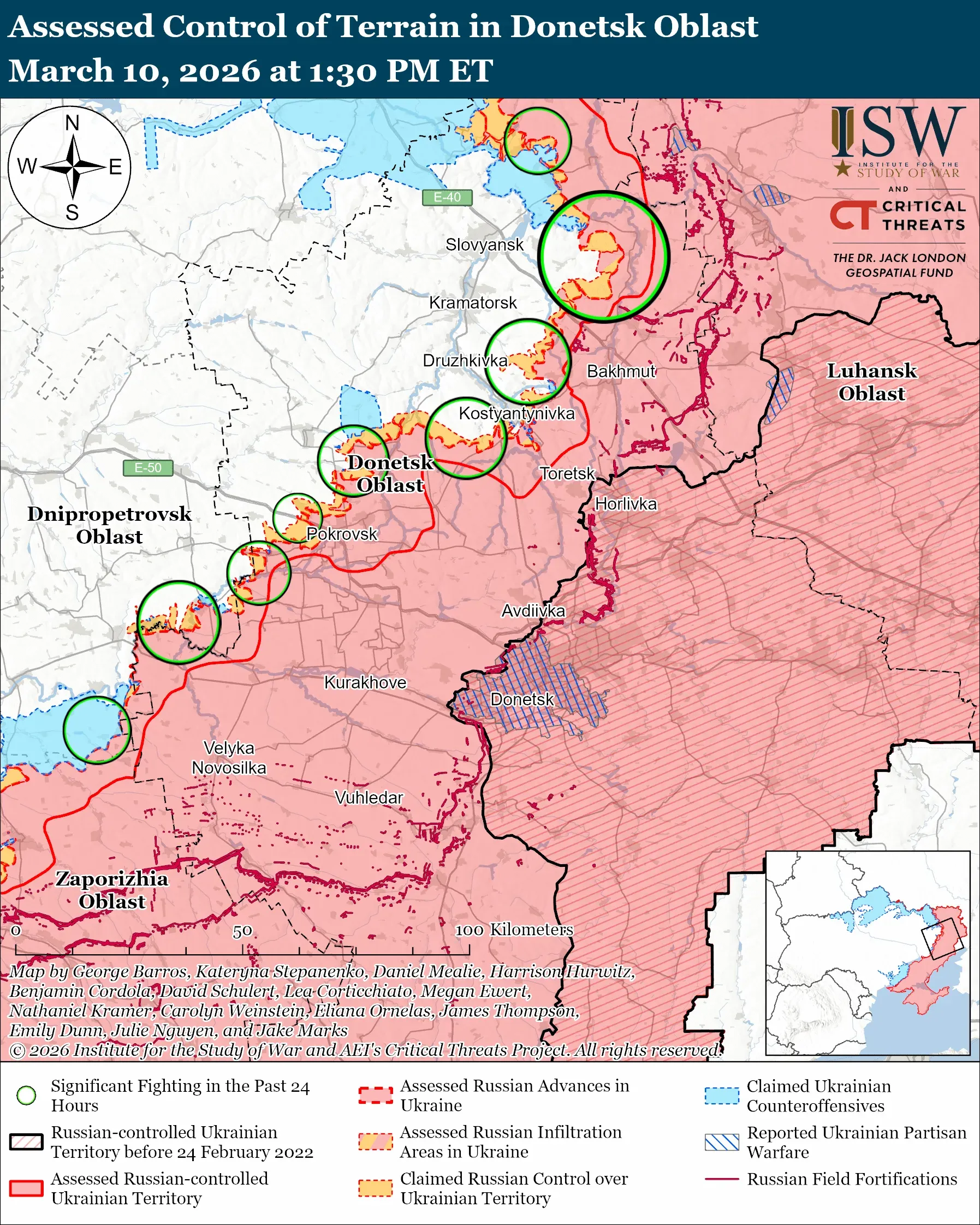
Ukraine liberated more than 400 km² of Dnipropetrovsk Oblast through two coordinated advances since late January, according to the Institute for the Study of War. The operation pre-empted Russia's anticipated spring offensive and exploited a specific vulnerability: winter weather that grounded Russian surveillance drones.
But weather was only half the story. Starlink, at Ukraine's request, bricked thousands of stolen satellite terminals that Russian forces had been using to control drones and coordinate troops. The combined effect — fog plus dead comms — partially blinded and muted Russian drone teams, assault groups, and headquarters. Ukraine moved when the eyes were closed and the radios were dead.
The lesson is counterintuitive: the most important variable in drone warfare isn't the drone — it's the communications network the drone depends on. Cut the network, and a drone swarm becomes expensive debris.
On the export front, this battlefield success is translating into real money. A Saudi arms company has signed a deal for Ukrainian interceptor missiles, with sources telling the Kyiv Independent to expect a "huge deal" as soon as today. Ukrainian interceptor drones — some costing $1,000 to $3,000 — now account for over 70% of Shahed downings as of March 2026. Gulf states watching Iranian drones rain on their neighbors want what works, and what works in 2026 costs less than a used car.
The Pentagon Is Ripping Out Anthropic's AI and Replacing It Mid-Crisis
An internal Pentagon memo reported today directs commanders to remove Anthropic's AI tools from nuclear command and control, ballistic missile defense, and cyber operations within 180 days. Until recently, Anthropic's Claude Gov was reportedly the only frontier AI model cleared for the Pentagon's classified cloud — favored by analysts for handling dense technical material.
Now the Trump administration has labeled the company a "supply-chain risk" — a designation normally reserved for foreign adversaries like Huawei. Anthropic has sued the Defense Department and, in the same week, opened a Washington DC office staffed with a policy brain trust to argue that punishing safety-minded AI developers hurts national security.
Simultaneously, Google expanded its Pentagon footprint by rolling out "Agent Designer" on the GenAI.mil portal — a no-code tool letting roughly 3 million DoD employees build custom Gemini-based AI assistants for unclassified work. The platform has already logged 40 million prompts since December 2025.
The vendor swap is happening in real time, during an active naval conflict. Which models backfill Anthropic's classified roles — and how smooth that transition actually is — may matter more than any single weapons system in the Gulf.
AI Fighter Jets Beat Human Pilots 8 Out of 10 Times in Simulation
Shield AI announced that its Hivemind autonomy system — software that lets drones and jets make split-second combat decisions without human input — outmaneuvered human-piloted fighters in 8 of 10 Air Force simulation scenarios. The company says integration into existing jets could happen within two years if funding holds.
This isn't a video game result. It's the kind of data point that accelerates procurement debates and forces a policy reckoning on what "human in the loop" actually means when the AI is faster, more consistent, and doesn't get tired. The next milestone to watch: whether the Pentagon greenlights live-flight tests.
⚡ What Most People Missed
- The AI guiding U.S. Army drone-killers in the Middle East comes from Romania. A firm called OVES Enterprise supplies "Nemesis AI" integrated into counter-drone systems deployed by the U.S. Army — handling target ID, flight-path prediction, and engagement parameters. Niche allied companies are already in the kill chain.
- OpenAI quietly admitted its models can't run in a war zone. Its national security lead acknowledged that cloud-only deployment means models "cannot be integrated directly into weapons systems, sensors, or other operational hardware." The military's AI problem isn't capability — it's connectivity. A model that's 85% as smart but runs without internet beats GPT-5 in a data center you can't reach.
- An AI targeting system in Ukraine misidentified civilian infrastructure as military targets in at least three strikes in the first week of March 2026. Operators caught the errors, but the incidents underscore why edge autonomy needs predictability, not just performance.
- The Army launched "Project ARIA" — essentially an app store for battlefield AI that works without internet. One team is building a "model armory" where soldiers download targeting-assist or logistics models onto laptop-sized hardware in denied environments. If it works as described, it solves the connectivity problem OpenAI just admitted it can't.
- Anduril unveiled a laser that zaps drones out of the sky — a dozen in under a minute. Effectively unlimited ammunition as long as you have power. If fielded to protect mine-clearance operations in the Gulf, it would be the first real-world validation of directed-energy air defense in a contested zone.
📅 What to Watch
- If Iran lays a dense minefield rather than scattered individual mines, the Navy's untested LCS mine-hunting system gets its hardest exam — and insurers, shippers, and refiners could quickly reroute cargo, spike spot freight and insurance premiums, and pressure governments to release strategic petroleum reserves.
- If Russia reconstitutes Starlink-equivalent communications via Chinese satellite terminals, the window Ukraine exploited closes; restored Russian ISR would enable massed drone and artillery integration within weeks, complicating planned Ukrainian offensives and forcing Kyiv to change tempo.
- If the Saudi-Ukraine arms deal is officially announced today, watch the White House — it could reduce U.S. diplomatic leverage by giving Gulf patrons direct influence over Ukrainian armaments procurement and delivery timelines, shifting bargaining power in future negotiations.
- If Shield AI's Hivemind gets greenlit for live-flight tests, the procurement timeline for autonomous air combat compresses, compelling the Pentagon and Congress to define certification, rules of engagement, and liability for decisions made without an onboard human.
- If Google's Agent Designer creeps from unclassified admin work into intelligence triage or logistics planning, expect a shift toward single-vendor operational dependencies, higher risks of sensitive-data leakage into commercial infrastructure, and a need to rewrite acquisition rules for agent-based tools.
A 50-year-old jet babysitting a robot boat in a minefield. A $1,000 Ukrainian drone outselling a $3 million Patriot interceptor. Palantir's battlefield AI reassigning office chairs.
The most capable AI model cleared for America's nuclear systems is being evicted because its maker believes in safety guardrails — which is either the most reassuring or most terrifying sentence you'll read today, depending on which word you emphasize.
See you tomorrow. —DTD