Dragon Bio — Jul 07, 2026

Photo: lyceumnews.com
Week of July 7, 2026
The Big Picture
This was a week of legal machinery grinding into gear, not a week of rockets launching. The Pentagon formally named WuXi AppTec a "Chinese military company" — the legal trigger for the BIOSECURE Act — but the actual procurement ban is still years away, buried inside a compliance timeline that could stretch to 2032. Meanwhile the quieter, more structural story keeps compounding: China holds three-quarters of the world's gene-edited seed patents, files them faster than the US can, and is building an agricultural IP estate while Washington issues designations. The scoreboard this week reads: China and Korea are building; the US is designating.
This Week's Stories
The WuXi Trigger Gets Pulled — and the Clock Starts Ticking Slowly
On June 8, the Department of Defense published its updated list of "Chinese military companies" under Section 1260H of the NDAA — and among the newly added names was WuXi AppTec, the contract manufacturer that processes drug ingredients for a large share of US clinical-stage biotech. This is the legal tripwire everyone has been waiting on. The Federal Register notice states that WuXi AppTec "is indirectly owned by" the State-Owned Assets Supervision and Administration Commission and "indirectly affiliated with" China's defense science administration and the People's Liberation Army.
WuXi pushed back the same day. The company called the designation "mistaken and baseless," insisted it is "an independent, publicly traded company," and vowed to "pursue all available remedies." The list also swept in BGI Group and seven affiliates, MGI Tech, Novogene, and Origincell.
Here's what changes — and what doesn't. The designation makes WuXi a "biotechnology company of concern" under the BIOSECURE Act, but a ban is not immediate. The Office of Management and Budget must publish its full list by December 2026, issue guidance within 180 days, and the FAR Council then has a year to rewrite procurement rules. If the government uses all its allotted time, prohibitions may not bite until nearly 2029 — and existing contracts get grandfathered for five years beyond that.
The signal to watch: whether OMB accelerates its December list. If it does, the administration is treating this as a live supply-chain weapon. If it drifts, WuXi has a multi-year runway to lock in clients.
China Holds 75% of Gene-Edited Seed Patents — and Europe Won't Catch Up Until 2028
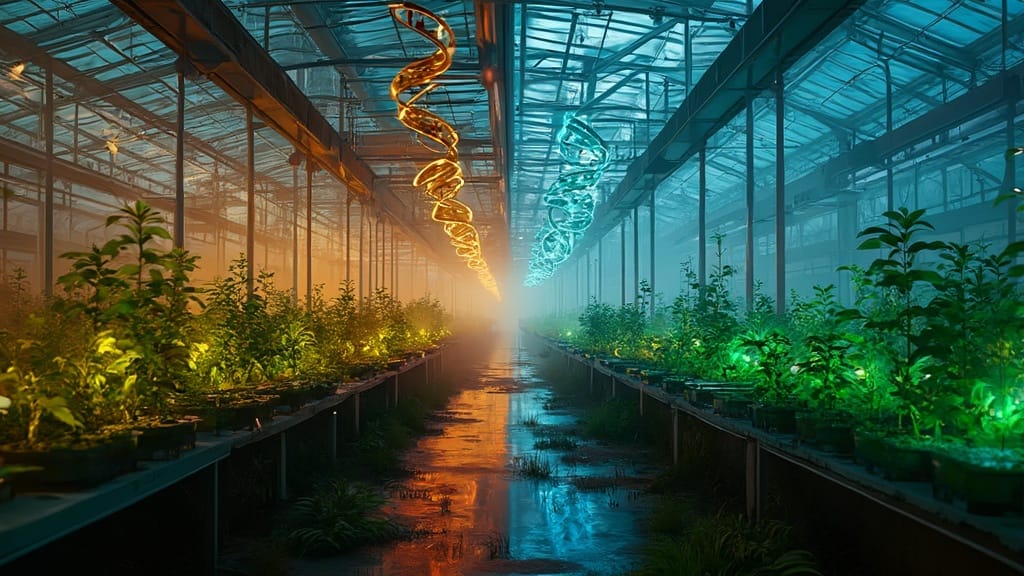
Want to know where agricultural power sits in 2040? Look at who files the patents today. Per a floraldaily.com analysis published in April 2026, 75% of gene-edited seed patents now belong to China. Not a plurality — three-quarters of the global IP estate in one of the century's most consequential agricultural technologies. (China now holds 75% of gene-edited seed patents as Europe moves to loosen NGT ru)
China got there through state-directed funding, a streamlined approval pathway, and sheer volume. Chinese scientists have published more crop-genomics and plant gene-editing papers in recent years than any other country's. In January 2022, China's Ministry of Agriculture and Rural Affairs (MARA) issued safety-evaluation guidelines emphasizing edits that introduce no foreign genes, and has since certified 17 gene-edited crop varieties, according to Reuters — including soybean, wheat, corn, rice, and cotton.
Europe is still legislating. Per the floraldaily analysis, the Council of Europe adopted its final position on the New Genomic Techniques (NGT) regulation in April 2026, but the rules for CRISPR-edited plants won't enter into force until 2028. (China now holds 75% of gene-edited seed patents as Europe moves to loosen NGT ru)
What changes if this holds: patent dominance becomes food-security leverage. A US or European seed company operating in gene-edited markets may increasingly be building on IP whose priority position belongs to Chinese institutions. Watch whether ChemChina's Syngenta subsidiary begins commercializing gene-edited varieties in markets where that IP advantage is structural.
Samsung Biologics Wants to Be the CDMO That Doesn't Need Washington's Permission

While Washington debates which Chinese firms to restrict, South Korea's Samsung Biologics is positioning itself as the indispensable alternative — on its own terms. At Bio USA in San Diego, the company pushed its CDMO technology positioning, and in a June 29 corporate update, it framed its newly acquired Rockville, Maryland facility as part of an integrated Korea-U.S. production network rather than a standalone American asset.
The concrete deliverable: Samsung completed the acquisition of GSK's Rockville facility on March 31, 2026, adding 60,000 liters of drug-substance capacity and bringing its global total to 845,000 liters — a scale that dwarfs any single US player. The company has since said it will add new contract-manufacturing orders at the site.
Why this matters strategically: Samsung Biologics is not a US-allied CDMO in the sense that US policymakers might assume. It's a Korean national champion that happens to be the best available alternative to WuXi. If the BIOSECURE timeline triggers a client migration, Seoul — not Washington — captures the leverage.
The failure signal: if Rockville's new orders never explicitly attach to US government or biodefense work, this stays a commercial capacity play rather than a strategic realignment.
China's CRISPR Crops Are Certified — But Stuck Before the Farm Gate
The story everyone tells is that China approves gene-edited crops fast and the US moves slowly. That's partially true — but the more interesting signal is inside China's own pipeline. MARA's approved events now span soybean quality and yield traits, corn yield traits, wheat disease resistance and herbicide tolerance, and rice quality traits.
Here's the part that doesn't get reported: China's system shows a gap between certification and market rollout. Even with gene-edited wheat and rice events approved, missing variety-registration standards can block commercialization — a second bureaucratic layer that sits after the biosafety certificate and before seeds reach farmers. It's the agricultural equivalent of a drug clearing FDA approval but lacking a reimbursement code.
The newly approved varieties include seeds from Beijing feed group Dabeinong, BASF, and Syngenta subsidiary China National Seed Group — meaning Western multinationals are already filing and commercializing inside China's system.
The honest scorecard: China leads on approval velocity and patent filings but lags on farm-level deployment; the US leads on neither. Watch whether China's variety-registration bottleneck clears in the next 12 months — that's when the approval lead becomes a yield lead, and the US window to close its regulatory gap shuts.
The BIOSECURE Act Is Law — But "Law" and "In Effect" Are Years Apart
President Trump signed the BIOSECURE Act into law on December 18, 2025, as part of the FY2026 NDAA. It limits US government procurement from and grants to "biotechnology companies of concern." But the gap between enactment and enforcement is where the real maneuvering lives.
The final version made a significant concession: unlike the 2024 bill, it does not name WuXi AppTec, WuXi Biologics, BGI, MGI, or Complete Genomics. Instead, per Ropes & Gray's analysis, a company qualifies as a "concern" only if it appears on the DoD's 1260H list and is involved in biotech equipment or services — which is precisely why the June 8 WuXi designation matters so much. (WuXi AppTec’s 1260H Listing Brings the BIOSECURE Act Back to Center Stage)
Per Inside Government Contracts, the sequence runs: OMB publishes its list within one year, guidance follows within 180 days, the FAR is revised within a year of that, and prohibitions take effect 60 days later. The five-year grandfather clock for existing contracts starts at the FAR revision. (WuXi AppTec’s 1260H Listing Brings the BIOSECURE Act Back to Center Stage)
The practical implication: a US pharma company that signs a new WuXi contract now could operate under it into 2032. Watch for a surge in long-term WuXi signings before the OMB list drops in December.
⚡ What Most People Missed
DARPA is asking the field what autonomous biology labs can even do: DARPA's Biological Technologies Office issued a Request for Information — not a funding solicitation — on autonomous science for biological applications, with a July 22 deadline. An RFI means a program office has spotted a strategic need but lacks the technical clarity to specify what to buy. If DARPA is still in "tell us what's possible" mode on self-directing robotic labs, the US may be further behind on biology automation than on the underlying science.
CNIPA's 15-month patent clock is quietly compounding against the USPTO's 20-month backlog: Per drugpatentwatch's 2026 analysis, China's patent office reviews invention patents in an average of 15 months versus the USPTO's 20-plus. In fast-moving fields like CRISPR delivery and protein design, a five-month priority-date head start compounds across hundreds of filings a year. CNIPA's January 2026 guideline update folded plant-variety and biological-breeding patents into the same reform package as AI — treating computational biology and ag-biotech as one IP category.
South Korea just opened a formal regulatory lane for cultured food: On June 30, the Ministry of Food and Drug Safety announced food-standards improvements that include creating standards for cell-cultured processed foods. A regulator writing a category into the rulebook is the difference between "science project" and "companies can build approval strategies" — Seoul appears to be racing Singapore for regional first-mover advantage in cultivated products. [Source: MFDS — Korean]
Japan's genome-editing pipeline added another commercial entrant: Japan's Ministry of Agriculture, Forestry and Fisheries updated its public genome-editing notification list to include Grand Green's high-sugar tomato, joining Sanatech's tomatoes, Regional Fish's edited species, and Corteva's waxy corn. The tell isn't that Japan likes gene editing — it's that the approval machinery is normalizing, with named firms, dated submissions, and public status updates. That makes Japan a more serious regulatory benchmark for the US than it usually gets credit for. [Source: MAFF — Japanese]
Samsung Biologics has a strike vote that nobody in the strategy conversation is tracking: Samsung Biologics' union represents roughly 75% of its workforce, and reporting indicates an overwhelming strike-authorization vote earlier this year over labor and ESG grievances. A work stoppage wouldn't just be a Korean labor story — it would be a global biomanufacturing capacity story, given Samsung's role as the primary WuXi alternative for dozens of US clients. (Sourcing here is Wikipedia only; treat as unconfirmed until primary reporting surfaces.)
📅 What to Watch
- If OMB accelerates its "companies of concern" list ahead of December, the administration is treating BIOSECURE as a live supply-chain weapon rather than a slow compliance exercise, and the industry's transition window compresses overnight.
- If WuXi's reconsideration request gains any traction with DoD, it becomes a removal template for every other 1260H-listed firm and reveals the designation has more political give than the statute implies.
- If the eventual OMB list adds WuXi Biologics — which is not on the 1260H list and thus not automatically a "concern" — it signals the administration is using the OMB pathway aggressively, and the entire Chinese CDMO complex faces a faster reckoning.
- If China clears its variety-registration bottleneck on any approved gene-edited wheat or rice event, its 75% patent share stops being theoretical and starts showing up in fields.
- If Samsung's Rockville orders attach explicitly to US government or biodefense contracts, allied substitution has moved from rhetoric to supply chain — and Seoul holds a card Washington will want.
The Closer
This week: the Pentagon labeled a company that makes a quarter of America's drug ingredients a military threat and then handed it a seven-year runway; China quietly owns three-quarters of the seeds while Europe schedules its rules for 2028; and DARPA sent out a survey asking scientists to explain what robot laboratories are capable of, which is a bold move for the agency that invented the internet. (WuXi AppTec’s 1260H Listing Brings the BIOSECURE Act Back to Center Stage)
Somewhere in Rockville, Maryland, a Korean CDMO with a 75%-unionized workforce is quietly becoming America's answer to Chinese biomanufacturing — a plan with exactly one moving part that could vote to walk out. (WuXi AppTec’s 1260H Listing Brings the BIOSECURE Act Back to Center Stage)
That's the week from Dragon Bio.
Forward this to the strategy lead who still thinks BIOSECURE goes into effect next quarter — they'll want to sit down first. (WuXi AppTec’s 1260H Listing Brings the BIOSECURE Act Back to Center Stage)
From the Lyceum
China's live-fire drills encircling Taiwan this week aren't only a naval story — Taiwan's role in allied biotech supply chains gets far more fragile if coercion escalates from exercise to blockade. Read → China Rehearses the Blockade — This Time With a Named Objective (WuXi AppTec’s 1260H Listing Brings the BIOSECURE Act Back to Center Stage)