Groundwave Weekly — Jun 18, 2026

Photo: lyceumnews.com
Week of June 18, 2026
The Big Picture
The thread running through this week is sovereignty over infrastructure — who controls the wires, the airwaves, and the licenses, and what happens when that question lands in court, in Brussels, or at the FCC. France confirmed Huawei's slow expulsion from European 5G without ever using the word "ban." Finland finally took someone to court over a severed Baltic cable. And in Washington, the same agency that governs spectrum and submarine cable landings is openly threatening broadcast licenses over war coverage. None of these are flashy launches. All of them are the state reasserting control over the nervous system of modern life — and that's the more important story.
What Just Shipped
- DARPA RoQS Phase 1 (DARPA): The Robust Quantum Sensors program entered Phase 1 to prototype quantum sensing for localized, non-satellite positioning — one selected firm reported two contracts totaling $24.4 million.
- DARPA RAAPTR (DARPA): A new program pulling chip-scale photonics into deployable RF systems for comms, sensing, and electronic warfare held its Proposers Day on June 16, explicitly targeting "longstanding performance limitations" in conventional electronics.
- 5G RedCap (AT&T) (AT&T): AT&T's nationwide RedCap rollout — the lower-power 5G profile aimed at wearables and IoT — now serves over 200 million points of presence.
- STOIC VLF navigation (DARPA): DARPA's contested-environment navigation program continues pointing toward very low frequency signals for earth-fixed positioning when GPS is jammed.
- NextNav PNT petition (NextNav): A petition before the FCC proposes allocating roughly $5 billion worth of spectrum to build a terrestrial PNT network with telecom partners.
This Week's Stories
France Quietly Confirmed Huawei's European Endgame
France issued no ban. It didn't need to.
Reuters reported this week that French limits on Huawei 5G equipment amount to a de facto ban by 2028 — and the how matters as much as the what, because it's the template the rest of Europe is likely to copy. French authorities have been quietly declining to renew authorizations for Huawei gear already in the ground, squeezing the company out without a headline. According to Reuters, France's cybersecurity agency ANSSI grants non-Huawei vendors renewals of up to eight years, while Huawei approvals run shorter — effectively sunsetting the company from the radio access network over time.
The strategic logic is clean: a formal ban invites WTO challenges and diplomatic retaliation; a quiet administrative squeeze achieves the same outcome with plausible deniability in talks with Beijing. Every EU government with cold feet now has a legally low-risk playbook — restrict via license renewal, not legislation.
What does failure look like? Watch whether the European Commission uses NIS2 directive implementation reviews to push laggards toward the French model. If it doesn't, France becomes an island of compliance in a sea of Chinese gear — which is the next story.
Seventeen EU Countries Still Can't Quit Huawei
France's de facto ban is the headline. The footnote that matters more: 17 EU member states still aren't ready to follow.
Euractiv reported this week that more than half the bloc remains unprepared to cut its dependence on Chinese 5G equipment, despite years of pressure and the EU's own 5G security toolbox. The reasons vary — some lack the budget to rip out Huawei and replace it with Nokia or Ericsson; some have political ties to Beijing they won't strain; some simply never built the regulatory muscle to enforce rules they already passed.
The practical result is a patchwork. The most security-conscious states build Huawei-free cores while their neighbors run Chinese equipment inside the same interconnected European backbone. A network is only as secure as its least-secured interconnection point — and in the EU's case, that point sits somewhere in central or eastern Europe, running gear Brussels has officially flagged as high-risk.
This is also a Huawei win story. The company's RAN — radio access network, the towers and base stations that connect your phone — keeps gaining share outside the West even as bans pile up. Turkmenistan announced this week it plans to introduce 5G with Huawei's help. For every Western market lost, several others open. Watch whether the Commission's next NIS2 review names non-compliant states publicly — that would be a real escalation, not just a survey.
Finland Is Finally Taking Someone to Court Over a Baltic Cable
Every time a ship drags an anchor across a Baltic fiber cable, European officials call it hybrid warfare — and then nothing happens. This week, something happened.
Finnish authorities announced they will try two sailors from the cargo vessel Fitburg over the New Year's Eve cable damage in the Gulf of Finland. The ship had sailed from St. Petersburg toward Haifa; Finnish police allege it dragged its anchor across the seabed for "at least several tens of kilometers" before damaging the line. The seizure earlier this year pulled in the Finnish Border Guard, customs, the Defense Forces, and the Safety and Chemicals Agency.
The prosecution matters because the legal framework is broken. The earlier Eagle S case — a Russia-linked tanker that damaged cables on Christmas Day 2024 — was dismissed by a Finnish court in October after prosecutors couldn't prove intent. That dismissal sent a chilling signal: anchor drag is nearly impossible to prosecute as deliberate sabotage, which is exactly why it keeps happening. The Baltic has now logged damage to Nord Stream, C-Lion1, Estlink 2, and multiple Arelion and Elisa cables.
If Finland can establish a pattern-of-behavior theory — rather than needing proof of intent on a single incident — the deterrence calculus for every shadow-fleet captain changes overnight. If the Fitburg case collapses like Eagle S did, Europe will have effectively built a legal safe harbor for cable attacks that no amount of NATO surveillance can close. Watch the charges, and watch whether prosecutors learned anything from October.
The FCC Is Using Broadcast Licenses as a War-Coverage Weapon
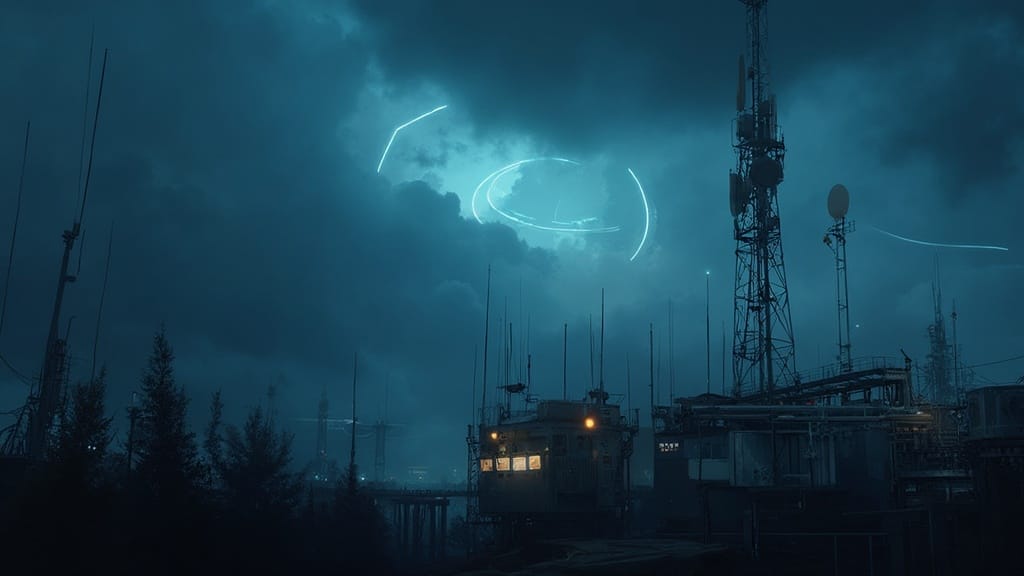
The FCC governs spectrum allocation, submarine cable landing licenses, and broadcast regulation. It is now openly threatening to revoke broadcast licenses over war coverage it doesn't like — and that's a story for everyone in this newsletter, not just media reporters.
FCC Chair Brendan Carr warned that "broadcasters that are running hoaxes and news distortions — also known as the fake news — have a chance now to correct course before their license renewals come up." The threat originated in mid-March around coverage of the U.S.–Israeli war on Iran and resurfaced this week via a renewed Guardian report. President Trump endorsed it, calling media organizations "Corrupt and Highly Unpatriotic." The legal reality, per CNN, is thin — the FCC hasn't denied a license renewal in decades, and the "news distortion" policy Carr invoked is notoriously hard to prove. The mechanism matters less than the signal: pressure media into self-censorship without explicit government action.
For infrastructure professionals, the angle isn't First Amendment law. It's that the same FCC running the submarine cable landing rules overhaul and weighing GPS-alternative spectrum petitions is now demonstrably willing to use its licensing power as a political instrument. That's a regulatory-capture risk bleeding into every proceeding the agency touches. The Washington Post separately reported that media organizations including Fox News have rejected the Pentagon's press-access policies around the Iran war — meaning information control is being attempted at both the transmission layer (FCC) and the access layer (Pentagon credentialing). Neither has succeeded yet. Watch whether any broadcaster actually faces a proceeding — that's the line between rhetoric and enforcement.
When GPS Goes Dark, the Pentagon's Navigation Problem Has No Easy Fix

GPS is so deeply woven into modern warfare — and modern finance, aviation, and power grids — that almost nobody plans for its absence. The Pentagon plans for it constantly, and a War on the Rocks analysis this week laid out how genuinely hard the problem is.
Russia has jammed GPS so routinely since the Ukraine war began that commercial pilots over the Baltics now lean on backup navigation as a matter of course. The U.S. response is layered: onboard inertial sensors and clocks that need no external signal, celestial and magnetic navigation, terrestrial image matching, even positioning data piggybacked on TV broadcast towers. At the frontier, DARPA's Robust Quantum Sensors program is prototyping quantum inertial navigation that requires no satellite signal and, in principle, cannot be jammed or spoofed. Vice Chairman of the Joint Chiefs Adm. Christopher Grady told industry executives that "if we're relying on space-based, GPS-based PNT, then we may be in trouble."
The core problem: GPS modernization and alternative PNT are running on separate tracks with no unified architecture. If the services keep funding parallel programs, the U.S. ends up with a dozen incompatible backups and no doctrine for which one a soldier reaches for when the signal dies. The observable signal of progress would be a DoD-wide architecture commitment — or its conspicuous absence — at the 2026 Assured PNT Summit. The quiet bet underneath all of it: M-code, GPS's jam-resistant military signal, still isn't fully unlocked, and until it is, every quantum demo is a hedge against a fix the Pentagon hasn't finished shipping.
⚡ What Most People Missed
Iran's internet trigger fired this week — and nobody declared it: Iran has gone dark a third time since the June war, with ordinary access to the global internet stuck near 1%. The prior trigger — connectivity below 20% through June 18 — is now met. The 88-day blackout that "partially restored" in late May was a pressure-release valve, not a reopening. The kill switch is now a routine wartime instrument with a documented on/off cadence other authoritarian states can study. [Source: Iran International — English]
The Eagle S precedent is the real threat to the Fitburg trial: The October dismissal of the Eagle S case established that anchor drag is nearly impossible to prosecute as sabotage. Finland is now attempting the same fight with the same fundamental flaw. If Fitburg collapses too, Europe has accidentally codified a legal safe harbor for hybrid cable attacks.
A spectrum fight over GPS backups is hiding in an FCC docket: Two PNT petitions are before the FCC — NextNav's, which wants roughly $5 billion in new spectrum allocation, and the National Association of Broadcasters', which proposes a new TV signal format requiring none. They're structurally incompatible. The FCC's choice determines whether America's GPS backup is built on licensed spectrum or parasitic on broadcast bands — a multi-billion-dollar question almost nobody is tracking.
DARPA thinks military radios have hit an analog wall: RAAPTR — "RF Architectures Applying Photonic Timing and Routing" — held its Proposers Day on June 16, aiming to pull chip-scale photonics into deployable RF systems. Translation: the Pentagon believes timing precision and photonic routing are the next bottlenecks in battlefield radios, not waveforms. This is getting almost no telecom-press coverage, which is busy with 6G.
📅 What to Watch
- If the Fitburg prosecutors advance a pattern-of-behavior theory instead of needing per-incident intent, Europe finally has a legal framework for hybrid cable attacks — and shadow-fleet economics shift overnight.
- If Germany extends its end-of-2026 Huawei core-removal deadline, the 17-country compliance gap becomes permanent, and Beijing cites it at every ITU forum for the next five years.
- If the FCC opens a formal license proceeding against any broadcaster over Iran coverage, it has crossed from rhetoric to enforcement — and every spectrum and submarine cable licensee should reassess its regulatory exposure to the same agency.
- If the FCC picks NextNav's spectrum-allocation path over the NAB's no-new-spectrum proposal, the entire GPS-backup ecosystem gets built on licensed bands — locking in a permanent rent rather than a public utility.
- If RoQS Phase 1 awards skew toward quantum startups over Raytheon and L3Harris, the Pentagon has decided its existing PNT supply base can't solve the problem, and a new vendor tier is being cultivated outside the usual primes.
The Closer
France firing Huawei without ever saying the word "fired," a Finnish prosecutor squinting at an anchor chain trying to prove a Russian sailor meant it, and an FCC chair who polices the airwaves now using them as a billy club. The quiet irony: the same agency threatening to pull a network's broadcast license over "fake news" is the one deciding whether your GPS backup runs on $5 billion of new spectrum or a clever hack of a TV signal — and almost nobody's reading that docket. Stay suspicious of anything labeled "in the public interest."
Forward this to the friend who still thinks a severed cable is an accident.