Groundwave Weekly — May 21, 2026

Photo: lyceumnews.com
Week of May 21, 2026
The Big Picture
The physical layer is doing the talking this week. Iran's internet blackout has now ossified into a tiered class system at 82 days; Finland is still trying to figure out how to prosecute an anchor; and the Pentagon spent roughly $157 million on the unglamorous work of getting its own radios to talk to each other. None of these are breakthrough stories — they're maintenance-of-empire stories. Which is exactly when the infrastructure tells you what it actually is.
What Just Shipped
- Asia Link Cable (ALC) (China Telecom / HMN Technologies): 6,200 km submarine cable landed at Chung Hom Kok, Hong Kong on May 14, with >325 Tbps designed capacity across seven Southeast Asian markets.
- Starlink Aviation 300 MPH and Aviation 450 MPH plans (SpaceX): new aviation-tier service plans introduced as Roam, Local Priority, and Global Priority plans with an in-motion speed cap reduced from 450 mph to 100 mph.
- MINC Phase 2 prototype work (Peraton Labs, BAE Systems / DARPA): autonomous multi-domain network discovery and configuration software for contested tactical environments, now in Phase 2 development.
- JITC-certified unified communications software (C2 Defense Inc.): voice interoperability stack for Army tactical and enterprise environments, awarded under a $97.8M five-year contract on May 18.
- Data link tactical tool, gateway, and mini-rack engineering services (COLSA Corp. / Naval Information Warfare Center Pacific): five-year sustainment for Link 16 / TTNT / MADL gateway interoperability, awarded $59.4M on May 12.
This Week's Stories
Iran's Internet Is Now a Class System — and the Government Won't Name a Date
The 82-day mark passed this week, and the story has shifted. This is no longer "when does the blackout end." It's "is this the new normal."
Per Euronews, Iran's government said Tuesday it could not say when the 82-day internet blackout would end, even as a tiered access system hardened in place. At the top sits what Iranians call "white internet" — unfiltered access historically reserved for senior officials and, under Rouhani, extended to journalists vetted by the Ministry of Culture and Islamic Guidance. A middle tier called "Internet Pro" is available to select professionals at roughly 40,000 tomans per gigabyte (about €0.20). Everyone else pays around 500,000 tomans per gigabyte for commercial VPNs — more than twelve times as much.
Al Jazeera's earlier reporting framed the economic cost in language the Pezeshkian government has not contested: the shutdown decision was taken by the Supreme National Security Council, outside the cabinet's control. Iranian economist Afshin Kolahi has estimated direct daily costs of $30–40 million, rising to $70–80 million per day once indirect effects are counted.
What changes if this hardens further: the tiered architecture becomes the export-grade template for authoritarian connectivity — a system where the state doesn't shut the internet off, it simply assigns it. Other regimes have been watching. The economic damage to Iran becomes the price Tehran is willing to pay to prove the model works.
Failure signal: a return to undifferentiated mobile data pricing and the quiet retirement of the "Internet Pro" SKU. So far there is no such signal. Watch instead for new professions added to the approved tier — that's the tell that this is permanent infrastructure, not an emergency measure.
Finland Is Still Trying to Figure Out How to Prosecute an Anchor

The Baltic cable problem has a structural flaw that sharpens with each incident: anchor drag is nearly impossible to prosecute as sabotage, which is exactly why it keeps happening.
The Register's reporting on the Fitburg case — the cargo vessel detained by Finnish authorities on New Year's Eve after its anchor dragged across "at least several tens of kilometers" of seabed, damaging an Elisa-owned submarine line — laid out the pattern. The Fitburg was transiting from St. Petersburg to Haifa. At least ten undersea cables have been cut or damaged in the Baltic since 2023. In November 2024, the Chinese-flagged Yi Peng 3 dragged its anchor 300 kilometers and severed two cables between Sweden and Lithuania. Per Euronews, the Eagle S case was dismissed by a Finnish court last October when prosecutors couldn't prove intent.
That's the operational problem in one sentence: the legal standard requires showing what a captain meant to do with an anchor, and "we forgot it was down" turns out to be remarkably hard to disprove.
What changes if Finland succeeds with Fitburg charges: the first criminal precedent for Baltic cable sabotage shifts the risk calculus for grey-zone operators. Insurance gets harder. Crew recruitment gets harder. Plausible deniability gets thinner.
What failure looks like: another quiet release, another vessel cleared to leave port, another cable repaired at carrier expense. The observable signal is whether Finnish and Estonian prosecutors move from "joint investigation" language to actual indictments before the summer shipping season.
The Navy Just Paid $59M to Keep Link 16 Talking to TTNT and MADL
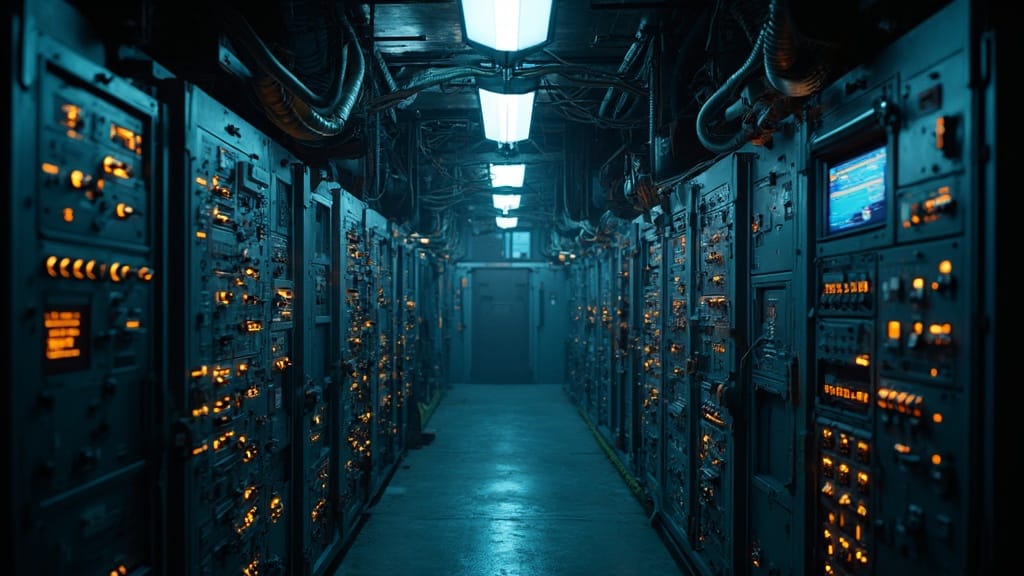
CJADC2 — the Pentagon's vision of one seamless sensor-to-shooter network across all services and allied nations — is harder than it sounds. Look at what the Navy is still paying just to maintain.
Per the May 12 DoD contracts release, COLSA Corp. of Huntsville, Alabama, was awarded a $59,398,717 IDIQ contract with a five-year ordering period running through May 2031, for engineering services supporting development, maintenance, interoperability, and operations of the data link tactical tool, gateway systems, and mini-rack systems. The contracting activity is Naval Information Warfare Center Pacific in San Diego.
Translation: keeping Link 16 (the NATO-standard tactical data link), TTNT (the high-bandwidth airborne link the Navy uses for time-critical targeting), and MADL (the stealthy F-35 link) able to share data through gateway boxes. Every new platform, every waveform upgrade, every allied requirement adds work. The institutional knowledge to do that work lives in a small handful of organizations, which is why this came in as a sole-source sustainment award rather than a competition.
What changes if this works: the gateway plumbing keeps quietly holding the joint kill chain together while the more visible CJADC2 programs catch up.
What failure looks like: a five-year contract that ends with the same fragmented service-by-service architecture, just on newer hardware. The signal to watch is whether the Army's parallel unified communications work (next story) and this Navy gateway sustainment ever get pulled into a common reference architecture — or stay in their lanes.
The Army Spent $97.8M to Get Its Tactical Radios to Talk to Its Office Phones
Voice interoperability sounds like a solved problem. It is not.
Per the May 18 DoD contracts release, C2 Defense Inc. of Savannah, Georgia, was awarded a $97,804,925 firm-fixed-price contract for Joint Interoperability Test Command–certified unified communications software and support, enabling secure, scalable voice interoperability across Army tactical and enterprise environments.
The JITC certification matters. It means the system has been tested across the full spread — from a garrison IP-PBX at Fort Cavazos to a tactical radio net at a forward operating base running on HF/VHF/UHF waveforms designed for contested, degraded, intermittent connectivity. The persistent inability to bridge those two worlds cleanly is one of the more embarrassing gaps in U.S. military communications, and adversaries who studied Iraq and Afghanistan know it exists.
What changes if C2 Defense delivers: a soldier's handheld can patch a commander's enterprise voice line without an analog gateway and three minutes of swearing.
What failure looks like: another five years of bespoke patches. The signal to watch is whether the contract's scope expands to allied-nation interoperability — that's the "C" in CJADC2 moving from slideware to procurement. Also worth noting: C2 Defense is not L3Harris, not Raytheon, not a household prime. The Army is looking outside the usual ecosystem for a problem the usual ecosystem has not solved.
China Telecom Lands the Asia Link Cable in Hong Kong — First International Fiber of the 15th Five-Year Plan
On May 14, the Asia Link Cable landed at the Chung Hom Kok Cable Landing Station in Hong Kong. Per Submarine Networks, the 6,200-kilometer system — led by China Telecom, supplied by HMN Technologies (formerly Huawei Marine Networks) — connects Hong Kong, Hainan, Singapore, Vietnam, the Philippines, Malaysia, and Brunei, with designed capacity above 325 Tbps and Hong Kong–Hainan–Singapore backbone latency optimized to 32 milliseconds.
It is also the first international submarine cable to land in China under the 15th Five-Year Plan, which runs 2026–2030.
The route threads every major Southeast Asian digital hub without touching a U.S.-allied landing station. The supplier is Chinese end-to-end. The timing is the message: this is the opening stake of Beijing's infrastructure chapter, not a legacy project closing one out.
What changes if the ALC operates as designed: Southeast Asian traffic gains a high-capacity, low-latency path that doesn't transit U.S.-influenced cable systems — and Chinese hyperscalers gain a backbone tuned to their interconnection points.
What to watch: Google's and Meta's Indian Ocean and South China Sea cable decisions over the next twelve months. Hyperscaler routing is increasingly a geopolitical risk question, not a latency-optimization question, and the ALC is the kind of facility that forces a choice.
Alleged Huawei Zero-Day Now Blamed for Luxembourg's 2025 National Telecom Crash
This one deserves more attention than it is getting.
Security Affairs reported this week that an alleged Huawei zero-day — a previously unknown software flaw — has been blamed for the July 23, 2025 outage that disrupted mobile, landline, and emergency communications across Luxembourg for more than three hours. Specifically crafted traffic pushed Huawei enterprise routers inside POST Luxembourg's infrastructure into a continuous restart loop; POST Luxembourg's communications chief said no patch was available at the time. No CVE has been publicly filed in the ten months since. Investigators found no evidence the incident was a targeted attack on POST Luxembourg.
The attribution question — accidental software defect versus latent capability — is unlikely to be resolved in public. That ambiguity is itself the strategic problem.
What changes if this is followed by a formal NIS2 disclosure: European regulators get a documented, attributable case to accelerate Huawei rip-and-replace timelines in NATO-member networks. Pair this with last week's reporting on Spain's €12.3 million Huawei wiretap-storage contract and the long tail of un-remediated Huawei infrastructure in Europe becomes a much harder thing to wave away.
What failure looks like: no CVE, no formal disclosure, no policy movement — and the same equipment still in the same racks at the next outage.
Peraton and BAE Win DARPA MINC Phase 2 — Because Tactical Networks Still Can't Configure Themselves
U.S. tactical networks are still stitched together by hand. That's the problem DARPA's Mission-Integrated Network Control (MINC) program is trying to fix.
Per Military Embedded Systems, MINC aims to ensure critical data finds a path to the right user at the right time in dynamic and heterogeneous communications environments, with autonomous real-time discovery and configuration of interconnected military networks supporting on-demand connectivity in contested tactical environments. Peraton Labs and BAE Systems both hold Phase 2 contracts.
Today, an operator picks waveforms, sets up cross-domain gateways, and hopes the topology survives contact with reality. MINC is trying to make that stitching autonomous — a degraded link reroutes itself before a human notices.
What changes if MINC works: the brittleness that has dogged U.S. tactical comms in every recent exercise — and that adversary EW doctrine is explicitly designed to exploit — gets meaningfully reduced. It's the connective tissue CJADC2 needs to be more than a wiring diagram.
What failure looks like: another DARPA program that produces beautiful demos and no transition partner. The observable signal is whether a service program office picks up MINC outputs for a program of record before Phase 2 closes.
⚡ What Most People Missed
- DARPA is still soliciting compact wideband tunable RF filters: The MTO SBIR topic pre-released May 6 and opens May 27, with a June 24 close. A tunable RF filter is the gearbox that lets a radio hop bands to dodge jamming. The fact that DARPA is going to SBIR for this means the DoD does not yet have a compact, power-efficient solution it considers deployable — which is a real gap in any contested-spectrum scenario.
- Orange-led Via Africa consortium announced a new Atlantic-coast cable on May 12, with landings in the UK, France, Portugal, Canary Islands, Mauritania, Senegal, Guinea, Côte d'Ivoire, and Nigeria. West Africa has been chronically dependent on a small overlapping set of cable systems; Guinea and Mauritania as landing points are unusual and suggest deliberate coverage of underserved coastal segments. This is an announcement, not committed capacity — treat as routing intent.
- NetBlocks reported Iran attempting to spoof connectivity measurements to "manufacture the narrative of a wider restoration and normalcy" during the blackout. If state-generated synthetic traffic can fool the measurement infrastructure that the outside world uses to assess shutdowns, every internet-freedom monitoring project needs to revisit its methodology. This is a new tool in the authoritarian playbook.
- Peraton Labs won the autonomous multi-domain network design contract under DARPA MINC: worth flagging separately from the main story because the partner mix — Peraton Labs and BAE Systems, not the usual radio primes — suggests DARPA is sourcing the autonomy work from network-engineering shops rather than waveform houses. That's a structural choice about where the hard problem lives.
- A Chinese ambassador publicly dismissed concerns about a Chinese-linked submarine cable this week, affirming "no threat to regional security." The cable and region were not fully identified in available reporting, but the fact that Beijing felt the need to issue a public denial is itself a signal that diplomatic pressure on Chinese cable projects is intensifying. [Source: elciudadano.com — Spanish]
📅 What to Watch
- If Iran adds new professions to the "Internet Pro" approved list while ordinary citizens stay on the expensive VPN tier, the tiered architecture is being treated as permanent infrastructure, and the 82-day blackout will functionally never end.
- If Finland advances the Fitburg case to formal charges rather than releasing the vessel as in the Eagle S case, it becomes the first criminal precedent for Baltic cable sabotage — and the insurance market for grey-zone shipping notices before the policymakers do.
- If a European NIS2 disclosure formally attributes the 2025 Luxembourg outage to a Huawei zero-day, the European Commission gains the documented case it has been missing to accelerate Huawei removal mandates beyond the existing 5G toolbox.
- If the C2 Defense unified communications contract scope expands to include allied-nation interoperability testing, CJADC2's "combined" ambition is moving from PowerPoint into procurement — watch Aberdeen Proving Ground announcements.
- If a service program office picks up DARPA MINC outputs before Phase 2 closes, the autonomous-tactical-network problem has a transition home and isn't another beautiful demo. If not, write it down for the next time someone promises self-healing networks.
The Closer
An anchor dragged across tens of kilometers of Baltic seabed by a crew who apparently never noticed; an Iranian journalist paying €0.20 a gigabyte while the neighbor pays €2.50; a $59 million sustainment contract whose entire purpose is to keep three acronyms from refusing to speak to each other. The Pentagon spent $157 million this week solving problems that would embarrass a mid-sized enterprise IT department, while Tehran quietly demonstrated that you don't have to turn the internet off — you can just decide who gets it. Infrastructure is policy wearing a hard hat.
Until next week — mind the anchor.
Forward this to the person on your team who still thinks "interoperability" is a slide, not a budget line.