Lyceum Daily: Breaking — War Shock Sends World Markets Into Freefall
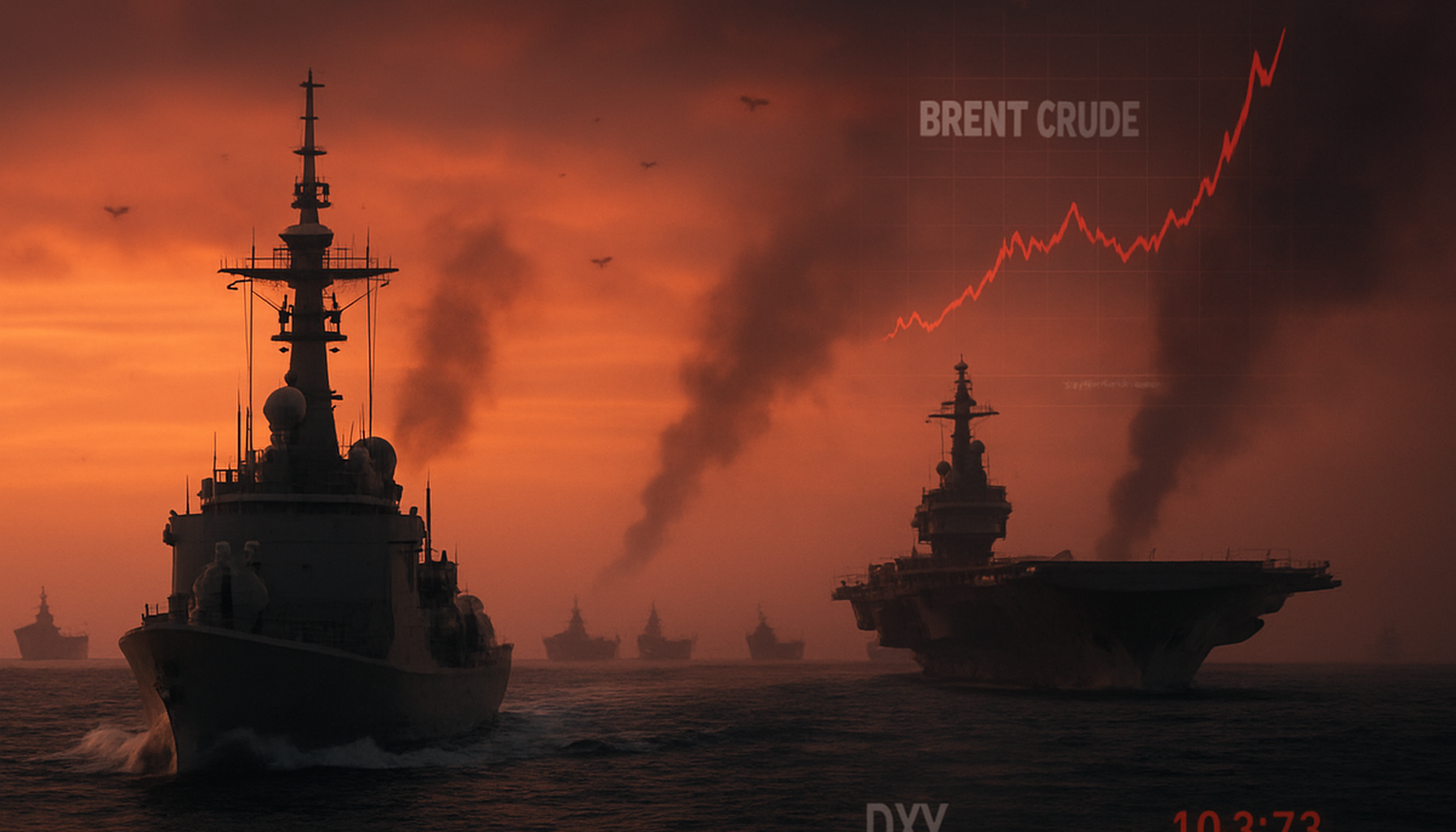
Photo: lyceumnews.com
What just happened
The Iran war's economic shrapnel hit global markets with full force on Monday. The effective closure of the Strait of Hormuz — the narrow waterway through which roughly 20% of the world's daily oil and liquefied natural gas flows — sent Brent crude spiking intraday past $119 a barrel overnight; levels not seen since 2022. The result was a cascade: South Korea's KOSPI index triggered an intraday circuit breaker and fell 7.7% on the session, Japan's Nikkei 225 sank 6.5% on the session, and the S&P 500 closed down roughly 1.3% on the session at 6,740, with the VIX — Wall Street's fear gauge — surging 24% on the session to 29.49.
Why this matters
This is not a normal selloff. It is the global economy absorbing the reality that a shooting war in the Persian Gulf can shut off a fifth of the world's energy supply in days. Asia imports 90% of the oil that transits Hormuz, amid which markets in the region were hit hardest. India's BSE Sensex plummeted 2,400 points on the session, and the Nifty 50 fell through the psychologically important 24,000 level on the session. Taiwan's TAIEX dropped nearly 5% on the session. Even China's relatively insulated Shanghai Composite slipped on the session.
But the pain extends far beyond trading floors. The U.S. national average for a gallon of gasoline has already jumped nearly 50 cents in the past week to about $3.48. Mortgage rates leapt 14 basis points in a single week to 6.14%. Qatar's energy minister warned the Financial Times that oil at $150 a barrel would "bring down the economies of the world." That is not hyperbole — it is a Gulf state official laying out the math if this drags on.
The timing is brutal. The U.S. economy unexpectedly lost 92,000 jobs in February, pushing unemployment to 4.4%. The Atlanta Fed's GDPNow tracker for Q1 growth has already slid to 2.1% from 3.0% a week prior. Rising energy costs layered on top of a weakening labor market is the textbook definition of stagflation — the ugly combination of stagnant growth and persistent inflation that central banks have almost no good tools to fight.
The backstory
The military trigger is Operation Epic Fury, the U.S.-Israeli campaign against Iran that began late last month. U.S. and Israeli forces have conducted intensive bombardments on Iranian military and energy infrastructure. Iran's supreme leader, Ayatollah Ali Khamenei, died during the conflict, with some reports saying his death occurred in an airstrike; the Assembly of Experts named his 56-year-old son Mojtaba as successor, a dynastic choice that signals Tehran's hardline establishment is doubling down rather than seeking an off-ramp. A top Iranian official told CNN the country is prepared for a long war.
Iran has responded with missile and drone strikes across the region, which have damaged oil and water infrastructure in Gulf states. Bahrain's national oil company, Bapco Energies, declared force majeure — a legal term meaning it cannot fulfill contracts due to extraordinary circumstances — on some refinery operations after Iranian strikes. Iraqi oil output has reportedly plunged roughly 70% since the start of the conflict. Qatar briefly halted some natural gas production. The supply picture, in other words, is deteriorating on multiple fronts simultaneously.
Meanwhile, the Wall Street Journal reported that Russia is sharing U.S. military locations with Iran — intelligence that could guide Tehran's missile targeting. If confirmed, this would mark a significant escalation in Russian-Iranian cooperation and complicate NATO's strategic calculus. On Monday, NATO intercepted a ballistic missile that entered Turkish airspace, a development with potential Article 5 implications that has not yet generated the attention it deserves.
What's developing

Source: thestreet.com
Confirmed: G7 finance ministers and the International Energy Agency are in emergency talks about a coordinated release from strategic petroleum reserves — potentially the largest in history. French President Macron is separately coordinating a naval escort proposal to reopen the Strait. As of publication, no decision has been made on either front. The gap between signaling and action is where the volatility lives.
Confirmed: The 10-year U.S. Treasury yield is pushing toward 4.50% on the session, and rate-cut expectations have collapsed. Traders now price only about 39 basis points of Fed cuts by year-end as of Monday's trading — essentially one quarter-point move — compared with two cuts expected just a week ago. Central banks globally are shelving planned rate-cut cycles amid rising "imported inflation" from oil price moves.
Developing: Vietnam is moving to scrap petroleum import tariffs entirely. South Korean officials are warning that the conflict could disrupt helium shipments critical to semiconductor manufacturing — a second-order supply-chain risk that could increase costs and production delays in chip fabrication globally.
Disputed: Oil price levels varied wildly across vendors on Monday. Brent was reported anywhere from $99 to $119 depending on the time of day and data feed; WTI spiked intraday above $119 and settled near $94–96 on the session. This intraday volatility — a roughly $25 range on a single commodity in a single session — is itself a signal of a market struggling to price a conflict with no clear endpoint.
Disputed: Reports of Iraqi output down 70% have received limited standalone confirmation. If accurate, it would represent one of the largest single-country supply disruptions in decades.
📅 What to Watch
— Wednesday's U.S. CPI report (February data, March 11, 2026, 8:30 a.m. ET): even partial oil pass-through into the headline number would materially raise the odds that the Fed delays or cancels planned rate cuts, locking in tighter policy and keeping mortgage and corporate borrowing costs elevated.
— Any concrete G7 announcement on strategic reserve volumes and timelines — a coordinated release could cap Brent price spikes and quickly reduce price volatility, easing pressure on oil-importing economies in Asia and Europe.
— The Atlanta Fed GDPNow update on Thursday, March 12, 2026, which will incorporate this week's data; a drop below 2% would materially lower growth expectations for Q1 and increase the likelihood that the Fed maintains higher rates into the summer.
— Whether NATO's interception of a missile over Turkish airspace triggers formal alliance consultations or collective-defense consideration under NATO procedures — a move toward formal consultations would widen the conflict's strategic scope and force clearer policy choices from Euro-Atlantic capitals.
— Friday's University of Michigan consumer sentiment survey (March 13, 2026), specifically the inflation expectations sub-index: a rise in 1-year inflation expectations would increase the risk of entrenched wage-price dynamics and make it harder for the Fed to pivot to easing.