Macro & Markets Daily — Mar 11, 2026

Photo: lyceumnews.com
Wednesday, March 11, 2026
The Big Picture
The February inflation report came in clean — and was obsolete before lunch. A textbook CPI print got steamrolled by three vessels that were damaged in the Strait of Hormuz, Iran threatening $200 oil, and a record IEA reserve release that the market shrugged off like a Band-Aid on a broken leg. Oracle's blowout AI earnings kept tech from cratering, but the real story is a bond market repricing risk in real time: yields climbed on the session, the dollar caught a safe-haven bid on the session, and the S&P 500 finished basically flat on the session while the world underneath it churned.
Today's Stories
The CPI Was Perfect — and Already Ancient History
February CPI came in at 0.3% month-over-month and 2.4% year-over-year, exactly matching expectations. Core CPI — which strips out food and energy — printed 0.2% monthly, 2.5% annually. One of the cleanest inflation reads in five years. The market yawned.
Here's why: this report covers a world that no longer exists. It was collected before the Iran war broke out, before gas prices jumped 22% in a single month to $3.58 a gallon nationally, and before three vessels were damaged in the strait that handles a fifth of global oil shipments. As Heather Long of Navy Federal Credit Union put it, 2.4% headline inflation "won't stay that way with gas prices surging above $3.50."
The bond market made the point more bluntly. The 10-year Treasury yield rose roughly 6 basis points to 4.21% on the session, amid a crude oil rally of about 4% on the session and supply anxiety ahead of Thursday's 30-year auction. The February CPI is a rearview-mirror number. The March print — due mid-April — is the one that will actually matter, and it's going to be ugly.
Fed funds futures now price a 99.3% probability of a hold at next week's FOMC meeting, as of Wednesday's close. The Fed cut rates three times in late 2025, pivoted to "wait and see" in January, and is now watching a war it can't model. Cutting with oil spiking would look reckless. Holding while the labor market softens (February lost 92,000 jobs) feels inadequate. Chair Powell's March 18 press conference will be the most closely parsed in months — not for the decision, which is locked, but for the language around what comes next.
The IEA Fired Its Biggest Weapon — Oil Shrugged
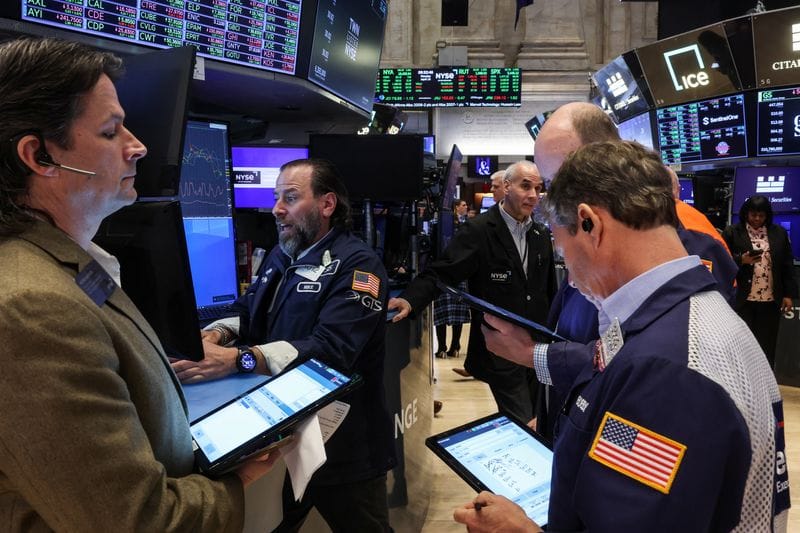
The International Energy Agency announced a 400-million-barrel coordinated reserve release across 32 member countries — the largest in its history — to offset supply disruptions from the Iran conflict. WTI crude settled at $87.25, up about 4% on the session. Brent closed at $91.98, up about 4.8% on the session. The cavalry arrived and the enemy had already regrouped.
The math explains why. The world burns roughly 100 million barrels a day. Four hundred million barrels buys about four days of covered supply, and the physical oil takes time to reach the market. Traders price the present, and the present got worse: three more vessels were damaged in the Strait of Hormuz on Wednesday morning. Iran's military command warned oil could hit $200 a barrel — not as a forecast but as a threat with a lever attached. Persian Gulf production has already dropped an estimated 6.7 million barrels per day since the start of the conflict.
ING analysts called the release a "temporary measure" and noted it might be sending a "hidden signal" that there are few expectations for an immediate ceasefire. Bloomberg reports the EU is warning inflation could top 3% if Brent stays around $100. Brent was at $91.98 on the session. The one caveat tempering the panic: some reporting suggests physical shipments from the Gulf to Asia — notably China — haven't entirely stopped, which could cap near-term spikes unless flows are materially interrupted. That's the variable to watch hour by hour.
After the close, President Trump hinted the U.S. would tap the Strategic Petroleum Reserve "a little bit" — with no specifics. The SPR was drawn down heavily during the 2022 Ukraine shock and only partially refilled. "A little bit" is notable for what it doesn't say.
Oracle Just Gave AI Its Best Earnings Day of 2026
In a session dominated by geopolitics, one company reminded the market why it spent three years betting on AI infrastructure. Oracle reported Q3 adjusted earnings of $1.79 per share on $17.19 billion in revenue, beating estimates of $1.70 and $16.92 billion respectively. Cloud revenue grew 44% year-over-year to $8.91 billion. The revenue backlog jumped $30 billion in the quarter — signed contracts, not speculation.
The stock opened up nearly 14% intraday, settled back to close roughly 8% higher on the session, and dragged AI-adjacent names up with it. The pullback from morning highs tells the macro story in miniature: Oracle's fundamentals look strong, but war-driven Treasury yield increases are a headwind for high-multiple tech. Higher rates make future profits worth less in today's dollars.
The Oracle beat wasn't isolated. Ramp's March AI Index — which tracks corporate card and bill-pay data — showed AI-related spending re-accelerating across mid-market and non-tech sectors. Separately, NVIDIA committed $2 billion to Nebius to build hyperscale AI cloud infrastructure, and Mira Murati's startup Thinking Machines locked in a gigawatt of next-gen Nvidia chips before shipping a product. AI capex is behaving like structural demand, not cyclical discretionary — which is why money keeps flowing into tech even as yields creep up.
⚡ What Most People Missed
- Iran named the AI stack a war target. The IRGC reportedly listed Google, Microsoft, Amazon, Nvidia, Oracle, and Palantir — plus their regional infrastructure — as "legitimate targets." PwC closed offices across four Gulf states; Deloitte evacuated Dubai staff. The Gulf's ambitions as an AI infrastructure hub — including OpenAI's 10-square-mile UAE campus — are now in a contested war zone.
- The Stryker cyberattack may be Iran-linked. Medical device giant Stryker dropped about 5% on the session after a "severe, global disruption across the Windows environment." The Wall Street Journal reported the pro-Palestinian group Handala's logo appeared on employee screens. Hospitals depending on Stryker devices are affected — the blast radius of this conflict extends well beyond energy.
- Alternative asset managers sold off in unison. BlackRock, Blackstone, Apollo, and KKR all dropped over 2% on the session. Private credit — loans made outside traditional banks — is sensitive to both higher rates and recession fears. A coordinated decline across all four major alts managers is a credit stress signal worth watching.
- A Commerce Department report due today could reshape AI regulation. Per a December 2025 executive order, Commerce was tasked with identifying state AI laws it deems inconsistent with federal policy — effectively a map of where the federal government plans to pick fights. Meanwhile, North Carolina's AG is leading a bipartisan coalition pushing back. The contents haven't surfaced yet. [DEVELOPING]
- 85% of Epic's hospital customers are now running AI (as of HIMSS 2026). Announced at HIMSS 2026, Epic — which runs EHR systems for roughly half of U.S. hospitals — is building an "AI agent factory" for clinical workflows. Healthcare is the quiet, at-scale AI deployment story the benchmark wars are completely missing.
📅 What to Watch
- PPI (Thursday 8:30am ET): If wholesale inflation prints hot with oil already up about 4% on the session, it cements "higher for longer" and likely pushes the 10-year toward 4.30% in the days following the release — a level that starts to stress corporate refinancing math, not just equity multiples.
- 30-Year Treasury Auction (Thursday): If demand is weak — signaled by a high "tail," meaning the auction clears at a higher yield than expected — it confirms bond investors are demanding a premium for inflation and deficit risk, which would widen mortgage spreads and raise borrowing costs for long-duration issuers.
- Weekly Jobless Claims (Thursday 8:30am ET): If claims rise alongside February's 92,000-job loss, the stagflation case — inflation up, growth slowing — becomes the consensus narrative heading into next week's Fed meeting, which would force Powell to address a scenario the Fed has limited playbook for.
- Strait of Hormuz Shipping (rolling): Every new vessel damaged moves oil, which forces shipping insurers and commodity traders to reprice risk and can amplify volatility in oil forwards and regional currencies — a transmission mechanism that will dominate data reactions until the conflict changes trajectory.
- Commerce Department AI Report (imminent): If the report aggressively targets state-level AI laws, it triggers a federal-vs-state regulatory fight that raises compliance costs and uncertainty for any company deploying AI across multiple jurisdictions — right as state AGs are organizing to resist.
- SPR Announcement: If Brent cracks $100 again, Trump's vague "a little bit" comment gets tested — and the market will quickly re-evaluate available buffer and short-dated Brent forward curves, prompting sharp moves in near-term contracts and fuel hedges.
A record oil reserve release that bought four days of supply. A CPI report from a world that ended two weeks ago. A startup with no product securing a gigawatt of chips. Wednesday was the day the market tried to price three different realities at once and landed on flat — which might be the most honest close of the year.
Somewhere, a Stryker hospital IT admin is staring at a Handala logo on a server screen and wondering how a medical device company ended up on the front lines of a Middle Eastern war. Welcome to 2026.
See you tomorrow. Bring coffee.