Robotics & Industrial Automation Weekly — Mar 10, 2026
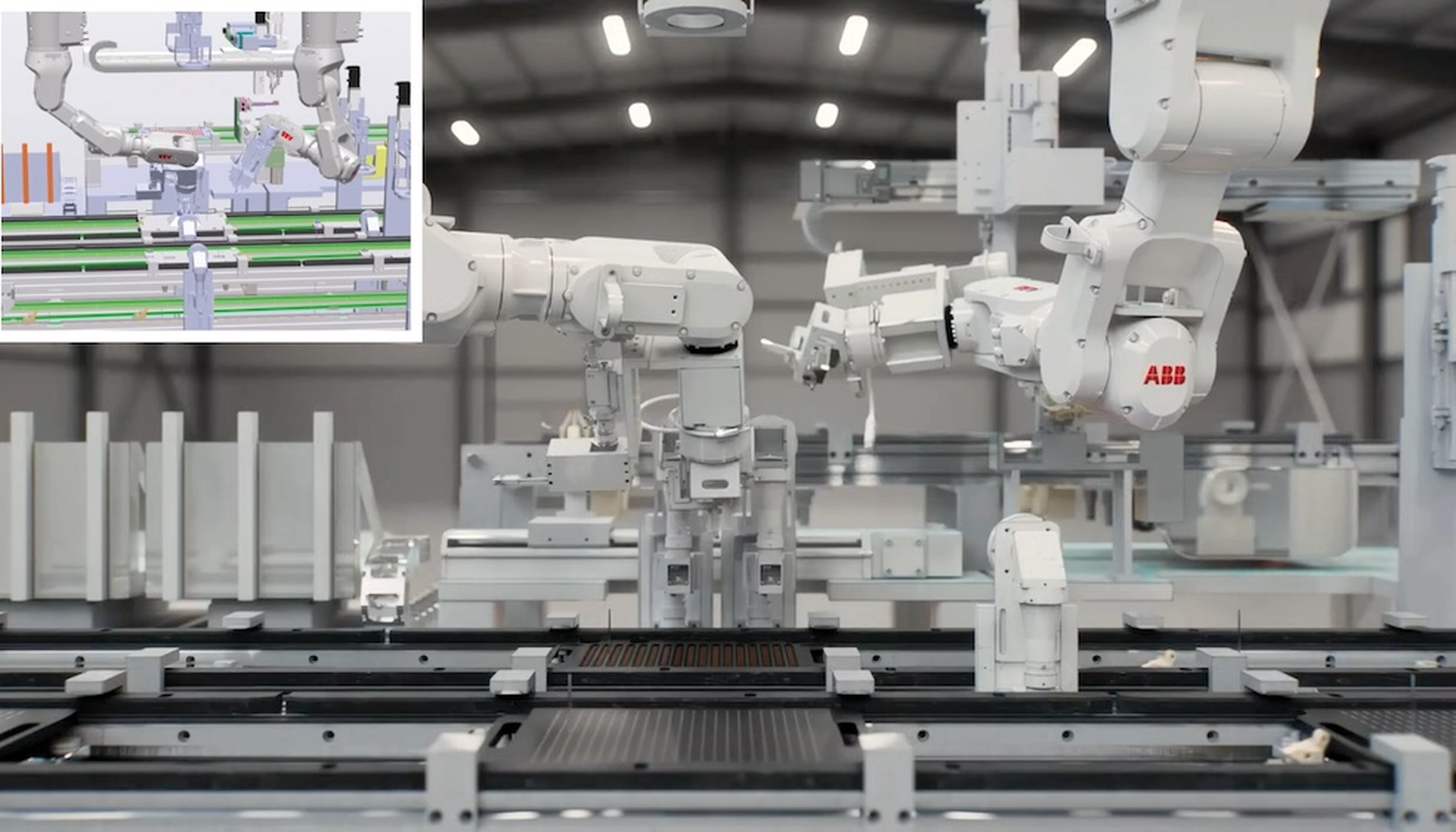
Photo: lyceumnews.com
Week of March 10, 2026
The Big Picture
Two things landed in the same week that, read together, tell you exactly where industrial automation stands in March 2026. ABB and NVIDIA delivered a credible technical answer to the sim-to-real gap — the maddening problem where a robot that works perfectly in simulation immediately embarrasses you on the real shop floor — with Foxconn already piloting it. And humanoid robots crossed from "it's coming" to "here are the KPIs": Xiaomi's EV factory, Agility's signed Toyota Canada contract, BMW's second-continent deployment, and Doosan's 100-unit cobot order all landed within days of each other. The gap between press conference and production line is finally closing — not everywhere, but in enough specific places that "humanoid in the factory" is becoming an engineering decision rather than a strategy slide.
This Week's Stories
ABB and NVIDIA Just Gave Manufacturers a Real Answer to the Simulation Problem
If you've ever watched a robot work flawlessly in simulation and then lose the plot completely when it meets real lighting, real variation, and real physics, you understand why the sim-to-real gap is the most expensive recurring frustration in robot deployment. ABB Robotics announced March 9 that it is integrating NVIDIA Omniverse libraries into its RobotStudio simulation software, claiming the combination closes the virtual-to-real deployment gap with up to 99% accuracy on synthetic-to-physical transfers — ABB projects manufacturers could cut deployment costs by 40% and reduce time-to-market by 50% on initial rollouts.
The product, called RobotStudio HyperReality, pairs ABB's virtual controller (notably the only one in the industry running identical firmware to its physical hardware) with NVIDIA's physically accurate simulation engine. ABB's Absolute Accuracy technology slashes positioning errors from 8–15 mm down to roughly 0.5 mm. Foxconn, the world's largest electronics contract manufacturer, is already piloting the system in consumer electronics assembly — training robots virtually using synthetic data, then moving them to the production line.
Two things to watch beneath the headline. First, California-based startup WORKR is building on HyperReality to offer near-programming-free deployment to smaller manufacturers, positioning "operated by anyone" robot deployment as a real product category. At NVIDIA GTC (March 16–19), WORKR will demonstrate AI-powered systems that onboard new parts in minutes. Second, ABB is evaluating NVIDIA Jetson integration into its OmniCore controller, which would push inference to the edge — meaning the intelligence lives at the machine, not in a cloud you depend on. The real battle will be over who owns the orchestration layer, training pipelines, and fleet-level data feedback loops as hardware commoditizes.
One wrinkle: ABB is selling its robotics business to SoftBank for $5.375 billion, a deal expected to close mid-to-late 2026. The NVIDIA partnership was announced in the middle of that transition, which makes ABB's 60,000-customer distribution network an interesting asset question for whoever lands on top of it.
Full release to all RobotStudio users is planned for H2 2026. The 99% accuracy figure is self-reported — independent validation hasn't appeared yet.
Xiaomi's EV Factory Just Became a Humanoid Robot Test Bed
Most humanoid robot announcements come with a polished video and zero production data. This one comes with an honest caveat — which is actually more useful.
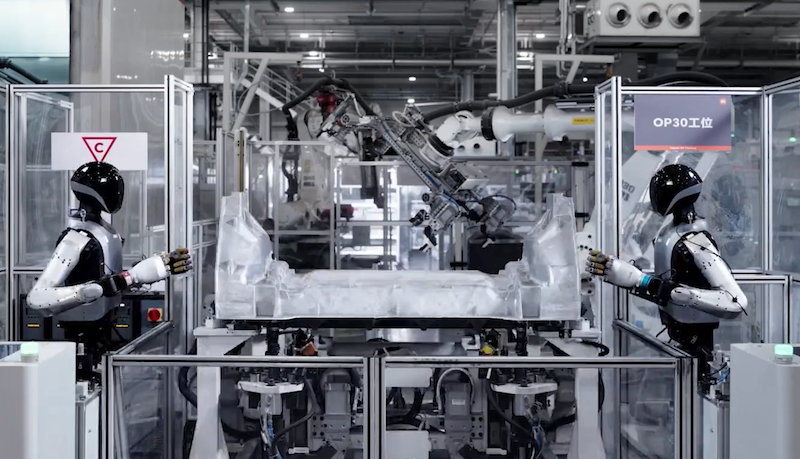
Xiaomi is testing two humanoid robots at an automotive assembly workstation in its electric vehicle factory, where they carried out a repetitive fastening task for several hours. CEO Lei Jun said the company's VLA (Vision-Language-Action) foundation model, Xiaomi-Robotics-0, has achieved autonomous operations in tasks including loading self-tapping nuts and transporting material boxes. Independent coverage indicates these units run roughly three hours per charge with success rates above 90% on narrow tasks — a realistic early-deployment profile where battery and repeatability constraints limit shift coverage.
The rare self-disclosure of unmet KPIs is what makes this worth watching. Xiaomi explicitly acknowledges that "significant challenges remain" in achieving industrial-grade reliability, specifically in cycle time and yield rate. That transparency sets a measurable bar. Xiaomi entering the humanoid factory race also matters for supply chain reasons: the company has deep relationships with Asia-Pacific component manufacturers that most Western humanoid OEMs don't. The next data point: whether Xiaomi publishes cycle-time benchmarks from these stations, or goes quiet.
BMW's Leipzig Humanoid Pilot Makes Germany the Second Real Testbed for Physical AI in Automotive
BMW now has humanoid robots running in factories on two continents, and the organizational infrastructure around them matters as much as the machines.
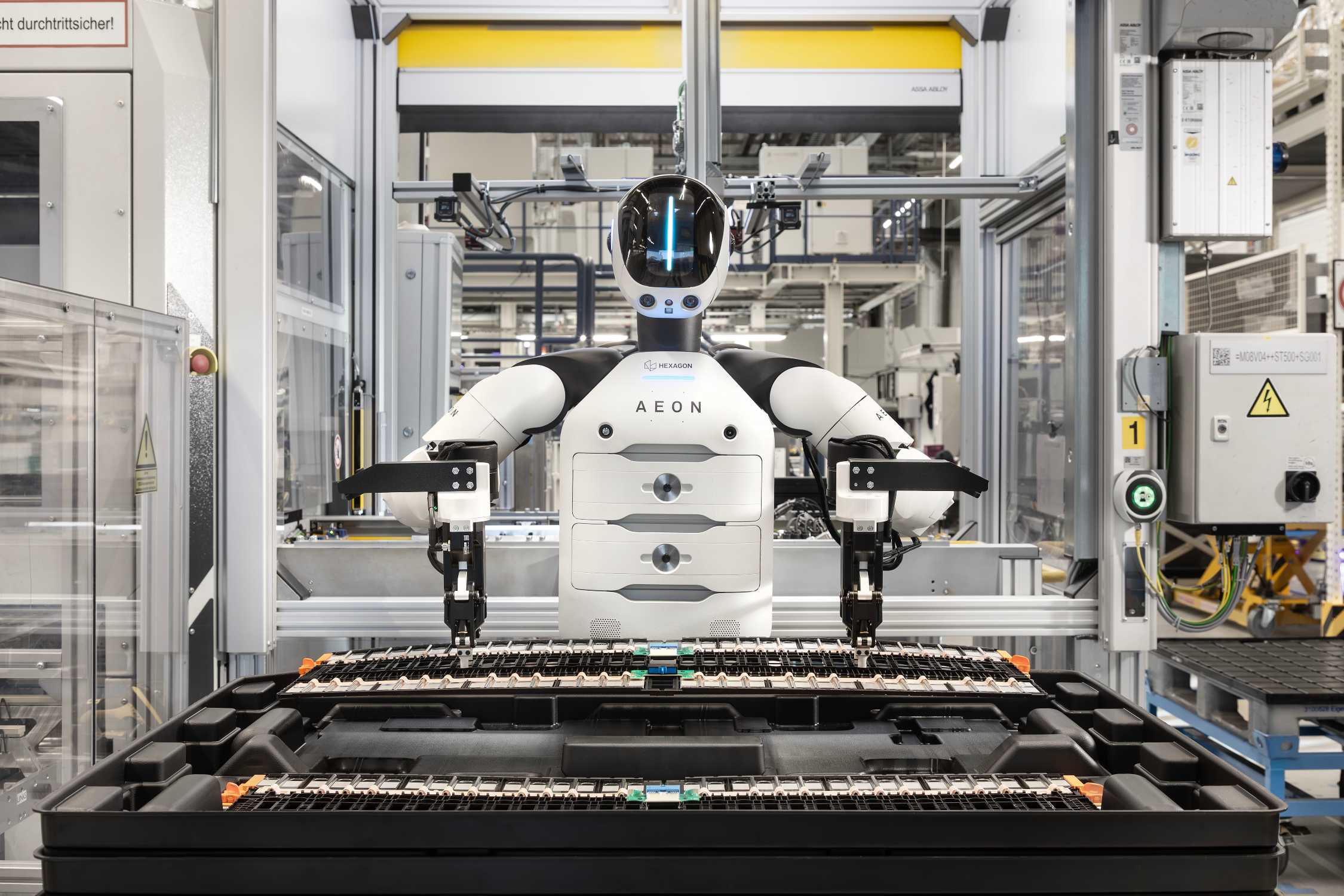
The company confirmed that Hexagon Robotics' AEON humanoid is in test operation at its Leipzig plant, with a structured path toward a pilot phase focused on high-voltage battery work starting summer 2026. BMW also stood up a Centre of Competence for "Physical AI" in Production — formalizing a global pipeline from lab to plant for future humanoid and advanced automation deployments. The German pilot follows the Figure 02 deployment at BMW Spartanburg, which ran ten-hour shifts and contributed to more than 30,000 X3 units produced over roughly ten months. Third-party coverage reports those Spartanburg units operated at roughly 85% of human cycle time in some workcells — a rare independently reported KPI in the humanoid debate.
A detail getting less attention: Gasgoo reports that DH-Robotics' electric grippers — a Chinese components supplier — are mounted on the AEON humanoid in Leipzig. Chinese end-effectors hitching a ride on Western OEM humanoid pilots into top-tier European plants is a supply chain signal worth tracking. If this sticks, more of the value pool shifts from arms and bodies into smart EOAT (end-of-arm tooling), where country-of-origin politics are fuzzier and price/performance wins.
GE Aerospace Bets Another $1 Billion on U.S. Factories — and It's Not Alone
While futuristic robots get the spotlight, the biggest immediate reshaping of American production capacity is coming from large capital programs and brownfield upgrades. GE Aerospace committed $1 billion to U.S. manufacturing sites for 2026 — the second consecutive year at that level — including 5,000 hires across 17 states. In Greenville, South Carolina, a $33 million slice goes toward advanced grinding, laser drilling, and next-gen machining systems. This is the unsexy but critical side of industrial automation: capital-intensive upgrades to existing sites with production-proven technology.
The signal extends well beyond GE. Three construction permits filed in early March for Class A advanced manufacturing facilities in Ohio and Indiana total roughly $1.8 billion in committed capital, with utility hookups and robotic assembly line equipment orders already on record. Fanuc reported a 12% year-over-year surge in North American robot orders (reported in early March 2026), driven by automotive and electronics. And Rockwell Automation filed permits for a proposed $500M Wisconsin facility — a demo-and-production campus that suggests integrators are betting big on onsite customer trials as a route to reshoring and faster purchases. When simulation fidelity improves and integrators build the facilities to show it, the purchasing funnel increasingly shifts toward demo-first procurement.
Agility's Digit Robots Are Now on Payroll at a Toyota Factory — Under Contract
The question everyone asks about humanoid robots is whether anyone has actually signed a commercial contract — not a pilot, not a donation, a real money-changing-hands agreement. The answer is increasingly yes.
Seven Agility Digit humanoid robots are heading to Toyota Motor Manufacturing Canada's Woodstock, Ontario RAV4 assembly plant under a Robots-as-a-Service agreement — making it the first commercial humanoid deployment in Canadian automotive manufacturing. RaaS means Toyota isn't buying the robots outright; it's paying a recurring fee covering hardware, software, and maintenance, lowering financial risk while giving Agility an ongoing revenue stream. The Woodstock contract follows earlier RaaS deployments in logistics, including Digit robots working at a GXO-operated Spanx warehouse in Georgia, moving totes between autonomous mobile robots and conveyors.
Seven units at one plant is not a revolution. But it is a signed contract with a Tier 1 automotive manufacturer, which is a very different category of signal than a trade-show announcement. The tasks — material handling, tote movement, logistics support — are the right early use cases: repetitive, physically taxing, well-bounded, and in areas where labor availability is genuinely tight.
New Products & Launches
ABB GoFa X cobot platform launched this week with enhanced force-torque sensing and stop-on-contact safety aimed at meeting ISO/TS 15066 — the collaborative robot safety standard governing how much force a robot can exert on a human. Targeted at electronics and packaging lines that want higher payloads with human-operator proximity, it complements the HyperReality simulation platform by offering safer, higher-capacity cobot hardware for short-cycle tasks. (ABB)
Kassow Robots' "Sensitive Arm" debuted March 8 with sub-50N force-limiting sensors and ISO/TS 15066 certification for collaborative settings — a practical safety improvement for cobots in electronics and pharma packaging lines where operators work within arm's reach. (Automate.org)
Doosan Robotics signed a 100+ unit order with Kwangjin Group, a global automotive components manufacturer. For a cobot-focused OEM where deployments typically happen cell by cell, a fleet-scale order signals that the customer is automating at production level, not experimenting. Initial deployments reportedly achieved near-zero defect performance on certain tasks, which the customer cites as the driver for expanding to a multi-site agreement. (Robotics & Automation News)
⚡ What Most People Missed
The inbound side of the warehouse is finally getting automated. Most prior investment went into outbound — pick, sort, pack, ship. Now robotic de-palletizing, pallet-building systems, and AI-enabled vision inspection are getting serious investment for the first time, with FedEx deploying Berkshire Grey's autonomous trailer unloader. Trailer unloading is one of the physically hardest, most injury-prone jobs in logistics, and where injuries concentrate. The vendors who can show documented mean time between failures in real inbound environments will have pricing power by Q4 2026.
Workers' comp carriers are quietly repricing facilities with high cobot density. Integrator forums and practitioner notes suggest premiums are ticking up 5–8% on recent renewals (noted in integrator forums in March 2026) for sites running more than one cobot per ten workers, as underwriters price in near-miss patterns and compliance gaps. Insurer pricing changes have in practice been followed by procurement responses such as funding better documentation, adding third-party safety validation, or deferring pilots that can't meet insurer requirements.
Humanoid safety standards have a walking-robot problem nobody has solved yet. ISO 25785-1 — the standard for dynamically stable robots — is under development, which means there is currently no completed, enforceable standard specifically for a walking humanoid in an industrial environment. Every humanoid pilot on a factory floor today operates under a regulatory framework designed for arms that don't move. Liability in a humanoid incident will be litigated, not adjudicated from existing code. Insurance underwriters are already pricing this gap.
Rhoda AI exited stealth with a $450 million Series A to build a hardware-agnostic robot intelligence platform, pre-training on hundreds of millions of internet videos then fine-tuning on specific robot hardware. Investors include Khosla Ventures and Temasek. When capital flows at this scale into software-first robotics, you typically see OEMs adopting common stacks faster and a shorter path from pilot to multi-site deployment. (BusinessWire)
China's 2026 government work report quietly elevated robotics and "embodied AI" to strategic priority, tying rare earths, advanced materials, and factory robotics together as inputs for the next phase of manufacturing upgrading. For Western operations leaders, any automation stack that depends heavily on Chinese components is now more directly exposed to policy risk — and China will likely subsidize upstream component capacity that reduces foreign suppliers' pricing power. (InsightsWire)
📅 What to Watch
- If ABB/WORKR's live demo at NVIDIA GTC (March 16–19) actually shows a robot learning a new part in minutes without programming, that would validate a "no robotics engineer required" deployment model and materially expand the buyer base for industrial robots — watch whether the live demonstration matches the press release claims.
- If BIS export control enforcement on agentic AI models used in robotics triggers rerouted or delayed China-bound shipments, expect that disruption to surface in Q1 2026 order books as production delays and lead-time extensions appear at OEMs with dual-use supply chains — some industry sources suggest this is already happening. (BIS)
- If cycle-time and uptime data from Agility's Toyota Canada deployment starts appearing in earnings commentary or trade press, that would be the first third-party-corroborated humanoid-in-automotive production data since BMW Spartanburg — shifting the evidence base for humanoid ROI and influencing purchasing decisions at Tier 1 suppliers.
- If OSHA issues interim citations or formal guidance on automated facility safety following the Rivian warehouse fatality investigation and the cited AMR collision in Illinois, that could accelerate ISO 10218 and ISO/TS 15066 adoption timelines and pressure facilities running humanoid pilots without documented risk assessments to formalize controls or pause pilots.
- If the Commerce Department publishes a readout from its March 10 robotics roundtable that hints at a national robotics strategy, watch whether attending CEOs start echoing the same supply chain priorities — alignment would signal the conversation moved from listening to coordinating.
A Foxconn robot trained entirely in simulation picking up a real phone chassis and nailing it on the first try. A Xiaomi humanoid honestly admitting it can't yet screw in a nut fast enough. An insurance underwriter in Ohio quietly adding 7% to a premium because there are too many cobots and not enough documentation.
The fenceless high-speed robot just got its safety certificate, the walking humanoid still doesn't have a standard, and the workers' comp carrier somehow got there first. Welcome to 2026.
—The Lyceum