Space Economy Weekly — Mar 12, 2026

Photo: lyceumnews.com
Week of March 12, 2026
The Big Picture
NASA's inspector general released an audit this week that reads like a coroner's report for the 2028 moon landing timeline — two years of Starship delays, an elevator that's never been tested in lunar conditions, and a backup lander that's barely past its preliminary design review. Meanwhile, Europe quietly turned on a weather satellite that will pump fifty times more atmospheric data into the models that price your crop insurance, and half a billion dollars flowed into private space stations that don't exist yet. The theme this week isn't ambition — it's the growing distance between what's been promised and what's been proven.
This Week's Stories
The Inspector General Drops a Report Nobody Wanted to Read
The Artemis restructuring announced two weeks ago looked like a confident pivot. The Inspector General's audit, released Tuesday, reads more like the rationale for that pivot.
NASA's watchdog found that SpaceX's Starship lunar lander has accumulated at least two years of development delays since its 2021 selection. The core problem: landing astronauts on the moon requires refueling Starship in orbit — a delicate cryogenic fluid transfer never done at scale — using more than eleven tanker flights before the crew vehicle can proceed. NASA is tracking the maturity of those refueling technologies as a "top risk."
Then there's the safety stuff. The audit revealed that NASA and SpaceX disagree on whether SpaceX is meeting the agency's manual control requirement — the ability for astronauts to fly the lander themselves if automation fails. Every Apollo landing used manual control. And Starship's design requires an elevator to transport crew 115 feet down to the lunar surface, with no backup method if it breaks. That elevator will not have been tested in lunar gravity and vacuum before astronauts step into it.
Blue Origin isn't faring better. Nearly half of the changes requested after its preliminary design review remain incomplete, including propulsion, mass, and propellant margin issues. Its critical design review is slipping to this summer — eleven months late.
The one bright spot: NASA's fixed-price contracts have contained costs effectively. SpaceX's contract has grown only 6% since 2021; Blue Origin's less than 1%. Cost discipline is holding. Schedule is not.
The less-covered ripple: auditors expect NASA to rephase milestone payments and add demonstration requirements, not just adjust dates. Cash-flow timing drives supplier hiring and test pacing. Small vendors building HLS components should be modeling for delayed payments and additional gates. And the program overhaul itself reframes Artemis III as an Earth-orbit dress rehearsal — astronauts will dock with commercial landers but won't descend to the surface — making Artemis IV the first real landing attempt.
Artemis II Gets a Target Date — and the Rocket Gets a New Upper Stage
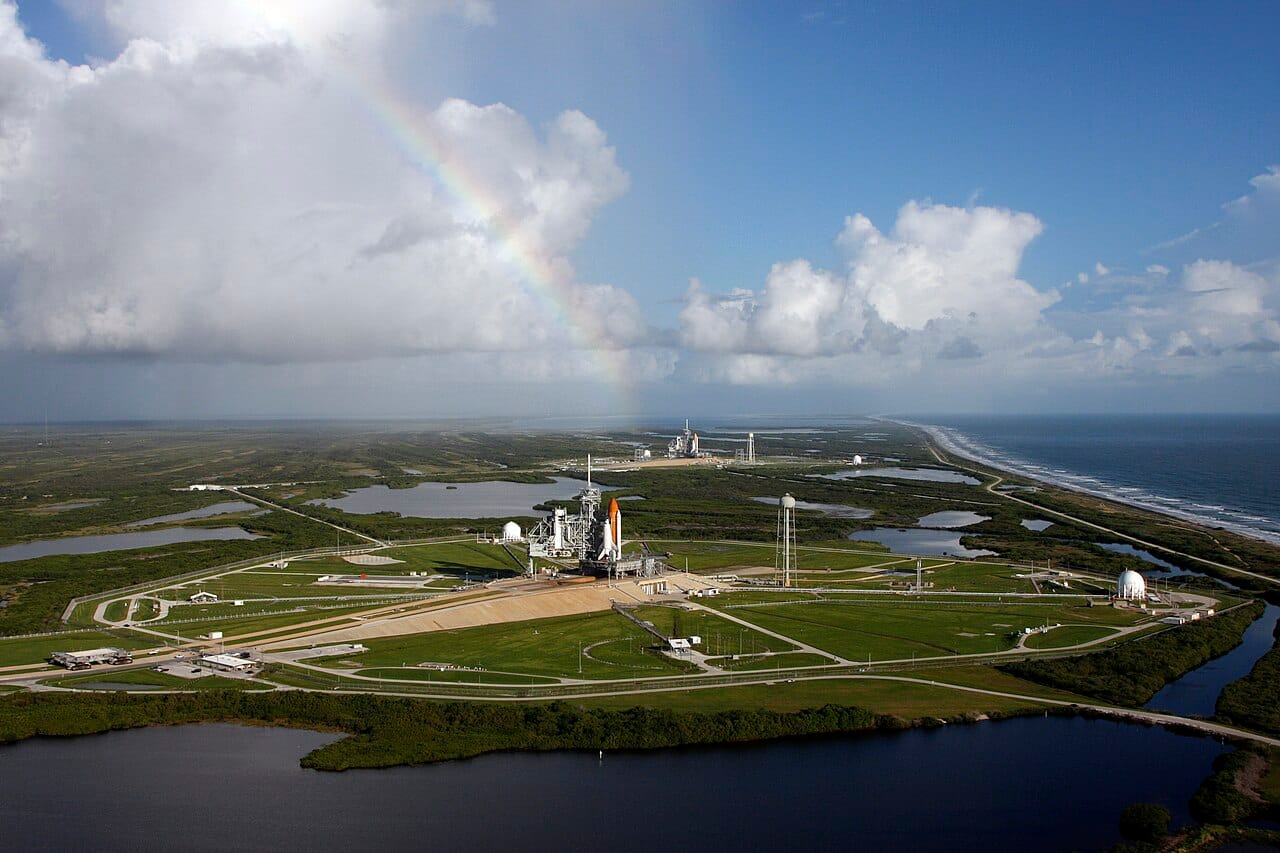
The SLS rocket rolled back to its hangar two weeks ago with a helium blockage in its upper stage. NASA repaired it, and launch prep continues for a window no earlier than April 1. If it holds, this will be the first crewed mission beyond low-Earth orbit since 1972.
But the more durable story is what comes after. NASA confirmed on March 7 the selection of ULA's Centaur V as the new upper stage for future SLS rockets, replacing Boeing's long-delayed Exploration Upper Stage that was canceled last month. Centaur V — the same stage flying on ULA's Vulcan rocket — is already built and flight-proven. No new development, test, or certification cycle required.
The ambition: standardize the SLS design and launch roughly every ten months instead of once every three years. NASA has actually studied Centaur V for this role since 2021, so it's not an improvisation — even if the announcement looks like one. Whether NASA can hit that cadence is the question every Artemis stakeholder should be modeling now — the entire restructured mission sequence only works if the launch tempo actually accelerates.
Watch the April 1 window. Another pad discovery could push everything further.
Europe's New Weather Satellite Is a Bigger Deal Than the Pretty Pictures Suggest

The Meteosat Third Generation Sounder — MTG-S1, now parked in geostationary orbit about 36,000 kilometers up — released its first science images this week. It was the highest-scoring space story on Hacker News. Most people clicked for the photos. The operationally interesting part is what the satellite actually measures.
MTG-S1 is Europe's first hyperspectral sounder in geostationary orbit, capable of surveying target areas every fifteen minutes to deliver continuous atmospheric profiles. Previous satellites measured the atmosphere in broad slabs; this one reads temperature and humidity in three dimensions using interferometric techniques across two spectral bands. The difference for forecasters is like going from a blurry snapshot to a full MRI — particularly for early detection of developing convective storms.
That matters well beyond meteorology. Crop insurance underwriters, agricultural trading desks, aviation route planners, and energy grid operators all consume European weather model output. When the full MTG constellation is operational, ESA says it will deliver more than fifty times as much weather data as the generation it replaces. The EU is also explicitly funding downstream applications to turn this sovereign data into commercial products in climate, energy, and finance.
The translation point — sensor to model to price — is where space data becomes market impact. Watch for EUMETSAT to announce commercial data partnership terms once commissioning wraps.
Anduril Buys Its Way Into Orbit
Defense tech company Anduril, known for AI-powered drones and battlefield sensor fusion, announced March 11 that it's acquiring ExoAnalytic Solutions — a company operating a global network of telescopes that track satellites and debris from low Earth orbit all the way out to geostationary orbit.
ExoAnalytic isn't a startup. It's a deeply entrenched provider of space domain awareness — the business of knowing where everything in orbit is and what it's doing — for both government and commercial clients. By acquiring them, Anduril gets an instant, world-class tracking capability without building one from scratch.
The strategic bet is clear: the future of defense, and the space economy itself, may favor whoever has the best real-time map of orbit. Watch for Anduril to integrate ExoAnalytic's data into its Lattice OS platform, which fuses disparate sensor feeds into a single operational picture for military commanders. This puts them in direct competition with established aerospace primes and a growing cohort of startups building space surveillance services.
Half a Billion Dollars for Space Stations That Don't Exist Yet
Two enormous funding rounds landed in the same week for companies building hardware for the post-ISS era.
California-based Vast announced $500 million — $300 million in Series A equity and $200 million in debt — to develop its Haven line of private space stations. Haven-1 still targets a 2026 launch on a Falcon 9. Separately, Sierra Space added $550 million in equity, led by LuminArx Capital Management, funding its Dream Chaser spaceplane, station modules, and defense subsystems.
Two massive raises in one week for station-adjacent hardware suggests capital is consolidating around a few deep-pocketed players. That could be bad news for undercapitalized boutique station concepts that haven't locked in anchor tenants. The signal to watch isn't the hardware — it's which government agencies and pharmaceutical or materials companies actually sign multi-year utilization contracts. That's what separates funded hardware from real orbital real estate.
⚡ What Most People Missed
- Google Earth AI models just entered classified government environments for the first time. Vantor (formerly Maxar) integrated Google's Earth AI imagery models into its Tensorglobe platform for air-gapped government workflows — meaning open-vocabulary object detection and change analysis from satellite imagery using natural language queries is now a classified ISR tool, backed by a 20-year archive of 30-centimeter imagery refreshed up to 15 times daily. The "foundation model for satellite imagery" concept just became operational intelligence infrastructure.
- CACI paid $2.6 billion to own an "agentic AI for space intel" stack. The acquisition of ARKA Group brings electro-optical, infrared, and hyperspectral imaging capabilities paired with AI software that autonomously initiates and chains analysis tasks — not just responding to queries but hunting for patterns on its own. This sits within a Pentagon FY2026 IT budget of $66.1 billion aimed at AI integration across every military branch.
- Rocket Lab is now a satellite manufacturer, not just a launch company. A $515 million DoD contract to build 18 satellites for the Space Development Agency's missile-tracking constellation signals that military space budgets are flowing to commercial players — and that launch providers pivoting to full-stack satellite production is now a proven business model, not a pitch deck aspiration.
- SpaceX filed for up to one million "orbital data center" satellites, and Amazon formally objected. The FCC chair then publicly scolded Amazon for complaining while lagging its own Kuiper milestones. The interesting part isn't the rhetoric — it's that regulators and rivals are treating satellites-as-data-centers as a serious near-term scenario, not science fiction. Astronomers are already filing comments treating these constellations as an immediate light-pollution problem.
- ESA plans to launch 48 Earth observation satellites in 2026 alone — the largest single-year EO deployment in the agency's history, including 33 Italian IRIDE smallsats, 11 Greek national smallsats, and several flagship missions. Commercial EO operators competing for European government contracts should be updating their competitive assessments now.
📅 What to Watch
- If Artemis II launches April 1, it validates the helium repair and gives NASA political momentum; if another pad anomaly surfaces, it could force rescheduling of HLS refueling demonstrations and milestone payments, disrupting supplier hiring and test timelines and undercutting the 10‑month cadence target.
- If the FCC's spectrum NPRM draws strong incumbent pushback, it could delay filings and create multi-year uncertainty over TT&C bands needed for rendezvous and in‑space servicing, forcing mission designers to add redundant communications or rely on national allocations and raising operational costs for private stations and servicers.
- If Rocket Lab's March 19 earnings show strong satellite production guidance, it would signal defense prime contracts are shifting volume toward vertically integrated commercial manufacturers, pressuring primes to change subcontracting models and potentially compressing margins on smallsat production.
- If EUMETSAT begins releasing routine MTG-S1 products into operational weather models, national meteorological agencies may update severe-weather warning protocols — changing trigger thresholds for flood and convective warnings and prompting insurers and energy traders to adjust automated hedging algorithms across Europe.
- If Blue Origin's critical design review slips past July, Artemis V (currently 2030 at the earliest) would likely slide, increasing pressure to rely on alternate commercial lander partners and potentially prompting NASA to reallocate HLS funds and revise procurement timelines.
An elevator that's never been tested in lunar vacuum, a weather satellite producing fifty times more data than its predecessor, and a defense company buying a telescope network to build the best map of everything in orbit. The space economy in 2026 runs on the gap between what's been filed and what's been flown — and this week, the gap got a formal audit score.
See you next Thursday. —SEW