The Academy — Mar 27, 2026

Photo: lyceumnews.com
Week of March 27, 2026
The Big Picture
The federal government is simultaneously trying to make it easier for colleges to merge and harder for career-tech programs to get innovation funding — which is a strange way to build a workforce. California's billion-dollar CTE bet just produced its first independent data. The corporate AI training gap got real numbers. And the bond market is quietly telling us more about higher education's future than any press release.
What Just Shipped
- Forge Learning AI Platform (Forge / Rise Up): Standalone AI company spun out from Rise Up LMS providing real-time, in-workflow performance support with tailored content and coaching — enterprise L&D, not course catalogs.
- Renaissance Intelligence (Renaissance): AI-driven personalized learning system with adaptive guidance, teacher workflow tools, and research-guided grouping recommendations built into the Education Intelligence platform.
- ISTE+ASCD × Google AI Literacy Program (ISTE+ASCD / Google): AI literacy training targeting 6 million K-12 and higher ed educators, covering pedagogy, ethics, Gemini, NotebookLM, bias, and responsible classroom use.
- Kajeet Connected Communities (Kajeet): $8.50/line/month 4G/5G connectivity program with discounted hotspots for K-12 and higher ed students — digital equity infrastructure, not a pilot.
- Pixalate Know Your Developer (KYD) (Pixalate): Free database evaluating 356,095 mobile app developers — including 86,028 child-directed — for privacy, safety, and fraud risks across App Store and Google Play.
- Samsung WAFX-P Interactive Display (Samsung): Premium classroom display with built-in 4K camera, mics, speakers, and AI Assistant for hybrid collaboration and virtual guest speakers.
- ClassDojo × Canva Education Integration (ClassDojo / Canva): Teachers can now create visual posts in Canva and share them instantly on ClassDojo for family engagement.
This Week's Stories
Washington Is Finally Ready to Make College Mergers Easier — Whether Colleges Are Ready or Not
Under Secretary of Education Nicholas Kent said it plainly at the P3•EDU MAP Summit at George Mason University this week: "Depending on how you count them, we have 6,000 institutions of higher education in this country, and not all of them are going to make it out of the next decade. And quite honestly, not all of them need to."
Kent said the Department of Education aims to begin rulemaking on streamlined merger pathways "either later this year or early next year." Right now, the regulatory process for merging two colleges is slow enough to outlast the financial crisis that prompted the conversation. Experts say current rules bog down an already cumbersome process, and the credit agencies aren't waiting: Fitch issued a "deteriorating" outlook for U.S. public finance higher education in 2026.
If this works, institutions explore partnerships while there's still something worth merging — not after the lights are already flickering. The difference matters enormously for students: only 47% of students who experienced a college closure between 2004 and 2020 re-enrolled elsewhere, and students caught in abrupt closures re-enrolled at far lower rates (40%) than those in orderly ones (64%), according to BestColleges research. If this stalls, the current pattern continues — distress-driven closures that leave students stranded. Watch whether accreditors, who must approve mergers on their own timelines, push back on any proposed rulemaking. That's the friction point ED alone can't fix.
California Releases First Real Data on Its $1 Billion CTE Bet — and the Early Read Is Cautiously Good
California's Golden State Pathways Program — roughly $1 billion to build structured career pathways connecting high school CTE to community college and employment — just got its first independent assessment from the Public Policy Institute of California.
The program funds regional consortia of school districts to build connected sequences: CTE coursework, dual enrollment, and work-based learning with employers. Not isolated vocational electives — coherent pathways from 9th grade to a labor market outcome. The early signal is that coherence itself is what predicts whether students complete and connect to employment. Implementation is uneven across consortia, which is predictable this early. The harder question — whether labor market outcomes track credential completion — won't be answerable for two to three more years.
If the coherence finding holds in later data, it validates the design principle behind every serious CTE reform: the full pathway matters more than any single course. If outcomes don't follow completions, the billion-dollar bet becomes a cautionary tale about building supply without employer demand. Watch for the PPIC follow-up outcome study in late 2026 or early 2027.
The AI Training Gap Is Real — and Bigger Than Most Companies Want to Admit
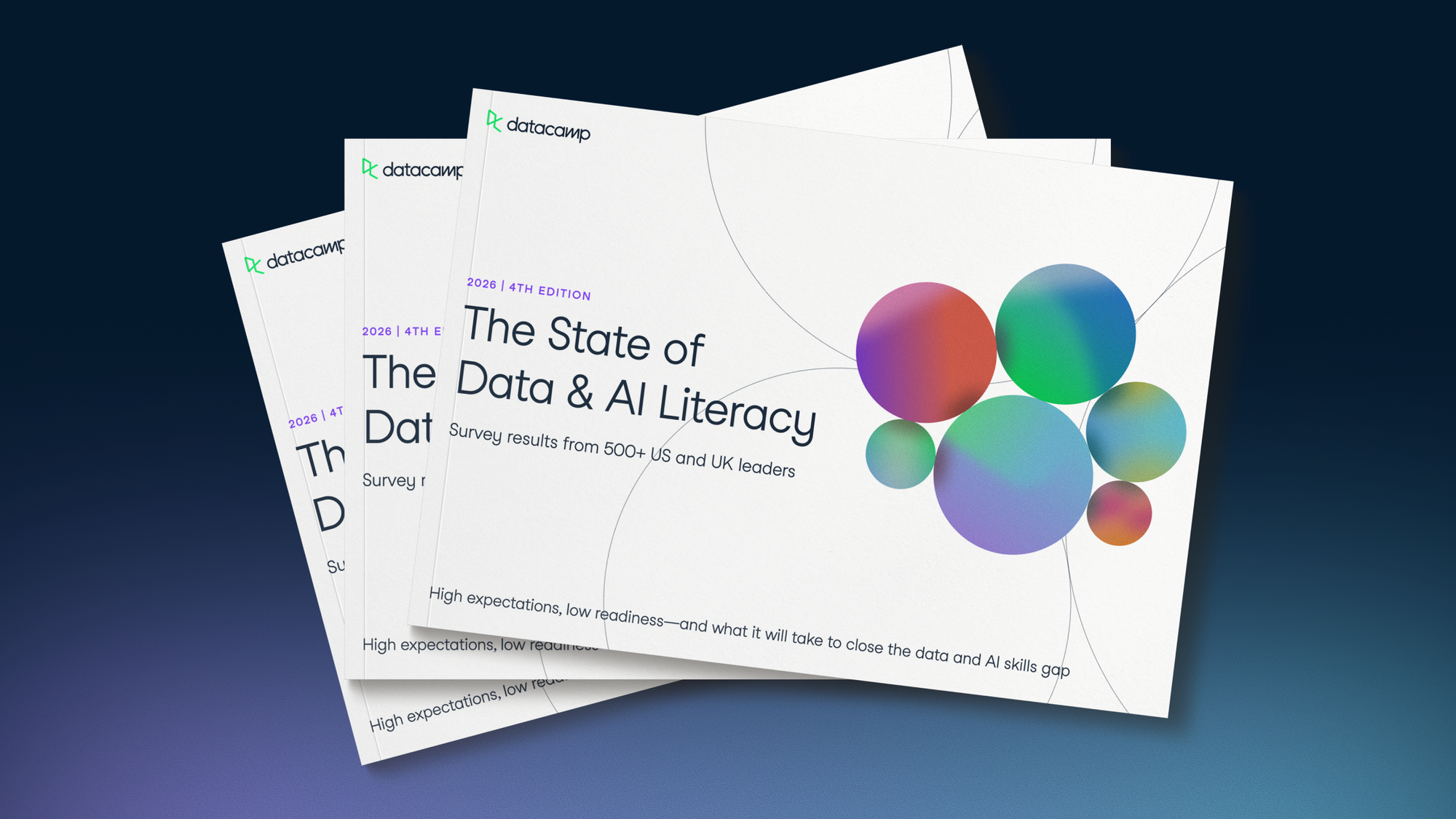
Here's the number every chief learning officer should be uncomfortable with: 82% of enterprise leaders say their organization provides AI training, and 59% report an AI skills gap — figures reported in DataCamp's 2026 State of Data & AI Literacy Report.
DataCamp attributes the gap to structural issues rather than motivation. Most corporate AI training is still passive and generic — it produces course completions, not capability. Organizations with mature, workforce-wide upskilling programs are nearly twice as likely to report significant positive AI ROI, per DataCamp. Maturity means hands-on applied practice, role-specific learning paths, and actual assessment — not a course catalog with a completion checkbox. Bayer's multi-tier Data Academy is the report's showcase: more than 90% of learners reported improved innovation or process improvements, though that's company-reported, not independently audited.
If companies treat this as a training-volume problem, they'll keep buying courses nobody applies. If they treat it as a capability-system problem — connecting learning to on-the-job application and business outcomes — the 59% gap closes. The observable signal: watch whether Q2 earnings calls from publicly traded learning platforms start reporting "capability metrics" alongside completion rates. If they don't, the market hasn't shifted yet.
Ohio Does the Unglamorous Work: Counting What CTE Actually Produces
The Thomas B. Fordham Institute published a detailed state-level analysis of Ohio's CTE system this week that does something most CTE coverage skips: it tries to measure outcomes.
The analysis examined coursework patterns, industry-recognized credential attainment, and work-based learning participation across Ohio's secondary CTE programs. The most important finding is structural: students in the same CTE pathway don't all get the same pathway. Some get the full sequence — coursework, credential, work-based learning. Many get one or two pieces. Students getting all three are the ones most likely to connect to employment. Students getting only a course or two get a credential on paper and not much else. Rural and lower-income districts show significant gaps in access to the credential-earning courses that carry real labor market value.
This is the evidence base for why California's coherence-first model makes sense — and why cutting competitive CTE grants that fund the connective tissue is analytically incoherent with any serious workforce goal. If Ohio's findings influence the state's pending CTE funding formula revisions, other states will follow. If they sit on a shelf, the "same pathway, different experience" problem persists. Watch for whether Ohio legislators cite this report in upcoming Perkins V reallocation debates.
The Administration's CTE Budget Math Still Doesn't Add Up — and States Are Starting to Notice
The administration keeps saying it loves career and technical education. The budget keeps telling a different story.
The House Appropriations Subcommittee on Labor, Health and Human Services, Education, and Related Agencies' FY2026 spending bill mark released in February 2026 proposes cutting the Department of Education by approximately $12.1 billion, or 15%. There is a $25 million increase for the Perkins State Grant, bringing it to $1.465 billion — a silver lining, per Advance CTE and CTE Policy Watch. But the surrounding infrastructure — competitive grants for work-based learning, career academies, employer partnerships — is getting hollowed out. Career-Connected High Schools grantees saw their funding slashed to $6 million, less than one-third of the original allocation and a fraction of the $200 million the administration had proposed for year two.
Formula funding survives; innovation funding gets cut. That means existing programs limp along while new employer-partnered models don't get seed capital to scale — precisely as national CTE participation surges to 8.6 million students. If states backfill with their own CTE innovation dollars in 2026 legislative sessions, the federal cuts become a speed bump. If they don't, the pipeline expands without the infrastructure to support it. Watch state supplemental CTE appropriations over the next 90 days.
TRIO Talent Search Quietly Becomes a Workforce Pipeline Program
If you still think of TRIO Talent Search as college field trips and FAFSA nights, read the new grant notice. The FY 2026 competition — $175.2 million, awards up to $10 million each — opened March 17, 2026 and, for the first time, runs through the Department of Labor's grants platform as part of "America's Talent Strategy."
The application language makes it explicit: projects must now surface apprenticeships, CTE programs, and in-demand postsecondary options — not just four-year pathways. An iconic access-to-college program is being rewired as an access-to-opportunity engine spanning college, CTE, and apprenticeships. For universities and community colleges that host Talent Search, this changes what "success" looks like and who they need at the table: employers, workforce boards, apprenticeship sponsors.
If grantees treat this as a compliance exercise — checking the "mentioned apprenticeships" box — nothing changes. If they integrate TRIO into regional talent strategies with real placement and wage metrics, it becomes a model for reorienting federal access programs toward employment outcomes. Watch which grantees win and whether early awards favor campus-based programs or community organizations with employer ties.
Governors Poised to Become Gatekeepers for Short-Term Workforce Programs Tied to Federal Aid
A March 9, 2026 Federal Register pre-publication draft proposes making state governors the primary approvers of "eligible workforce programs" tied to federal student aid — including programs serving as related technical instruction for registered apprenticeships. Programs would have to demonstrate employer hiring alignment, lead to stackable and portable credentials, and articulate into at least one certificate or degree at an eligible institution.
If finalized in this form, it creates a state-level "mini-accreditation" layer for career-focused credentials. That's a tailwind for community colleges and high-performing noncredit providers already embedded in regional ecosystems, and a real hurdle for standalone bootcamps or thin online certificates that can't show articulation or employer demand. Connecticut isn't waiting — Governor Ned Lamont has assigned the Office of Workforce Strategy to lead the state's Workforce Pell implementation, treating it as labor-market policy, not higher ed administration.
The public comment period on the related Workforce Pell rules is scheduled to close in early April 2026. If the governor-gatekeeper model survives comments largely intact, expect a scramble among providers to demonstrate state-level relationships they may not currently have. The July 1, 2026 effective date for Workforce Pell is the hard deadline driving all of this.
The "Credential Fluency" Gap Has Actual Numbers Now
A new 2026 report from OneTen and the Burning Glass Institute, analyzing hiring patterns across more than 1,000 large U.S. employers, found that removing degree requirements alone is associated with only a two-percentage-point increase in the share of hires with non-degree credentials. There's little correlation between advertising credentials in job postings and actually hiring for them — which helps explain why skills-based hiring often falls short in practice, per HR Executive and the original press release.
The equity dimension is where this bites: per the report, workers without a bachelor's degree see a 6.8% wage premium from their first job-relevant credential, nearly double the return for college graduates. These are precisely the populations for whom credential-based pathways represent the clearest route to economic mobility. But there are now more than 1.85 million distinct credentials from 134,491 providers in the U.S. — an employer navigation problem that's orders of magnitude harder than "drop the degree requirement."
The bottleneck isn't credential supply. It's employer infrastructure to recognize credentials at all. If HR systems and hiring managers can't parse which credentials signal real capability, the entire skills-based hiring movement stalls at the press release stage. Watch whether ATS (applicant tracking system) vendors start building credential-recognition features into their platforms — that's the plumbing that would make this real.
Edtech Funding Is Stabilizing — but the Structure Has Permanently Changed
Global edtech-focused startups have raised around $2.8 billion so far in 2026, roughly flat with 2024 and a fraction of the 2021 peak. But the shape of the capital has shifted. Average funding amounts are rising to $7.8 million, with three deals representing nearly half of all capital raised, per Crunchbase. Fewer checks, bigger bets on winners with proven traction.
The structural change underneath the numbers is what Visible.vc calls the "Efficacy Reckoning": institutional buyers and VCs now demand verifiable proof that a tool improves learning outcomes. Simple engagement metrics are insufficient. Founders need logic models or third-party research proving measurable gains to secure contracts.
If this standard holds, edtech platforms built on engagement metrics and content volume are structurally disadvantaged against platforms that can show verified outcomes. That's a slow-motion competitive reshuffling that will take 18–24 months to fully show up in platform revenue. If the efficacy standard softens — if buyers accept marketing claims again — the market reverts to pre-crash patterns. The tell: watch whether the next round of major enterprise edtech contracts includes outcome guarantees or clawback provisions. That's when the reckoning becomes real.
⚡ What Most People Missed
- DOL's $145 million apprenticeship "pay-for-performance" experiment is the design shift nobody's covering. Massachusetts circulated guidance on the new program, which ties payments to apprentice enrollment and completion metrics rather than seat counts. If this model sticks, community colleges and workforce boards that can track completions and wage gains will be structurally advantaged over those that can't.
- Harvard needed a bank letter of credit — and that's a canary for the entire sector. Bank of America provided the backstop after the administration put Harvard on a list usually reserved for vocational schools, per Bond Buyer reporting. If the most financially secure institution in American higher education is seeking bank backstops, imagine what the next tier is doing quietly.
- Columbia College Chicago just crossed into junk credit territory, with S&P lowering its rating to BB+, per the Columbia Chronicle. It's not Harvard's Columbia — it's a mid-sized arts institution in Chicago, and it represents the category of tuition-dependent, humanities-focused school most exposed to the demographic cliff and federal policy turbulence simultaneously.
- MIT's "Missing Semester" just normalized AI as baseline CS literacy, not a special topic. The 2026 edition now includes "Agentic Coding" and weaves AI tooling into every lecture on shell use, version control, and debugging. Localized versions in Chinese and Thai appeared within weeks — this is becoming the template for how developer education integrates AI.
- GitHub's April 24, 2026 default change on training data is about to become an education governance problem. Starting that date, interaction data from Copilot Free, Pro, and Pro+ users will train AI models unless users opt out, per community reports. CS departments and bootcamps that standardized on Copilot just inherited a data-governance problem they didn't plan for. Maryland's state AI policy already tells agencies to disable training-data sharing — expect universities to follow.
📅 What to Watch
- If the Ed Department issues a merger rulemaking notice within 60 days, it signals the consolidation clock just started for dozens of institutions currently in quiet distress — and the real fight will be with accreditors, not legislators.
- If Q1 earnings calls from Coursera and 2U/edX show enterprise revenue growing while consumer revenue flattens, it confirms the edtech market has permanently bifurcated — and the "efficacy reckoning" is being enforced by procurement teams, not VCs.
- If the Workforce Pell comment period closes in early April 2026 without major pushback on the governor-gatekeeper model, standalone bootcamps and thin online certificate providers face a structural barrier they can't lobby away quickly.
- If Lightcast or Burning Glass publishes updated credential-level wage data confirming the AI skills premium PwC reported, that number becomes the ROI benchmark for every corporate AI training budget conversation through year-end.
- If Ohio legislators cite the Fordham CTE analysis in upcoming Perkins V reallocation debates, it creates a template for other states to demand outcome data before distributing formula funds — a quiet but consequential shift in CTE accountability.
The Closer
A federal official telling 6,000 colleges that not all of them should survive the decade. A state spending a billion dollars to prove that a full career pathway beats a random elective. An enterprise survey confirming that 82% of companies offer AI training and 59% still can't find anyone who learned anything.
There are now 1.85 million credentials from 134,491 providers in the United States, per recent analyses, and the average employer can recognize approximately none of them — which makes "skills-based hiring" less a revolution and more a very expensive game of Marco Polo.
See you next week.
If someone you know is trying to make sense of the space between campus and career, send them this.
From the Lyceum
A Los Angeles jury found Meta and YouTube liable in a social media addiction trial — the "design defect" theory is now a litigation playbook with implications for edtech product design. Read → Two Verdicts in Two Days
The construction workforce gap number everyone cites may need a significant downward revision — if your planning decks say half a million, update them. Read → The 350,000-Worker Gap Has a Complicated Asterisk