The Catalyst — Apr 03, 2026
Photo: lyceumnews.com
Past 2 Weeks — April 3, 2026
The Big Picture
Fischer–Tropsch chemistry just learned to make olefins on purpose instead of by accident — at atmospheric pressure. A preprint showed you can tune magnetism in a 2D material by adjusting enantiomeric excess like a volume knob. And Nature published what amounts to a census of self-driving labs, confirming they've crossed from demo to infrastructure. The through-line: synthesis, structure, and autonomy are converging into a single design loop, and the groups that treat them as coupled variables — not separate departments — are pulling ahead.
This Week's Stories
Syngas to Light Olefins at 0.1 MPa — Fischer–Tropsch Finally Does What You Want
Every petrochemical engineer knows Fischer–Tropsch gives you a Schulz–Flory distribution — a thermodynamic grab bag of chain lengths you then have to crack and separate. A Dalian Institute of Chemical Physics team just broke that expectation. Their hydroxyl-modified cobalt oxide catalyst converts syngas directly to C₂–C₄ olefins at 250–260 °C and 0.1 MPa — essentially atmospheric pressure — with 70–82% CO conversion and >60% olefin selectivity across H₂/CO ratios of 1–2. The trick: physically mixing cobalt oxides with hydroxyl-containing promoters restructures surface chemistry so C–C coupling and β-hydrogen elimination funnel into short olefins rather than over-hydrogenated paraffins.
If this scales, it rewires the olefin value chain. Biomass- or CO₂-derived syngas could plug directly into existing ethylene/propylene infrastructure without the high-pressure reactors and complex separations that make current FT economics painful. Chinese industry media are already framing this as strategic — coal-to-chemicals and CO₂-electrolysis projects could adopt it, and the H₂/CO ratios match what those units produce. The failure mode is familiar: lab catalysts that deactivate under industrial feed impurities (sulfur, chlorides). Watch for pilot-plant announcements and long-duration stability data. If neither appears within 18 months, file under "beautiful mechanism, impractical catalyst."
Chirality as a Material Dial: Enantiomeric Excess Controls Magnetism in a 2D Hybrid
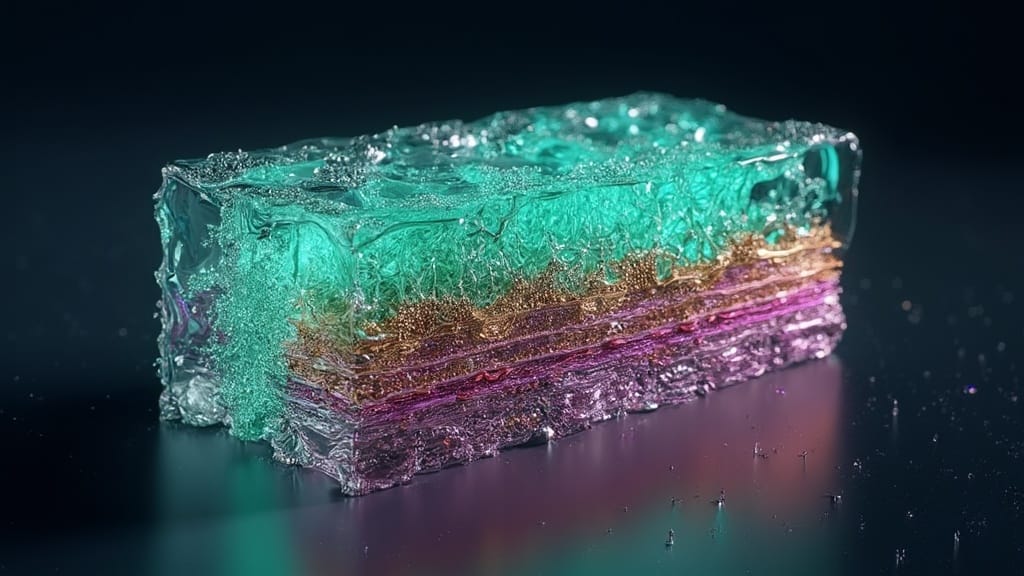
Magnetism knobs are usually composition, strain, or thickness. This Berkeley preprint from the Bediako group adds enantiomeric excess to the list.
They intercalate chiral organic cations into MnPS₃ — a layered magnetic semiconductor — and show that the magnetic ground state depends not on which enantiomer you use, but on how enantiopure the intercalant is. Enantiopure samples exhibit stable ferrimagnetism; low-ee samples show thermally activated, dynamically fluctuating magnetism that evolves on timescales of minutes. The mechanism: correlated packing of chiral cations in the van der Waals gap directs local ordering of Mn vacancies, which rearranges the magnetic exchange network. Racemic packing leaves vacancies disordered; enantiopure packing locks them into a ferrimagnetic superlattice.
If this generalizes beyond MnPS₃, ee becomes a continuous synthetic tuning parameter for electronic ground states in 2D materials — a genuinely new design axis for spintronic and chiral-magnet devices. The failure signal is specificity: if the effect only works in this one host, it's a curiosity. If other groups reproduce it in different layered magnets, it's a paradigm. Not yet peer-reviewed, but the experimental detail is substantial.
Battery Chemistry Kills Forever Chemicals — and Recycles the Fluorine

Amanchukwu's group demonstrated lithium metal–mediated electrochemical reduction that mineralizes C–F bonds in PFOA and dozens of related PFAS, yielding recoverable LiF — which they then upcycled into non-PFAS fluorochemicals for batteries and pharma. As C&EN reported, electrodeposited lithium acts as a potent reductant in nonaqueous media, breaking the thermodynamic stubbornness of the C–F bond.
This is not an immediate field solution — lithium reacts with water, and the process needs concentrated, nonaqueous feeds. But it reframes PFAS cleanup from pure cost center to potential resource stream: destroy the pollutant, recover the fluoride, make something useful. A Nature Chemistry perspective provides the sober counterpoint on what remains (aqueous compatibility, capture, lithium handling at scale). Meanwhile, regulatory tailwinds are real: U.S. regulators are proposing tighter PFAS rules that would phase out many non-essential uses over a multi-year timeline and require annual manufacturer disclosures, a policy direction that would materially accelerate demand for exactly this kind of technology. The make-or-break question: can someone demonstrate an aqueous-compatible, lithium-free variant? Until then, this is a proof of concept with excellent chemistry and difficult engineering.
Self-Driving Labs Go Mainstream: Nature Maps the Autonomous R&D Ecosystem
Nature published what amounts to a field census: Aspuru-Guzik's 50-robot empire, OpenAI–Ginkgo's 30,000-experiment protein campaign, commercial players like Lila Sciences and Periodic Labs, and Coscientist — an LLM-driven "AI scientist" — outperforming standard Bayesian optimization in materials search spaces. The message: end-to-end loops where LLMs propose, robots execute, instruments analyze, and AI replans are running at thousands of experiments per week, at lower cost per data point than humans.
This isn't just academic. Berkeley Lab's A-Lab platform previously demonstrated 41 successful syntheses of previously unrealized inorganic materials in 17 continuous days — a 71% hit rate. Germany's €30M ASCEND program is explicitly betting that catalysis automation will be central to decarbonizing heavy chemistry. And AI-integrated electron microscopy is collapsing characterization from days to minutes — precisely the analytics bottleneck that kept autonomous loops from closing.
The non-obvious consequence: industrial "AI Science Factories" with tens of thousands of square meters of automated lab space are now real companies, not renderings. If one of these startups lands a major industrial R&D contract this quarter, it will force chemical firms to reallocate R&D budgets away from in-house experimental headcount toward outsourced automation contracts, change how IP is negotiated, and push procurement teams to adopt platform-based service agreements. The failure mode is integration debt — stitching together hardware, software, and institutional workflows is harder than any individual component.
Single Indium Atoms on Hafnia Rewrite the CO₂-to-Methanol Playbook
ETH Zürich anchored isolated indium single-atom sites on hafnia (HfO₂) supports for CO₂ hydrogenation to methanol. The hafnia stabilizes indium against sintering and provides a well-defined coordination environment so every metal atom is surface-active — a boon for expensive metals and for mechanistic clarity. Early characterization and DFT are unusually thorough.
The win over conventional In₂O₃/ZrO₂ catalysts: atom efficiency. You're not burying most of your indium in a bulk oxide where it does nothing. If the hafnia scaffold survives industrially relevant pressures and long time-on-stream, this could be a practical route to more robust CO₂-to-methanol technology. The failure signal: sintering or support degradation under realistic feed conditions. Watch for stability data beyond the initial characterization window.
Solar Cells Break 100% External Quantum Efficiency — Singlet Fission Leaves the Textbook
A device leveraging singlet fission via a spin-flip metal complex split one high-energy photon into two excitons, yielding >100% external quantum efficiency in a working solar cell — the kind of result that forces you to reread the Shockley–Queisser derivation and remember the footnotes about multi-exciton generation.
This is lab-scale and the transport/recombination losses at scale are the obvious question. But >100% EQE in device form (not just a spectroscopic measurement) changes the conversation: if exciton harvesting and transport can be engineered without recombination eating the gains, module architectures will need to accommodate >1 electron per photon as a design parameter, not a theoretical curiosity. The observable signal: if follow-up work demonstrates stable EQE >100% over hundreds of hours under AM1.5, PV module designers will start taking singlet fission seriously in stacking strategies.
A Disk-Shaped Catalyst Geometry Boosts CO₂-to-Methanol by Design
Heterogeneous catalysis usually means a nanoparticle on a support — sphere on a surface. This work designs a flat disk geometry where active sites are arranged in a plane, maximizing reactant contact while minimizing internal diffusion paths. For CO₂ reduction to methanol, the geometry maintains a local CO₂-rich microenvironment and speeds product desorption, achieving high efficiency at lower temperatures.
It's an instructive complement to the single-atom work: composition and atomics matter, but macroscopic shape is suddenly a controllable design variable. The broader signal — from disk catalysts to MXene nanoscrolls delivering ~40% charge-storage improvements — is that mesoscale geometry is an under-leveraged lever delivering step-change performance, not just incremental tweaks.
Lattice Oxygen and Metal Redox at the Same Time: A Long-Life OER Interface
OER electrocatalysts usually force a trade-off: high activity via lattice-oxygen redox, or stability via metal-centered redox. This ACS Catalysis paper finds a loophole by constructing an AgₓO/CoOOH heterointerface doped with Fe. DFT and spectroscopy show that Ag–O species couple to neighboring Co–O lattice sites in a coupled oxygen-metal mechanism (COM), dropping overpotential from ~0.96 V to 0.22 V. Fe doping further lowers oxygen vacancy formation energy and shifts the O 2p-band toward the Fermi level. The resulting AgFe–CoOOH catalyst runs at 10 mA cm⁻² with 220 mV overpotential and survives ~3,000 h at 1 A cm⁻² in an AEM electrolyzer — industrial-regime stress.
For green hydrogen, this is less about record overpotentials and more about a clear design rule: engineer heterointerfaces that co-activate metal and lattice oxygen while taming vacancy chaos. The failure mode would be if the Ag component leaches under long-term operation at different pH or with real-world water feeds. Watch for third-party durability validation.
Mesoporous Silica Turns Allyl Alcohols into Allylating Agents — No Metals Required
Allylation of simple ketones from allyl alcohols is annoyingly hard — water is the worst leaving group. A new ACS Catalysis paper shows mesoporous silica can promote α-allylation under mild conditions without transition metals. The silica's acid sites activate the allyl alcohol toward dehydration; pore confinement and tailored acidity bias the mechanism away from polymerization, giving synthetically respectable yields with only water as byproduct.
If the catalyst proves robust and regenerable, this is the kind of green, heterogeneous C–C coupling that migrates from academic flasks into continuous processes for fine chemicals and agrochemical intermediates. The test: catalyst lifetime over hundreds of cycles and tolerance to real feedstock impurities. A failed catalyst regeneration study would kill the industrial story quickly.
New Products & Launches
- Iktos × Chemspeed integrated AI-to-robot synthesis pipeline: Iktos and Chemspeed announced a partnership coupling Iktos's generative molecule design (Makya), retrosynthesis planning (Spaya), and a new orchestration layer (Ilaka) directly to Chemspeed's robotic synthesis platforms. The system clusters compatible reactions for parallel execution — a commercial offering aimed at pharma teams without deep robotics expertise.
- HyPIS compressive hyperspectral phasor imaging: A preprint describes single-pixel detection with phasor encoding that classifies materials pixel-by-pixel using ~100× less data than conventional hyperspectral cameras — immediately relevant for polymer sorting, catalyst monitoring, and process analytics.
⚡ What Most People Missed
- Critical slowing down in a bench-top chemical oscillator. Radboud University chemists tuned a trypsin enzyme circuit to the edge of a tipping point and observed recovery times blowing up — the same generic early-warning signals seen in ecosystems and markets. Portable to flow reactors and self-driving labs, this gives process-control systems a low-cost lever to avoid runaways before they happen.
- A failed control experiment accidentally invented an "anti-Friedel–Crafts" reaction. A Cambridge group's botched control run produced a genuinely new photocatalytic C–C bond formation under mild conditions — a reminder that scalable discovery will be hybrid: automated breadth plus human pattern recognition when things go off-script.
- GNoME's AI-predicted crystals are getting experimentally validated. A Japanese group synthesized MnFeCo₄Si₂ in the predicted rhombohedral lattice, confirming soft ferromagnetism with a reported Curie temperature of ~1,039 K. One validation, but from an independent lab following an AI-flagged target — evidence that large generative crystal databases can seed real synthesis campaigns.
- Shock-crystallization in CaSiO₃ glass happens in nanoseconds, not geological time. Dynamic compression experiments show a mantle-analogue glass transforms to perovskite-like crystal above ~100 GPa essentially instantaneously, bypassing diffusion. Implications for planetary impact modeling and for shock-synthesis of metastable phases impossible via slow processing.
- Machine learning just narrowed decades of competing theories for URu₂Si₂'s hidden order. Cornell physicists combined resonant ultrasound spectroscopy with symmetry-aware neural nets to dramatically winnow candidate order parameters — a template for using precision probes plus ML to rule out theory space in any "hidden order" problem.
📅 What to Watch
- If an autonomous lab startup (Lila Sciences, Periodic Labs) lands a named industrial R&D contract this quarter, expect chemical firms to reallocate R&D budgets away from in-house experimental headcount toward outsourced automation contracts, change IP-negotiation practices, and accelerate procurement of platform services.
- If anyone demonstrates aqueous-compatible, lithium-free PFAS mineralization with fluoride recovery, the remediation economics flip from "expensive disposal" to "revenue-generating recycling" on short order, creating upstream demand for fluoride recovery infrastructure.
- If the enantiopurity–magnetism effect replicates in a layered magnet beyond MnPS₃, expect a wave of device-focused proposals for chiral-controlled spintronics and a rush to secure intellectual property on ee-tunable device architectures.
- If MLIP stability claims for million-atom alloy simulations survive benchmarking by experimental groups on segregation and creep, simulation will become the default first screen for aerospace alloy development, shortening development cycles that otherwise require months of trial heats.
- If the U.S. Trade Representative does not expand tariff exemptions to cover specialty chemical intermediates and battery precursors, expect accelerated reshoring announcements and procurement diversification from U.S. chemical firms within 90 days.
The Closer
A cobalt oxide that makes olefins on purpose at atmospheric pressure; a magnet whose strength depends on how carefully you separated your enantiomers; a lithium electrode that eats forever chemicals and spits out battery-grade fluoride.
Somewhere a grad student is explaining to their PI that the failed control experiment is the result — and for once, the PI is listening.
Until next time — keep your ee high and your overpotentials low.
If someone in your group would read this over coffee instead of scrolling Twitter, forward it their way.
From the Lyceum
This week's tariff proclamation spares chips and drugs temporarily, but specialty chemical intermediates are exposed and procurement teams are already scrambling. Read → Tariff Earthquake Lands — Chips and Drugs Get a Temporary Pass, Not a Permanent One