The Lyceum: AI Daily — Aug 21, 2026

Photo: lyceumnews.com
Friday, August 21, 2026
The Big Picture
This was an infrastructure day wearing a model-day disguise. Anthropic gave agents a more complete workspace, banks began testing specialized financial AI, and three new robotics papers tackled the unglamorous barriers—safety, skill retention, and scarce training data—that separate impressive demos from useful machines.
What Just Shipped
- Computer use, Skills API, and Files API (Anthropic): Anthropic made the tools generally available on August 20. Claude can operate software, follow versioned procedures, and retain files across an agent workflow.
Today's Stories
Anthropic Gives Claude Better Hands—and a Filing Cabinet
Anthropic made computer use, the Skills API, and the Files API generally available on August 20, giving Claude a fuller workspace. It can now navigate software across multiple actions, use reusable organizational procedures, and retain documents it reads or creates. A browser tool can also inspect webpage structure instead of relying only on screenshots. (claude.com)
Together, these features matter more than any one of them. Persistent files and versioned skills move an agent beyond being a clever visitor and closer to a managed employee: it can repeatedly use the same procedures, work from shared records, and leave a trail for review.
Anthropic says healthcare and insurance company Included Health cut its longest claims workflow from 32 minutes to 13 minutes while reducing cost per task by roughly 30% on the workflow it tested. If customers reproduce those results across messier software, browser agents could replace some custom integrations. If error rates climb outside tightly designed workflows, these tools will remain supervised automation with a better interface.
Ant International Moves a Time-Series Model Into Bank Workflows

Banks are testing a model built for one of their most consequential jobs. Business Standard reported on August 20 that Ant International rolled out Falcon Time-Series Transformer Model 2.0 for foreign-exchange and liquidity-risk work with Citi, HSBC, Deutsche Bank, Standard Chartered, and Barclays. Unlike a general chatbot, a time-series model looks for patterns in data that changes over time—cash balances, currency movements, and funding needs. (m.cnyes.com)
If the system improves forecasts without creating an audit nightmare, Ant International gains a route into high-value global banking infrastructure. General-purpose model providers, meanwhile, face competition from software built for one consequential job. (theinformation.com)
Failure will be quieter. Banks will keep Falcon in pilots, disclose no measured improvement, and preserve existing risk systems as the real source of truth. Production expansion—and published forecasting or workflow results—will show whether this is operational software or an elaborate demonstration.
GLM-5.3’s Cheap Tokens Come With an Expensive Footnote
Cheap tokens can still produce an expensive bill. Artificial Analysis published an independent evaluation of Z.ai’s GLM-5.3 Max during the August 20–21 window. It scored 60 on the firm’s Intelligence Index, ranked eighth among 182 tested models, generated roughly 93 tokens per second, and supported a one-million-token context window. (GLM-5.3 Gets Its First Detailed Independent Cost Check)
The catch is consumption. Artificial Analysis recorded 170 million output tokens across its evaluation, versus a 72 million median among comparable reasoning models. A model charging less per token can still cost more per completed task if it talks twice as much. (GLM-5.3 Gets Its First Detailed Independent Cost Check)
That puts pressure on model routers—the software that automatically chooses which model handles a request—to measure completed-work cost rather than compare price cards. If GLM-5.3 remains competitive on long agent jobs without runaway output, Z.ai has a credible frontier product. If latency and token use compound over many steps, its attractive pricing will prove mostly cosmetic. (GLM-5.3 Gets Its First Detailed Independent Cost Check)
SafeBranch Rewinds a Robot to the Moment It Became Dangerous
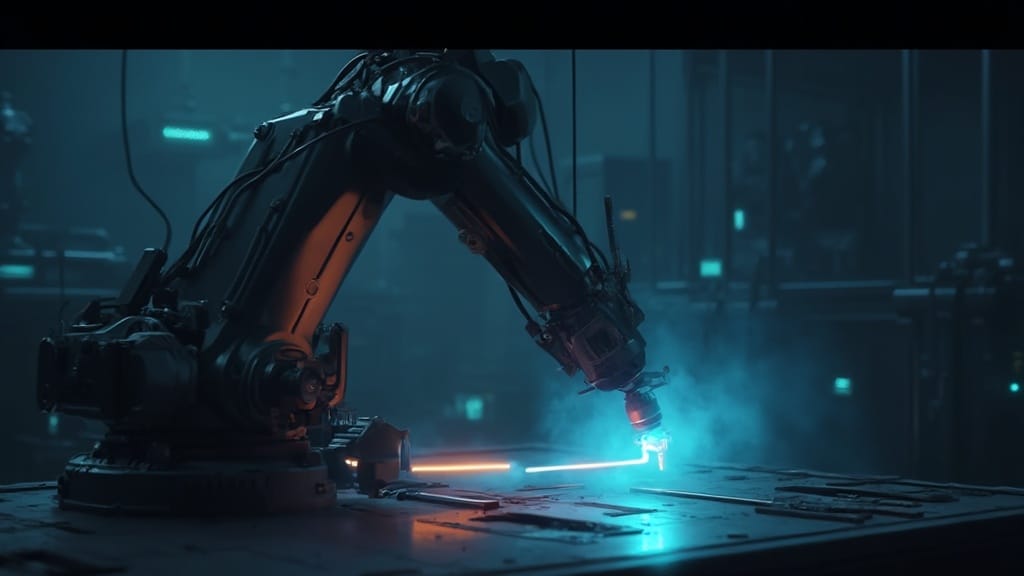
SafeBranch starts where a robot goes wrong. A non-peer-reviewed preprint posted in the latest arXiv update introduces the safety-training method for embodied agents—AI systems that perceive and act in simulated or physical environments. After an agent violates a rule, SafeBranch returns to the critical decision and contrasts the unsafe action with a safer alternative.
That creates a precise lesson: not “this whole attempt was bad,” but “this particular move changed the outcome.” The authors report roughly ten times more safe task completions than an untrained baseline in one unfamiliar-object test, without reducing overall task success.
If the method transfers to real robots, developers may be able to teach safety without running a separate supervisory model during every action. If it breaks around people, clutter, or ambiguous instructions, the benchmark gain will have captured clean laboratory errors rather than physical-world risk. Independent replication on hardware is the test.
OrthoSkillVLA Tries to Teach Robots Without Erasing Their Memory
Teaching a robot one new skill should not make it forget another. Another August 20 preprint presents OrthoSkillVLA, a method intended to help vision-language-action models learn new physical skills without damaging old ones. The researchers separate updates to semantic understanding—what an instruction means—from updates to movement patterns.
The target is catastrophic forgetting: a robot learns to load a dishwasher and becomes worse at folding a towel. Solving that would make robot deployments cumulative, allowing one machine to acquire skills over time instead of requiring repeated retraining from a fixed foundation.
The paper has been accepted by PRCV 2026, but acceptance is not evidence of deployment readiness. If robots retain performance after learning long sequences of unrelated tasks, continual learning becomes commercially useful. If accuracy erodes after the first few additions, fleets will still depend on carefully managed model versions.
A Robot Model Generates Some of Its Own Practice
Robot training data is scarce, so this preprint asks robots to make more of it themselves. A third new preprint describes self-demonstrated generative control, a technique that lets a vision-language-action model generate additional training examples from its own interactions. The authors tested the method on an ALOHA robot and report that it learned new manipulation tasks while retaining broader instruction-following behavior.
If the approach holds up, robot developers could stretch scarce human demonstration data further. That would especially help smaller manufacturers that cannot afford enormous collections of expertly recorded motions.
The risk is circular learning: a model can amplify its own mistakes as readily as its useful behavior. Tests on unfamiliar objects and tasks—and comparisons against equally sized human-generated datasets—will reveal whether self-demonstration creates new competence or merely rehearses the model’s existing habits.
Salesforce Turns Business Software Into a Governed Agent Interface
Salesforce wants its business software to become the governed back end for more agents. IT Brief Asia reported on August 20 that Salesforce expanded Headless 360 across its core software clouds, adding Model Context Protocol servers. MCP is a standard that allows agents to discover and call external tools; Salesforce’s implementation is designed to preserve existing permissions, validation rules, and governance controls. (Salesforce Extends Headless 360 With MCP Servers)
If it works as advertised, compatible agents could invoke Salesforce functions without every provider building a bespoke connector. Salesforce wins by making its platform the governed back end for many agent interfaces—not only Agentforce.
But interoperability does not decide who may issue refunds, change customer records, or export sensitive data. Adoption will show up in cross-vendor deployments using Salesforce’s existing permission system. Failure will look like companies restricting MCP to read-only pilots because the approval and audit burden remains unresolved.
⚡ What Most People Missed
- AI’s campaign-money phase has begun: Reuters reported on August 20 that organizations backed by OpenAI, Anthropic, or their executives spent more than $23 million supporting competing candidates in a New York Democratic primary. Leading the Future, backed partly by OpenAI co-founder Greg Brockman, Anna Brockman, and Andreessen Horowitz, has raised $140 million ahead of the November 3 midterms.
- Nvidia may be reaching into the human-data supply chain: The Information reported that Nvidia has discussed investing in Mercor at a $20 billion valuation. No completed investment or technical deliverable has been announced, but the talks show why expert demonstrations and evaluations are becoming strategic inputs alongside chips.
- SenseTime open-sourced SenseNova U1.5 Lite: Phoenix Technology reported that SenseTime released the native unified multimodal model, which is designed to handle multiple kinds of media within one architecture. Independent performance and deployment evidence has not yet surfaced in the provided research. [Source: Phoenix Technology — Chinese]
- Four policy reports circulating again are outside this edition’s window: Reuters’ open-weight testing report dates to August 4; its anticipated Trump oversight-order report dates to May 20; and its Anthropic access-restriction and banking-AI scrutiny reports date to June 12. None represents a new August 20–21 action, while the Pentagon press-policy and Politico subscription disputes fall outside this newsletter’s AI remit.
📅 What to Watch
- If companies reproduce Anthropic’s workflow results across ordinary websites, browser agents will begin competing with conventional integration software rather than merely assisting employees.
- If banks publish measured gains from Ant International’s model, specialized financial AI will gain a stronger procurement advantage over general-purpose chatbots.
- If GLM-5.3 performs economically on long, multi-step jobs, model routers will have to treat verbosity as a systems variable rather than a personality quirk.
- If SafeBranch works on physical robots around people, counterfactual training could reduce the need for a separate safety model supervising every movement.
The Closer
Claude arrived with a mouse and a filing cabinet. A robot rewound the tape to find the exact moment it chose violence, and bankers handed their currency charts to a transformer with a calculator.
Meanwhile, the cheapest frontier model may simply be the one that knows when to stop talking—a standard several humans in Washington have yet to benchmark.
Keep your hands inside the agent loop.
Forward this to someone who still thinks the chatbot is the whole story.