The Lyceum: AI Daily — May 12, 2026

Photo: lyceumnews.com
Tuesday, May 12, 2026
The Big Picture
Google's next-gen video model leaked out of Google's own app one week before I/O, Unitree put a human inside a 500kg transforming mech and sold it for approximately $537,000, and a federal lawsuit named Mark Zuckerberg personally for allegedly authorizing 267 terabytes of pirated books to train Llama. Underneath the spectacle, the boring story is the more important one: the Pentagon just spread up to $200 million-each contracts across xAI, Google, and Anthropic, Nvidia unveiled inference-specific silicon, and a Michigan utility quietly told data centers to wait a year. The frontier is moving faster than the announcement calendar — and the infrastructure beneath it is starting to push back.
What Just Shipped
- IBM Granite 4.1 (IBM): 8B-parameter open-weight model IBM claims performs comparably to 32B models on enterprise benchmarks; vendor-reported, not independently verified.
- xAI Grok 4.3 (xAI): Live now with improved real-world performance over prior versions.
- DeepSeek V4 Flash (DeepSeek, non-reasoning variant): 1M-token context at $0.14/M input tokens via DeepInfra — one of the cheapest long-context options on the market.
- Kimi K2.6 (Moonshot AI): 256K context, $0.95/M input / $4.60/M output, live on SiliconFlow, Together, and Phala.
- MiMo v2.5 Pro (Xiaomi): 1M context at $1.00/M input — Xiaomi's quiet entry into the frontier API market.
- Trinity Large Preview (Arcee AI): 131K context at $0.15/M input.
- Qwen3.6 35B A3B (Alibaba): Open-source 35B model optimized for reasoning.
Today's Stories
Google's Next Video Model Leaked From Inside Google's Own App
One week before I/O, Google showed its hand by accident.
A Reddit user gained early access to a model called "Gemini Omni" inside the Gemini app, with an in-product description reading: "Meet our new video model. Remix your videos, edit directly in chat, try a template, and more." The leak — confirmed by Android Authority and TestingCatalog — looks like either a misfired A/B test or a staging slip.
The interesting part isn't generation fidelity. Early viewers say raw quality lags ByteDance's Seedance 2. What stands out is in-chat editing: removing watermarks, swapping objects mid-clip, and rewriting scenes through conversation. Google's current setup splits Veo 3.1 for video and Gemini for images; Oimi AI's read of the leak suggests Omni merges text, image, and video into one native system.
If Omni ships at I/O (May 19–20) with chat-based video editing, Google is competing on workflow, not pixel quality — a more durable advantage than benchmark wins. The signal to watch: whether Sundar Pichai puts Omni on the keynote stage or whether Google quietly walks it back, amid signs the leak exposed an unfinished product. Usage limits in the leaked UI burned 86% of a Google AI Pro daily quota on two video generations, which suggests Google's unit economics aren't ready for mass rollout.
Unitree Put a Human Inside a Transforming Robot and Sold It for $537,000
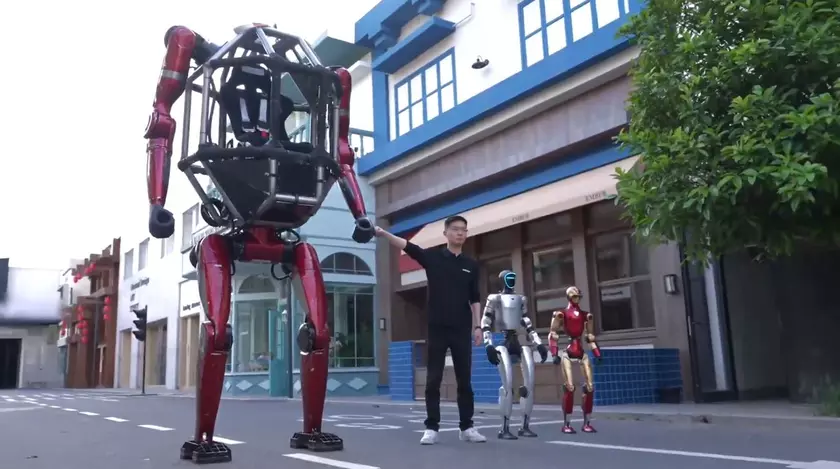
The company that made robot dogs affordable went somewhere unexpected this morning.
Unitree Robotics launched the GD01, what it calls the world's first mass-produced manned mech suit, starting at RMB 3.9 million (approximately $537,000). The 500kg machine transforms between two-legged and four-legged modes, with a frame that tilts horizontal for rough terrain (gagadget).
The product is almost beside the point. Unitree is simultaneously pursuing a $610 million Shanghai STAR Market IPO that would make it the first publicly listed humanoid robotics company in China (ChinaBizInsider). The GD01 is a proof point that Unitree can manufacture at scale — alongside the quiet launch of UniStore, the company's app store for humanoid robots.
If the IPO clears, it sets the first public market price on humanoid robotics — a number Figure, Agility, and Tesla Optimus investors will all be benchmarked against. If it doesn't, Chinese policymakers could consider ways to fund Unitree directly. Battery runtime, autonomous range, and payload specs are still unpublished, so treat the capability narrative as marketing until practitioners get their hands on one.
The Meta Copyright Case Just Got Personal
Most AI copyright suits target companies. This one names Mark Zuckerberg.
Author Scott Turow and five publishers — Elsevier, Cengage, Hachette, Macmillan, and McGraw Hill — filed a class action in federal court in Manhattan alleging Meta and Zuckerberg personally authorized the torrenting of over 267 terabytes of pirated material to train Llama, equivalent to many times the print collection of the Library of Congress (Breitbart's filing summary).
The case is engineered to survive the precedent that killed Sarah Silverman's suit. In June 2025, Judge Vincent Chhabria ruled Meta's training on copyrighted books qualified as "fair use." The new complaint quotes a Meta employee writing: "If we license once [sic] single book, we won't be able to lean into the fair use strategy" (NPR). The complaint also alleges Meta considered licensing and abandoned it "at Zuckerberg's personal instruction" (Jamaica Gleaner).
That internal quote is the case's sharpest weapon — it frames data acquisition as deliberate legal arbitrage rather than incidental scraping. If the court denies a motion to dismiss, every frontier lab's legal team will likely rewrite data-acquisition policies before Q3. Meta said it will "fight this lawsuit aggressively." Watch the docket: the first ruling will tell us whether the fair-use shield holds when the plaintiff has internal emails.
The Pentagon Widened the Frontier-Model Club
The Department of Defense awarded contracts worth up to $200 million each to xAI, Google Public Sector, and Anthropic, per The Information. OpenAI received a similar award last month, so federal frontier-AI procurement now spans four labs.
This is the moment government AI stops being pilots and starts being procurement. Defense buying tends to convert experimental tools into infrastructure quickly — and a multi-vendor structure means no lab gets a monopoly on classified workloads. Combined with OpenAI's FedRAMP Moderate authorization this week, the federal stack is firming up fast. The failure mode to watch: if one vendor's classified deployment fails a red-team eval, the others will use it as a wedge.
Nvidia Made Inference Its Own Hardware Category
Nvidia unveiled Rubin CPX, a new GPU class designed specifically for massive-context inference — million-token applications and long-context serving. Training and inference have always shared silicon; Nvidia is now arguing they shouldn't.
If Rubin CPX delivers, the economics of always-on agents and long-context apps shift materially — because inference, not training, is where per-request costs accumulate. The signal to watch: hyperscaler order announcements over the next two quarters. If AWS, Azure, and GCP all commit publicly, specialized inference silicon becomes the new default. If they hedge with AMD MI400-class parts or in-house silicon, Nvidia's pricing power on inference compresses.
OpenAI Is Becoming a Services Company
The Information reports OpenAI launched a $10 billion private-equity joint venture — the OpenAI Deployment Company — and acquired a consultancy to help enterprises put AI into production.
This moves OpenAI from API supplier toward systems integrator: workflow redesign, data plumbing, compliance work. Anthropic has a similar PE-backed vehicle. The implication: frontier labs are betting enterprises won't buy raw model access — they'll buy outcomes, delivered by humans with model access. The winners look less like Stripe and more like Accenture-with-a-model. The risk: services businesses don't have software margins, which complicates the trillion-dollar valuation math.
Workday CEO: AI Replaces Labor, Not Software
Workday CEO Aneel Bhusri argued in an interview that AI displaces the humans coordinating enterprise systems — not the systems themselves. The trusted incumbents (Workday, SAP, Oracle) become the platforms that host and govern AI-driven labor substitution.
If Bhusri is right, the SaaS incumbents that own enterprise data graphs capture most of the automation upside — and the "AI will eat SaaS" thesis loses ground. The observable signal: whether Workday's next earnings call shows seat-based revenue holding while AI-agent revenue grows on top, or whether seats start shrinking. Recent cloud-industry layoffs have been attributed in company statements to automation and agents, suggesting the labor side of this thesis is already underway.
⚡ What Most People Missed
- Google's threat intel team confirmed the first AI-assisted zero-day used for mass exploitation: Google Threat Intelligence Group documented a threat actor using AI to generate weaponized exploit code targeting 2FA defenses, staged for mass deployment before detection intervened. The gap between zero-day existence and weaponization just compressed dramatically.
- A Michigan utility paused new data center hookups for a year: The Ypsilanti Community Utilities Authority imposed a one-year moratorium on water and sewer service to new data centers. AI capacity is now failing at the plumbing layer — not just at GPUs and transmission lines.
- NERC issued a rare Level 3 alert on data-center load volatility: The North American Electric Reliability Corp ordered specific grid-participant actions by August 3 after data centers were observed disconnecting unexpectedly and swinging demand fast enough to threaten reliability. The grid is treating AI as a control-systems problem now, not a forecasting one.
- An r/LocalLLaMA post claims 1T-parameter local inference on Intel Optane: A Reddit post claims running a trillion-parameter model at 4+ tokens/sec using secondhand Optane Persistent Memory as a high-speed swap layer. Unverified, but the post is moving fast — if it replicates, the memory wall that kept frontier models inside hyperscalers has a workaround in the secondhand server market.
- Xiaomi quietly entered the frontier API market: MiMo v2.5 Pro lists at $1.00/M input with a 1M-token context window. Xiaomi competing on API pricing adds a fourth front to the inference cost war, alongside DeepSeek, Moonshot, and Alibaba.
📅 What to Watch
- If Gemini Omni headlines the May 19–20 I/O keynote with in-chat editing demos, Google is competing on workflow rather than generation quality — and ByteDance's Seedance lead matters less than it looks.
- If a federal judge lets the Turow v. Meta complaint past a motion to dismiss, the fair-use defense becomes conditional on intent, and every lab's data-acquisition policy gets rewritten before Q3.
- If Unitree's STAR Market IPO prices, the public-market valuation of humanoid robotics gets set in Shanghai before Figure or Agility get a chance to set it in New York.
- If a second municipal utility follows Ypsilanti with a data-center moratorium, expect site-selection economics to shift from "where's the power" to "where's the water" within two quarters.
- If hyperscalers commit publicly to Rubin CPX orders, training and inference become permanently separate silicon markets — and AMD's roadmap looks suddenly mismatched.
- If Google's GTIG zero-day disclosure produces a named threat actor, attribution becomes the precedent that justifies AI export controls reaching into model weights, not just chips.
The Closer
A 500-kilogram transforming mech knocking down a brick wall on Weibo, a Meta employee on the record explaining why licensing one book would ruin the legal defense, and a Michigan water authority telling the world's most valuable industry to wait its turn. Somewhere in a Google staging environment, a video model is burning through 86% of a Pro user's daily quota generating dinner scenes where objects materialize out of thin air — which is, in fairness, also what 267 terabytes of pirated books look like as a training corpus.
See you tomorrow.
Forward this to the friend who keeps asking what's actually happening in AI — they'll thank you, eventually.