The Lyceum: AI Daily — May 17, 2026

Photo: lyceumnews.com
Sunday, May 17, 2026
The Big Picture
Two days before Google I/O, the AI industry is sprinting toward its biggest product showcase of the year while a real political backlash forms underneath it. A May 2026 Gallup poll shows seven in ten Americans oppose AI data centers being built near them, and the opposition spans the political spectrum in a year when almost nothing does. Meanwhile the open-source gap with frontier labs keeps compressing, a quiet merge in llama.cpp just made local AI roughly 1.5–2x faster intraday, and Chinese streets continue to function as the world's largest uncontrolled robotics testbed.
What Just Shipped
- DeepSeek V4-Pro and V4-Flash (DeepSeek): Open-weight Mixture-of-Experts models with 1M-token context; V4-Pro at 1.6T parameters (49B active), V4-Flash a lower-latency sibling at 284B (13B active).
- Kimi K2.6 (Moonshot AI): Up to 256K-token context, live across SiliconFlow, Together, DeepInfra, BaseTen, Venice, and Phala.
- Qwen 3.6 27B with MTP (Alibaba/Qwen): 27B-parameter open model published in MTP-compatible GGUF format, designed to exploit the new llama.cpp speculative decoding path.
- Gemini Intelligence for Android (Google): Device-level automation layer rolling out ahead of I/O, capable of executing multi-step tasks across apps on-device.
- llama.cpp Multi-Token Prediction (PR #22673) (ggml-org): Speculative decoding via built-in MTP heads merged into the dominant local-inference engine; community benchmarks report 1.5–2x throughput gains.
Today's Stories
The 70% Problem: America's Data Center Backlash Just Got a Gallup Number
A new Gallup poll conducted in May 2026 shows seven in ten Americans oppose AI data centers being built near them, and the opposition spans the political spectrum. That's not a niche concern — that's a cross-partisan majority in a year when those barely exist. In Maine, the legislature approved the first statewide moratorium on new AI data centers; the governor vetoed it. In Utah, residents are fighting plans for what would be the largest data center in the world in Box Elder County.
If the industry succeeds in absorbing this, it will be amid labs and hyperscalers negotiating community benefit deals before they file permits — energy rebates, water commitments, local hiring floors. If they fail, the cost curve on AI flips: it stops being a story about cheaper tokens and becomes a story about permitting delays measured in years. Watch for a second state moratorium passing chamber-and-signature before summer recess. One veto is an anecdote. Two laws are a trend.
China's Streets Are Now a Live Robotics Lab — And Nobody Voted for That
Videos circulating on r/singularity overnight appear to show self-driving electric motorcycles operating without riders on public streets in Chinese cities. The footage is community-sourced — no manufacturer has claimed it, and the "fully autonomous" framing should be held loosely until a primary source confirms — but the surrounding context is real. Xpeng's CEO told reporters at Auto China 2026 the company aims to surpass Tesla's self-driving capabilities in China by August, per IndexBox's coverage of the briefing.
And the regulatory picture is genuinely strange: on March 31, more than a hundred of Baidu's Apollo Go robotaxis simultaneously froze on Wuhan streets, trapping passengers for up to two hours, Fortune reported. Beijing suspended new autonomous driving permits nationwide weeks later. China is both an aggressive deployer of autonomous vehicles and a country that has paused new permits — which makes any new two-wheeler footage either a continuation of testing under existing permits, or something operating in the regulatory gray. A manufacturer's claim would convert viral clips into industrial reality.
The Open-Source Gap Is Closing Faster Than Anyone Expected
DeepSeek V4-Pro is now posting agentic benchmarks that sit alongside — not behind — GPT-5.5 and Claude Opus 4.7, according to Codersera's benchmark review and MindStudio's analysis. V4-Pro's input pricing of $0.145 per million tokens is roughly 7x cheaper than the closed frontier; output at $1.74 per million tokens is about 6x cheaper.
If this trend holds, the binding constraint on AI products stops being model access and becomes application architecture. That's a fundamentally different competitive landscape — and a much more solvable one for most teams. The companies most exposed are the ones whose entire value proposition rests on access to a frontier model. The signal that it's failing: closed labs widening the gap again on a benchmark that matters (long-horizon agentic tasks, multi-modal reasoning) by enough that the price differential stops mattering. So far that signal isn't appearing.
Humanoid's Schaeffler Deal Is the Rare Robot Story That Actually Matters
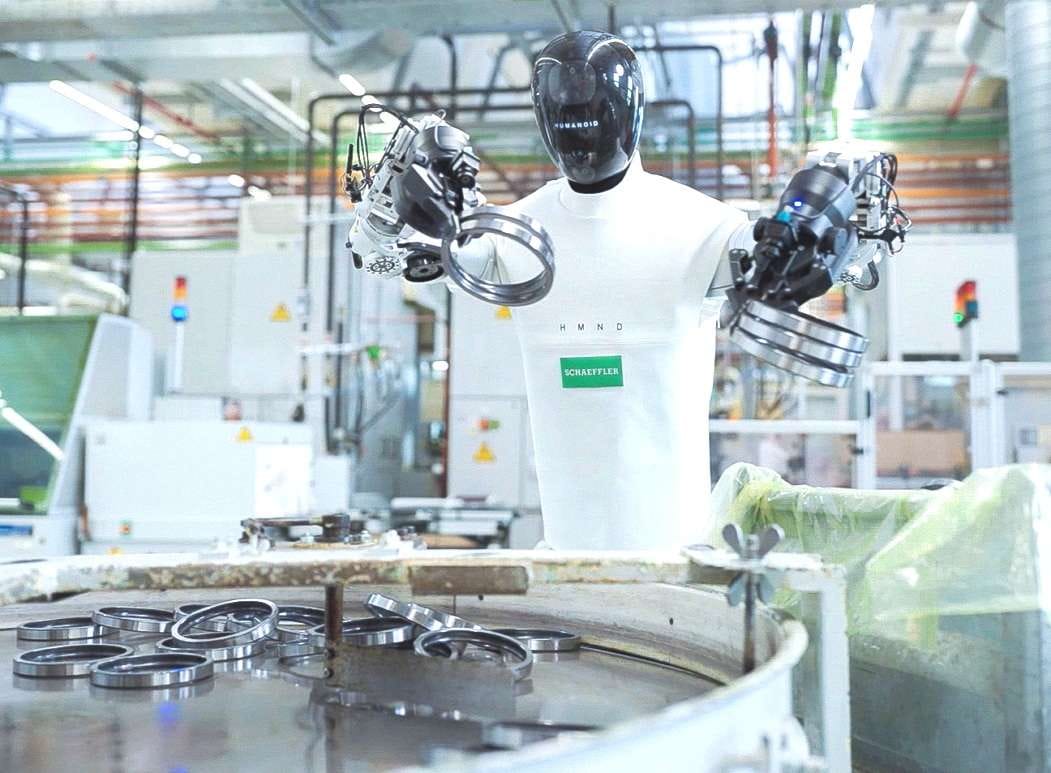
Most robot news is theater. This one isn't. British robotics company Humanoid plans to deploy up to 2,000 humanoid robots at German auto-parts giant Schaeffler's plants, with the initial rollout at two German sites scheduled from December 2026 through June 2027, Reuters coverage via MarketScreener reported. The deal includes a five-year actuator supply agreement and integration into existing production lines.
The reason to care: factories don't pay for vibes. If the deployment hits its 2027 timeline, it's the first humanoid contract at industrial scale outside of a demonstration video — and it gives every other auto supplier in Europe a concrete reference customer. If it slips or quietly shrinks, it joins a long list of robotics announcements that died in the integration phase. Watch the December rollout date. That's the moment the press release becomes a fact.
Microsoft's DELEGATE-52 Quietly Surfaces a Hard Ceiling on Agents
A Microsoft Research benchmark spanning 52 professional domains found that frontier models frequently corrupt documents and lose substantial content during long-running multistep workflows, per a MarketingProfs digest summarizing the research. Only Python programming consistently met Microsoft's reliability threshold after 20 delegated interactions. The finding that deserves more attention: agentic systems equipped with tools performed worse in many cases.
The numbers come from a digest rather than the primary paper, so treat the specifics as provisional until Microsoft publishes the full results. But the directional finding aligns with what developers have been quietly reporting in LangChain and LlamaIndex communities for months — agents look brilliant for ten steps and degrade badly by step twenty. If this replicates, the agent-tooling wave needs a redesign around verification and checkpoints rather than chain length. The signal that it won't: a fresh benchmark showing tool-augmented agents crossing 90%+ reliability on 20+ step workflows. That paper doesn't exist yet.
China's "Little Dragons" Are Becoming Capital-Market Machines
Moonshot AI, the company behind Kimi, raised about $2 billion at a valuation above $20 billion as it navigates China's new IPO rules, the [South China Morning Post reported](https://www.scmp.com/tech/article/3352751/kimi-developer-moonshot-ai-valued-us20b-it-navigates-chinas-new-ipo-rules). 36Kr's analysis of the broader cohort frames the shift more sharply: China's AI second tier is being sorted into "can monetize" (Kimi) and "national AI infrastructure" (DeepSeek), with parallel reporting noting active work to certify Chinese models on domestic accelerators like Huawei's Ascend.
If this consolidation lands, China could end 2026 with a vertically integrated AI stack — models, chips, cloud, enterprise distribution — that can operate under tighter export controls than the current ones. If it stalls, the financing froths and the chip gap compounds. Anthropic's own scenario paper published this week put numbers on that gap: Huawei is projected to produce just 4% of NVIDIA's aggregate compute in 2026, per Anthropic's analysis. Those Huawei figures are Anthropic's; they deserve independent scrutiny. But the financing is real.
Japan's Physical Society Moves from AI Debate to AI Detection
The Physical Society of Japan announced a pilot program to test software that detects whether submitted research papers were created or substantially assisted by generative AI. It's a small story with a large implication: a scientific society is moving from hand-wringing to operational tooling.
If the pilot expands, other major STEM societies will follow within a year, and "AI assistance disclosure" becomes a routine submission field alongside conflicts of interest. If it fails — too many false positives, too many appeals — it becomes a case study in why detection-first regulation doesn't work, and the field pivots to provenance and watermarking instead. [Source: 47NEWS — Japanese]
⚡ What Most People Missed
- llama.cpp's MTP merge shifts the deployment calculus: PR #22673 landed Friday, bringing speculative decoding via built-in prediction heads to the engine that sits underneath Ollama and most local-AI tooling. Community benchmarking and tooling updates suggest the merge will accelerate local deployment and raise new expectations for on-device throughput and latency.
- Persistent memory for coding agents is becoming its own product category: Multiple repositories shipped within days of each other offering local-first memory layers for Claude Code, Codex, and Cursor — markdown storage, daily logs, knowledge graphs, semantic search. When independent teams converge on the same architecture in the same week, it usually means a real operational bottleneck has surfaced, not a fad.
- Anthropic published unusually political framing in research: "2028: Two scenarios for global AI leadership" reads less like research and more like a Senate briefing, explicitly noting that a January bipartisan bill closing an export-control loophole remained pending in the Senate. Anthropic naming unfinished legislation in a research paper is itself the story.
- Frontier models have broken the open CTF format: Security researcher Kabir Mahmood argues current models trivially solve many capture-the-flag hacking competitions with structured prompting and scripting. This complements Microsoft's DELEGATE-52 finding from a different angle: certain evaluation formats need redesigning, not just retiring.
- Power volatility is becoming the new data center constraint: Fluence signed master supply agreements and disclosed that AI workloads can swing data center demand by up to 50% within minutes, Utility Dive reported. The bottleneck is shifting from raw capacity to grid quality — and that puts battery and grid-balancing vendors closer to the critical path than most coverage suggests.
📅 What to Watch
- If Google announces a meaningful Gemini 3.1 capability jump at I/O on Tuesday rather than ecosystem polish, the narrative shifts from "Google is catching up" to "Google has reset the field" — and OpenAI's summer release calendar gets read as a defensive move.
- If a second U.S. state legislature passes a data center moratorium before summer recess, the cost of building AI infrastructure stops being a power-availability problem and becomes a political-risk problem priced into every site decision.
- If a manufacturer officially claims the autonomous motorcycle footage, it's the first acknowledged street-scale deployment of self-driving two-wheelers and a tell that Beijing's permit pause is selective, not universal.
- If the DELEGATE-52 findings replicate in independent benchmarks, expect agent-product roadmaps to quietly add "human verification checkpoints" as a feature rather than a limitation.
- If DeepSeek or Moonshot publishes official Ascend-compatibility numbers within 60 days, the parallel Chinese AI stack stops being a roadmap and becomes a product.
The Closer
Riderless motorcycles weaving through Wuxi, humanoid robots clocking in at a Schaeffler plant in 2027, and seven in ten Americans politely declining to host any of it in their backyard. Somewhere between the autonomous two-wheelers and the Maine moratorium veto sits an industry that has solved cheaper tokens and forgotten how to ask the neighbors. See you Tuesday after I/O.
Forward this to the friend who keeps asking what's actually happening in AI this week — this is the one to send them.