The Lyceum: AI Daily — May 27, 2026

Photo: lyceumnews.com
Wednesday, May 27, 2026
The Big Picture
Today is about compression — of price, of moral authority, of the gap between Chinese and Western AI. Xiaomi cut MiMo prices by up to 99% effective this morning, dropping a token-economics bomb four days before DeepSeek's promotional pricing locks in permanently. Magnifica Humanitas, the Pope's 42,000-word AI encyclical from Sunday, is now drawing political responses in Washington. And in a quieter corner of the stack, China is starting to give every humanoid robot a serial number. The cost of running an agent, the moral framing of who controls these systems, and the regulatory category robots belong to — all moved in the same 24 hours.
Today's Stories
Xiaomi Just Cut MiMo Prices by Up to 99% — Effective This Morning
The Chinese inference price war has a new combatant, and the timing is pointed. Effective at midnight CST today, Xiaomi cut MiMo-V2.5 API prices by up to 99% and increased Token Plan subscription credits by 5–8×, resetting all previously consumed credits for existing subscribers. The updated Token Plan is explicitly compatible with Claude Code, OpenCode, and OpenClaw — meaning developers can swap MiMo into the same scaffolds they use for Anthropic models.
The context matters. MiMo-V2.5-Pro scores 57.2 on SWE-bench Pro and sits alongside Claude Opus 4.6 and GPT-5.4 on most agentic benchmarks while using 40–60% fewer tokens per task, according to Puter Developer's model card. The wider market now spreads from $0.10 to $5.00 per million input tokens depending on vendor, per DevTk.AI's pricing comparison. Xiaomi just moved decisively toward the floor.
What changes if this sticks: the agent cost crisis Microsoft disclosed last week — running Claude Code internally cost more than paying humans — gets a Chinese answer that's drop-in compatible with Western tooling. What failure looks like: U.S. enterprise compliance teams block the API on data-residency grounds, and adoption stalls outside developer experimentation. Watch: whether any U.S. company discloses MiMo or DeepSeek in its production stack within 30 days. That's the moment this becomes a Commerce file rather than a procurement decision.
The Pope's AI Document Is Now Drawing Responses From Washington
We covered Magnifica Humanitas on its release Sunday. Three days in, the encyclical is doing something more interesting than generating headlines — it's generating political responses. TIME reported that Pope Leo XIV used the 42,300-word document to call for stronger AI regulation, with particular force on autonomous weapons: "The 'just war' theory which has all too often been used to justify any kind of war, is now outdated."
That's not theological abstraction — it's a direct challenge to every defense ministry currently deploying autonomous targeting systems, including the United States. The encyclical also discourages an AI arms race and criticizes political deepfakes, framing the choice as one between "constructing Babel and rebuilding Jerusalem."
What changes if this lands: with 1.3 billion Catholics worldwide and the encyclical co-presented with an Anthropic co-founder at the Vatican, Leo has inserted the Church into AI governance more effectively than any regulator. What failure looks like: the document gets shelved as theology and never gets cited in operative policy text. Watch: whether the autonomous weapons language surfaces in upcoming UN discussions on lethal autonomous weapons systems. That's where the leverage either materializes or doesn't.
Mythos Solved the Same Erdős Problem as GPT-5.5 — and the "Overhang" Framing Is the Real Story
Two days after we covered an AI agent cracking Erdős problems that stumped mathematicians for 56 years, Anthropic's Claude Mythos independently solved the planar unit distance problem — the same 80-year-old conjecture OpenAI cracked last week. The Decoder reported that Anthropic engineer Sholto Douglas described Mythos's proof on X as "cute, simple" and called it evidence of "serious overhang" in AI-driven math discovery.
"Overhang" is a specific claim: there are many more solved problems waiting to be found, not that each requires heroic effort. Anthropic's setup used isolated Claude Code instances with Mythos access, with one instance summarizing routes and distributing them to others working independently. Mathematician Daniel Litt called Mythos's result "a bit worse" than OpenAI's, but Mythos reportedly also found OpenAI's solution. TestingCatalog reports Anthropic is preparing Mythos 1 for broader release through Claude Code and Claude Security.
What changes if this is real: two frontier labs independently producing novel mathematics within days of each other suggests a replicable capability threshold, not a one-off. What failure looks like: peer review finds the proofs derivative or flawed, and the "overhang" framing collapses. Watch: whether Lean proof files from either system get cited in working mathematical papers in the next two weeks. Peer review hasn't happened yet — treat the claim as a hypothesis worth tracking, not a settled finding.
China Is Starting to Regulate Humanoid Robots Like Manufactured Products, Not Science Projects
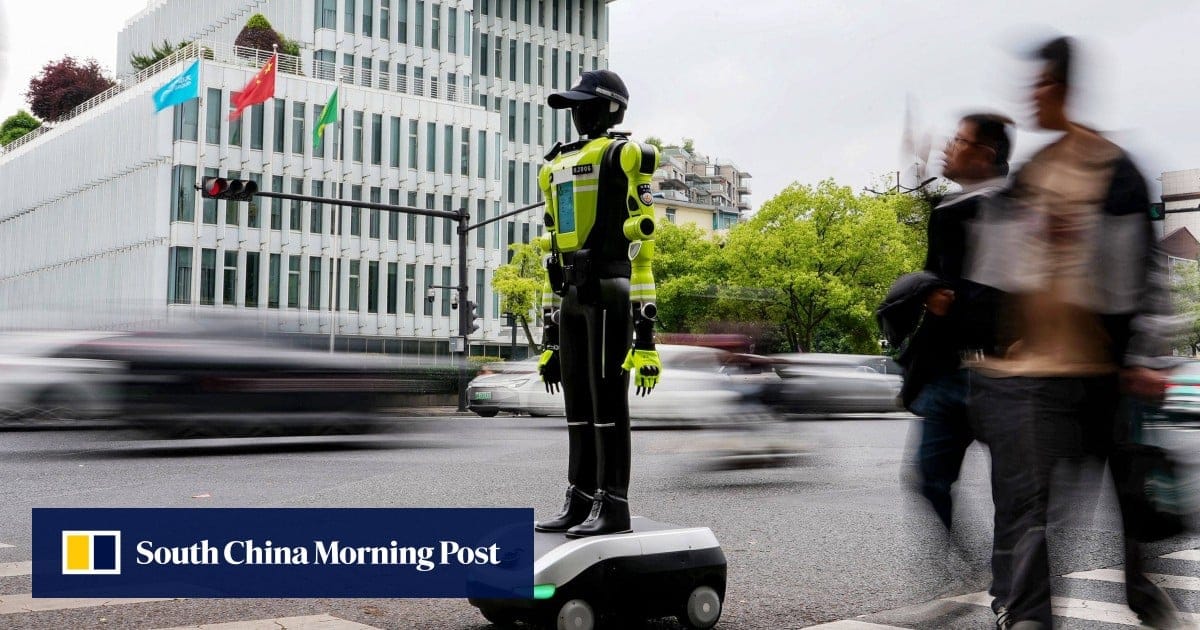
Serial numbers. That's how you know a government expects volume. According to the South China Morning Post, China will assign every domestically made humanoid robot a unique identification code through a national lifecycle-management platform led by the Humanoid Robotics and Embodied Intelligence Standardization committee under the Ministry of Industry and Information Technology. The IDs follow each robot from production to recycling, paired with fresh guidance on supply-chain responsibility.
That sounds bureaucratic. It isn't. China is treating humanoids as a governable industrial category before most of the West has settled on what counts as a commercial deployment. Serial numbers make recalls, liability, procurement rules, and field tracking dramatically easier — and they signal that Beijing expects volume.
What changes if this scales: humanoid procurement in China gets the same boring infrastructure that made automotive supply chains work — and Western buyers eventually demand equivalents. What failure looks like: the registration system becomes a paperwork burden manufacturers route around, and enforcement never materializes. Watch: whether Schaeffler's 2,000-unit Humanoid rollout in Germany triggers an EU-side identification scheme by year-end. The regulatory category, once established, tends to harden fast.
China's AI Token Volume Has Led the World for Four Consecutive Weeks
The most strategically significant number of the week comes with no launch event and no funding round. Tencent News reports that Chinese AI models handled 9.223 trillion tokens during May 18–24, against 4.93 trillion for U.S. models — the fourth consecutive week China has led global weekly usage. Global model calls hit 28.9 trillion tokens last week, up 7.4% week-over-week.
We flagged this trend Sunday when it first surfaced. A four-week streak moves it from data point to pattern. The benchmark wars get the coverage; the usage gap is the story that determines long-term market position. More usage generates more feedback, feedback improves models faster, better models attract more usage. DeepSeek's permanent price cuts and Xiaomi's 99% reduction today are accelerants on the same flywheel.
What changes if this continues: developer mindshare follows where the inference is actually happening, and the "U.S. labs lead" narrative becomes unmoored from observable behavior. What failure looks like: the gap turns out to reflect domestic Chinese consumer usage rather than enterprise or international deployment, and the strategic implication is narrower than it appears. Watch: whether a U.S. enterprise discloses a Chinese model in production within the month. That converts pattern into policy file.
[Source: Tencent News — Chinese]
PrismML Ships a Diffusion Model That Runs Natively on iPhone
No API call. No cloud round-trip. PrismML — Caltech-rooted, backed by Khosla Ventures and Cerberus Ventures — released Bonsai Image 4B today, a family of compressed image-generation models that ship in 1-bit and ternary variants. The company says the compression reduces a modern 4B-class diffusion transformer's footprint by up to 8.3×, making it the first image model in its parameter class to run directly on iPhone. A separate browser path runs the model in-browser via WebGPU. PrismML is also launching Bonsai Studio, an iOS app for trying the model directly.
The r/LocalLLaMA thread is already past 469 points, which suggests genuine developer interest rather than press-release noise.
What changes if quality holds up under independent testing: on-device image generation removes the API call entirely — different privacy calculus, different latency, different cost structure for any app generating images. What failure looks like: the compressed outputs degrade noticeably against cloud diffusion, and the use case stays niche. Watch: whether a mainstream consumer app — a photo editor, a messaging client — ships Bonsai integration in the next 60 days. That's the moment on-device diffusion becomes infrastructure rather than demo.
Louisiana Just Landed Another Multibillion-Dollar AI Data Center
Louisiana officials announced Tuesday that Rapides Parish will host a $3.6 billion AI data center campus, one of the largest economic development projects in the region. Pair this with Oracle's plan to deploy up to 2.45 gigawatts of Bloom fuel cells at its New Mexico data center — disclosed earlier this month by Datacenter Dynamics — and the pattern is clear: the AI infrastructure conversation has moved from chips to megawatts.
A few months ago, Meta's Louisiana energy expansion was the headline. Now another massive campus is heading to the same state, and Oracle is procuring fuel cells at gigawatt scale to skip utility timelines entirely.
What changes if this trend holds: AI competition stops being primarily about models and becomes about who can secure land, generation, and grid priority fastest. What failure looks like: transmission constraints and local opposition stall the announced builds, and the gap between announced and operational capacity widens into a credibility problem. Watch: whether utilities and governors stop talking about tax breaks and start talking about generation capacity. That language shift is the leading indicator.
⚡ What Most People Missed
- Xiaomi's MiMo Token Plan is now drop-in compatible with Claude Code: Developers can run MiMo through the same scaffolding they use for Anthropic models — at a fraction of the cost. The U.S. compliance risk is real, but the open-weight workaround is equally real. This is the quiet infrastructure piece that makes today's price cut more than a headline.
- Mozilla.ai's "cq" — Stack Overflow for Agents — is getting renewed developer attention: Instead of every coding agent rediscovering the same integration bug, agents query a shared commons of past learnings first. It's an architecture signal, not a product launch. If retry loops are what blow up enterprise agent bills, shared memory may become the real moat before another raw model gain does.
- MiMo-V2.5-Pro and DeepSeek V4 Pro now sit at parity on the open-weights intelligence leaderboard: Per Artificial Analysis, Kimi K2.6 (54), MiMo-V2.5-Pro (54), and DeepSeek V4 Pro (52) are clustered at the top — three Chinese open-weight models competing on both capability and price this week.
- China's gaokao just triggered an AI tool blackout across Douyin and Tencent's Yuanbao: Chinese-language feeds report that major AI platforms are disabling or restricting tools during the national university entrance exam. The state controls the on/off switch — a useful counter to the "China deploys AI without guardrails" caricature. [Source: Sina Finance — Chinese]
- China launched its first AI industry mutual insurance association for large models: Sina Finance reports the body is aimed at making model risk systematically insurable across the domestic AI industry. It's a concrete financial backstop for a sector moving fast from pilots to production. [Source: Sina Finance — Chinese]
- DeepSeek's promotional V4 Pro pricing locks in permanently on Saturday, May 31: That deadline is still approaching, and Xiaomi's 99% cut today is best read as a flanking move to grab developers before DeepSeek's rates stabilize.
📅 What to Watch
- If a U.S. enterprise discloses MiMo or DeepSeek in production within 30 days, the AI cost war stops being a procurement story and becomes a Commerce Department file in the same quarter.
- If the Vatican's autonomous-weapons language appears in operative UN text on lethal autonomous weapons systems, Magnifica Humanitas will have done what no secular regulator has managed — gotten the arms-control conversation moving.
- If Lean proof files from Mythos or OpenAI's system get cited in working math papers within two weeks, the "overhang" hypothesis becomes a literature event rather than a corporate blog post.
- If the EU announces a humanoid identification scheme before year-end, China's serial-number framework will have set the global regulatory template — and Western manufacturers will be designing to a Beijing-shaped category.
- If Anthropic or OpenAI introduces consumption-smoothing pricing on agent tiers within 30 days, Xiaomi and DeepSeek will have forced the Western labs into a defensive pricing posture for the first time.
- If a mainstream consumer app ships Bonsai-style on-device diffusion in 60 days, the assumption that creative AI requires a cloud round-trip is officially over.
The Closer
Today: a Chinese phone maker undercut Anthropic by 99% before breakfast, a 42,000-word papal text picked a fight with the Pentagon's targeting doctrine, and somewhere in Beijing a bureaucrat is preparing to assign your future household robot a serial number. The thing nobody's saying out loud is that all three are the same story — the question of who gets to set the defaults — just wearing different costumes. Forward this to the friend who still thinks the AI race is about benchmarks.
— The Lyceum
Send this to one person who'd want it. That's how it spreads.