AI Weekly — Apr 20, 2026

Photo: lyceumnews.com
Week of April 20, 2026
The Big Picture
This was the week the AI race stopped being a metaphor. A robot crossed a half-marathon finish line in Beijing faster than any human ever has. DeepSeek — the Chinese lab that built its identity on refusing outside money — opened its hand for the first time. And Stanford's 2026 AI Index Report landed with a number that should rattle anyone who assumed American dominance was permanent: as of Stanford's 2026 AI Index Report, the US-China performance gap has narrowed to 2.7%, despite the US spending 23 times more on private AI investment, per the report. The story of AI in 2026 is no longer about who has the best model. It's about who can sustain the pace.
What Just Shipped
- Claude Opus 4.7 (Anthropic): New flagship model scoring 64.3% on SWE-bench Pro — up 11 points from Opus 4.6 — with triple the image resolution and a new "xhigh" reasoning tier that Claude Code now uses by default.
- Claude Design (Anthropic): A research-preview tool that turns plain-language instructions into prototypes, slides, and one-pagers, with exports to Canva, PowerPoint, PDF, and HTML.
- Codex Computer Use (OpenAI): Codex can now drive a computer alongside the user, run tasks in parallel, schedule future work, and remember preferences across sessions.
- GPT-Rosalind (OpenAI): A biology and drug-discovery model, released only through a restricted "trusted access" program, already deployed with Amgen, Novo Nordisk, and the Allen Institute.
- Chrome Skills (Google): Save Gemini prompts as one-click workflows that run across multiple browser tabs at once — the first native AI workflow layer in a major browser.
- Gemini Robotics-ER 1.6 (Google DeepMind): Upgraded embodied reasoning model that reads analog gauges at 93% accuracy (up from 23% on the prior version in earlier tests), built with Boston Dynamics' Spot robot.
This Week's Stories
The Number That Rewrites the AI Race
Stanford's 2026 AI Index Report dropped this week, and it contains a number that deserves more attention than it's getting. As of the 2026 report, the performance gap between the best American and Chinese AI models has collapsed to 2.7%, down from a 17.5–31.6 point lead in May 2023 — despite the US spending 23 times more on private AI investment ($285.9 billion versus $12.4 billion).
That 2.7% is the current margin between Anthropic's Claude Opus 4.6 and ByteDance's Dola-Seed-2.0 Preview on Arena scores. It's narrow enough to flip with the next major release. And while the US still leads on investment and top-tier model production, China leads in AI patents (69.7% of global filings), publications (23.2% of global output), and industrial robot installations (roughly 9x the US rate). AI talent migration into the US has dropped 89% since 2017.
Buried deeper in the report is a second finding the capability coverage largely skipped: as of the 2026 report, the Foundation Model Transparency Index has dropped from 58 to 40, with Meta falling from 60 to 31 and Mistral from 55 to 18. The most capable models are becoming the least transparent — at the exact moment they're being deployed in hospitals, courts, and government systems.
If China ships a model that clears the 2.7% gap in the next two quarters, the "America leads in AI" narrative becomes a historical claim. If the US responds with meaningful talent and transparency policy, the gap stabilizes. Watch the migration numbers — they're a structural problem that no chip export control can fix.
DeepSeek Blinked
For two years, DeepSeek was the lab that said no to everyone. No to Sequoia. No to Tencent. No to the entire Chinese venture apparatus. That posture was part of its identity — a research-first institution whose parent hedge fund, High-Flyer Capital, was printing enough returns to self-finance.
This week, according to reporting from The Information citing four people familiar with the matter, DeepSeek is raising at least $300 million in its first outside round at a valuation above $10 billion. The timing is the story: the round comes on the eve of its V4 flagship launch, expected later this month.
The infrastructure detail buried in the reporting is the one that matters most. DeepSeek is migrating V4 entirely off Nvidia chips and onto Huawei's Ascend silicon — engineers are rewriting low-level code to bridge the integration gaps. The company is also building a physical data center in Ulanqab, Inner Mongolia.
If V4 ships at frontier performance on domestic Chinese silicon, the core logic of US export controls takes its most serious hit yet. The observable signal is simple: the model's benchmark scores at release, and whether independent testers can replicate them. If V4 is delayed again or underperforms, the "China can't scale without Nvidia" argument survives another quarter. If it lands as promised, expect a policy response from Commerce within weeks.
A Robot Just Beat the Human Half-Marathon World Record
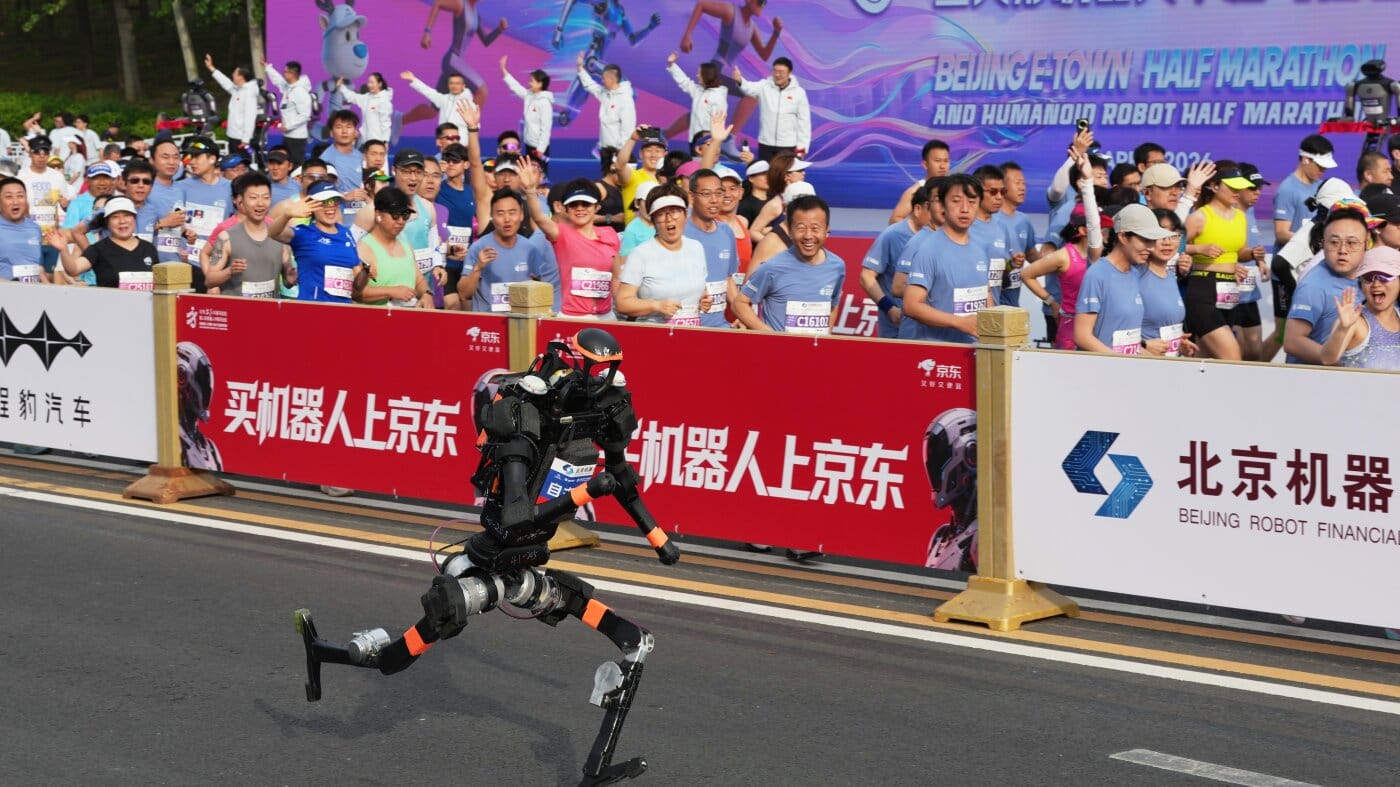
Yesterday in Beijing, a humanoid robot built by Chinese smartphone maker Honor completed a 21-kilometer race in 50 minutes and 26 seconds — faster than Uganda's Jacob Kiplimo, who set the human world record of roughly 57 minutes in Lisbon last month. Honor's robots took the top three spots, all self-navigated.
The year-over-year jump is the real signal. Last year's inaugural race winner finished in 2 hours, 40 minutes. This year's winner was more than three times faster. 112 teams entered, including five international teams from Germany, France, and Brazil.
The caveats matter. Mid-race footage showed engineers packing robot joints with ice at pit stops — thermal management remains a limiting factor. And as analysts at CNBC noted, speed on a closed course is not the same as assembling a car door. Manual dexterity, real-world perception, and handling unexpected situations are where humanoids still struggle.
But two things changed this week that reframe the story. First, Boston Dynamics said serial production of Atlas has begun — and Hyundai has already sold out the 2026 allocation. Hyundai Mobis adapted its mass-produced automotive actuator designs for robot joints, cracking the economics that Google and SoftBank couldn't solve when they owned Boston Dynamics. Second, reports point to roughly 40 Chinese "robot schools" running humanoids 24/7 to generate physical training data at industrial scale.
The humanoid race just moved from engineering to manufacturing. Watch whether Hyundai announces a second production facility by Q3. That signals whether this is a sustained market or a one-time event.
Anthropic's Dangerous Admission
Claude Opus 4.7 launched this week to strong reviews. SWE-bench Pro jumped from 53.4% to 64.3% on release. Cursor's internal benchmark moved from 58% to 70% on release. Artificial Analysis ranked it #1 on GDPval-AA, its agentic-work benchmark. Same pricing as before: $5 per million input tokens, $25 per million output.
The more consequential part of the launch wasn't the model. It was what Anthropic said about the model it didn't release.
Anthropic openly acknowledged that Claude Mythos Preview — its most capable model — is being withheld because it's too dangerous for broad release, particularly around cybersecurity. Opus 4.7 is explicitly being used as a live test bed for the safety infrastructure Anthropic thinks it will need before Mythos ships more widely. The company says it even experimented with reducing Opus 4.7's cyber capabilities during training.
Meanwhile, according to The Information, Google is in talks with the Department of Defense to deploy Gemini models inside classified environments — work Anthropic has refused. The Pentagon's AI roster is getting crowded, and labs are making very different bets about where the line is.
If Mythos is released publicly within six months, the safety framework worked. If it stays gated for 12+ months, the risks are structural, not temporary — and Anthropic is now operating a permanent two-tier model strategy. Either outcome reshapes how every other lab thinks about withheld capability.
OpenAI Builds a Model for Biologists — and Locks It Behind a Velvet Rope
Drug discovery takes 10 to 15 years on average, and most of the wasted time lives in the early stages — figuring out what's worth testing at all. GPT-Rosalind is OpenAI's attempt to compress that window.
The model connects to more than 50 scientific databases and tools, synthesizes literature, generates hypotheses, and plans experiments. On RNA prediction tasks run with Dyno Therapeutics using unpublished sequence data, OpenAI says its outputs ranked above the 95th percentile of human experts. It beats GPT-5.4 on 6 of 11 tasks in the LABBench2 benchmark.
It's already being used by Amgen, Novo Nordisk, Moderna, Thermo Fisher, and the Allen Institute — but only by them, and only through a restricted "trusted access" program. There's no public API. No consumer tier. No "try it now" button.
The velvet rope is the story. OpenAI appears to be learning from Anthropic's Mythos situation: some capabilities are valuable precisely because they're controlled. If other labs launch similarly gated domain models for law, finance, or defense by end of Q2, the industry is shifting away from one-size-fits-all chatbots toward professional-tier AI that looks more like Bloomberg Terminal than ChatGPT. The observable signal is whether access expands on a predictable timeline — or stays permanently narrow.
Chrome Becomes an Agent Platform
Google rolled out Skills in Chrome on April 14, letting users save Gemini prompts as reusable one-click workflows that execute against the current page or across multiple tabs. You type a slash, pick a skill, and it runs. The browser comes with a starter library — ingredient analyzers, gift finders, document scanners — and you can build your own.
On its face, this is a convenience feature. But it's the first time a browser vendor has shipped persistent AI workflows as a native capability, exposed to regular users. What developers used to build manually with LangChain pipelines and prompt management systems now ships inside Chrome's UI. Google added confirmation gates for high-impact actions like sending emails or creating calendar events — a direct response to the agent-safety problem that's dogged the whole category.
The bigger move is what this enables. Combined with Google DeepMind's upgraded Gemini Robotics-ER 1.6 (which now reads analog gauges at 93% accuracy, up from 23% on the prior version in earlier tests) and the new native Gemini app for Mac, Google is staging a product offensive across browser, robotics, and desktop simultaneously. If Google I/O in May includes a consumer robotics product or a Gemini 3.1 Ultra announcement, it confirms the company has decided to compete on every front at once.
The Open-Source Agent Ecosystem Has a Security Crisis
At an AI engineering conference in San Francisco this week, Peter Steinberger gave two talks about OpenClaw — the fastest-growing open-source project in history. The public version at TED was inspiring. The version for engineers was grim.
Steinberger described 60 times more security reports than curl receives, and estimated that at least 20% of community-contributed "skills" to the platform were malicious. An adjacent finding from community trackers: roughly 135,000 OpenClaw instances are exposed on the public internet with critical privilege-escalation vulnerabilities.
This isn't unique to OpenClaw. It's the shape of the whole open-agent moment. Hermes Agent, Deep Agents, Claude Code skill libraries — GitHub trend trackers show a cluster of "agent harness" tools adding tens of thousands of stars a week. Nous Research's hermes-agent added roughly 38,000 stars this week alone. The middleware layer for agents is being built in public, at speed.
The problem is that agents touch real systems — files, calendars, API keys, production databases. The old pull-request review model assumed human maintainers could catch bad code. When contributions come from anonymous actors at scale, and the software runs with elevated permissions, the security model breaks. GitHub quietly let maintainers disable pull requests on open-source repos this week — the first time in 21 years they've offered that option. The old collaboration primitives are straining.
⚡ What Most People Missed
A preprint claims to have solved diffusion language models' core quality problem. The "Introspective Diffusion Language Models" paper (April 13, 2026) introduces a decoding algorithm called Introspective Strided Decoding. The authors — including Tri Dao of FlashAttention fame and Stanford's James Zou — report their 8B-parameter model matching a 16B autoregressive competitor while delivering 2.9–4.1x throughput at high concurrency. Still a preprint, benchmarks self-reported, but the author list is credible. Independent replication is the next gate.
UBTECH is paying $18 million a year for a single embodied-AI researcher. The humanoid talent war just went nuclear. That's venture-scale compensation for one hire, and it signals that some Chinese robotics firms have decided top researchers are worth more than small companies. [Source: UBTECH recruitment listing]
Europe's AI transparency rules take effect August 2, 2026. The European Commission's consultation on code-of-practice for transparent AI systems is live now, with the AI Act's disclosure obligations for AI-generated content coming into force on August 2, 2026. The difference between "disclose sometimes" and "disclose by default, machine-readably" is product architecture, not PR copy. Teams shipping consumer AI in Europe have four months.
📅 What to Watch
- If DeepSeek's V4 ships on Huawei Ascend chips this month and posts frontier benchmark scores, the US export-control thesis fails at its core, and Commerce responds within weeks.
- If Claude Code's weekly user numbers approach Codex's three million by May, the coding agent market consolidates into a duopoly and model quality becomes secondary to distribution.
- If Hyundai announces a second Atlas production facility by Q3, humanoid manufacturing moves from one-time event to sustained industrial category — and every other carmaker faces a build-or-partner decision.
- If more than three labs launch restricted-access domain models by end of Q2, the industry has chosen professional-tier AI over universal chatbots, and the business model for frontier AI fundamentally changes.
- If Google I/O in May includes a consumer robotics product, Google is betting it can compete on hardware where it's historically failed — watch whether the announcement includes a partner or is fully in-house.
The Closer
A robot crossing a Beijing finish line with ice packed into its knees; a hedge fund that spent two years refusing venture capital suddenly passing the hat in Inner Mongolia; Anthropic selling you the second-best model while keeping the dangerous one in the basement. Somewhere in a Hyundai factory, a production line is being retooled to build the robots that will eventually work the production line — and the only real question is whether they'll unionize before the humans do.
See you next week.
If you know someone who'd rather read this than skim five tech blogs — forward it along. That's how this thing grows.
From the Lyceum
A jury just told Live Nation it may be time to start packing — and the remedies phase is where the real fight begins. Read → A Jury Just Told Live Nation to Start Packing