The Lyceum: Biotech & Life Sciences Weekly — Mar 22, 2026
Photo: lyceumnews.com
Week of March 22, 2026
The Big Picture
Biology is quietly winning arguments that chemistry used to own. This week, gene-edited cells made insulin inside a human body without immunosuppression, a CRISPR-tuned fungus made meat economics look nervous, and bacteria learned to adapt like tiny brains — not metaphorically, but through engineered genetic circuits that implement actual learning rules. The common thread isn't any single breakthrough; it's that the engineering platforms underneath all of this — the promoter toolkits, the protein nanoshells, the autonomous enzyme labs — are maturing fast enough that the gap between "cool preprint" and "industrial process" is measurably shrinking.
This Week's Stories
A Man With Type 1 Diabetes Makes His Own Insulin — From Cells Designed to Hide
For 400 million people with diabetes worldwide, the daily arithmetic of finger pricks and insulin doses is life itself. This week brought the clearest signal yet that the arithmetic might change. A Vertex-led team transplanted CRISPR-edited pancreatic cells into a type 1 diabetes patient — stem-cell-derived islets engineered to produce insulin on demand and dodge immune attack by knocking out the HLA proteins that flag cells as foreign. No immunosuppression drugs. Early data shows the cells engrafting safely.
This isn't the only approach racing toward the same finish line. A C&EN deep dive published this month maps the competitive landscape: Sana Biotechnology used CRISPR-Cas12b to create "hypoimmune" islets that silence immune-recognition genes and upregulate CD47 — the "don't eat me" signal. In their case, a 42-year-old Swedish patient received only about 7% of a curative dose in that patient, yet PET/MRI showed surviving cells producing insulin at 3–12 months. Sana is targeting an IND filing in Q2 2026; Vertex is scaling production to billions of cells in bioreactors.
If either approach delivers durable glucose control without immunosuppression, it transforms type 1 diabetes from a lifelong management problem into a one-time procedure. If the immune evasion fails at higher doses — or manufacturing can't produce consistent cells at scale — we're back to incremental improvements on existing pump-and-inject systems. The signal to watch: glucose control data from the Vertex patient over the next six months, and whether Sana's IND actually files in Q2 2026.
Half the Tumors Disappeared — Rockefeller's Immunotherapy Cracks Cold Cancers
Checkpoint inhibitors changed oncology, but they mostly work on "hot" tumors already infiltrated by immune cells. Pancreatic cancer, bile duct cancer — the cold tumors — shrug them off. Rockefeller's Phase I/II results this week change that calculus: in 28 patients with advanced solid tumors, a CD8-targeting bispecific antibody produced objective responses in 50% of patients in the Phase I/II trial, including complete remissions in pancreatic and bile duct cancers.
The mechanism is distinct from CAR-T (no cell manufacturing) and from standard checkpoint blockade (active recruitment and activation of killer T cells rather than just removing the brakes). The drug essentially grabs CD8+ T cells and drags them to the tumor, then keeps them from exhausting — a two-step solution to the two problems that make cold tumors cold.
If this holds in Phase II expansion, it opens a treatment path for cancer types that have had essentially no immunotherapy options. If the responses don't durably replicate in larger, more diverse cohorts — a common failure mode for small Phase I/II trials — it joins a long list of exciting early signals that didn't scale. Watch enrollment speed and whether any pharma partner steps in for the expansion trial; both are proxies for how seriously the field takes the data.
Two Genes Out, One Superior Fungus In — CRISPR Rewrites the Mycoprotein Math
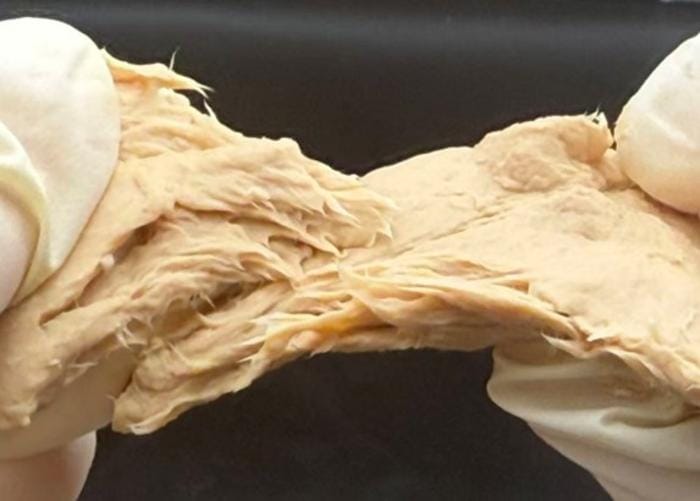
Lab-grown meat keeps promising scale and keeps not delivering it. Meanwhile, a CRISPR-edited fungus is quietly making the economics of alternative protein look very different. Researchers at Jiangnan University took Fusarium venenatum — the organism behind Quorn — and deleted two genes. One deletion thinned the cell wall, making protein more bioavailable. The other rewired carbon metabolism to waste less sugar on byproducts.
The numbers, per Phys.org's reporting: 44% less sugar required in the study's fermentation tests, 88% faster growth in lab conditions, greenhouse emissions cut up to 60% in the study's life-cycle analysis, and 70% less land than chicken production in the life-cycle analysis. The life-cycle analysis covered six country scenarios — unusually rigorous for food-tech. Crucially, no foreign DNA remains in the edited strain, which positions it favorably under regulatory frameworks like the EU's evolving New Genomic Techniques rules that distinguish gene-edited foods from traditional GMOs.
If pilot-scale fermentation confirms these numbers and regulatory pathways open, CRISPR-tuned mycoproteins could reach price parity with chicken trimmings and start appearing in processed foods well before cultured meat scales. If the numbers don't replicate in larger fermenters, or if regulators treat the edits as GMOs anyway, it stays a compelling paper. The tell: watch for scale-up partnerships or offtake agreements in the next 12 months.
A Sleep Apnea Pill That Actually Works — and 80 Million People Are Waiting
Half of CPAP users abandon their masks. For the estimated 80 million undiagnosed people with sleep apnea in the U.S. alone, there hasn't been a real alternative. Apnimed's AD109 just delivered one: a 300-patient Phase II trial reported March 20, 2026, showed a 55% reduction in the apnea-hypopnea index in the trial, with the strongest effects in obese patients. The drug targets orexin neurons to maintain airway muscle tone during sleep — no hardware, no mask, no hose.
If Phase III (starting Q2 2026) confirms these results, this becomes one of the largest addressable markets in medicine — sleep apnea is linked to hypertension, stroke, and heart failure, and most cases go untreated because the current solution is a machine people hate wearing. If the effect size shrinks in larger trials or side effects emerge at scale (orexin modulation touches wakefulness, appetite, and mood), the CPAP remains king by default. Signal to track: Phase III enrollment pace and whether the FDA grants fast-track designation.
Bacteria That Learn — A Genetic Circuit That Implements Hebbian Rules
This one sounds like science fiction, but the wet-lab data is real. A bioRxiv preprint from March 18, 2026, describes E. coli engineered with a genetic circuit that implements a local learning rule — the same "neurons that fire together wire together" logic that governs synaptic strengthening in brains. Repeated chemical stimuli strengthen certain gene-expression responses and weaken others. The bacteria demonstrably "learned" to navigate toward nutrients, boosting survival fivefold in the experiments' dynamic environments.
The team ran real-time microfluidic experiments with fluorescent reporters, demonstrated learned toxin avoidance across generations, and included controls for circuit leakage and stochastic noise. This isn't cells merely responding to stimuli — it's cells tuning themselves based on experience, in a programmable way.
If the circuits prove robust and transferable to other organisms, this becomes a new class of tool for industrial biotech: fermentation strains that dynamically adjust their own metabolism in response to changing conditions without external sensors. If the learning degrades over generations or can't survive the stress of production-scale fermenters, it remains a beautiful proof-of-concept. The test: whether anyone ports this circuit into a medically or industrially relevant chassis within the next year.
Nature's Nanofactories Get a Multi-Lab Stress Test
Bacterial microcompartments — protein shells that bacteria use as tiny, self-assembling reaction chambers — have been a promising tool for years. What's been missing is confidence that they work reliably across different enzymes and different labs. A multi-lab preprint posted March 18, 2026, provides exactly that: several groups independently loaded different enzyme cascades into standardized BMC shells and showed consistent 5–10x activity improvements over free enzymes in the experiments, with proof-of-concept yields approaching 200 mg/L in those experiments.
Think of it as a biological version of containerized software: drop your enzyme cascade into the shell, and it runs in isolation from the host cell's metabolism. The ACS Nano work on chaotrope-based assembly provides the loading method; this preprint provides the multi-enzyme, multi-site validation that the approach generalizes.
If CDMOs adopt BMC shells for bespoke cascades — and the design files are being shared openly — this quietly becomes foundational infrastructure for cell-free manufacturing. If the yields plateau at bench scale or the shells can't handle the shear forces of industrial fermenters, it stays academic. Watch for any CDMO announcing a BMC-based process within the next two years.
The FDA Opens a Door for Organoids, Chips, and Computational Models
The FDA issued draft guidance this week describing how drug developers can validate new approach methodologies — organ-on-chip systems, human-cell models, computational approaches — to replace animal testing for certain preclinical decisions. This isn't a mandate to stop using animals; it's a formal pathway saying: if you can demonstrate your human-relevant model predicts safety and efficacy as well as an animal model, we'll accept the evidence.
For synthetic biology companies building organoid platforms, and for the broader push toward human-relevant preclinical data, this is the regulatory signal they've been waiting for. It compresses preclinical timelines for anyone whose platform validates. If the comment period produces a watered-down final guidance, or if validation standards prove impossibly high, the status quo persists. The concrete signal: watch which companies submit validation packages in the next 12 months, and whether the FDA accepts any before the guidance is finalized.
⚡ What Most People Missed
- Seven new inducible promoters for Zymomonas mobilis — the ethanol workhorse that's been hard to engineer precisely — were characterized in a bioRxiv preprint this week. The NREL-affiliated team confirmed minimal crosstalk via RNA-seq and drove a butanol pathway to ~12 g/L. Nerdy chassis work, but these genetic dials are what separates a nice paper from a viable industrial process for next-gen biofuels and chemicals.
- Edinburgh researchers engineered E. coli to convert PET plastic waste into L-DOPA, a frontline Parkinson's drug, achieving 5.0 g/L by splitting the pathway across two strains. Bio-upcycling — adding pharmaceutical value to waste streams — is a more compelling economic story than simple plastic degradation.
- A PHA nanoparticle toolbox for Cupriavidus necator lets manufacturers grow biodegradable plastic beads with customizable surface chemistry — enzymes, targeting ligands, binding tags — during fermentation. This reframes bioplastic from commodity resin to tunable nanomaterial platform for drug delivery and immobilized biocatalysis.
- FDA approved expanded use of IMCIVREE (setmelanotide) for acquired hypothalamic obesity on March 19, 2026, validating brain-circuit metabolic mechanisms. Separately, Lynavoy (linerixibat) was approved for cholestatic pruritus in primary biliary cholangitis the same day — a quiet win for ileal bile acid transporter inhibition as a drug class. Per RTTNews FDA calendar.
📅 What to Watch
- If Sana Biotechnology files its hypoimmune beta-cell IND in Q2 2026, it means manufacturing and safety data are mature enough to run a real trial — and the race between Sana and Vertex becomes the defining competition in regenerative medicine for diabetes.
- If Carbios reports first-run output from its Longlaville enzymatic PET recycling plant, it validates biological plastic recycling at industrial scale and reshapes feedstock economics for biomanufacturers that rely on recycled inputs.
- If the EU votes to advance the New Genomic Techniques framework, CRISPR-edited foods like the Fusarium mycoprotein move from lab to market years faster — and the regulatory divergence with non-EU countries becomes a trade issue.
- If anyone demonstrates the bacterial learning circuit in a gut commensal or industrial production strain, it signals that adaptive living therapeutics and self-tuning fermentation are no longer theoretical categories.
The Closer
A fungus that forgot how to waste sugar. A bacterium that learned to remember. A protein shell that runs any enzyme you hand it, like a biological shipping container that doesn't care what's inside.
Somewhere, a spider is watching Kraig Labs' Vietnamese factory and wondering if it should unionize.
Until next week — stay curious, stay skeptical.
If someone you know is watching biology eat chemistry's lunch, forward this their way.
From the Lyceum
The White House released an AI legislative blueprint — and told the states to back off. Read → The White House Releases an AI Rulebook