Critical Minerals Weekly — Apr 22, 2026
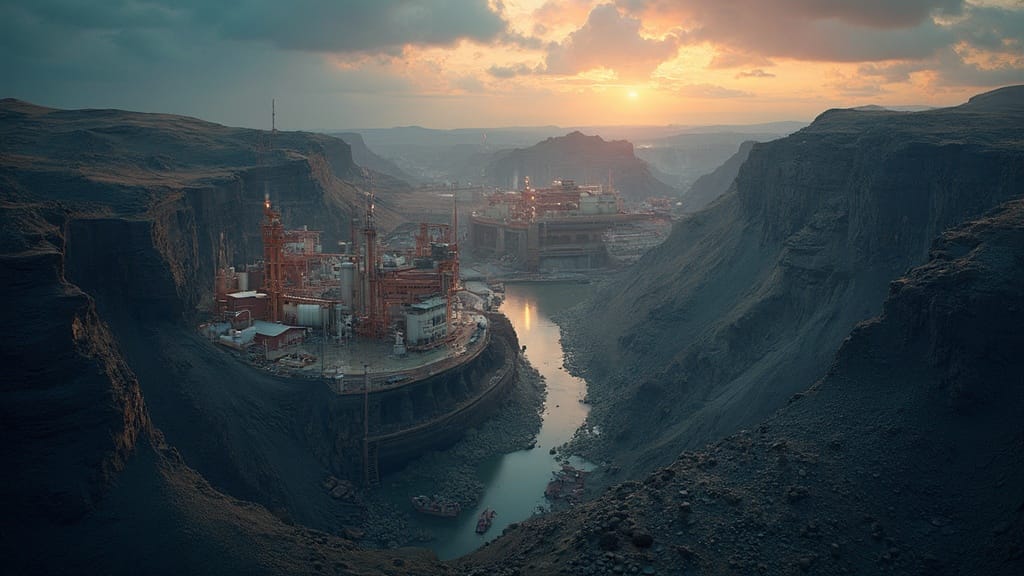
Photo: lyceumnews.com
Week of April 22, 2026
The Big Picture
This was the week the Western rare earth story stopped being about rocks. USA Rare Earth is paying $2.8 billion for a Brazilian mine to anchor a U.S. magnet line, CATL is charging an EV in six minutes with a chemistry that needs no cobalt and no nickel, and the U.S. Trade Representative is telling allies — out loud now — that they'll need to pay a "security premium" for supply that doesn't transit Chinese ports. Processing, chemistry, and price floors: that's the whole game now.
This Week's Stories
USA Rare Earth Buys Brazil's Serra Verde for $2.8 Billion — and the Magnet Supply Chain Gets Its First Real Non-Asian Anchor
The rare earth magnet bottleneck has never really been about finding deposits. It's been about finding a producer outside Asia that can deliver all four magnetic rare earths — neodymium, praseodymium, dysprosium, and terbium — at commercial scale. On Monday, that bottleneck got a serious challenger.
USA Rare Earth (Nasdaq: USAR) announced a definitive agreement to acquire 100% of Serra Verde Group, owner of the Pela Ema mine and processing plant in Goiás, Brazil, for roughly $2.8 billion — $300 million in cash and 126.849 million newly issued shares. Pela Ema is currently the only large-scale producer outside Asia capable of supplying all four magnetic rare earths, and Serra Verde has a 15-year offtake agreement with a U.S. government-backed special purpose vehicle covering 100% of that production.
If this works, the architecture is genuinely new: Brazilian ore, U.S. magnet plant in Oklahoma, federal offtake with what appears to be embedded price support. The combined company projects approximately $1.8 billion in EBITDA by 2030 — a company projection, not an independent estimate. The deal is expected to close in Q3 2026.
If it fails, the failure mode is legible: Serra Verde's Phase 2 expansion doesn't complete until mid-2027, Chinese spot prices flood the market before Western production scales, and the SPV's price floor gets stress-tested earlier than anyone wants. The signal to watch is whether the SPV structure gets disclosed publicly. If it does, it becomes the template other allied rare earth projects copy. If it stays opaque, it stays bespoke — which limits how much architecture this actually builds.
CATL's Six-Minute LFP Battery Is a Demand-Side Earthquake for Lithium and Phosphate
The important thing about CATL's new battery isn't the charging speed. It's what it does to the argument for leaving lithium iron phosphate (LFP) chemistry behind.
At its 2026 Tech Day, CATL unveiled the 3rd-generation Shenxing LFP battery: 10% to 80% charge in 3 minutes 44 seconds, 10% to 98% in 6 minutes 27 seconds, with internal resistance of 0.25 milliohms — 50% lower than the industry average as of 2026, per CATL. At −30°C, 20% to 98% still takes about 9 minutes. Capacity retention stays above 90% after 1,000 cycles, the company says.
Here's why this reprices the upstream map: LFP uses lithium and iron phosphate — no cobalt, no nickel. Every EV that stays on LFP rather than migrating to nickel-manganese-cobalt is a vote for lithium and phosphate demand over cobalt and nickel demand. CATL also introduced Naxtra, its sodium-ion battery, with mass production targeted for end of 2026, and teased a 1,500 km pack. All company-disclosed targets, not independently verified.
What to watch: whether OEMs outside China begin specifying Shenxing 3rd Gen in 2027 models. That's the moment the demand signal goes global — and the moment cobalt and nickel processors with 2028–2030 payback assumptions need to revisit their cash-flow models.
The U.S. Trade Representative Tells Allies to Pay a "Security Premium" — and the Price Floor Architecture Gets Clearer
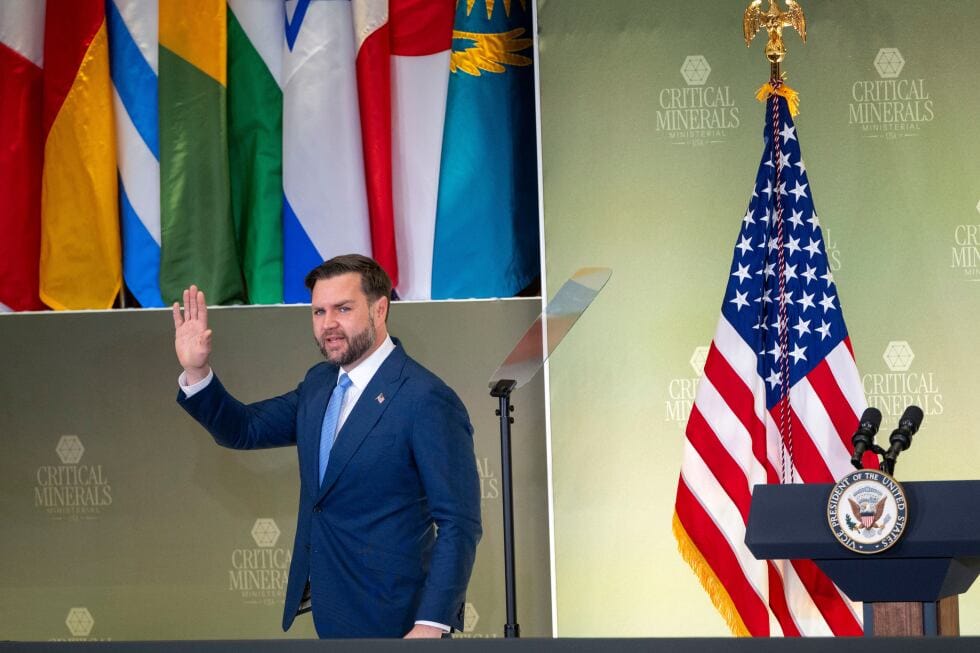
The most important policy signal this week wasn't a funding announcement. It was a sentence about pricing.
U.S. Trade Representative Jamieson Greer told allied nations this week that they should be prepared to pay a "national security premium" for critical minerals sourced outside China. AP and others reported the line. The administration, per the same reporting, is considering a formal price floor mechanism for certain critical minerals — an instrument designed to neutralize the single biggest weapon Beijing has against Western projects: the ability to flood the market and crater prices before a new plant pours its first ingot.
This architecture helps explain the Serra Verde offtake's logic. The government-backed SPV with embedded price support parallels the mechanism Greer described.
The question now is whether allied OEMs — European automakers, Japanese electronics manufacturers — actually accept the premium, or keep sourcing Chinese material as long as it's cheaper. The observable signal: whether the G7 minerals ministerial later this year produces a multilateral floor, or produces another communiqué. One of those changes procurement. The other doesn't.
Australia and the U.S. Sign a $5 Billion Manufacturing-Linked Critical Minerals Framework
Quietly, while Serra Verde dominated the wire, Canberra and Washington formalized a $5 billion framework tying critical minerals investment to downstream manufacturing outcomes — not just extraction. Projects seeking support need to demonstrate processing or manufacturing linkages on one end of the chain.
This is the processing-geography shift in institutional form. The framework reportedly includes concessional loans and offtake guarantees to de-risk bankable projects — lithium hydroxide plants, nickel sulfate, rare earth separation — rather than grants to exploration juniors. Early targets flagged in coverage include Queensland lithium hydroxide tied to U.S. battery gigafactories and Northern Minerals' Browns Range heavy rare earth refinery, which reached financial close earlier this month.
Success looks like Lynas Rare Earths or Northern Minerals being formally designated under the framework before end of Q2, with disbursement schedules attached. Failure looks like another round of ministerial photos without named projects six months from now. The delivery test has started.
Canada Signs 20+ Critical Mineral Deals — But Faces a $12 Billion Gap Between Diplomacy and Actual Mines
Canada has been on a diplomatic sprint. MOUs don't smelt ore.
According to The Hub, Canada has signed over 30 critical mineral agreements unlocking $12.1 billion in mining project capital. Canada's prime minister elevated partnerships with India and Australia this week, with critical minerals named alongside defence and AI. Foreign Affairs Minister Anita Anand is in Washington as the Trump administration pitches a Canada–U.S. critical minerals trade zone. Ottawa also committed roughly $3.6 billion this week toward onshore refining for lithium, nickel, cobalt, and graphite anodes — complementing the $2 billion Critical Minerals Sovereign Fund announced in March.
The Hub's blunt line: "America is rapidly crowding us out of the market. It's time for the federal government to put its MoUs where its mouth is." CSIS, in its own analysis this week, argued Canada may be the United States' best hope for minerals security — precisely because geology and geography line up — but warned that REE margins are "punishingly slim, driven down further by China's ability to channel state resources."
The signal to watch: whether the Sovereign Fund makes equity investments in processing facilities, not exploration. Announced is not financed. Financed is not construction. Construction is not qualified product.
BHP Hits Record Escondida Throughput — and the Copper Supply Picture Gets a Rare Piece of Good News
In a week dominated by rare earths, copper delivered a signal worth noting. BHP reinforced its fiscal 2026 outlook, with Escondida — the world's largest copper mine, in Chile's Atacama Desert — hitting record throughput. The company now expects nearly 2 million tonnes of copper production across its portfolio for the year.
This matters amid a copper deficit narrative that rests partly on whether aging porphyry deposits can sustain output as ore grades decline. Escondida's record throughput suggests processing efficiency gains are partially offsetting grade decline — for now. The caveat: record throughput at lower grades means more rock moved per pound of copper, with energy and water consequences. Escondida's water supply agreements are always a dry-season constraint in the Atacama. Watch whether they hold.
USA Rare Earth's French Processing Partnership, Buried Under the Serra Verde Headline
The wires this week were all Serra Verde. The more strategically interesting thread happened earlier in April and is being overlooked: USAR's partnership with French rare earth processor Carester, paired with commercial-grade yttrium metal production starting up at a UK facility.
Commercial yttrium metal production outside China is genuinely rare — the last time a Western facility did this at scale was years ago. Carester operates a rare earth separation facility in France and has been quietly building European processing capacity. A U.S. mine-to-magnet platform linking American mining, French separation chemistry, and now Brazilian heavy rare earth feedstock is a fundamentally different architecture than anything that existed six months ago, per Fortune's reporting on the broader USAR strategy.
Success looks like Carester's separation capacity formally integrated into the Serra Verde-to-Oklahoma supply chain with disclosed terms. Failure looks like the Carester partnership staying at MOU level while Serra Verde's output is sold into whatever separator will take it. Watch for disclosed tonnage commitments.
⚡ What Most People Missed
- The DFC just bought into South Africa's phosphate waste piles. The U.S. International Development Finance Corporation made a $50 million equity investment — equity, not a loan — in a project to extract rare earths from tailings dunes at a legacy phosphate plant in Phalaborwa, per reporting in the Washington Times. The feedstock is already above ground; the infrastructure already exists. And the check cleared despite significant U.S.–South Africa diplomatic friction, which tells you how seriously Washington is treating the diversification mandate. [Washington Times]
- A Defense Priority rating just landed on a rare earth separator's construction equipment in Louisiana. Ucore Rare Metals received a DPAS-rated long-lead component on April 16 at its Louisiana Strategic Metals Complex, per the company. DPAS — Defense Priorities and Allocations System — means suppliers must fulfill this order ahead of commercial ones. The U.S. government is now queue-jumping rare earth separation capacity through its procurement priority system, not just funding it. [Ucore]
- REalloys and U.S. Critical Materials signed an MOU to build the oxide-to-metal step. That's the step between separated rare earth oxides and finished magnets — the step almost every Western rare earth roadmap quietly skips. The MOU isn't a financed project, but pairing REalloys' defense magnet customer base with a processing partner signals someone is finally trying to close the gap on U.S. soil. [REalloys / US Critical Materials MoU]
- Europe's black mass reclassification is quietly turning scrap into captive feedstock. The European Commission's updated waste codes — black mass classified as hazardous, shipments to non-OECD countries banned — are now mechanically harder to export and easier to process inside the bloc. A boring rule change is doing what years of industrial policy could not: it's keeping recycled battery material inside European recyclers' permit envelopes. [European Commission]
- China's March magnet export data showed the bifurcation deepening. Global shipments rose roughly 10% year-on-year in March. Shipments to the United States and Japan both declined — continuing the pattern from January–February, when U.S. shipments were down 22.5% year-on-year. Beijing isn't using the export tap as an on/off switch. It's using it as a precision instrument. [Source: e南洋 — Chinese] [China's March rare earth magnet exports]
📅 What to Watch
- If CATL's Naxtra sodium-ion hits mass production on schedule at year-end, watch lithium carbonate futures — a credible non-lithium alternative for stationary storage caps the current price recovery in a way most spreadsheets don't assume.
- If the Serra Verde SPV's price floor structure gets publicly disclosed at closing, it becomes the template for allied rare earth projects in Canada, Australia, and Southeast Asia — and the first transparent test of whether OEMs will actually pay the premium.
- If OEM earnings calls start discussing battery chemistry mix by model and region rather than just EV volumes, sodium-ion and fast-charge LFP have become procurement decisions, not R&D footnotes — and nickel/cobalt offtake assumptions need to be rewritten.
- If Lynas or Northern Minerals receive formal designation under the Australia–U.S. $5 billion framework before end of Q2, the framework has moved from press release to industrial policy; if they don't, it's another ministerial photo op.
- If April's Chinese magnet export data shows European buyers joining the U.S. and Japan in seeing declines, the bifurcation is no longer a bilateral signal — it's a broader policy of channeling supply toward non-Western-aligned customers.
- If Energy Fuels' reported bid for Australian Strategic Materials closes, Dubbo metallization capability comes under North American-aligned ownership — and the midstream consolidation story turns from thesis into balance sheet.
The Closer
This week: a Brazilian mine got wrapped in an American flag, an EV charged faster than a gas station card reader can process a tip, and a U.S. government agency wrote an equity check into a pile of South African phosphate dust while the State Department wasn't on speaking terms with Pretoria.
Washington has finally found the sentence it couldn't say out loud for a decade — non-Chinese minerals cost more, and you're going to pay for them — and somewhere an OEM procurement director is staring at a spreadsheet wondering whether "national security premium" is a line item or a lifestyle.
Until next week.
Forward this to the procurement lead who still thinks the Serra Verde deal was about Brazil.