The Lyceum: Critical Minerals Weekly — Mar 18, 2026
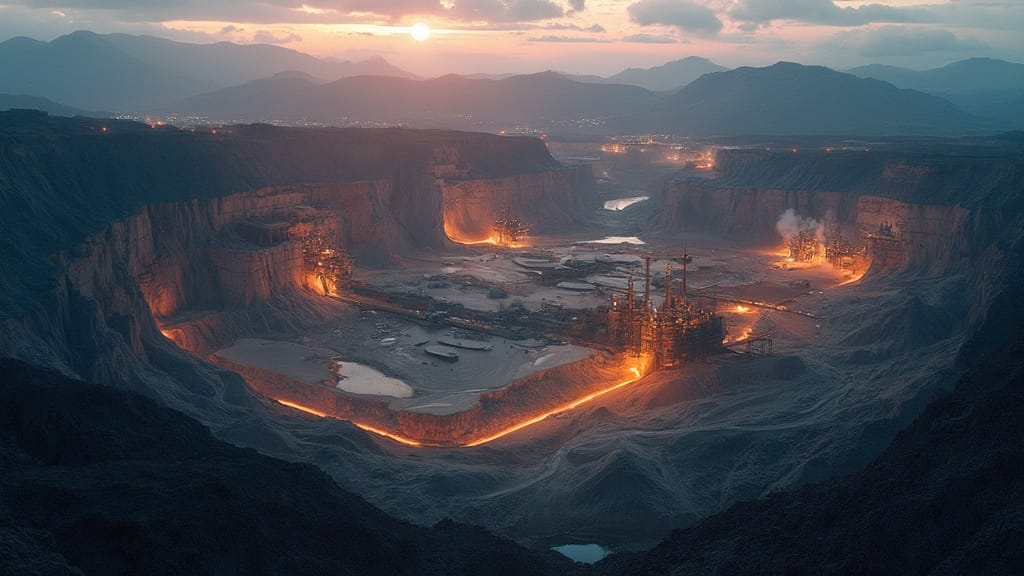
Photo: lyceumnews.com
Week of March 18, 2026
The Big Picture
The IEA published data this week showing that refining concentration for critical minerals got worse in 2024 — the top three processing nations controlled 86% of output in 2024, up from 82% in 2020, with nearly all growth accruing to China. Meanwhile, allied governments are finally writing checks instead of communiqués: price floors embedded in commercial contracts, $500 million DOE funding windows, a fully financed heavy rare earth plant in Saskatchewan, and a U.S.–Indonesia trade pact that barters tariff relief for midstream access. The question is no longer whether the West is serious about breaking China's processing lock — it's whether the money arrives before the November 10 export-control clock runs out.
This Week's Stories
China's Processing Lock Isn't About Ore — and Everyone Finally Admits It
A Fortune interview this week delivered the clearest articulation yet of a truth the minerals world has been dancing around: China accounts for roughly 70% of global rare earth production as of 2024, but it's the country's dominance in processing that gives Beijing real leverage. The ore is interesting. The refinery is the chokepoint.
Since the 1980s, China has invested billions in government-led subsidies and strategic planning to lock down every step of the rare earth value chain — separation, alloying, magnet manufacturing. The rest of the world is now trying to compress four decades of patient industrial policy into a single administration's term. South Korea has some processing technology, but it's small-scale. Aclara Resources announced a demonstration plant targeting 175 kg/day of NdPr alloy (the core permanent-magnet input) at greater than 99.5% purity, using proprietary electrolysis cells with "no established industrial standard outside of China" — but that's a demo, not a commercial facility.
This matters: building a Western rare earth industry could take a decade. The IEA's own numbers reinforce the point — the average market share of the top three refining nations rose to 86% in 2024, and investment growth in critical minerals slowed to just 5% in 2024, down from 14% in 2023. All the MOUs and ministerials haven't moved the refining needle yet.
Meanwhile, Beijing isn't standing still. In January, China imposed new dual-use controls targeting Japan — the world's largest importer of rare earth permanent magnets — including restrictions on medium and heavy rare earths. Germanium quotas were reportedly cut for Q2. The export-control architecture is expanding, not contracting.
Nth Cycle Lands a Billion-Dollar Recycling Deal — and the Circular Economy Gets a Trading Giant
Massachusetts-based Nth Cycle, which recovers nickel, cobalt, and other critical metals from "black mass" — the shredded remnants of dead batteries — signed a binding 10-year offtake agreement with Trafigura, one of the world's largest commodity traders, valued at over $1 billion.
This matters: the biggest challenge for recycling startups isn't chemistry — it's proving they can produce a bankable product that someone will actually buy at scale. By signing with Trafigura, Nth Cycle gets a guaranteed route to market and a stamp of commercial credibility that makes financing its planned U.S. and European processing plants dramatically easier.
The deal lands in a week when the "urban ore" narrative — treating e-waste and spent batteries as feedstock rather than garbage — went fully mainstream in finance circles. Recycling advocates at a March 11 Washington panel urged a temporary pause on exporting e-scrap containing rare earths, arguing domestic processors should capture that material instead of shipping it back into Asian supply chains. That's not legislation yet, but if it migrates into a bill or executive action, domestic recyclers suddenly get both feedstock security and pricing power.
The IEA's recycling data offers a reality check: despite growing ambitions, secondary supply as a share of total demand actually fell for copper (from 37% to 33%) and nickel (35% to 31%) between 2015 and 2023. Battery metal recycling is growing fast — recovery rates hit 40% for nickel and cobalt — but from a low base. Recycling is a critical long-term structural tool. Anyone selling it as a near-term fix to processing concentration is selling something they don't have.
The U.S.–Indonesia Pact: Tariff Relief for Midstream Access in the World's Nickel Capital
Washington and Jakarta signed a trade pact this week that explicitly ties tariff relief to greater U.S. investment rights across Indonesia's mineral sector — from exploration through refining and export. Under the pact signed this week, the U.S. trimmed a threatened 32% tariff on Indonesian imports to 19% and grants zero-tariff entry for major commodities. In return, Indonesia promises "no less favorable" treatment for U.S. investors and relaxed restrictions on critical-mineral exports to American partners.
Indonesia banned unprocessed nickel ore exports years ago to force in-country smelting, a policy that reshaped global nickel geography almost entirely in China's favor — Chinese-backed nickel complexes dominate Indonesian processing. The new deal includes tightened rules on some existing foreign-owned plants, a veiled check on that dominance.
The catch: diplomatic access doesn't automatically produce built refineries. A major HPAL nickel project on Obi Island — HPAL stands for high-pressure acid leaching, the process that converts laterite ore into battery-grade nickel — recently delayed its final investment decision amid rising costs and investor caution. If Jakarta wants foreign refineries on the ground, the policy deal must be followed by project-level finance and binding offtake contracts.
REalloys and Saskatchewan Lock In the First Financed Heavy Rare Earth Metal Plant Outside China
Defense planners who lose sleep over dysprosium and terbium — the heavy rare earth elements essential for high-temperature permanent magnets in fighter jets, missiles, and wind turbines — got the most concrete midstream news in years. REalloys (NASDAQ: ALOY) announced its heavy rare earth metallization facility, developed with the Saskatchewan Research Council, is fully financed and moving into build-out, targeting first production in 2027.
Metallization is the step between oxide and magnet alloy — the conversion that very few plants outside China can do at scale. SRC already operates a rare earth processing facility in Saskatoon; REalloys sits one step further down the chain, converting heavy rare earth oxides into metallic form. The company holds an 80% offtake on SRC's processing output and has ambitions to scale magnet manufacturing to 10,000 tonnes per year, with feed sourced from Canada and Greenland.
Most rare earth announcements are press releases dressed as progress. This one is different because the financing is reportedly in place — both capex and operating — which puts it in a materially more credible category than the typical exploration-stage MOU. The next gate to watch: which magnet manufacturers sign binding offtakes. If defense primes commit, this becomes a market-maker for dysprosium and terbium outside Chinese control.
Qatar's Helium Shutdown Puts Chip Fabs — and the Minerals World — on a Two-Week Clock
This one crossed into trending tech news, but it belongs squarely on the critical minerals desk. A disruption at QatarEnergy facilities removed roughly 20–30% of global helium supply during the disruption and prompted a force majeure declaration, triggering immediate concern about semiconductor fab operations at TSMC, Samsung, and Intel. Most fabs hold only two to four weeks of helium buffer inventory.
Helium isn't on most critical minerals watchlists because it's not a "transition mineral" — but it's a processing-critical material. It cools the superconducting magnets and vacuum systems in EUV lithography equipment to near-cryogenic temperatures (roughly −269°C), and there is no viable substitute at that performance level. There is no recycled helium market at meaningful scale. South Korea is especially exposed, importing roughly 65% of its helium from Qatar in 2025.
The LNG shutdown also cascaded into electricity for local industry, forcing Qatar's aluminum smelters offline — a concrete demonstration of how energy interruptions cascade into seemingly unrelated material shortages. If the disruption extends, expect emergency classification moves in the U.S. and EU, and listen for semiconductor OEM disclosures about fab impacts.
Buried in the Korea supply-chain coverage: South Korea sourced approximately 90% of its bromine imports from Israel in 2025. Bromine is used in PCB and photoresist applications. Helium and bromine hitting simultaneously would be a compound shock with no quick substitution — an underreported, high-consequence operational risk.
⚡ What Most People Missed
- Japan faced new Chinese rare earth controls in January 2026; Western minerals coverage was limited. That development underscores Tokyo's vulnerability and may accelerate Japanese moves to secure domestic magnet supply, expand recycling, or diversify suppliers.
- A Japanese contract just built a price floor under non-Chinese rare earths. Lynas Rare Earths revised its long-term supply deal with a Japanese government-backed joint venture to include a reported floor price of $110/kg for NdPr — the key permanent-magnet ingredient. For years, the existential threat to non-Chinese rare earth projects has been China's ability to crash prices and make competitors uninvestable. Embedding a floor price in a binding commercial contract is a new architecture for de-risking supply, and if it becomes standard, it changes which projects are bankable.
- Mexico was conspicuously absent from the February 2026 Minerals Ministerial. The U.S. signed frameworks with Argentina, Peru, Ecuador, and the Philippines — every significant Latin American minerals jurisdiction except the country with which it shares a 2,000-mile border and an active free trade agreement. Mexico is now offering a reported $500 million incentive package to attract U.S. lithium processing investment near Sonora in March 2026, and its 60-day action-plan window from the February 2026 ministerial is closing. The gap between USMCA integration and minerals diplomacy will matter when nearshoring timelines get serious.
- AI-designed separation recipes just showed up in a preprint — and recyclers should pay attention. A multi-institution team published a system using AI agents to automatically design and run selective precipitation experiments that pull critical metals from messy mixed feeds like e-waste leachate. If this generalizes, it's a template for turning artisanal hydrometallurgy into something closer to self-driving separation plants. Bench-scale only, no industrial deployment, but the specificity of the approach is worth tracking.
📅 What to Watch
- If the Qatar helium disruption extends past two weeks, secondary fabs and gas distributors — not the big three chipmakers — become the weak link; watch for delayed HBM and AI accelerator deliveries that ripple into hyperscaler capex guidance.
- If Aclara's prefeasibility study (due this month) shows viable economics, it becomes the rare example of a vertically integrated rare earth chain — ore in Chile to separated alloy in Louisiana — operating outside Chinese control; if it doesn't, another Western processing project quietly exits the pipeline.
- If CATL's Q1 2026 battery shipment data shows commercial truck pack volumes up more than 20% year-over-year, revise 2027 graphite and LFP demand models upward — China's electric trucks outselling diesel is a demand earthquake that most analysts haven't fully modeled.
- If U.S.–China trade talks stall before the November 2026 midterms, China's November 10 export-control suspension could be reviewed early; the announced January 1, 2027 defense ban on Chinese-sourced rare earths would create a second forcing function that compresses procurement windows further.
- If magnet manufacturers sign binding offtakes with REalloys/SRC, that financed Saskatchewan metallization plant becomes a market-maker for dysprosium and terbium — the first credible non-Chinese heavy rare earth metal supply for defense primes.
The Closer
A price floor written into a magnet-metal contract in Tokyo. A recycling startup's billion-dollar handshake with a Swiss commodity giant. A helium shortage in Qatar putting semiconductor fabs on a countdown clock measured in days, not quarters.
The West spent four decades letting China build the rare earth refining industry, and now it's trying to buy back processing sovereignty with a combination of MOUs, floor prices, and the quiet hope that Saskatchewan can do what Sichuan did — just faster, and with better PowerPoint decks.
Until next week. ⛏️
If someone in your orbit makes decisions that depend on where materials actually come from, send them this.
From the Lyceum
The FTC just declared "unfair" AI a Section 5 enforcement target — relevant for any AI-driven procurement or supply chain tool your team deploys. Read → FTC Draws a Line: "Unfair" AI Is Now an Enforcement Target Under Section 5