Defense Tech Daily — Apr 15, 2026
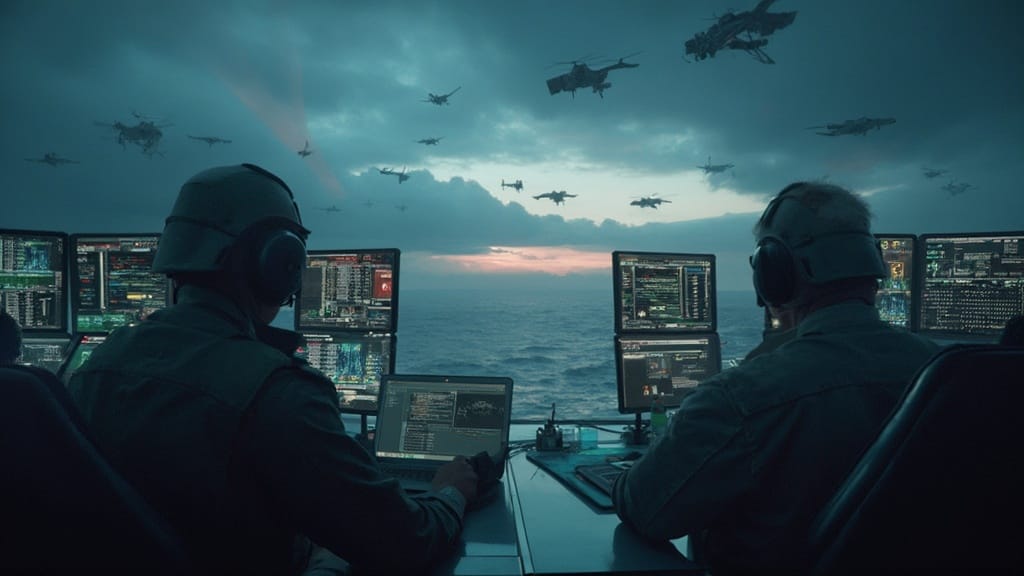
Photo: lyceumnews.com
Tuesday, April 15, 2026
The Big Picture
The U.S. naval blockade of Iran entered its third day and is already intercepting tankers — but the real story isn't the ships turning around, it's what's orbiting overhead. Iran tasked a Chinese-built commercial satellite to monitor American bases, the Pentagon has publicly acknowledged it faces limited options for dealing with commercial imagery used against U.S. forces, and the Air Force chose this exact moment to show the world the top of its next stealth bomber. Visibility — who has it, who's losing it, and what it costs — is the defining contest of this conflict right now.
What Just Shipped
- H-60Mx Autonomous Black Hawk (DARPA/Sikorsky): Formally transferred to U.S. Army for advanced operational testing; equipped with Sikorsky's MATRIX autonomy suite for reduced-crew and fully autonomous flight.
- AGM-158C-3 LRASM Export Pricing Memo (DSCA): Policy Memo 26-57 establishes nonrecurring cost recoupment charges — the back-office step that typically precedes foreign military sales availability.
- U-C8600/U-C8601 Edge AI Boards (Aitech): Rugged single-board computers on Intel 14th Gen Core Ultra, designed for real-time AI inference in contested electromagnetic environments at battalion level.
Today's Stories
The Blockade Is Live — and the Enforcement Geometry Tells You Everything
● Strait of Hormuz · Washington DC, USA · Iran · Oman · UAE
The U.S. isn't enforcing this blockade where you'd expect. American warships are waiting in the Gulf of Oman — not inside the Strait of Hormuz — intercepting vessels only after they clear the chokepoint. One official told The War Zone: "Our net is the Gulf of Oman." That's a deliberate choice. The Strait itself is shallow, mined, and within range of Iran's coastal missiles — a kill zone for surface ships loitering predictably.
A U.S. destroyer interdicted two oil tankers leaving Chabahar port on Tuesday and directed them to turn around, according to a U.S. official cited by multiple outlets. CENTCOM confirmed six merchant vessels total complied with orders to reverse course in the first 24 hours. The blockade involves more than 10,000 U.S. forces, over a dozen warships, and dozens of aircraft, according to the Spokesman-Review.
Here's the loophole that will define the next phase: ships claiming non-Iranian origin or destination are free to pass. A Chinese-owned tanker, the Rich Starry, successfully transited on Tuesday after being initially turned back — it was coming from the UAE, not Iran, according to Fox News. Analyst Noam Raydan at the Washington Institute for Near East Policy noted that many ships working with Iranian oil simply go dark on tracking systems. The shadow fleet's next move is probably a documentation game, not a physical confrontation.
If Iran's fast-attack boats — over 60% of the IRGC fleet reportedly remains intact as of early April 2026 despite weeks of strikes — attempt to contest the blockade, the ceasefire is effectively dead. If the documentation loophole holds, expect a sanctions-evasion cat-and-mouse that looks more like financial warfare than naval combat.
Iran Tasked a Chinese-Built Satellite to Monitor U.S. Bases
● China · Iran · United States
Time-stamped coordinate lists and orbital analysis show Iranian commanders tasked a Chinese-built satellite — TEE-01B, built by Earth Eye Co — to monitor U.S. military sites, with imagery taken before and after drone and missile strikes, according to the Irish Times. The satellite captures half-meter resolution imagery, roughly ten times sharper than Iran's best domestic satellite, the Noor-3. Earth Eye's business model is "in-orbit delivery" — spacecraft launched in China, transferred to overseas customers after reaching orbit.
Jim Lamson, a former CIA analyst now at the James Martin Center for Nonproliferation Studies, called this "a dispersion strategy for Iran's space assets" — you can bomb an Iranian ground station, but you can't hit a Chinese one in another country.
This is the commercial space problem made concrete. A Chinese company legally sells a satellite, Iran obtains targeting-quality imagery of American bases, and there is no clean legal or military answer. Gen. Stephen Whiting of U.S. Space Command warned at the Space Symposium that Iran's use of commercial imagery is forcing the Pentagon to rethink operations. If the U.S. moves to sanction Earth Eye Co directly, it sets a precedent with enormous implications for the entire commercial space industry. If it doesn't, every adversary with a checkbook just learned the playbook.
The Pentagon Acknowledged It Has a Commercial Satellite Problem — and No Good Fix
● Washington DC, USA · Ukraine · Russia · Iran · United States
The same transparency that let the world watch Russia invade Ukraine is now being used against American forces. Space Force Chief Gen. Chance Saltzman put it bluntly, according to Breaking Defense: "How many times in a war game have we said, 'and here's the commercial imagery that the adversary is using to target us, and what are you going to do about it?'"
The problem runs in two directions. Chinese firm MizarVision continues posting AI-analyzed satellite imagery of U.S. forces to Chinese social media, according to Washington Post reporting cited by Breaking Defense. Meanwhile, U.S. officials have quietly urged American firms to voluntarily constrain public access to imagery of the conflict zone. Planet Labs imposed a 14-day delay on Iran-area imagery in March — but the Global Times had already published detailed satellite imagery of the U.S. buildup in January, according to National Today. American companies go dark; Chinese companies don't.
Commercially available imagery can now compress the intelligence-to-strike cycle from days to hours. If Congress moves to regulate AI-enhanced satellite analysis exports, it reshapes a multibillion-dollar industry. If it doesn't, the asymmetry only widens.
The B-21 Raider Just Got Its First Official Overhead Photo — and It Tells You a Lot
The Air Force almost never shows you the top of a stealth aircraft — exhaust nozzles, air intakes, radar-absorbing geometry. Yesterday, they showed you anyway.
The USAF released the first image of the B-21 Raider's upper surface during aerial refueling tests from a KC-135 at Edwards Air Force Base, according to The Aviationist. The photos reveal a two-piece clamshell refueling door arrangement — different from the B-2 Spirit's rotating receptacle — and inlet shaping that analysts say suggests optimization for lower infrared and radar signatures during high-altitude, long-duration missions. The War Zone and Defense One captured similar overhead frames.
The timing isn't accidental. Current long-range bombers are actively hitting Iranian targets. Showing the next-generation bomber mid-refueling — proving it can operate at long ranges for extended periods — is a deliberate signal. Per Northrop Grumman's announcement, the B-21 is the most fuel-efficient bomber the company has built, consuming a fraction of the fuel of fourth- and fifth-generation aircraft. Every tanker you don't need in contested airspace is one fewer target.
First delivery to Ellsworth Air Force Base remains on track for 2027. Next milestone to watch: weapons integration testing.
The Navy Lost a $238 Million Surveillance Drone — and the Timing Is Terrible
● Middle East
The Navy confirmed it lost an MQ-4C Triton — a high-altitude surveillance drone roughly the size of a regional jet — over the Middle East on April 9. The War Zone reported that a Naval Safety Command mishap summary shows the aircraft vanished from tracking while returning from a mission, dropped rapidly in altitude, and squawked emergency code 7700 before disappearing. No public evidence it was shot down.
The Triton flies at 60,000 feet, stays aloft for 24 hours, and monitors areas the size of small countries. Budget documents put per-aircraft cost at approximately $238 million. Losing one during a blockade enforcement operation isn't just expensive — it's a gap in the surveillance picture at exactly the wrong moment.
The harder question: the MQ-4C carries radar and electronic intelligence systems an adversary would love to recover. Whether this was mechanical failure, electronic warfare, or something else will shape how the Navy operates high-value unmanned aircraft in contested airspace. If the cause turns out to be jamming or GPS spoofing, it accelerates the debate about whether large, expensive surveillance drones can survive at all where adversaries are actively looking for them.
Cheap Drones Are Threatening the Gulf's Trillion-Dollar AI Dream
● Saudi Arabia · Persian Gulf · UAE
The biggest bottleneck to building the world's most powerful AI data centers isn't semiconductors — it's physical security. Foreign Policy reports that the proliferation of cheap loitering munitions is directly threatening the massive AI infrastructure buildout in the Persian Gulf. Saudi Arabia and the UAE are pouring billions into hyperscale data centers, but these facilities require enormous power plants and cooling towers — massive, stationary, fragile targets.
You cannot build a physically defenseless multi-billion-dollar technology hub in a neighborhood where adversaries regularly launch $500 exploding drones. The counter-drone market and the AI infrastructure market just became the same market. Watch for Gulf states to start bundling data center construction contracts with localized counter-drone defenses — and for insurers to demand demonstrable physical protections before underwriting large projects. If they don't, the AI buildout stalls on a threat that costs less than a used car.
Germany Just Told Its Men: You Need Permission to Leave the Country
● Germany
Germany now requires men aged 18–45 to obtain Bundeswehr approval for any foreign stay exceeding three months, according to DW. The rule took effect January 1 under the Military Service Modernization Act but is only now getting broad attention — it's trending on Hacker News today. According to IMI Daily, there is currently no legal basis for the Bundeswehr to deny an application — yet filing remains mandatory. Thousands of men who left Germany this year are technically in violation of a rule most never knew existed.
The travel permit is part of a larger effort to expand the Bundeswehr from approximately 184,000 to between 255,000 and 270,000 soldiers by 2035, according to United24 Media. Think of it as the mobilization registry being built before the mobilization is needed — the administrative skeleton of a conscription system while conscription itself remains voluntary. When that changes, the infrastructure is already in place.
⚡ What Most People Missed
- The H-60Mx transfer forces the Army to take responsibility for operational test doctrine, maintenance, training, and safety certification on an autonomous retrofit program — responsibilities that previously lived in DARPA prototype phases.
- Policy Memo 26-57's pricing for the AGM-158C-3 makes exportability a design and program-management consideration; U.S. suppliers will now need to plan manufacturing scale-up and international logistics earlier in development.
- France moved its Chorus heavy-payload strike drone into serial production. Designed for ranges up to ~3,000 km with heavier ordnance than light strike drones, Chorus represents the bifurcation of the drone market into expensive endurance platforms and mass-producible strike UAVs. Watch export approvals to see if this stays niche or goes global.
- Cambodia may be getting pulled off the U.S. arms embargo list. Trade compliance watchers flagged Cambodia's potential removal from EAR Group D:5 — a deliberate carrot from Washington to a country that has granted China's PLA access to its Ream Naval Base. If confirmed, expect U.S. defense firms to start pitching maritime surveillance packages to Phnom Penh.
📅 What to Watch
- If Iran's fast-attack boats contest the blockade kinetically in the next 72 hours, U.S. forces would need to commit sustained anti-surface warfare assets and minesweeping operations, risking wider regional escalation; the IRGC fleet remains over 60% intact as of early April 2026.
- If the U.S. sanctions Earth Eye Co or its parent Emposat, expect export controls, satellite-tasking bans, and pauses in multinational commercial contracts as firms reassess sales to state customers — a legal precedent would ripple across the commercial imagery market.
- If the MQ-4C Triton loss is attributed to electronic warfare rather than mechanical failure, anticipate accelerated shifts toward distributed sensor architectures, shorter-endurance platforms, and revised operational rules for high-value unmanned systems.
- If Gulf states mandate integrated counter-drone defenses for data-center projects, insurers will demand hardening standards, creating recurring security procurement contracts for defense firms and raising upfront construction costs for hyperscale builds.
- If Space Force finalizes its acquisition portfolio by early summer, contract awards will reveal whether procurement reform shortens fielding timelines or merely reshuffles program offices, affecting when new space capabilities actually deploy.
The Closer
A Chinese satellite photographing American bases for Iranian targeting officers, a $238 million drone falling out of the sky over the exact ocean it was supposed to be watching, and Germany quietly building a mobilization registry while insisting it's not building a mobilization registry.
The Pentagon spent a decade celebrating commercial satellite transparency as a tool of accountability — turns out accountability has a return address.
Clear satisfying skies from the Gulf of Oman. ☕
If someone you know cares about where defense tech meets the real world, forward this their way.
From the Lyceum
Tariffs gave chips and pharmaceuticals a temporary pass — but the fine print matters for defense supply chains. Read → Tariff Earthquake Lands