Defense Tech Daily — Apr 17, 2026
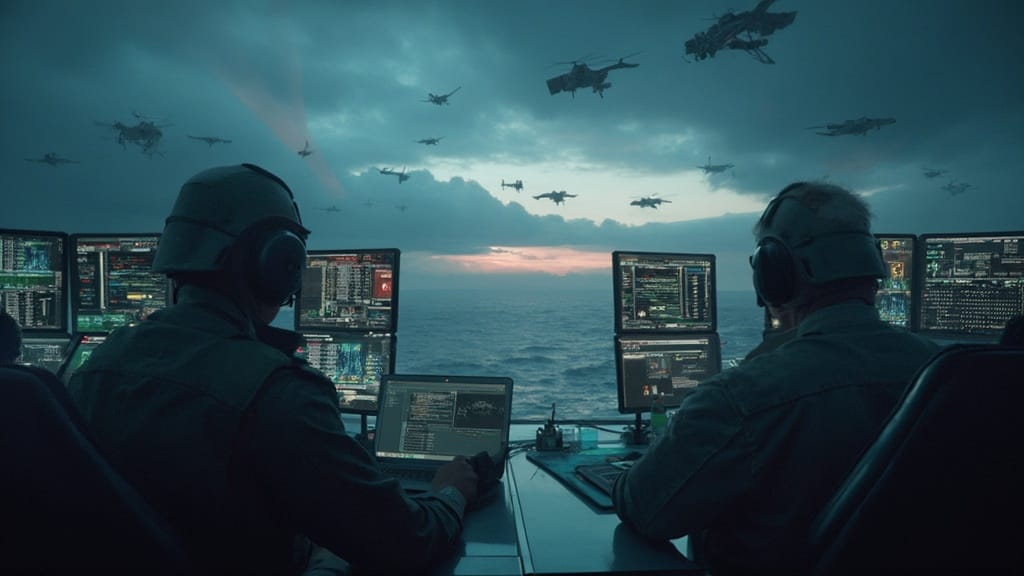
Photo: lyceumnews.com
Friday, April 17, 2026
The Big Picture
The Iran campaign just split into two fronts that don't involve aircraft: Treasury is sanctioning the financial plumbing while the Navy enforces a blockade that's deliberately leaking — and both moves are occurring amid a negotiating deadline in Islamabad before April 21. Meanwhile, the Air Force revealed it's using AI to wargame thousands of scenarios at once, Ukraine punched across the Russian border again, and the Pentagon is quietly turning pilot programs into permanent budget lines. The theme this week isn't any single weapon — it's the machinery behind the weapons: production rates, funding streams, procurement pipelines, and the commercial networks everything rides on.
What Just Shipped
- WarMatrix AI Wargaming System (U.S. Air Force): Operational debut at GE 26 Benchmark Wargame; simulates campaigns up to 10,000× real time with human-in-the-loop decision architecture.
- PAC-3 MSE Production Framework (Lockheed Martin / U.S. DoD): Multiyear deal to triple interceptor output from ~600/year to 2,000, backed by ~$4.7B contract.
- Counter-UAS Marketplace (JIATF 401 / U.S. Army): Live procurement portal with 1,600+ catalog items; first four purchases totaling $13M completed.
- Maven Smart System — Program of Record Transition (Palantir / Pentagon): Deputy SecDef memo mandates formal budget integration by the end of FY2026.
- JAGM-Armed Saildrone Surveyor (Saildrone / Lockheed Martin / U.S. Navy): Armed unmanned surface vessel slated for live testing at RIMPAC 2026.
Today's Stories
The Blockade Gets a Financial Twin — And the Numbers Are Brutal
● Washington DC, USA · Islamabad, Pakistan · Beijing, China · Tehran, Iran · India · United States
The Iran pressure campaign is no longer just ships and missiles. Treasury Secretary Scott Bessent called Operation Economic Fury "the financial equivalent" of a bombing campaign, and the targeting is specific: three individuals, 17 entities, and nine oil tankers blacklisted for sanctions evasion, according to UPI. The centerpiece is the Shamkhani network — a multi-billion-dollar Iranian-Russian petroleum empire — plus a Hezbollah laundering scheme that traded Iranian oil for Venezuelan gold to finance the IRGC-Qods Force, according to Benzinga.
The dollar math is staggering. Miad Maleki of the Foundation for Defense of Democracies estimated blockade losses at roughly $435 million per day, including $276 million in missed oil and petrochemical exports, the Wall Street Journal reported per Benzinga. But the real escalation is the secondary sanctions threat: Bessent said Washington could sanction countries purchasing Iranian oil — "if Iranian money is sitting in your banks, we are now willing to apply secondary sanctions," according to NTD. That's aimed squarely at China and India. With ceasefire talks set to resume in Islamabad before April 21, per Kurdistan24, the sanctions appear timed to maximize leverage.
If Tehran comes to Islamabad with concessions, observers may credit the financial squeeze as the mechanism that worked. If talks collapse, watch whether Treasury actually designates a Chinese bank — that would be economic warfare against Beijing, not just Iran, and it would land weeks before Trump's planned meeting with Xi Jinping.
The Blockade Is Leaking — and That's Actually the Story
● Strait of Hormuz · Washington DC, USA · Beijing, China · Iran · Oman · United States
A blockade nobody crosses is deterrence. A blockade some ships cross is a negotiating tool. Right now, it's the latter.
Iranian media reported four vessels transited near Iran despite the blockade: the Greek-operated Agios Fanourios, Chinese-operated Alicia and RHN, and the OFAC-sanctioned Iranian container ship Golbon, according to CNN. Chairman of the Joint Chiefs Dan Caine clarified this is "a blockade of Iran's ports and coastline, not a blockade of the Strait of Hormuz," per Daily Signal. A U.S. official confirmed interdictions are happening in the Gulf of Oman, not the Strait itself.
The Chinese-flagged vessels are the test. Boarding one risks a diplomatic incident before the Trump-Xi meeting, per CNN's analysis. Beijing is probing the blockade's limits in real time, and Washington is threading a needle between credibility and escalation. If a Chinese vessel gets turned back this week, that's the single biggest signal that the administration has decided maximum pressure on Iran is worth friction with Beijing.
The Air Force Built an AI That Simulates Wars 10,000 Times Faster Than Real Life
● China · United States
WarMatrix — the Air Force's new AI wargaming system — made its operational debut at the March 27 GE 26 Benchmark Wargame, according to Military Times. The two-week event drew over 150 participants including Pacific Air Forces leadership, allied planners, and technical experts, per Mirage News. Pacific Air Forces in the room is not subtle — this is being stress-tested against China scenarios.
The system runs thousands of simulated campaigns simultaneously, integrating live intelligence, logistics, and weather data while keeping human judgment in the decision loop. But the ambition goes beyond strategic planning: Air Force officials described building toward "campaign planning at the tactical level" — meaning squadron-level mission simulation for tonight's sortie, not just next year's force structure, according to NTSA.
If WarMatrix's outputs start shaping actual force structure and procurement decisions — the Air Force said GE 26 insights will directly inform the Secretary and Chief of Staff — it becomes the most consequential AI deployment in the Pentagon. If it stays a planning toy that commanders consult but ignore, it joins a long line of expensive simulations that didn't change behavior. The Space Force and Marine Corps have already expressed interest in adopting it.
Missile Defense Is Turning Into a Manufacturing Race
Lockheed Martin's January framework agreement with the U.S. government will raise PAC-3 MSE interceptor capacity from roughly 600 per year to 2,000 over seven years, per Lockheed Martin's announcement. The Pentagon backed this with a contract package reported at approximately $4.7 billion across open sources. The PAC-3 MSE is the upgraded Patriot interceptor that kills incoming ballistic missiles — and the real story isn't the technology but the production math. The difference between 600 and 2,000 interceptors per year determines how many salvos a defended country can absorb before running dry.
The fragility is in the supply chain. Solid rocket motors and advanced guidance electronics come from a narrow set of suppliers. If those nodes can't scale, the announced output targets become optimistic paper. Watch for whether similar multiyear production deals spread to other air-defense programs — that would signal governments have accepted that manufacturing speed is now a frontline capability, not a back-office concern.
Ukraine's 47th Brigade Crossed Into Belgorod — and Russia Is Denying It
● Ukraine · Moscow, Russia · Iran
Ukraine's 47th Mechanized Brigade — one of its best-equipped units — claimed a border breakthrough into Russia's Belgorod Oblast, according to Ukrainian investigative outlet Slidstvo.Info. Russia's defense ministry denied the claims, though the Belgorod governor acknowledged the border situation "remains difficult."
The timing is deliberate. With diplomatic bandwidth consumed by Iran and Russia-Ukraine ceasefire talks stalled, a Ukrainian foothold on Russian soil complicates any negotiation — Moscow won't agree to a ceasefire with foreign troops inside its borders. It's the same logic that drove the 2024 Kursk incursion. Whether this is a raid for leverage or a new front is genuinely unclear; satellite imagery in the next 24 hours will be the first reliable signal. [DEVELOPING]
The Counter-UAS Marketplace Opens to Local Police
● Iran
The Army's Joint Interagency Task Force 401 completed four purchases — $13 million combined — through a new counter-drone marketplace now open to military, federal, state, and local buyers, according to DefenseScoop. The catalog lists over 1,600 items: sensors, radars, electronic warfare tools, and repair parts across a dozen systems.
Thirteen million dollars is a rounding error in the defense budget, and that's the point. The model compresses procurement from years to weeks. The real test is whether the same pipeline can serve CENTCOM, border missions, and Super Bowl security simultaneously without creating conflicts over inventory and priority. Army acquisition leaders also described buying 13,000 Merops interceptors at roughly $15,000 each during the Iran conflict's opening days — treating some interceptor classes as consumables, not capital assets. If that logic holds, it reshapes how defense firms plan production runs.
The Pentagon Forces Maven Into the Budget — and That Changes Everything
A March 9 memo from Deputy Defense Secretary Steve Feinberg gives Pentagon components until the end of FY2026 to transition the Maven Smart System — Palantir's AI platform that fuses sensor and intelligence feeds — into a formal program of record, according to DefenseScoop. Programs of record get stable funding, formal oversight, and a path to broad adoption. Maven is already running in multiple combatant commands during live operations.
This is how software stops being a cool demo and becomes military infrastructure. Algorithmic targeting is being institutionalized, not just tolerated. The observable signal: if Maven gets its own budget line in the FY2027 request, it's permanent. If the transition stalls in bureaucratic limbo, it joins the Pentagon's graveyard of promising pilots that never scaled.
⚡ What Most People Missed
- The blockade's legal scope just expanded quietly. The UK Maritime Trade Operations agency stated April 16 that "all Iranian vessels, vessels with active OFAC sanctions, and vessels suspected of carrying contraband" are subject to belligerent right of visit and search, per NTD. That means any ship suspected of carrying weapons components can be boarded — not just ships heading to Iranian ports. Almost nobody is covering the legal architecture, which is where the real escalation risk lives.
- Iran halted all petrochemical exports. Reuters reported Iran stopped petrochemical exports to prioritize domestic supply after Israeli strikes damaged several hubs, per Benzinga. Petrochemicals are Iran's second-largest export. Iranian state media estimated reconstruction costs at $270 billion — the industrial base is under severe strain before the blockade's full effects hit.
- Italy didn't just suspend a defense pact — it denied U.S. basing access. Rome refused to let U.S. bombers refuel at Sigonella, the Navy's key Mediterranean base for P-8 Poseidons and MQ-4C Tritons, according to Al Jazeera. That's an operational constraint on strike missions, not a symbolic gesture.
- Arming a Saildrone shifts the operational and legal questions. The planned Saildrone Surveyor test with JAGM missiles at RIMPAC 2026, per National Defense Magazine, isn't just a tech milestone — it forces navies to resolve command-and-control, rules-of-engagement, and liability questions for remotely operated or autonomous lethal strikes at sea before deployment scales up.
📅 What to Watch
- If a Chinese-flagged vessel gets boarded in the Gulf of Oman, it means Washington has decided Iran pressure is worth pre-summit friction with Beijing — and the Islamabad talks are likely to lose leverage.
- If Hungary's new government reverses Orbán-era vetoes on EU Ukraine aid, it removes the single biggest institutional blocker on European defense cooperation and unlocks billions in stalled funding, changing procurement timelines for allied capabilities.
- If Maven Smart System gets its own budget line in the FY2027 request, algorithmic targeting has crossed from experiment to permanent Pentagon infrastructure — and Palantir's revenue model fundamentally changes.
- If PAC-3 MSE supplier audits reveal bottlenecks in solid rocket motors or guidance electronics, the announced tripling of production becomes aspirational math — watch quarterly delivery reports, not contract announcements.
- If satellite imagery confirms Ukrainian forces holding ground in Belgorod, the ceasefire calculus inverts: Moscow can't credibly negotiate with foreign troops on Russian soil, which may be exactly Kyiv's point.
The Closer
A Treasury secretary calling sanctions "the financial equivalent of bombing," an AI that wargames 10,000 futures before breakfast, and a robotic sailboat being handed a missile and told to go find trouble. The Pentagon's procurement system just discovered same-day delivery — $13 million in counter-drone gear bought through what is essentially Amazon for air defense — while Italy quietly locked the gas station door on American bombers mid-campaign. Somewhere in the Gulf of Oman, a Chinese cargo ship is doing more diplomacy than any ambassador this week.
Stay sharp out there.
Know someone tracking the Iran situation, the drone economy, or just trying to understand why their defense stocks moved? Forward this their way.
From the Lyceum
A jury just told Live Nation it illegally monopolized ticketing — but the real breakup fight is only beginning. Read → Live Nation Verdict