Defense Tech Daily — Apr 18, 2026
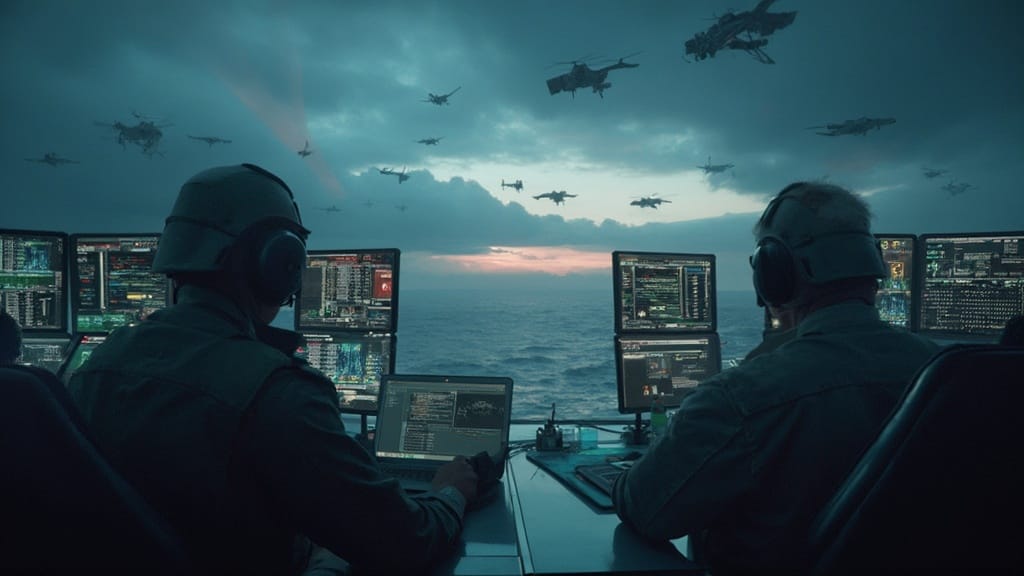
Saturday, April 18, 2026
The Big Picture
Today the world's most important shipping lane became a shooting gallery, the Air Force handed what it calls its most advanced combat drone to a handful of airmen with ruggedized laptops, and a Dutch journalist exposed a €496 million warship with a postcard. The connecting thread: the gap between how militaries think they're protected and how they actually are. Cheap tech is outpacing expensive doctrine, and the next 96 hours in the Strait of Hormuz will test whether that gap closes with diplomacy or gunfire.
What Just Shipped
- YFQ-44A "Fury" (Anduril): Semiautonomous combat drone completed contested-operations sorties at Edwards AFB run by a handful of airmen with a laptop-based command system.
- Mayhem 10 (AeroVironment): Modular "launched effect" drone unveiled at Army Aviation summit — 10-pound payload, ~62-mile range, under five minutes to assemble and launch.
- PAC-3 MSE contract (Lockheed Martin): $4.7 billion award to triple annual interceptor production, replenishing stocks burned through in the Iran and Ukraine wars.
- ME-11B HADES (U.S. Army): New details released on the surveillance jet designed to launch long-range drones from standoff distances; prototype flight testing targeted for this summer.
- Orbital AMTI contracts (U.S. Space Force): Nine firms awarded early-stage deals to build space-based aircraft-tracking satellites — vendor names and values classified.
Today's Stories
Iran Reopened the Strait — Then Slammed It Shut Again, Guns Out
● Strait of Hormuz · Tehran, Iran · India · Oman · United Kingdom
About 20 percent of the world's traded oil moves through a narrow channel between Iran and Oman. Today, that channel became a shooting gallery.
Iran reversed Friday's move to reopen the Strait of Hormuz and, within hours, IRGC gunboats opened fire on a tanker attempting to transit — confirmed by the UK Maritime Trade Operations center, per Military.com. Defense News, citing Reuters, reported Iran broadcast warnings over marine radio and multiple vessels were reported hit. Two Indian-flagged ships were forced to turn back; the VLCC Sanmar Herald was reportedly fired on despite receiving prior clearance, per NBC News, which obtained radio recordings via maritime intelligence firm TankerTrackers of a captain pleading to reverse course mid-engagement.
India summoned the Iranian ambassador, per Al Jazeera. U.S. Central Command says 21 ships have been turned back since the blockade began Monday. The Wall Street Journal, citing unnamed U.S. officials, reports the Pentagon is preparing to board and seize Iran-linked tankers in international waters within days.
What to watch: A two-week U.S.–Iran ceasefire expires Tuesday evening, April 22. If talks collapse — or if a boarding goes wrong first — the escalation ladder gets shorter fast. If Tehran accepts a nuclear framework in exchange for lifting the blockade, today's gunfire becomes the peak, not the prelude.
The Air Force's Autonomous Fighter Drone Just Passed Its Most Important Test Yet
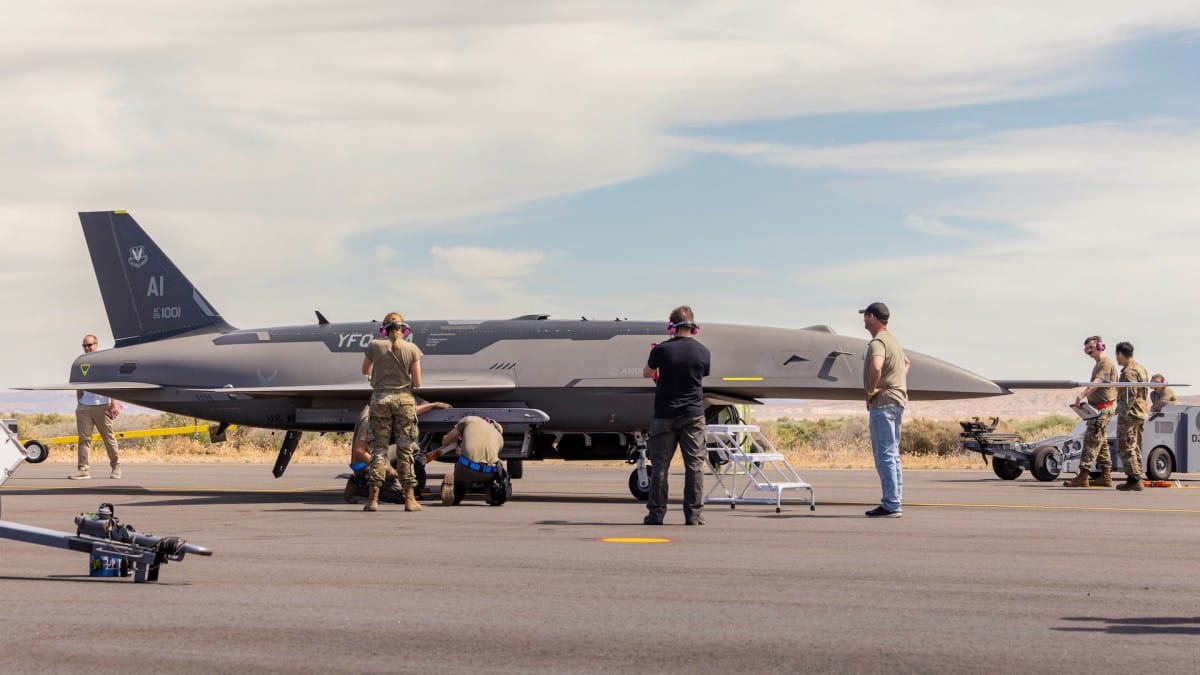
Forget the pilot in the cockpit. The Air Force just ran a test where a jet-powered combat drone flew, landed, and was turned around for the next mission — and the person running it was holding a ruggedized laptop.
The Experimental Operations Unit at Edwards AFB conducted sorties with Anduril's YFQ-44A "Fury" — roughly half the size of an F-16, designed to fly alongside F-35s and the forthcoming F-47. What made this test different, per Military Times and The Defense Post: EOU operators handled pre- and post-flight checks, weapons loading, and in-flight tasking themselves, without Anduril staff holding their hands. The whole thing ran off Anduril's Menace-T system — two Pelican cases and a laptop — and required only a handful of maintainers with days of training.
The Air Force wants at least 1,000 Collaborative Combat Aircraft. The competing design, General Atomics' YFQ-42A Dark Merlin, recently suffered a takeoff accident, per The War Zone. A production decision is expected this summer.
The signal to watch: if General Atomics can't get Dark Merlin back in the air before that decision, Anduril is heading toward a sole-source contract worth billions — and the Air Force's first mass-produced autonomous combat aircraft will have one supplier, not two.
A €5 Postcard Just Tracked a NATO Warship for 24 Hours
● France · NATO Europe
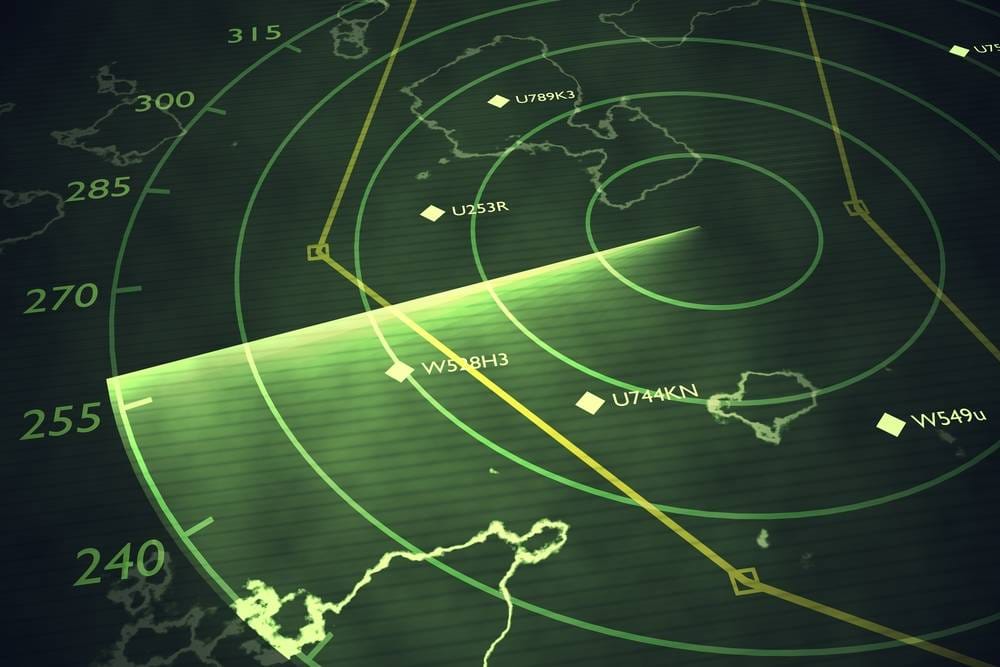
The Dutch navy spent hundreds of millions of euros making HNLMS Evertsen hard to find. Omroep Gelderland journalist Just Vervaart spent €5 and two stamps.
Vervaart concealed a Bluetooth tracker in a postcard and mailed it to the frigate, which was deployed protecting France's carrier Charles de Gaulle. Per Defense News, the Dutch Ministry of Defense X-rays packages but not envelopes — so the tracker went aboard undetected. For about 24 hours, Vervaart watched the ship leave Heraklion and turn toward Cyprus.
The technical wrinkle most coverage missed: the tracker didn't broadcast directly. Crew members' personal smartphones silently pinged it and uploaded location data to Apple's Find My network. The vulnerability isn't postcards — it's the civilian devices every sailor carries. Dutch authorities have now banned electronic greeting cards aboard ships. That addresses the symptom.
What changes if this replicates: every NATO navy is now auditing mail screening and personal-device policy. If a peer adversary ran the same experiment at scale — across dozens of ships, timed to operations — emissions-control doctrine built over decades becomes obsolete.
China Launches Drills After Japanese Destroyer Sails Taiwan Strait
● Taiwan Strait · Beijing, China · Tokyo, Japan · Iran
While Hormuz burned, a different chokepoint flared. Japan's JS Ikazuchi transited the Taiwan Strait on April 17, and Beijing responded with unannounced joint combat readiness patrols in the East China Sea, per Japan Times. The PLA's Eastern Theater Command called the passage a "deliberate provocation" and said it tracked the destroyer throughout, per CGTN.
Allied transits like this have become routine since 2024 as Tokyo pushes "free passage" under international law. The operational question is whether Beijing's calibrated responses are timed to exploit American distraction elsewhere — and on a day the U.S. was convening a Situation Room meeting on Iran, the timing is hard to call accidental.
What to watch: if the U.S. Navy joins a coordinated allied transit in the next two weeks, PLA blockade drills and shipping-insurance premiums across Asia will move together.
The Army's New Surveillance Jet Is Getting Drone Bodyguards
The Army is building the ME-11B HADES — a business-jet-based intelligence platform reportedly derived from the Bombardier Global 6500 — and has already concluded it can't safely fly where the Army needs it to look.
Per The War Zone, HADES will launch long-range drones from hard points built into the airframe, sending them forward into contested airspace while the jet stays at standoff. Planning has referenced mission legs around 620 miles. Prototype flight testing is targeted for this summer.
It's the same logic driving Fury: keep the expensive platform out of the kill zone by sending something cheaper ahead. The observable signal on whether this concept works: whether the datalinks and autonomy software can sustain tasking at hundreds of miles in a jammed electromagnetic environment. If summer testing slips, that's the answer.
Space Force Quietly Picked Nine Firms to Build Aircraft-Tracking Satellites
For decades, tracking aircraft over long distances meant flying radar planes like the E-3 AWACS. The Space Force is betting part of that mission moves into orbit.
Per Breaking Defense, the Space Force awarded nine early-stage contracts for airborne moving target indication — space-based aircraft tracking. Vendor names and dollar values are classified. Air Force officials said this week the capability has been demonstrated. The FY27 budget request reportedly seeks $7 billion to begin procurement, after asking for zero in FY26.
What changes if this works: satellites are harder to target than a handful of radar planes at known bases and can cover oceans without tankers. The case for continuing traditional AWACS/Wedgetail-scale buys weakens with every successful AMTI demonstration.
AeroVironment's New Mayhem 10 Shows Where Battlefield Drones Are Going
AeroVironment unveiled the Mayhem 10 at the Army Aviation summit in Nashville this week — a modular "launched effect" drone that, per The War Zone, handles reconnaissance, electronic warfare, comms relay, decoy work, and precision strike depending on payload. Ten-pound payload, ~62-mile range, ~50-minute endurance, under five minutes to assemble and launch. The company claims eight-plus payload options integrated and a production ramp toward 1,000–2,000 units per year.
Why this matters: the winning drones are starting to look less like missiles and more like smartphones — same airframe, different payload. The Army's launched-effects programs will either reward that modularity or stick with purpose-built systems. Watch the next HADES payload solicitation for the answer.
⚡ What Most People Missed
- India has become a direct party to the Hormuz crisis. India summoned the Iranian ambassador after two Indian-flagged vessels were fired on today, per Al Jazeera. New Delhi's next moves will show whether Iran's economic-relief coalition is fracturing.
- Commercial maritime intelligence firms are shaping wartime awareness. Firms such as Kpler and TankerTrackers supplied the near-real-time transit corridors and radio recordings multiple outlets relied on today; when private analytics outpace state reporting in an active blockade, governments must decide whether to lean on or litigate against commercial data providers.
- DARPA just closed proposals on a program making military AI auditable. The CLARA program — Compositional Learning-And-Reasoning for AI — hit its proposal deadline April 17, per DARPA. It targets kill-web, logistics, and C2 systems that can "show their work." If explainability becomes a procurement requirement, black-box sensor-fusion vendors lose.
- DARPA handed the Army an autonomous Black Hawk. Per DARPA, the ALIAS-derived autonomy stack built on Sikorsky's MATRIX suite, integrated into a UH-60Mx, has transitioned to Army operational testing — the step where demos become programs of record.
- The Dutch fix is cosmetic; the deeper problem is device and network policy. Banning electronic greeting cards addresses mail screening but not the underlying operational-security trade-offs created by sailors' personal smartphones and shipboard network design. NATO navies now face a hard choice between strict device controls that harm morale and more complex network-segmentation and forensics investments.
📅 What to Watch
- If U.S. forces board an Iranian-linked tanker before Tuesday's ceasefire expires, the blockade crosses from economic pressure into an act of war, and Iran's response sets the template for how future dark-fleet enforcement gets resisted.
- If General Atomics doesn't fly YFQ-42A Dark Merlin before the summer CCA production decision, Anduril wins a sole-source contract for America's first mass-produced autonomous combat aircraft — and the Air Force loses its second source on the program that matters most.
- If a NATO ally announces personal-device restrictions on deployed warships within two weeks, the Dutch postcard incident has been classified as a genuine intelligence vulnerability, not a journalism stunt.
- If India begins rerouting vessels away from Hormuz entirely, the coalition Iran was counting on for economic relief has collapsed, and Tehran's leverage at the negotiating table evaporates with it.
- If the FY27 AMTI procurement request receives its proposed funding, defense planners will begin reprioritizing airborne radar procurement toward space-based persistence, altering tanker requirements, basing decisions, and long-range radar force structure.
The Closer
Today: two Iranian gunboats firing on a tanker whose captain had clearance in writing, a Dutch frigate outed by a postcard whose stamp cost less than a sandwich, and an airman at Edwards turning around a combat jet with a laptop and two Pelican cases. The most expensive assets in modern warfare keep getting humiliated by things you could buy at a hardware store — and somewhere in the Netherlands, a journalist is probably deciding which carrier to mail next.
Stay sharp.
Forward this to the friend who keeps asking what's actually happening in the Strait of Hormuz — they deserve better than cable news.