Defense Tech Daily — Apr 19, 2026
Photo: lyceumnews.com
Sunday, April 19, 2026
The Big Picture
Three chokepoints lit up at once this weekend: Iran slammed the Strait of Hormuz shut for the second time in 24 hours — this time with gunboats firing on Indian-flagged tankers — while North Korea launched what may be submarine-launched missiles from its Sinpo naval base, and China ran live-fire drills in the East China Sea right after a Japanese warship transited the Taiwan Strait. The through-line isn't coincidence; it's occurring amid Washington's focus on the Gulf, while other actors are testing what the U.S. can still respond to.
What Just Shipped
- YFQ-44A Fury (Anduril): Autonomous combat drone completed integrated flight testing with the Air Force's government-owned autonomy software stack, a key step toward the Collaborative Combat Aircraft program's first operational increment.
- Vector AI reconnaissance drone (Quantum Systems): 8-kilogram VTOL drone with onboard computer-vision target recognition — U.S. Army awarded a $15.3 million contract for squad-level deployment.
- Mayhem 10 launched effect (AeroVironment): Modular drone unveiled at the Army Aviation summit in Nashville, configurable for reconnaissance, electronic warfare, or comms relay from a single airframe.
- Mogami-class frigate (export variant) (Mitsubishi Heavy Industries): Selected as the design basis for 11 new Royal Australian Navy frigates under a roughly ¥2 trillion (~$13B) co-production deal; first delivery targeted for 2029.
- Project Posokh counter-drone laser (LazerBuzz): Russian developer reports successful burn-down of an aircraft-type drone at 1.5 km — unverified vendor claim, awaiting independent confirmation.
Today's Stories
The Strait That Won't Stay Open — And the Guns That Proved It
● Strait of Hormuz · United Kingdom · South Korea · Washington DC, USA · Malaysia · Tehran, Iran · China · Egypt · India
For about twelve hours on Friday, the Strait of Hormuz looked almost normal. Then Iran's Revolutionary Guard announced Saturday that the waterway "has returned to its previous state" — and to prove it, gunboats opened fire on a tanker while an unknown projectile damaged a container vessel and some of its cargo, according to the United Kingdom Maritime Trade Operations centre (per CBC).
The detail that matters most isn't the closure itself — it's who got shot at. India summoned Iran's ambassador to protest a "shooting incident" involving two Indian-flagged merchant vessels. India had been on Iran's informal "friendly nation" list, alongside China, Malaysia, Egypt, and South Korea, per Al Jazeera. That courtesy just evaporated. If Tehran is now firing on ships it previously waved through, the informal pressure-release valve keeping Asian energy markets from full panic may be reduced.
The Wall Street Journal reported the U.S. military is preparing to board Iran-linked tankers and seize ships in international waters in the coming days, per the Irish Times live blog. A two-week ceasefire expires Wednesday, April 22. If Washington seizes a vessel flagged by China or Malaysia — countries that paid Iran's informal tolls to transit — a bilateral confrontation becomes a multilateral one overnight. The observable signal to watch: whether any statement from former President Donald Trump extends the ceasefire in the next 72 hours, or whether CENTCOM confirms its first boarding.
North Korea Fired Possible Submarine-Launched Missiles — From the Base That Would Actually Matter
● Jerusalem · Pyongyang, North Korea · Japan · Seoul, South Korea · Iran · United States
At 6:10 a.m. local time Sunday, North Korea fired multiple ballistic missiles from the Sinpo area toward waters off its east coast, per South Korea's Joint Chiefs of Staff (via Bloomberg). The missiles flew roughly 140 kilometers. South Korea's military said it is "considering the possibility" the launches involved submarine-launched ballistic missiles, according to The Japan Times.
Sinpo is where North Korea bases its submarine fleet. That's why Seoul is being careful with its language — and why the test matters even if the SLBM characterization isn't yet confirmed. A land-based missile sits in a fixed silo you can watch and target. A submarine-launched missile can come from anywhere in the ocean, which means a preemptive strike can't eliminate all of Pyongyang's nuclear options. That's the deterrence math changing.
This is Pyongyang's seventh launch of 2026 and its fourth in April alone. Kyungnam University's Lim Eul-chul told The Jerusalem Post the pattern is deliberate: "As the US is focused on Iran, the North sees this as a golden time to upgrade their nuclear power and missile capability." Japan's Ministry of Defense held an extraordinary press briefing within hours — unscheduled, rapid, and itself a signal that allied sensor-and-messaging networks are being visibly tightened. Watch for U.S. Indo-Pacific Command's post-analysis in the next 48 hours; an official SLBM designation would trigger a different diplomatic and military response than a standard test.
China Ran Live-Fire Drills in the East China Sea — Right After Japan Transited the Taiwan Strait
● South China Sea · Taiwan Strait · Philippines · Japan
China's Eastern Theater Command conducted joint drills in the East China Sea directly after a Japan Maritime Self-Defense Force vessel sailed through the Taiwan Strait. Senior Col. Xu Chenghua called the exercises "a routine arrangement organized in accordance with the annual plan," per The Japan Times. "Routine" is doing an enormous amount of work in that sentence.
The operational pattern is the story. China is now running exercises around Taiwan and in the East China Sea in the same week, testing Japanese response time and U.S. resolve simultaneously. If a third theater activates — the South China Sea, say, during this week's Balikatan exercises in the Philippines — this stops looking like reactive signaling and starts looking like a coordinated pressure campaign. The observable signal: whether the Eastern Theater Command publishes a second round of drill maps before Balikatan's live-fire segments begin.
Japan Just Made Its Biggest Postwar Defense Export — and It's a Shipyard, Not a Ship
● Australia · Japan

Japan and Australia agreed to jointly develop and build 11 next-generation frigates for the Royal Australian Navy, based on Mitsubishi Heavy Industries' Mogami-class design. Per SBBIT, Mitsubishi will build the first three ships in Japan, then transfer the design, tooling, and production technology so Australia can build the remaining eight domestically. Total program value is reported at up to roughly ¥2 trillion (~$13B). First delivery: 2029. [Source: SBBIT — Japanese]
For decades Japan constrained arms exports on constitutional grounds. This deal effectively ends that posture — and the structure is the point. Australia could have bought American or European frigates off the shelf. Instead, it's importing a Japanese industrial base. If the U.S. shipyard backlog is capacity-constrained by multiple contingencies (and it is), allies are now building their own surge capacity rather than waiting in line. If the 2029 delivery holds, expect more of these — missiles, munitions, drones — in the next 24 months. If it slips, the thesis that Japan can be a major defense exporter takes years to recover.
The Air Force's Drone Wingman Bet Is Really a Software Standards Bet
● United States
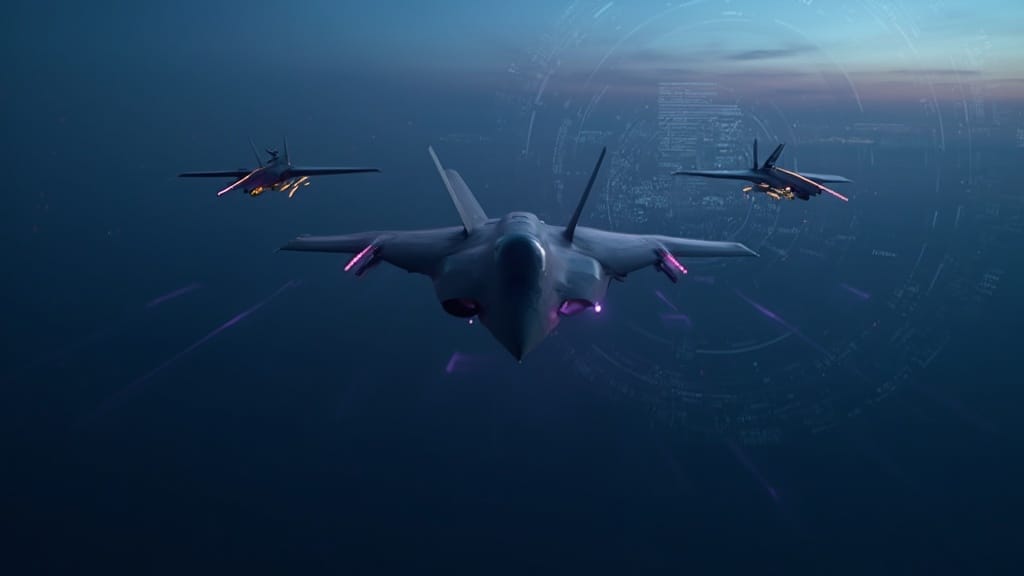
Defense News reported the Air Force successfully integrated government-owned autonomy software onto both prototype Collaborative Combat Aircraft — Anduril's YFQ-44A and General Atomics' YFQ-42A. The important acronym is A-GRA, the Autonomy Government Reference Architecture: a standard that lets autonomy software move between airframes without a full rebuild.
Translation: the Air Force is trying to make drone brains interchangeable. If it works, upgrade cycles compress from years to months, and no single contractor can hold the Pentagon hostage on autonomy software. If it fails — if vendors find ways to lock in proprietary hooks anyway — the CCA program becomes another exquisite platform trapped in decade-long refresh cycles. The observable signal is whether the next flight-test milestone features autonomy code swapped between the two airframes, or whether each vendor keeps flying its own stack.
Ukraine Bombed the Factory That Builds Russia's Drones
● Moscow, Russia · Kyiv, Ukraine
Overnight April 19, Ukrainian forces struck the Atlant-Aero defense plant in Taganrog — the facility linked to Molniya strike drones and guided-bomb payloads for Orion UAVs — according to the Kyiv Independent, which says Ukraine's military confirmed the strike. It came roughly 24 hours after a separate Ukrainian drone swarm flew nearly 900 kilometers to set a Russian oil refinery ablaze.
The logic: don't shoot down the swarm, blow up the factory that makes the swarm. If the pattern holds, it forces Russia to disperse manufacturing, harden production lines, and defend industrial sites — not just airspace. The observable signal is whether Atlant-Aero output visibly drops in Russian drone sortie rates over the next few weeks, or whether Moscow's redundancy absorbs the hit without a blink.
Russia Is Hacking Its Own Jammers With Civilian SIM Cards
● Russia
The Institute for the Study of War reports that Russia has begun equipping kamikaze drones with standard telecom SIM cards, letting them fall back on civilian 5G and cellular networks when military jammers sever satellite or military radio links. It's a $5 workaround to a multimillion-dollar electronic warfare problem.
The defender's dilemma is acute. Block the signals and you shut down civilian connectivity in contested zones. Leave them open and you invite more jamming workarounds. This is the electronic warfare version of the Bluetooth-tracker-on-a-warship problem we flagged yesterday: militaries keep getting outflanked by consumer infrastructure. Expect pressure on telecoms and regulators for wartime cooperation frameworks — and expect them to be messy.
⚡ What Most People Missed
- Cambodia just came off the U.S. arms embargo list. The Commerce Department quietly removed Cambodia from Country Group D:5 — the regulatory tier that blocks many dual-use and defense exports. Washington is using export-control relief as a carrot to pull Phnom Penh away from Beijing's Ream naval base investments. Expect more granular regulatory moves like this as the quiet front of Indo-Pacific competition.
- Britain hard-coded "buy faster" into procurement law. The UK's new Defence Industrial Strategy, published this weekend, mandates three-month procurement cycles for drones, software, and uncrewed systems, with under-12-month windows for modular upgrades and "spiral-by-default" development. If allied procurement shifts from multi-year programs to quarterly upgrade windows, the suppliers who can't match that cadence — including some U.S. primes — lose on speed, not price.
- The U.S. just quietly made foreign military sales financing a competitive weapon. A DSCA memo cut the standby letter-of-credit requirement on Credit Assured Payment Schedules from full remaining value to the greater of the three largest remaining payments or 50% of the balance. Boring on paper, enormous in practice: it makes U.S. offers more competitive against cash-or-credit deals from China in exactly the countries — Indonesia, Thailand, the Philippines — where procurement is now a loyalty test.
- Indonesia's J-10 deliveries are arriving now. The $9 billion Chinese fighter deal, confirmed last fall, is quietly entering its delivery phase this month per The Aviationist. Mixing Chinese datalinks with U.S. F-16s and French Rafales creates an almost impossible network-security problem — and may quietly freeze Jakarta out of top-tier U.S. intelligence-sharing, regardless of what happens with its pending F-15EX order.
- Sensor fusion is diplomacy now. Rapid public confirmations by allied defense ministries — exemplified by Japan's unscheduled Ministry of Defense briefing after the North Korean launches — show that integrated allied sensor networks and coordinated public messaging are being used to shape markets and deterrence in real time, not just to inform domestic audiences.
📅 What to Watch
- If the U.S. boards a Chinese- or Malaysian-flagged tanker in coming days, a bilateral Iran crisis becomes a multilateral one, and Beijing gets a legitimate pretext for its own freedom-of-navigation response.
- If U.S. Indo-Pacific Command publicly designates Sunday's North Korean launches as SLBMs, expect an emergency UN Security Council session and a rapid U.S. submarine posture shift in the Pacific.
- If the 2026 Hormuz ceasefire lapses on April 22 without extension, watch oil markets within hours — but watch Lloyd's of London war-risk premiums within minutes.
- If Balikatan's Japanese live-fire anti-ship drill draws sharper-than-usual Chinese protest, the alliance theater is landing as intended and Tokyo's shooter-not-observer shift is now priced in by Beijing.
- If Mitsubishi publishes a firm Australian frigate build schedule within 90 days, Japan-as-defense-exporter stops being theoretical and becomes a template other allies will demand.
- If A-GRA-enabled autonomy code flies on both YFQ-44A and YFQ-42A airframes in the same test window, the Air Force has actually broken vendor lock-in on autonomy — the most consequential procurement outcome of the decade.
The Closer
This weekend: Iranian gunboats shooting at Indian tankers over an alleged crypto toll, a possible submarine missile lobbed out of Sinpo while Tokyo's defense minister convened a 6 a.m. press conference, and a Dutch frigate still — still — being tracked by a €5 Bluetooth tag mailed to it. The common thread isn't strategy; it's that everyone has figured out the U.S. can only look one direction at a time, and cheap gear keeps beating expensive gear. Don't sleep on the Cambodia export-control story — regulatory memos move slower than missiles and matter longer.
See you tomorrow.
Forward this to the friend who keeps asking you what's actually going on — this is the one to send them.