Defense Tech Daily — Apr 22, 2026
Photo: lyceumnews.com
Wednesday, April 22, 2026
The Big Picture
The Pentagon asked for $1.5 trillion yesterday, and the shopping list reads like a confession: more drones, more interceptors, more robot ships, after lessons from the last two years that quantity often substitutes for other forms of advantage. Meanwhile, Saildrone unveiled a 54-meter (about 177-foot) unmanned submarine hunter that is capable of launching missiles, China ran day two of live-fire drills around Taiwan with a new stated goal of keeping outside forces out of the fight, and the U.S.-Iran ceasefire was extended. The connective tissue: every operational lesson from Ukraine and the Persian Gulf is being converted, in real time, into an industrial plan — and the question is no longer what to build, but whether anyone can build it fast enough.
What Just Shipped
- Saildrone Spectre (Saildrone): 54-meter unmanned surface vessel with anti-submarine sensors and a two-cell Mk70 vertical launch system; sea trials early 2027.
- GPS III SV-10 (U.S. Space Force / SpaceX): Hardened navigation satellite launched April 21 with roughly 3× accuracy and 8× jam resistance over legacy GPS.
- Golden Dome FY27 Architecture (Missile Defense Agency): $17.5B FY27 request unveiled, including $12.4B for R&D on integrated interceptors and battle command.
- DAWG FY27 Drone Plan (DoD Drone Autonomous Warfare Group): $54.6B program detailed this week, a 24,000%+ jump from FY26, covering platforms, counter-UAS, and autonomy software.
- ATSP V Contract Vehicle (Defense Microelectronics Activity): 10-year, $25.4B engineering support award to 10 companies for trusted military microelectronics.
Today's Stories
The Pentagon Just Asked for $1.5 Trillion — and the Shopping List Tells You Everything
● Iran
If you want to know where the U.S. military thinks warfare is going, skip the strategy documents and read the budget.
The Pentagon unveiled a $1.5 trillion proposal for fiscal 2027 on April 21 — a 42% year-over-year jump. Acting comptroller Jules Hurst called it "a generational investment," and the line items back him up. Drone spending triples to more than $74 billion. Munitions get over $30 billion, specifically to refill interceptor stockpiles the Iran war has burned through. Tomahawk cruise missile buys jump from 55 last year to 785 — a 14-fold increase year-over-year.
The most eye-watering number is buried inside the drone total. The Drone Autonomous Warfare Group — DAWG — is requesting $54.6 billion, up from $225.9 million in FY26, a 24,070% increase from FY26 to FY27. It's not a typo, and it's not just "buy more drones": DAWG replaces earlier efforts like Replicator and is meant to fund platforms, autonomy software, production incentives, and command networks all at once.
What changes if it works: the Pentagon stops being a platform buyer and becomes an industrial planner, with force structure rebuilt around cheap autonomy. What failure looks like: $54 billion the Pentagon cannot obligate because the contracting infrastructure doesn't exist to spend it. Watch the FY27 obligation rate — if less than half of DAWG gets onto contract, it's a placeholder, not a program. Also watch the congressional budget reconciliation process: $350 billion of the $1.5 trillion total depends on reconciliation language being negotiated by the House Committee on the Budget and the Senate Committee on the Budget as of April 21, 2026.
Meet the Robot Sub-Hunter That Can Also Fire Missiles
Hunting submarines demands patience, silence, and weeks at sea. It is exactly the kind of job you'd hand to a robot.
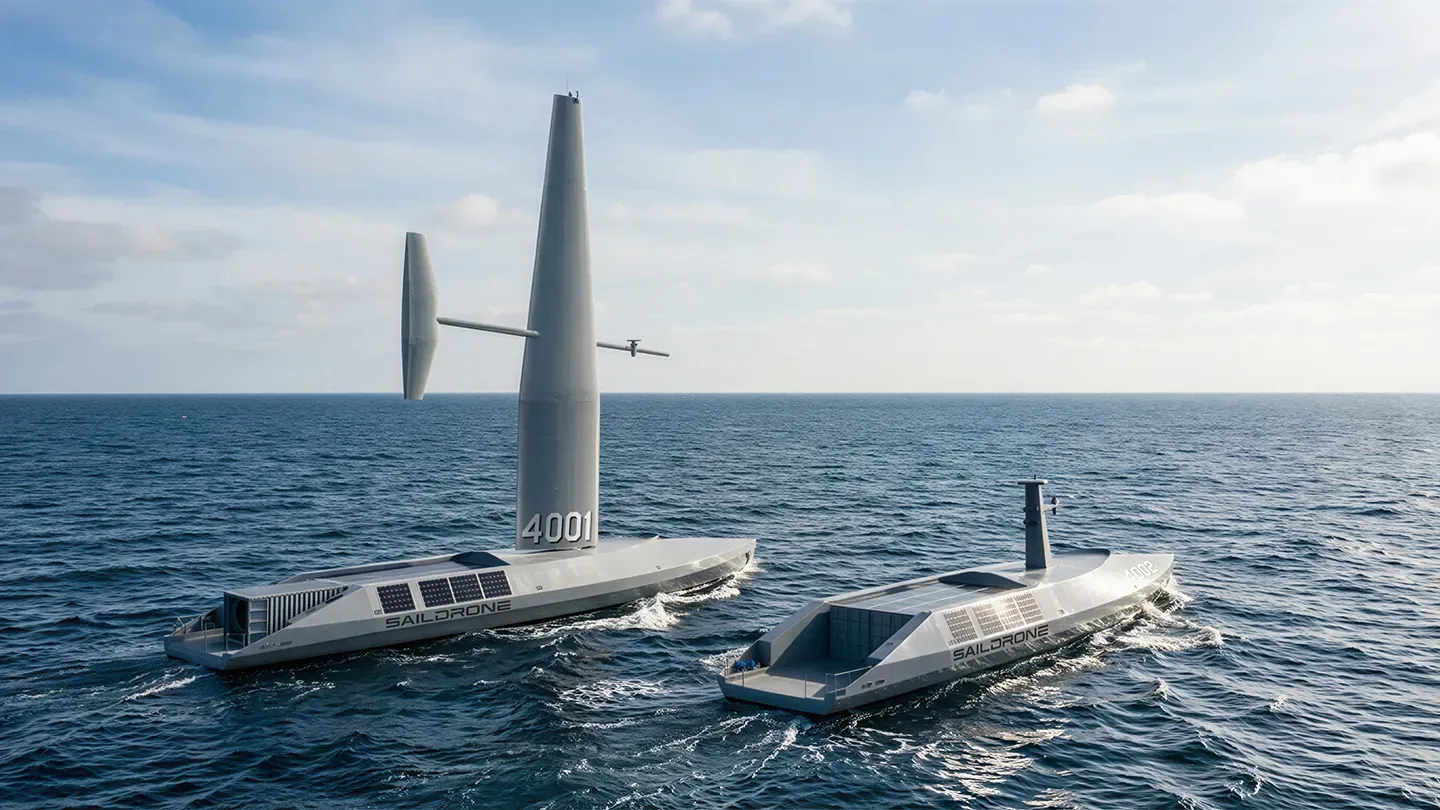
At Sea-Air-Space this week, Saildrone unveiled the Spectre — a 54-meter, 250-ton unmanned surface vessel capable of 30 knots. Half a football field long, moving at highway speed, with nobody aboard. The design comes in two flavors: a Silent Endurance variant with Saildrone's signature wing sail for acoustically sensitive sub-hunting, and a Stealth Strike version that drops the wing for higher sprint speed and strike roles. Lockheed Martin confirmed compatibility with the TB29 towed sonar array, the CAPTAS-4 variable-depth sonar from Thales, and a two-cell Mk70 vertical launch system — meaning one version listens for submarines, the other is configured for strike. Each hull runs about $40 million. Fincantieri's Wisconsin shipyard will build up to five per year, with sea trials in early 2027.
What changes if it works: ASW economics invert. Patrol hours shift from $2 billion frigates to $40 million robots, and the Navy's planned sevenfold expansion of its medium USV fleet (to at least 30 vessels) suddenly has a credible centerpiece. The observable signal: Saildrone is scheduled to live-fire a JAGM missile from a Surveyor USV against a maneuvering surface target at RIMPAC this summer, with 25 allied navies watching. If the live-fire is successful, the procurement conversation will change immediately.
China Ran Live-Fire Drills Around Taiwan — Again. But This Time Something's Different
● Middle East · Washington DC, USA · Taiwan · China · Tokyo, Japan
If you've been tuning out China's Taiwan exercises because they've become routine, don't tune out this one.
For a second day, PLA destroyers, frigates, fighters, bombers, UAVs, and long-range rockets conducted live-fire drills to the north, southwest, southeast, and east of Taiwan. Taiwan's aviation authority said more than 100,000 international travelers would be affected by cancellations and diversions. What's new is the stated objective: Senior Col. Shi Yi's command publicly described the exercises as practicing "all-dimensional deterrence outside the island chain" — meaning China is explicitly rehearsing how to keep the U.S. Navy out of a Taiwan fight, not just how to blockade the island. State broadcaster CCTV framed the maneuvers as a dual-pincer blockade of Taiwan's primary shipping lanes.
Separately, a PLA Navy task group led by Type 052D destroyers — multi-role warships with vertical launch cells for anti-ship and air-defense missiles — transited a Japanese strait this week, a posture play on Japan's southern approaches.
What changes if China's operational tempo keeps compounding: the Pacific bench gets very thin very fast, with two U.S. carriers already committed to Operation Epic Fury in the Middle East and a third en route. Watch whether Washington repositions a carrier from the Gulf, and whether Tokyo or Canberra issue formal statements rather than the usual expressions of concern.
⚡ The Golden Dome Gets a Price Tag — and a Skeptic
President Trump's promised "impenetrable shield" over America got its first real budget numbers — and they are more complicated than the marketing.
The Pentagon wants $17.5 billion for Golden Dome in FY27, but only $398 million sits in the base budget. The other $17 billion depends on reconciliation legislation being negotiated by the House Committee on the Budget and the Senate Committee on the Budget as of April 21, 2026. The Missile Defense Agency's R&D budget jumps from $8.2 billion to $12.4 billion, funding not just interceptors but the Integrated Battle Command System — the digital plumbing that connects radars, satellites, and shooters. The Golden Dome "czar," Space Force Gen. Michael Guetlein, signaled that space-based interceptors — missiles in orbit shooting down other missiles — are not guaranteed. Rep. Seth Moulton was blunter: "the reality does not match what President Trump has promised to the American people."
What changes if it succeeds: the U.S. gets a layered homeland missile defense architecture for the first time. What failure looks like: the reconciliation process stalls, space-based interceptors get descoped, and Golden Dome ends up as a $12 billion radar-and-command upgrade with a golden paint job. Watch the Congressional Budget Office score, which will be the first independent reality check on the $185 billion total.
America's Cyber Strategy Has a Fatal Contradiction
● Iran
War on the Rocks published a sharp analysis today arguing that the White House's new cyber strategy is structurally incoherent: it calls for hardened critical infrastructure and robust response capacity while the agencies responsible for doing that work — CISA and NSA — are being hollowed out.
The defense angle matters because the Iran conflict has demonstrated that kinetic and cyber operations run in parallel. A degraded U.S. cyber posture during an active shooting war is not a theoretical risk; it's an operational one. The strategy also effectively pushes more of the defensive burden onto private telecom and cloud companies that own the infrastructure.
What changes if the critique lands: Congress uses House and Senate Appropriations Committees' hearings to reverse staffing cuts, and private-sector operators push back in filings. What failure looks like: a Colonial Pipeline–scale incident during the Iran standoff with no federal capacity to help. Watch upcoming House and Senate Appropriations Committees' hearings on CISA and NSA funding, and whether major cloud and telecom filings start flagging federal capacity gaps as material risk.
30 Nations Convene in London to Plan Hormuz Reopening — Before Anyone Has a Deal
● Washington DC, USA · Pakistan · France · London, UK · Tehran, Iran · United Kingdom
The U.S.-Iran ceasefire was extended this week — the deadline is still active, pending Iran's proposal — and the blockade remains in place. Hours after the extension was announced, an Iranian gunboat fired on a container ship near the Strait. Vice President JD Vance's planned trip to Pakistan for a second round of talks was put on hold after Tehran informed Washington through an intermediary it would not appear.
Today, the UK and France are convening military planners from over 30 nations in London to discuss reopening the Strait — a planning session that assumes a post-conflict maritime picture the diplomats have not yet agreed to.
What changes if the London conference produces a coalition: allied navies move from contingency planning to convoy coordination. What failure looks like: working-level attendees, no flag officers, and the first post-ceasefire commercial convoy gets fired on with no agreed rules of engagement. Watch which nations send flag-level officers. That tells you who's actually prepared to put hulls in contested water.
Myanmar's Junta Blinks and Releases the President
● Thailand · Burma/Myanmar · Beijing, China
Myanmar's military regime unexpectedly released former President U Win Myint from detention this week. Foreign Policy frames it less as mercy and more as a diplomatic flare: the junta is losing ground fast to an ethnic-resistance alliance that has, in a development defense analysts have been tracking for over a year, effectively weaponized commercial drones into a guerrilla air force. Border crossings and bases have fallen. Soldiers, money, and options are running out.
What changes if this is the start of an off-ramp: Thailand or China gets pulled into brokering a ceasefire, and the drone-guerrilla playbook gets a case study ending in political concession. What failure looks like: the release is cosmetic, Aung San Suu Kyi remains detained, and the fighting continues. Watch Beijing's response. A regime crumbling next door to China's rare-earth and pipeline interests is not a spectator sport.
⚡ What Most People Missed
- DAWG's FY27 request approaches Ukraine's defense budget, highlighting competing Western priorities for aid versus domestic industrial investment. Ukraine's 2026 national security and defense spending is roughly $60.7 billion; the FY27 DAWG request alone is $54.6 billion.
- The Defense Microelectronics Activity just quietly got a 45% bigger contract vehicle. ATSP V is a 10-year, $25.4 billion engineering support award to 10 companies — up from $17.5 billion in the predecessor. DMEA is the immune system that keeps classified U.S. electronics from being built with adversary chips. A jump that size means somebody upstairs is worried about a serious infection.
- A procurement approach that shares ramp-up pain with industry is spreading. Lockheed Martin's profit-share arrangement on PAC-3 MSE production signals that Washington is willing to underwrite industrial risk rather than rely solely on spot buys, which changes how governments budget for surge capacity.
- U.S. Space Command leadership has been shifting to battlefield language for space in public remarks this week. Watch for active counter-space line items in FY28.
- 62 U.S. military veterans were arrested protesting the Iran war at the Capitol. Reporting from the Times of India describes folded flags and red tulips. One protest doesn't determine outcomes, but visible military-community fractures compress political time horizons on escalation.
- Taiwan's defense ministry reported more than 30 PLA aircraft crossed the median line into its ADIZ during today's drills, a sharper airspace posture than recent exercises, specifically testing Taiwan's detect-to-engage timelines. [Source: Phoenix TV — Chinese]
📅 What to Watch
- If the FY27 reconciliation process stalls in the Senate, roughly $17 billion of Golden Dome funding evaporates — and with it the political premise of an "impenetrable shield."
- If Saildrone's JAGM live-fire at RIMPAC hits a maneuvering target, expect a medium USV contract announcement before the exercise ends — and a rapid restructuring of how navies price ASW.
- If Iran's military commanders frame the blockade as "bombardment" in state media again this week, they're building the rhetorical predicate for a kinetic response independent of whatever the diplomats produce.
- If the London conference sends only working-level attendees home with communiqués, NATO appetite for actually escorting the first post-blockade convoy is likely lower than the headline 30-nation number suggests.
- If the Pentagon cannot obligate 50% of DAWG's $54.6 billion in FY27, the drone revolution is a budget placeholder — and the industrial base, not the strategy, is the binding constraint.
- If Beijing signals openness to brokering Myanmar's transition, Beijing's balancing of rare-earth and pipeline access against regional stability will become an explicit part of any settlement calculus, shifting incentives for both local actors and external patrons.
The Closer
A 54-meter robot hauling two missiles toward a submarine nobody can hear; a $1.5 trillion shopping list with a $54 billion drone aisle; 62 American veterans in handcuffs on the Capitol steps, holding folded flags and red tulips. The Pentagon wants an impenetrable shield, an impenetrable fleet, and an impenetrable force posture — financed, mostly, by reconciliation language that does not yet exist.
Stay suspicious of round numbers.
Forward this to the friend who still thinks "defense budget" is a line item and not a weather system.