Defense Tech Daily — Apr 27, 2026
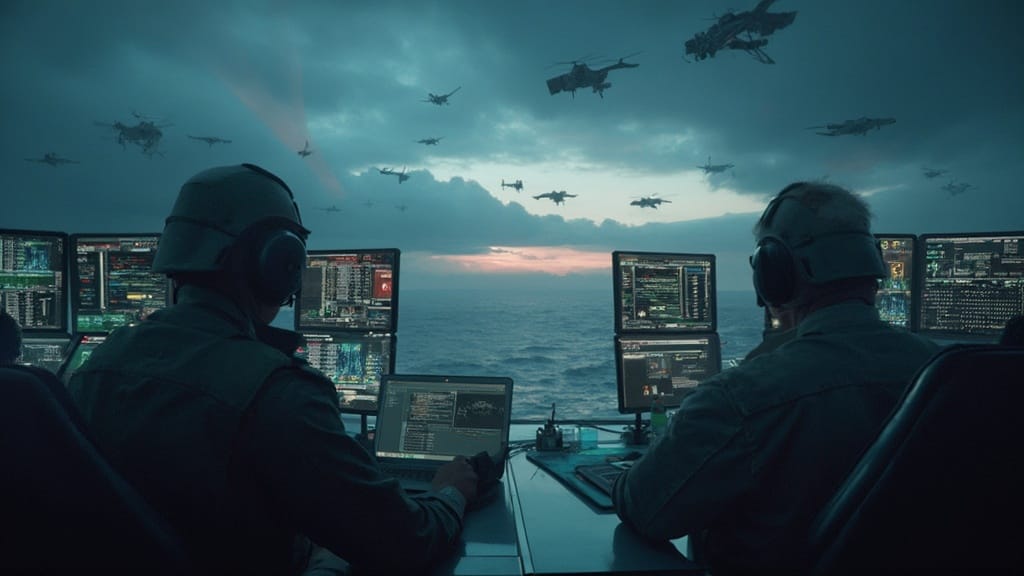
Photo: lyceumnews.com
Monday, April 27, 2026
The Big Picture
Three of the world's biggest defense stories are running on the same logic this morning: cheap reach beats expensive presence. Ukraine is damaging refineries 1,800 kilometers inside Russia with drones that cost less than the fences around their targets. Iran is still holding the world's most important oil chokepoint closed with mines and small boats — and trying to trade that leverage for nuclear breathing room. China just rolled an amphibious assault ship into a Taiwan exercise for the first time. None of these are flukes. They're what happens when long-range, low-cost, semi-autonomous systems quietly become the default tool of statecraft.
What Just Shipped
- Merops AI interceptor system (U.S. defense industry, tested by Romania): AI-enabled package with ground control, launchers, and Surveyor interceptor drones, tested at Capu Midia on the Black Sea.
- GMLRS production lots (Lockheed Martin): U.S. Army awarded up to $4.79 billion for two full-rate production lots of guided rockets, the workhorse munition fired from HIMARS.
- Sting interceptor drone, USV-launched (Ukrainian Defense Forces): First confirmed kill of a Shahed by an interceptor drone fired from an unmanned surface vessel.
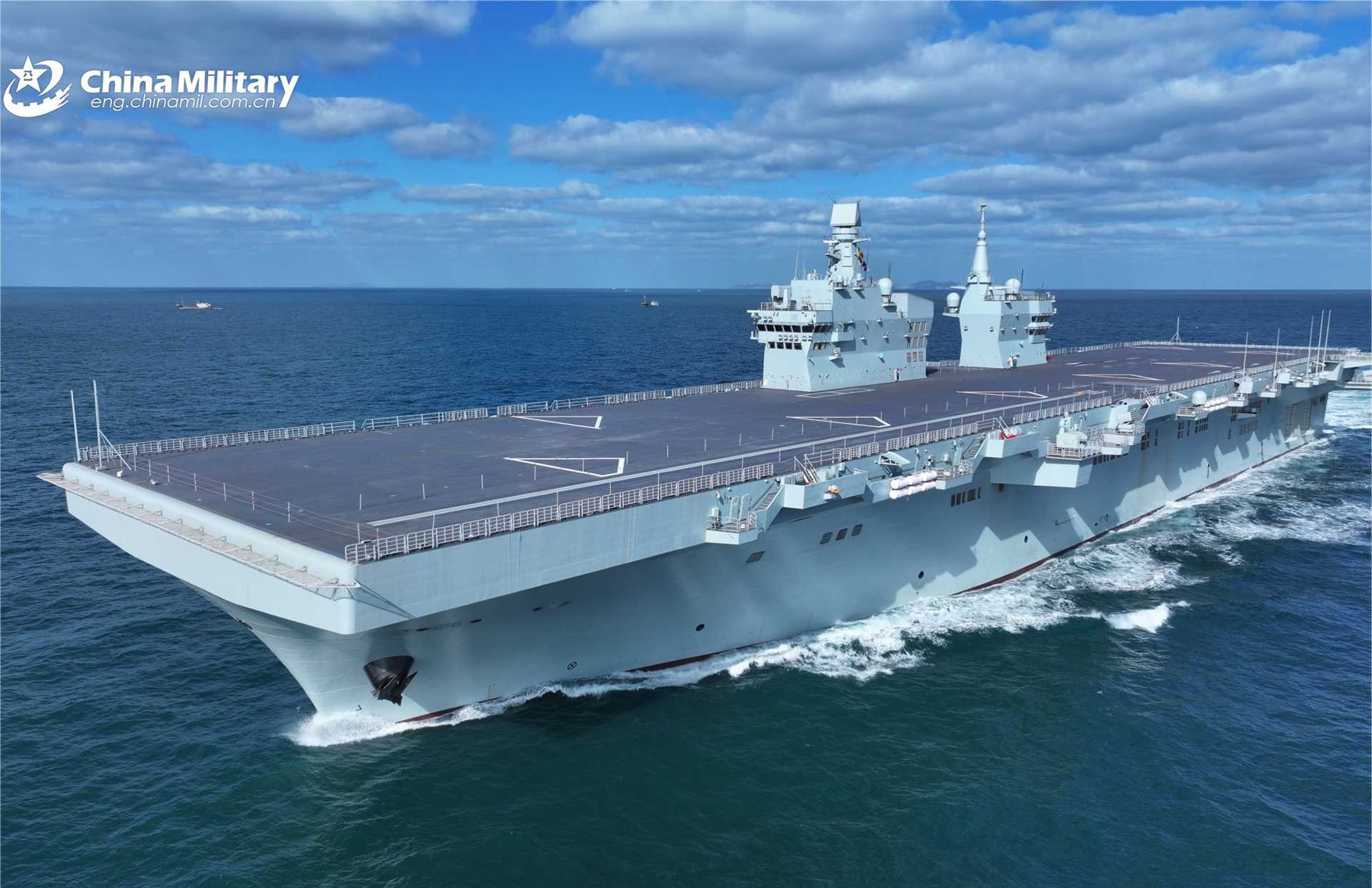
- Type 076 Sichuan (PLA Navy): China's first Type 076 amphibious assault ship deployed to the South China Sea for trials, reportedly testing electromagnetic catapult systems for fixed-wing drones.
Today's Stories
Ukraine Damaged a Refinery 700 Kilometers Inside Russia — and That Wasn't Even the Furthest Strike This Week
● Moscow, Russia · Crimea · Kyiv, Ukraine
If you want to understand how Ukraine is fighting a war it cannot win conventionally, watch where its drones are landing.
Ukraine's General Staff confirmed overnight strikes on the Slavneft-YANOS refinery in Yaroslavl, a strategic asset that processes roughly 15 million tons of oil annually for Russian military logistics, according to the Kyiv Post. A fire was reported on the premises; damage assessment is ongoing. Earlier in the week, long-range drones reached the Urals for the first time, damaging targets near Yekaterinburg and Chelyabinsk — more than 1,800 kilometers from Ukrainian territory, per United24. And in Vologda Oblast, drones damaged the Cherepovets branch of Apatit, a major phosphate fertilizer plant, bursting a high-pressure pipeline and injuring five with acid burns.
If this campaign succeeds as a coercive tool, Ukraine may force Russia to negotiate from a degraded industrial base — fertilizer, refining, and chemical capacity are all harder to replace than fuel storage. If it fails, it becomes the new attritional baseline: every week, another fire, another fix, another shrug from Moscow. The signal to watch is range. Two weeks ago the record was around 1,400 kilometers. This week, 1,800. If a Ukrainian drone reaches the Moscow industrial belt before June, the political math changes for both capitals.
Iran Wants to Reopen the Strait of Hormuz — But Keep Its Nuclear Program Off the Table
● Strait of Hormuz · Washington DC, USA · Islamabad, Pakistan · Tehran, Iran · United States

The world's most important oil chokepoint has been effectively closed for weeks, and Tehran just made its most concrete move yet to reopen it — with a catch Washington won't like.
Per Axios, citing a U.S. official and two people with knowledge, Iran has handed Washington a proposal — via Pakistani mediators — to end the war and reopen the Strait of Hormuz, with nuclear negotiations deferred to a later stage. Foreign Minister Araghchi raised the plan during meetings in Islamabad with Pakistani, Egyptian, Turkish, and Qatari mediators over the weekend, signaling there is no internal Iranian consensus on how to handle U.S. nuclear demands. About a fifth of the world's oil normally flows through Hormuz; the International Energy Agency has called the disruption the largest oil supply shock in history. President Trump is expected to convene a Situation Room meeting on Iran with his national security team on Monday, according to Ya Libnan.
If Washington accepts the sequencing, it sets a precedent that maritime pressure converts directly into nuclear leverage — and every Pacific planner watching mine warfare in chokepoints learns the same lesson. If it rejects the proposal, the blockade and the oil-price shock that could push prices above $100 per barrel on the session stay live indefinitely. The quieter defense-tech story underneath is that the U.S. Navy, the most capable in the world, has not been able to cheaply reopen a mined waterway. That's a doctrinal data point with a long tail.
Lockheed Just Got a $4.8 Billion Rocket Order Because Precision Fire Is Now Basic Infrastructure
● Ukraine
If you want to know what Western planners actually fear, don't read the strategy documents — read the contracts.
The U.S. Army awarded Lockheed Martin up to $4.79 billion for Guided Multiple Launch Rocket System rounds — the GPS-guided rockets fired from HIMARS — covering two full-rate production lots and logistics support, per Janes. GMLRS isn't glamorous. It's the Toyota Camry of precision strike: cheap relative to its effect, reliable, and suddenly in extraordinary demand from Ukraine to the Pacific.
If this contract converts into actual throughput, the Pentagon proves it can scale a proven munition under wartime pressure — the test case for what War on the Rocks this week called the "affordable mass" problem, the question of whether the Defense Department can buy lots of good-enough weapons rather than a handful of perfect ones. If it doesn't — if supplier bottlenecks swallow the dollars — then "affordable mass" remains a slogan and the West discovers, the hard way, that you can't surge what you can't manufacture. Watch for paired supplier-expansion announcements in the next 60 days.
China Ran Its Most Ambitious Taiwan Drill Yet — and Debuted a New Class of Ship
● South China Sea · Taiwan Strait · Beijing, China
China's Taiwan exercises have become so routine that tuning them out is the default response. This week's was different in a specific, measurable way.
The PLA's "Mission Justice-2025" island encirclement exercise was reported to have wrapped on April 27, and Chinese-language reporting confirmed that the Type 075 amphibious assault ship — Beijing's purpose-built marine landing platform — appeared in a Taiwan Strait drill for the first time. Separately, the first Type 076, the Sichuan, has entered sea trials in the South China Sea, reportedly testing electromagnetic catapults that would let it launch heavier fixed-wing drones, per Army Recognition. The Pentagon publicly called on Beijing to stop pressuring Taiwan.
If the Type 075/076 mix becomes a fixture in Taiwan-focused exercises, Beijing has quietly normalized rehearsing the full invasion — blockade, port seizure, beach landing, organic air power — instead of just the opening missile salvo. If the Type 076's catapult trials fail, expect a 12-to-18-month delay in fielding the platform and a fallback to carrier-centric task forces. The signal to watch is whether PLA vessels linger near Taiwan's eastern coast after the exercise officially ends.
The Joint Chiefs Chair Says Autonomous Weapons Are "Key and Essential"
Sometimes the most important defense-tech news is a sentence, not a prototype.
Per Defense One, Joint Chiefs Chairman Gen. Dan Caine said autonomous weapons will be a "key and essential part" of U.S. warfare, and that the Pentagon is actively working out how to apply autonomy to drones and command-and-control systems. Official language shapes procurement, doctrine, and what officers feel permitted to build. The taboo is fading — the question has moved from whether autonomy belongs in military systems to where, how fast, and with what safeguards.
If the House Armed Services Committee and the Senate Armed Services Committee respond with sharper rules-of-use language during FY2027 National Defense Authorization Act markups in the coming weeks, the U.S. gets a real public framework before the hardware fully arrives — the rare case of policy catching up to capability. If those committees stay quiet, the doctrine gets written by procurement officers and contract language, which is how the Pentagon usually settles questions it would rather not debate in daylight. Watch markup activity in both armed services committees on the FY2027 NDAA for the answer.
⚡ What Most People Missed
- The UK is quietly defining its next drone wingman around electronic warfare and disposable mass. A live UK Ministry of Defence tender explicitly calls for systems built around electromagnetic warfare effects, signature-managed air vehicles, one-way disposable aircraft, and autonomous command-and-control. This is what "autonomous collaborative platforms" actually means once procurement officers stop using strategy-deck language.
- China's technology vacuum runs through universities, not hackers. A War on the Rocks analysis published this week argues that Beijing's United Front Work Department is systematically channeling Western aerospace materials, AI training data, and dual-use processes back to China through entirely legal academic and commercial relationships. Export controls focused on chips may be fighting the last war.
- Germany has reinstated exit permits for military-aged men. Per Deutsche Welle, German men aged roughly 18–45 now need a military permit for extended stays abroad — administrative infrastructure that only makes sense if you're seriously preparing for mobilization. Berlin is rebuilding the machinery of a country that expects to fight a war.
- Space-based aircraft tracking is moving from concept to classified buying program. Breaking Defense reported that nine firms won Space Force orbital AMTI deals — a new sensor layer that, if it delivers, changes how easily small surface vessels and aircraft can mass for chokepoint closure.
📅 What to Watch
- If Trump rejects Iran's Hormuz-first proposal at Monday's Situation Room meeting, the blockade becomes structural rather than tactical, and oil markets price in a multi-month closure rather than a negotiation window.
- If a Ukrainian drone reaches a target inside the Moscow ring road before June, Russia's air defense reputation collapses faster than its refinery output.
- If the House Armed Services Committee and the Senate Armed Services Committee fail to include autonomous-weapons rules-of-use language during FY2027 NDAA markups, doctrine gets written by contract officers and the details will surface only after operational use creates precedents.
- If the Type 076's electromagnetic catapult trials succeed cleanly, Beijing accelerates production and the U.S. Navy loses a quiet assumption about Pacific air-power asymmetry.
- If the Pentagon pairs the GMLRS award with named supplier-expansion measures, "affordable mass" becomes industrial policy; if not, it stays a slogan and the munitions bottleneck holds.
- If Romania or Poland places production-scale orders for Merops-class interceptor drones, Ukrainian battlefield improvisation has officially become NATO doctrine.
The Closer
A Joint Chiefs chairman blessing the killer robots, and a high-pressure pipeline in Cherepovets teaching us that the future of industrial warfare smells like phosphoric acid and costs less than a used sedan. Until tomorrow.
Forward this to the friend who keeps asking why oil is at $100 — they're going to want the Hormuz section.