The Lyceum: Defense Tech Daily — Aug 15, 2026

Photo: lyceumnews.com
Past 48 Hours — August 15, 2026
The Big Picture
The past 48 hours were less about wonder weapons than endurance: keeping tankers moving through contested water, stretching Ukraine’s shrinking interceptor supply, and building military hardware that can be upgraded without starting over. The common thread is control—over sensors, supply chains, orbital networks, and the cost of staying in the fight. A date check matters: the supplied CBS item about President Donald Trump and Iran ran March 12, the Pentagon press-policy dispute dates to October 2025, and the China-visit item predates this 48-hour window, so none is presented as a new development.
This Week's Stories
Iran’s Drones Are Turning Shipping Rules Into a Live-Fire Experiment
Drones damaged two tankers operated by Abu Dhabi National Oil Company while they crossed the Strait of Hormuz on Thursday evening, the Associated Press reported. The United Arab Emirates blamed Iran and called the attacks piracy; Britain’s United Kingdom Maritime Trade Operations separately received reports that two vessels had been damaged. No casualties were reported. (Iran’s Drones Put the Strait of Hormuz’s New Traffic Rules on Trial)
The immediate damage was limited. The strategic damage may not be. Iran does not need to sink every tanker to disrupt trade—it needs insurers, crews and shipping companies to doubt that identification rules and naval patrols can protect them.
If commercial traffic holds steady, the new transit arrangements will have survived contact with cheap precision weapons. If traffic falls or insurance costs jump, drones will have achieved much of what a physical blockade would, without Iran having to maintain one.
Ukraine’s Oil Campaign Is Becoming an Industrial Siege

Ukrainian drones damaged Gazprom’s Neftekhim Salavat refining and petrochemical complex in Bashkortostan on Thursday, according to the Associated Press. AP described it as the fourth reported Russian refinery attack in three days.
Refineries are unusually sensitive targets: most of the facility can remain standing while damage to a specialized processing unit reduces output for weeks. Repeated attacks also force Russia to choose between protecting industrial revenue and keeping air defenses around military bases, command centers and weapons factories. (Ukraine’s Oil Campaign Is Becoming an Industrial Siege)
The campaign succeeds if Russia begins treating hundreds of industrial sites as permanent air-defense obligations. Failure looks like rapid repairs, little effect on fuel output and no meaningful redeployment of Russian defenses. The clearest signal will be where Russia moves its surface-to-air missile systems—not simply how spectacular the fires look. (Ukraine’s Oil Campaign Is Becoming an Industrial Siege)
Ukraine Put Its Patriot Request in Percentages
Ukrainian President Volodymyr Zelenskyy said Ukraine holds roughly 1% of the United States’ Patriot interceptor inventory, needs 5% to protect its cities through winter and could stop Russia’s ballistic-missile attacks with 10%, Cadena SER reported from his CNN interview. He also said Ukraine has received two-and-a-half times fewer interceptors in 2026 than in 2025. (Ukraine Put Its Patriot Request in Percentages)
Those are Zelenskyy’s estimates, not an independently verified inventory count or an agreed transfer. But the framing matters: he is no longer asking abstractly for “more Patriots.” He is asking Washington to debate what percentage of its own magazine it is willing to spend on Ukraine’s survival. (Ukraine Put Its Patriot Request in Percentages)
Success would be a predictable flow of interceptors that lets Ukraine plan coverage by city and season. Failure is continued barrage-by-barrage rationing. The signal is not another pledge—it is a funded transfer from an identified inventory with a delivery schedule. (Ukraine Put Its Patriot Request in Percentages)
The FCC Is Redefining a Consumer Drone as a Military Sensor Platform
The Federal Communications Commission is seeking comment on restrictions covering certain foreign-produced drones already on its national-security Covered List. The proposed categories include LiDAR laser-ranging sensors, thermal imaging, swarming functions, autonomous docking stations and heavy-payload capability. (The FCC Is Drawing a New Line Between Consumer Drones and Military Sensors)
That list reaches well beyond combat aircraft. LiDAR helps civilian drones avoid obstacles and map construction sites; thermal cameras inspect power lines and find missing people. The FCC is effectively arguing that widely available commercial features can become military capabilities when combined on an untrusted platform. (The FCC Is Drawing a New Line Between Consumer Drones and Military Sensors)
The comment period remains open until September 2. If LiDAR and thermal imaging survive into a final restriction, foreign manufacturers will lose access to parts of the U.S. market while American surveying, agriculture and infrastructure companies face a narrower—and probably more expensive—supplier pool. If the FCC narrows the categories, commercial users will have shown that dual-use regulation still has limits. (The FCC Is Drawing a New Line Between Consumer Drones and Military Sensors)
The Pentagon Cleared a Path for Lasers to Test in American Airspace
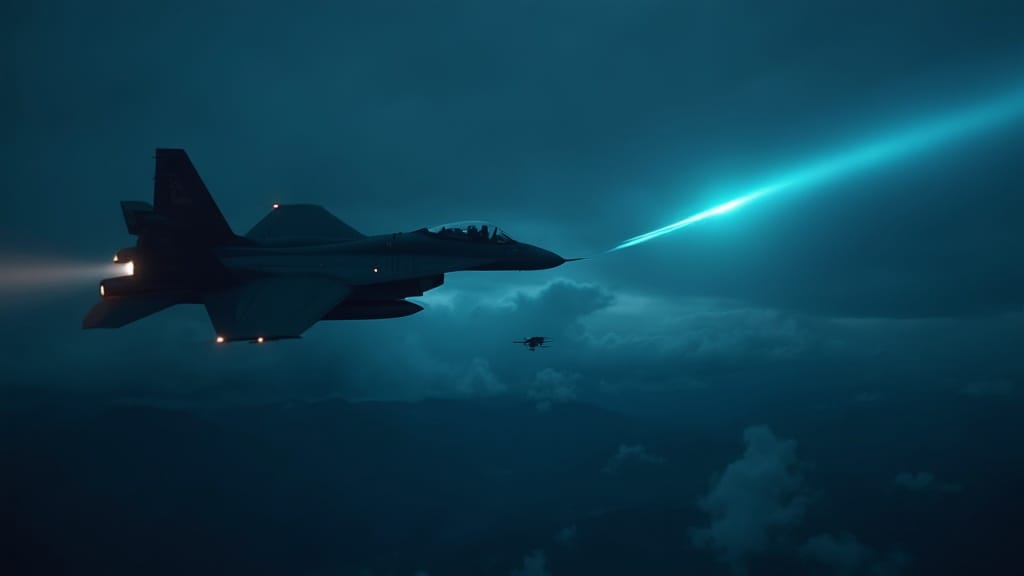
Thomas Dodd, a senior Pentagon technology official, called for lighter directed-energy weapons that can fly aboard aircraft and special-operations platforms, Air & Space Forces Magazine reported. More concretely, Dodd said high-energy lasers can now undergo approved testing in U.S. national airspace following a safety review with the Federal Aviation Administration.
That regulatory opening matters because airborne lasers are difficult to test realistically. Aircraft vibration, clouds, dust, cooling demands and power limits all punish systems that look impressive on a ground range.
If regular flight tests begin, developers can finally measure whether airborne lasers can track and damage drones outside laboratory conditions. Failure will look like years of slide decks, carefully staged ground demonstrations and no operational aircraft. The signal to watch is an announced live-fire flight test with a named platform and measured engagement results.
The Space Force Is Paying Five Companies to Break SpaceX’s Monopoly on the Router
The U.S. Space Force awarded Rocket Lab, York Space Systems, Northrop Grumman, Lockheed Martin and Amazon LEO for Government $12 million each to demonstrate links among satellites built by different vendors, Air & Space Forces Magazine reported. Each company must also develop a “Space Exchange Point”—an orbital router that passes data between spacecraft and the network backbone. (The Space Force Is Trying to Build a Satellite Network Without a Single Landlord)
SpaceX holds a $2.9 billion agreement to build that backbone. The new demonstrations are meant to stop the military network from becoming a closed ecosystem in which one company controls the connections, standards and upgrade path. (The Space Force Is Trying to Build a Satellite Network Without a Single Landlord)
If the five vendors establish secure cross-company links, the Space Force can swap suppliers without rebuilding the whole network. Failure means nominal interoperability that works only in presentations or tightly scripted tests. The decisive signal is one company’s satellite routing operational data through another company’s exchange point. (The Space Force Is Trying to Build a Satellite Network Without a Single Landlord)
The Next Abrams Is Being Built to Age Like a Smartphone
The U.S. Army is preparing soldier tests of M1E3 Abrams tank and XM30 infantry fighting vehicle prototypes, Breaking Defense reported. The M1E3 design combines hybrid-electric propulsion, an unmanned turret, a three-person crew and an open computing architecture intended to accept new software, sensors and weapons. (The Next Abrams Tank Is Part Armored Vehicle, Part Smartphone)
The Army says hybrid propulsion could cut fuel use by 50%. Both XM30 competitors—the General Dynamics Land Systems Wolf and American Rheinmetall Lynx—also use hybrid power, unmanned turrets and 50-millimeter cannons. (The Next Abrams Tank Is Part Armored Vehicle, Part Smartphone)
If the open architecture works, the Army can update vehicles without treating every new sensor as major surgery. Failure will look familiar: proprietary interfaces, ballooning integration costs and upgrades that arrive after the threat has changed. Soldier testing and the subsequent National Training Center exercise should reveal whether this is genuinely modular armor or merely a more complicated tank. (The Next Abrams Tank Is Part Armored Vehicle, Part Smartphone)
The Pentagon Is Buying a Domestic Counter-Drone Utility
The Pentagon’s Joint Interagency Task Force 401 awarded AeroVironment a $500 million indefinite-delivery, indefinite-quantity contract for the Domestic Shield program, Inside Defense reported. An initial $80.5 million order covers AeroVironment’s Titan system, which combines sensors and electronic countermeasures to detect and defeat small drones. (The Pentagon Wants to Put Drone-Killing Lasers in the Air)
The contract structure matters almost as much as the equipment. Instead of designing a separate defense for every base, the Pentagon can add systems site by site under one purchasing vehicle—closer to expanding a utility network than launching a new weapons program each time. (The Pentagon Wants to Put Drone-Killing Lasers in the Air)
Success means repeat orders, rapid installation and common operating procedures across U.S. facilities. Failure means incompatible site configurations and expensive equipment that cannot distinguish a hostile drone from ordinary civilian traffic. Deployment numbers and false-alarm rates will show which version the Pentagon bought. (The Pentagon Wants to Put Drone-Killing Lasers in the Air)
⚡ The Air Force Funded AI to Hunt New Signals—and Attack Them
The Air Force Research Laboratory awarded Parsons a $15.1 million contract on August 13 for BLADE, short for Battlefield Lethal AI-Driven Electronic Warfare. The official contract notice covers electronic support—finding and understanding radio signals—and electronic attack, meaning jamming or otherwise disrupting them. The work runs through October 2030, with $1.125 million obligated at award.
The important shift is from using artificial intelligence as a spectrum analyst to placing it inside an engagement workflow. If BLADE works, U.S. forces could recognize unfamiliar emitters and develop countermeasures faster than conventional threat libraries allow.
Failure could be dangerous: misclassification, unreliable jamming or operator rules that make the automation too risky to use. Watch for field demonstrations that identify a previously unseen signal, recommend an effect and disclose where a human must approve the attack.
⚡ What Most People Missed
- The SM-3 supply chain is moving below final assembly: The U.S. Department of War signed framework agreements with Boeing and RTX to strengthen production of SM-3 Block IB and Block IIA missile interceptors. No value, production target or delivery schedule was disclosed, so this remains an industrial agreement—not proof that more missiles are leaving factories.
- The Space Force intends to own the backbone satellites: The spacecraft SpaceX is building for the Space Data Network are supposed to be government-owned and modified for military security requirements. Commercial design, in this case, does not mean commercial control during a crisis.
- Existing foreign drones are not being grounded: The FCC proposal focuses on future equipment authorizations, imports and sales. The first shock would hit distributors and replacement purchases, not pilots already holding an affected controller.
- Steam catapults would require more than nostalgia: President Donald Trump directed the Navy to pursue steam catapults and hydraulic elevators on future Ford-class carriers, Breaking Defense reported. General Atomics said the future USS Doris Miller is already nearly halfway through production, making any conversion a redesign problem rather than a parts swap.
📅 What to Watch
- If tanker traffic falls despite ships following the new Hormuz procedures, it means identification rules have become a targeting aid rather than a safety mechanism.
- If Russia permanently moves air defenses toward refineries, Ukraine’s industrial campaign will be reducing protection elsewhere even when physical damage is quickly repaired.
- If the FCC retains broad LiDAR restrictions after September 2, communications regulation will have become an industrial-policy tool for creating a protected domestic drone market.
- If the Space Force demonstrates a cross-vendor orbital link, supplier diversity will become technically real rather than contractually decorative.
- If AeroVironment receives repeat Domestic Shield orders at multiple installations, counter-drone defense will be turning into permanent U.S. infrastructure.
- If BLADE identifies and engages an unfamiliar signal during a field test, artificial intelligence will have moved from sorting the electromagnetic battlefield to actively shaping it.
The Closer
Two tankers dodging flying explosives, an Abrams trying to update like a phone, and five satellite companies attempting the world’s most expensive group chat. Meanwhile, the Navy may be shopping for steam machinery while the Space Force builds orbital routers—which is one way to keep every century involved. Stay difficult to target. Forward this to the friend who knows a “simple redesign” is never simple. (The Space Force Is Trying to Build a Satellite Network Without a Single Landlord)
⚡ EDGE Signals
The following signals appeared in the adversarial edge sweep but were not carried forward in the primary synthesis:
- Volodymyr Zelensky told CNN that Ukraine currently has roughly 1% of the U.S. Patriot interceptor inventory, needs 5% to protect cities through winter and could stop Russia’s ballistic-missile attacks with 10%. He also said Ukraine received two-and-a-half times fewer interceptors this year than in 2
- The Air Force Research Laboratory awarded Parsons a $15.1 million contract on August 13 for BLADE—Battlefield Lethal AI-Driven Electronic Warfare. The program covers the design, development and deployment of electronic-support and electronic-attack capabilities able to engage new and emerging signal
- [3] Zelenski pide a EEUU más Patriot: "Con el 10% de sus reservas destruiríamos todos los misiles balísticos rusos"
URL: https://cadenaser.com/nacional/2026/08/13/zelenski-pide-a-eeuu-mas-patriot-con-el-10-de-sus-reservas-destruiriamos-todos-los-misiles-balisticos-rusos-cadena-ser/
- [4] Department of War, Boeing, and RTX Forge Agreements to Strengthen Production of Critical SM-3 Block IIA and SM-3 Block IB Munitions > U.S. Department of War > Release | U.S. Department of War
URL: https://www.war.gov/News/Releases/Release/Article/4567790/department-of-war-boeing-and-rtx-forgeဂreements-to-strengthen-production-of-c/