The Lyceum: Defense Tech Daily - Jul 05, 2026
Past 48 Hours — July 5, 2026
The Big Picture
The theme of these two days is the collapsing distance between the improvised and the industrial. Ukraine is running a missile that could reach Moscow on flight software you can download for free. Turkey just hit a moving ship with a ballistic missile — a trick only a handful of nations can pull off. And three governments finally wrote a $6.1 billion check for a fighter jet that's less a plane than a flying computer. Meanwhile, the Strait of Hormuz stays half-broken, the 60-day ceasefire clock keeps ticking, and China's PLA circles Taiwan again with more rehearsals under its belt than last time.
What Just Shipped
- LOCUST Laser Weapon System (AeroVironment): The Secretary of the Army, Dan Driscoll, personally tested the counter-drone laser at White Sands Missile Range after the FAA and the Defense Department signed an agreement letting these lasers operate alongside civil aviation — a first step toward firing directed-energy weapons in shared airspace.
- TAYFUN Block-3 (Roketsan): Turkey's ballistic missile struck a free-moving unmanned surface vessel in a live-fire test, joining the rare club of nations that can hit a maneuvering ship with a ballistic missile.
- Nyan one-way effector (UK Royal Navy): A combat-proven kamikaze drone was launched from the experimentation ship XV Patrick Blackett at sea — the Royal Navy's first ship-launched loitering munition.
- GCAP demonstrator (Edgewing) (BAE Systems / Leonardo / Mitsubishi Heavy Industries): The £4.6 billion contract funds a flying prototype expected before the end of 2027.
- Overland AI ground vehicles (Overland AI): Won a $20 million Marine Corps contract for autonomous ground vehicles supporting the Marine Air Defense Integrated System, initially for resupply under fire.
This Week's Stories
Ukraine's Most Powerful Missile Runs on Open-Source Drone Software

Every defense procurement officer should set down their coffee for this one. Ukraine's most powerful long-range weapon — a six-ton cruise missile that can reach targets 3,000 kilometers (roughly 1,865 miles) away — runs on the same free, publicly available flight control software that hobbyists load onto backyard drones.
According to Defence Blog, the CEO of the Ukrainian company behind the missile publicly defended the choice, arguing open-source software is battle-tested, constantly patched by a global community, and faster to iterate on than anything proprietary. That's a sound engineering argument. It's also a quiet demolition of the assumption that "military-grade" means "expensive and secret."
The same reporting ties this to Ukraine's broader improvisation: Defence Blog says Ukraine publicly revealed a truck-mounted coastal defense launcher it secretly received from the United States four years ago and kept off camera ever since — now used to threaten Russian ships in the Black Sea. Hidden foreign launchers plus homegrown long-range weapons. Old stockpiles and new code, mixed to keep Russia off balance.
If this model spreads, capable weapons proliferate faster than any embargo can contain them — and attribution gets murkier when the software is public. If it fails, it fails loudly, with a guidance bug and a missile in the wrong field. The signal to watch: whether Western defense ministries start auditing their own software supply chains, or keep paying nine figures for what a GitHub repo already does.
Britain, Italy, and Japan Just Made Their Sixth-Generation Fighter Real
For years, the Global Combat Air Programme — the joint plan by the U.K., Italy, and Japan to build a sixth-generation stealth fighter — was the kind of project that sounds thrilling in a press release and then vanishes into a funding dispute. On Friday, that changed. The dispute over cash was severe enough to cost two British officials their jobs.
Japan, Italy, and the U.K. handed a £4.6 billion ($6.1 billion) development contract to Edgewing, the industrial joint venture of BAE Systems, Leonardo, and Mitsubishi Heavy Industries, per Defense News and the U.K. Ministry of Defence. The 18-month contract runs from July 2026 through December 2027 and follows an earlier £686 million bridge deal in April.
What makes GCAP interesting isn't the airframe — it's the brain. The program treats computing, software, and secure networking as seriously as aerodynamics. The jet is designed to fight inside jammed electromagnetic environments, keep building targeting solutions when its links are severed, and direct drone wingmen autonomously. A flying command node that happens to be supersonic.
If GCAP succeeds, it becomes the West's only non-American sixth-gen fighter — a status it now holds by default, since the rival Franco-German-Spanish Future Combat Air System collapsed less than a month ago over a feud between Dassault and Airbus. If it slips, Europe has no fallback. The prototype is due to fly before the end of 2027; the Farnborough International Airshow opening July 20 is the next place to look for cracks or confidence.
Turkey Joins the Exclusive Club That Can Sink Moving Ships with Ballistic Missiles
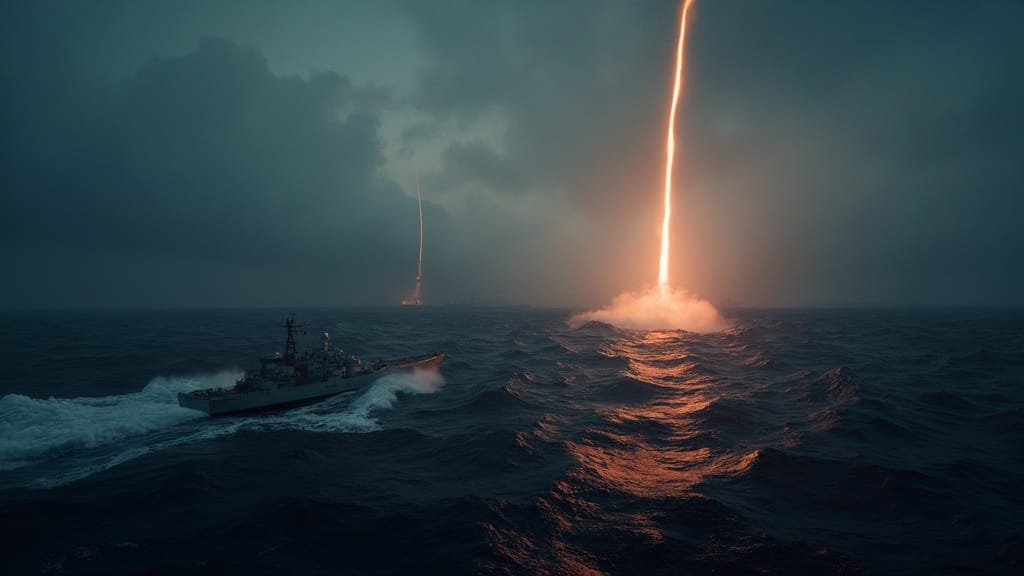
Anti-ship ballistic missiles are among the most strategically loaded weapons of the era. China's DF-21D, the "carrier killer," is why U.S. Navy planners lose sleep. This week, Turkey joined the tiny group that can field one.
According to Defence Blog, Turkish manufacturer Roketsan live-fired its TAYFUN Block-3 against a free-moving, unmanned surface vessel about 7 meters long, built to mimic a real naval target. The hard part isn't the boom — it's the math: the missile must predict where the ship will be when it arrives, not where it was at launch.
Turkey is a NATO member, which makes this both reassuring and complicated. A reliable anti-ship capability shifts the threat calculus across the Eastern Mediterranean and Black Sea — and it lands as Ankara's alliance relationships wobble. DW also reported Turkey shot down an Iranian missile headed toward its territory during the regional fight, a reminder of how fast missile-defense networks get pulled into someone else's war.
Watch Greece. Athens has been tracking Ankara's missile program closely, and a successful moving-target test is exactly the kind of milestone that accelerates a rival's procurement calendar.
The Strait of Hormuz Is Still a War Zone — Just a Quieter One

The U.S.-Iran ceasefire was signed on June 17 — but the Iranian Revolutionary Guard didn't fully get the memo. The memorandum commits Iran to its "best efforts" to keep the Strait of Hormuz open toll-free for "60 days only," a remarkably thin guarantee for a waterway carrying roughly a fifth of the world's oil.
It's already cracking. Trump accused Iran of a "foolish violation," describing four one-way attack drones fired at ships — one of which "solidly hit the upper deck of a large and very expensive cargo-carrying ship," per Fox News, with three others knocked down by U.S. forces. Trump has warned the U.S. will "blast" Iran if the strait doesn't stay open, and, per CBS News, floated the war wrapping up in two to three weeks even as gas pushed past $4 a gallon. CNN reports Qatar and Pakistan called the latest talks "positive," with a U.S. Navy MH-60S Sea Hawk down in the Arabian Sea on July 2 and an aircrew member still missing.
The number to watch is that 60-day clock — still running, set to expire in mid-August. If Iran's demand to charge "service fees" for passage hardens into policy before it lapses, Washington faces a choice between renegotiating from weakness or re-escalating. Whether Trump's "you'll find out" threats become anything concrete is the tell.
The Royal Navy Launched a Kamikaze Drone from a Ship at Sea
The Royal Navy quietly crossed a line this week. It launched a one-way attack drone — a "loitering munition" that flies to a target and destroys itself on impact — from a ship at sea for the first time.
According to The War Zone, the drone is the Nyan, described as "combat-proven," meaning it's already been used in real fighting, not just on a range. The launch came off the experimentation ship XV Patrick Blackett during trials off England's south coast, involving Royal Navy, British Army, and Royal Air Force personnel. It's a step toward what the U.K. calls a "hybrid" naval force — warships carrying both conventional missiles and swarms of cheap, expendable strike drones.
The cost asymmetry is the whole point. A Nyan costs a fraction of the anti-ship missiles it fights alongside, but it can saturate enemy defenses so the expensive missiles slip through. If this works, a warship becomes a fundamentally different threat; if it stays a trial curiosity, it's an expensive photo op. The signal: whether other NATO navies suddenly discover urgent loitering-munition programs of their own.
⚡ What Most People Missed
The Hormuz mine problem exposed a hole in U.S. naval readiness: With an estimated 80 naval mines still fouling the central shipping lanes, the U.S. is relying on unmanned systems after retiring most of its dedicated minesweepers — whose remaining hulls were based in Japan, not the Gulf. Think of a fire department that sold its ladder trucks for promising drones, then caught a high-rise fire before the drones were fielded. The clearance estimate — up to six months — comes from a Pentagon assessment reported secondhand, so treat the timeline as directional.
Iran's toll-road gambit is the real innovation: Per the International Crisis Group, Iran has defined a "Strait of Hormuz management supervision area" and stood up an IRGC-run "Persian Gulf Strait Authority" — which the U.S. Treasury has already sanctioned. U.S. envoys Steve Witkoff and Jared Kushner were reportedly in Doha trying to talk Iran out of charging ships to pass. If the toll-authority model survives any final deal, it's a template for turning a chokepoint into a revenue stream.
The Pentagon is putting almost all drones under one boss: Breaking Defense reported that Defense Secretary Pete Hegseth signed a memo creating a Direct Reporting Portfolio Manager for autonomy, covering all small air drones, all autonomous ground vehicles, and most unmanned surface vessels. When one office sets requirements across land, sea, and air, autonomy is being treated as a portfolio, not a gadget — which favors common software over bespoke platforms.
The Pentagon's secret anti-vax campaign is back in the light: Reuters' investigation into a covert 2020–2021 DoD effort to discredit China's Sinovac vaccine — using at least 300 fake social accounts across the Philippines, Central Asia, and the Middle East — is recirculating. The thread worth pulling: General Dynamics IT, which worked on it, later won a contract worth nearly $500 million to keep providing "clandestine influence services." Information operations are a standing procurement line, not a one-off. [Source: China Daily HK — English]
Japan is tripling its no-drone buffers around defense sites: Japan's Ministry of Defense said on July 3 that flight-restriction zones around designated facilities expand from roughly 300 meters to roughly 1,000 meters starting July 14. Governments don't widen restricted airspace by accident — this treats small drones as persistent security threats, not hobby aircraft. [Source: Japan Ministry of Defense — Japanese]
📅 What to Watch
- If Iran's "service fee" demands harden into policy before the 60-day ceasefire clock expires in mid-August, the U.S. faces re-escalation or a renegotiation from weakness — either way, the ceasefire's survival gets tested.
- If Farnborough (opening July 20) reveals the GCAP propulsion consortium or a demonstrator flight date, it signals the program has cleared the industrial infighting that just killed its European rival.
- If Turkey's TAYFUN test triggers a Greek naval procurement announcement, the Eastern Mediterranean arms race has moved from posturing to timelines.
- If other NATO navies stand up ship-launched loitering-munition programs, the Royal Navy's Nyan demo will have quietly reset what a "warship" is expected to carry.
- If China's export-control list of 20 Japanese dual-use entities expands, Beijing is normalizing supply-chain coercion as a standing tool, not a one-time signal.
The Closer
A six-ton cruise missile flying to Moscow on software a teenager could download; a British warship coughing a suicide drone into the Channel; and an Iranian toll booth quietly rising in the middle of the world's most important shipping lane. Somewhere in a Southeast Asian server farm, 300 fake accounts are presumably still logged in, waiting for their next war — the infrastructure always outlives the reason for it.
Stay sharp.
Forward this to the friend who still thinks "military-grade" means something.