The Lyceum: Defense Tech Daily — Jul 07, 2026

Photo: lyceumnews.com
Past 48 Hours — July 7, 2026
The Big Picture
Two things happened in the same city this week, and the coincidence tells the whole story. In Ankara, at a NATO summit, Trump approved airstrikes on Iran after Tehran attacked three commercial ships in the Strait of Hormuz — the sharpest test yet of a three-week-old ceasefire. At that same summit, NATO quietly decided that for the first time since 1982, its eyes in the sky would no longer be American. The thread running through both: the old assumptions about who fights, how, and with whose equipment are being rewritten in real time — and everyone, including America's closest allies, is hedging.
What Just Shipped
- US Army autonomous Volcano mine-laying (U.S. Army): Tested a driverless version of the Volcano mine dispenser on July 7 — a system that can blanket roughly 32 acres with up to 960 mines, now without a soldier behind the wheel.
- Titan counter-drone base defense (AeroVironment): First $80.5 million task order executed July 6 under the Army's $500 million counter-drone contract, built around AeroVironment's AI-enabled Titan system for Air Force base protection.
- Counter-UAS Authority interim final rule — see What Most People Missed; the July 6 Federal Register rule expanding drone-mitigation authority to local police could not be independently linked and is treated as a signal, not a shipped product.
This Week's Stories
The Ceasefire Is Breaking — Again
The ink on the U.S.-Iran memorandum was barely three weeks dry. Iran attacked three commercial ships in the Strait of Hormuz on Monday and Tuesday. The U.S. answered with airstrikes described as four to five times larger in scope than the previous round ten days earlier — damaging Iranian air-defense systems, coastal surveillance, anti-ship cruise missile sites, drone launch sites, and port facilities, according to a U.S. official. (The Ceasefire Is Breaking — Again)
Trump approved and ordered the strikes from Turkey, where he was attending the NATO summit. At the same moment, the U.S. revoked the sanctions waiver that had let Iran sell oil — one of the central concessions that got the ceasefire signed in the first place, per CNN. Both the military and economic pillars of the deal took a hit in the same 24 hours.
The tech dimension is the trap. Tehran has declared that only its approved route through the strait is safe, and all three ships were struck near the Omani and UAE coasts, NPR reports. Iran is using drones and anti-ship missiles to enforce a toll road on international water — which means the U.S. is now locked in a cycle of bombing the very launch infrastructure it will have to keep bombing to keep the strait open. If Iran goes quiet, the ceasefire limps forward. If it fires again, the framework is dead in practice. The next 72 hours are the tell.
NATO Just Fired Boeing and Hired Sweden

For 44 years, NATO's flying radar stations — the Boeing E-3 Sentry AWACS, essentially a jet that can see hundreds of miles of airspace and coordinate an air battle in real time — have been American. That era just ended.
Secretary General Mark Rutte announced that allies will jointly acquire up to 10 Swedish-built Saab GlobalEye aircraft to replace the aging E-3 fleet. The GlobalEye pairs Saab's Erieye Extended Range radar with a suite of sensors on a Bombardier business jet that can stay airborne more than 11 hours, per The Aviationist. Saab says it can track low-observable aircraft, drones, ballistic missiles, and hypersonic threats — the exact categories the 1970s-era E-3 was never designed to see, according to Air Data News.
The backstory is a procurement soap opera. NATO had leaned toward Boeing's E-7 Wedgetail, then dropped it in 2025 amid uncertainty over the U.S. Air Force's own E-7 plans, per Army Recognition. Layer in the friction between Washington and European capitals, and you get a genuinely historic choice made while Trump was in the same city ordering strikes on Iran. If contract negotiations produce a delivery schedule that beats the E-3's ~2035 retirement, this is real engineering momentum. If the timeline stays vague, it was theater. Watch Farnborough, opening July 20.
The Reaper Is Dying — and Its Replacement Is Built to Be Lost
The MQ-9 Reaper defined American air power for two decades — 27-hour loiters, the Soleimani strike, the drone everyone pictured when they pictured a drone. Combat is retiring it. During the campaign against Iran, the Air Force lost as many as 24 Reapers, close to $1 billion at $40 million each, which Defense Express reports accounted for roughly a quarter of all U.S. losses in Iran by value.
Now the Defense Innovation Unit — the Pentagon's fast-acquisition shop — is hunting for cheaper drones to do the Reaper's job, Breaking Defense reports, after nearly 30 were lost. The requirements reveal a philosophical flip. The replacement must use open architectures, be mass-producible, and tolerate attrition — with a range near 932 miles, 20-hour endurance, and a mandate to fly 100 missions at "low-to-medium" cost, per The War Zone. The Reaper was too expensive to risk. Its heir is designed to be affordable enough to lose.
If DIU draws bids from drone startups rather than legacy primes, the Pentagon has genuinely internalized the lesson. If a contract lands before the fiscal year ends, that's urgency, not planning. Watch the bidder list. (The Reaper Is Dying. What Comes Next?)
The Army's Robot Minelayer
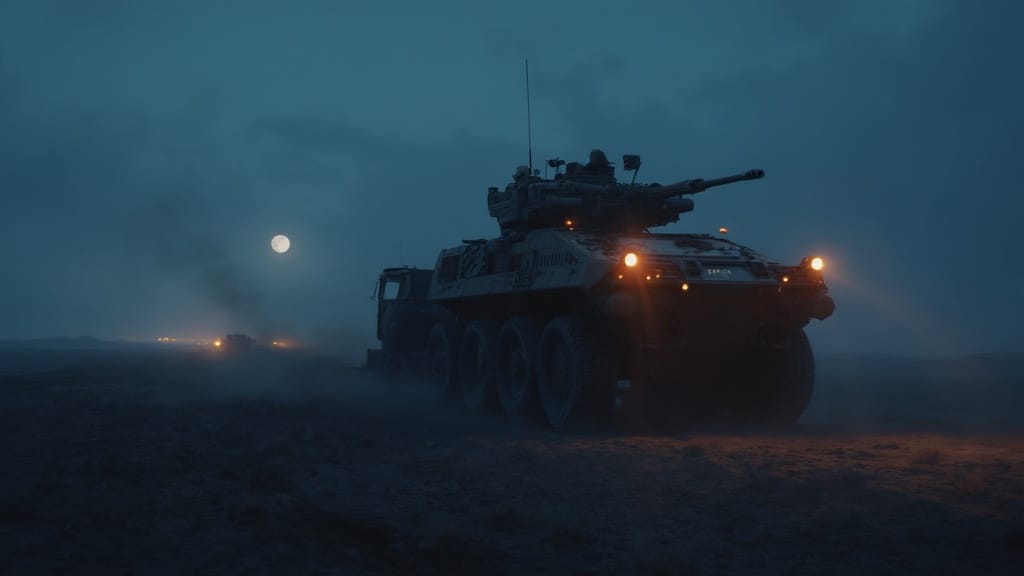
Autonomous weapons get their headlines when they fly. This week the U.S. Army tested one that crawls — and it may matter more. Defense News reports the Army trialed a driverless version of its Volcano mine dispenser, which can seed roughly 32 acres with up to 960 mines. The new twist: no driver, and the system logs each mine's placement into the digital battle picture so units can track and later clear it. (The Army's Robot Minelayer)
The strategic logic is blunt. Autonomous mass mine-laying lets NATO deny large stretches of ground to a Russian armored advance without putting soldiers in the most lethal terrain. Mines are ancient; pairing them with driverless delivery at scale is not. The failure mode is equally visible: if the autonomy can't navigate contested, GPS-denied ground reliably, it stays a demo. Watch whether this feeds NATO's new "Persistent Airfield Denial" innovation challenge — the two ideas are natural partners. (The Army's Robot Minelayer)
The Air Force Wants Thousands of Supersonic Missiles to Kill Drones
The U.S. Air Force has asked industry to rapidly prototype a supersonic ground-launched counter-air missile — a weapon to shoot down enemy aircraft and drones before they reach friendly forces — and it wants to buy between 1,000 and 3,500 of them. That quantity is the story. You don't stockpile thousands of interceptors for the occasional rogue jet; you do it for saturation raids, waves of cheap drones arriving faster than exquisite missiles can answer. (The Air Force Wants Thousands of Supersonic Ground-Launched Counter-Air Missiles)
This is the clearest signal yet that air defense is shifting toward high-volume, high-speed interceptors built for drone-heavy skies — magazine depth over gold-plating. The tell will be what seeker technology bidders propose: radar, infrared, or multi-sensor guidance reveals exactly how the U.S. plans to hunt swarms in the 2030s. If the program stalls in prototyping, the Pentagon is still writing checks its factories can't cash — a pattern the GAO flagged this week for hypersonics too. (The Air Force Wants Thousands of Supersonic Ground-Launched Counter-Air Missiles)
⚡ What Most People Missed
Your phone's 3D scans are now navigating military drones: Niantic — the maker of Pokémon Go — licensed its Visual Positioning System data, built from a decade of players scanning the real world with their phones, to defense autonomy startup Vantor for GPS-denied drone navigation. The commercial-to-military pipeline is running in reverse: consumer apps now generate the environmental maps defense systems need, and it's not clear export-control rules ever anticipated a mobile game becoming a dual-use dataset. Single-source (DronXL, June 9), trending hard on Hacker News — treat contract terms as reported, not confirmed.
Jim Keller's chip fab startup rebranded and moved to Texas: Atomic Semi, co-founded by legendary chip architect Jim Keller, is now Fab2, building small modular fabs that cost tens of millions instead of tens of billions. The defense angle isn't cutting-edge nodes — it's that legacy weapons run on older chips no one manufactures anymore, and a modular U.S. fab for small runs is exactly what the Pentagon has been begging for. Rebrand and relocation, not a production milestone — but Keller's résumé (AMD Zen, Apple Silicon) keeps it out of vaporware territory.
Kyrgyzstan is quietly pivoting its defense alignment from Moscow to Beijing: The Robert Lansing Institute is tracking a Central Asian shift that would have been unthinkable five years ago — a member of Russia's CSTO alliance shopping Chinese security guarantees. If real, it signals the CSTO is losing credibility as a security provider in real time, not just in think-tank papers, as Moscow's war in Ukraine and sanctions hollow out its reach. Analytical signal, not confirmed policy — watch the equipment sales.
Britain adds a 500 km strike option: The UK Ministry of Defence said on July 7 it will join the Precision Strike Missile program with £190 million, framing the supersonic ballistic missile alongside cheap one-way attack drones and ground-launched cruise missiles. The interesting part is the layering — London is building a menu of deep-strike options at different price points, less Cold War artillery park, more Ukraine-era range war.
Europe puts drones at the center of joint procurement: On July 3 the European Commission proposed five joint defence projects, one of them — DECODER — aimed squarely at pooled drone and counter-drone production across most of Europe plus Norway and Ukraine. Still a proposal, not signed orders, but it's the clearest sign in weeks that Europe is trying to turn battlefield lessons into industrial institutions, not slogans.
📅 What to Watch
- If Iran retaliates for Tuesday's strikes with another round of ship attacks, the ceasefire collapses in practice even if it survives on paper — and Hormuz becomes a standing war zone with global oil-price consequences.
- If NATO's Saab contract produces a real delivery schedule before Farnborough opens July 20, GlobalEye has engineering behind it; vague dates mean the announcement was summit theater.
- If DIU's Reaper replacement draws bids from drone startups rather than legacy primes, the Pentagon has actually learned that cheap-and-many beats expensive-and-few — a harder cultural shift than any budget line.
- If the July 6 counter-drone rule sees big-city police departments buying military-grade systems, the U.S. quietly acquires a layered domestic airspace-defense grid, with all the civil-liberties questions that follow.
- If Kyrgyzstan formalizes any Chinese security arrangement, a CSTO member has defected from Moscow's orbit — and Russia's strategic depth to its south starts to erode visibly.
The Closer
A Swedish business jet inherits NATO's eyes while Trump bombs Iran from the summit next door; a Pokémon Go player's phone scan quietly teaches a war drone how to find its way through a city; and the Air Force goes shopping for three thousand missiles to swat drones out of the sky. Somewhere in all this, the Pentagon's most expensive drone is being retired not for a better one, but for one cheap enough to throw away — which is either strategic maturity or a very expensive way to admit the old plan was too precious to survive contact with reality. (The Air Force Wants Thousands of Supersonic Ground-Launched Counter-Air Missiles)
Stay skeptical of the vague delivery date.
Forward this to the friend who still thinks the defense budget buys things that come back.
⚡ EDGE Signals
The following signals appeared in the adversarial edge sweep but were not carried forward in the primary synthesis:
- ### AeroVironment just turned a vague $500 million counter-drone award into a real base-defense program [link removed]
- On July 6, AeroVironment said it received an $80.5 million task order to help defend U.S. Air Force bases against small drones, the first order under the Army's newly disclosed $500 million contract vehicle. The company tied the work to Domestic Shield and Joint Interagency Task Force 401, the Army-
- A quick note on the big-front-page items: Reuters' earlier reporting on the Pentagon's anti-vaccine influence campaign against Chinese shots is important context for any discussion of U.S. information operations and alliance trust, but it is not a new event inside the July 5–7 window. Ukraine and th
- [1] Pentagon awards $80M task order for AI-enabled tech to defend Air Force bases against small drones | DefenseScoop
URL: https://defensescoop.com/2026/07/06/pentagon-awards-task-order-to-av-for-titan-drone-defense/
- The last 48 hours have a clear pattern: drone defense and AI-enabled base protection are moving from policy talk to implementation, and not just inside the Pentagon.[1][11] An interim federal rule now lets state and local police detect and sometimes disable drones, while AeroVironment's first $8