The Lyceum: Defense Tech Daily — Jul 11, 2026
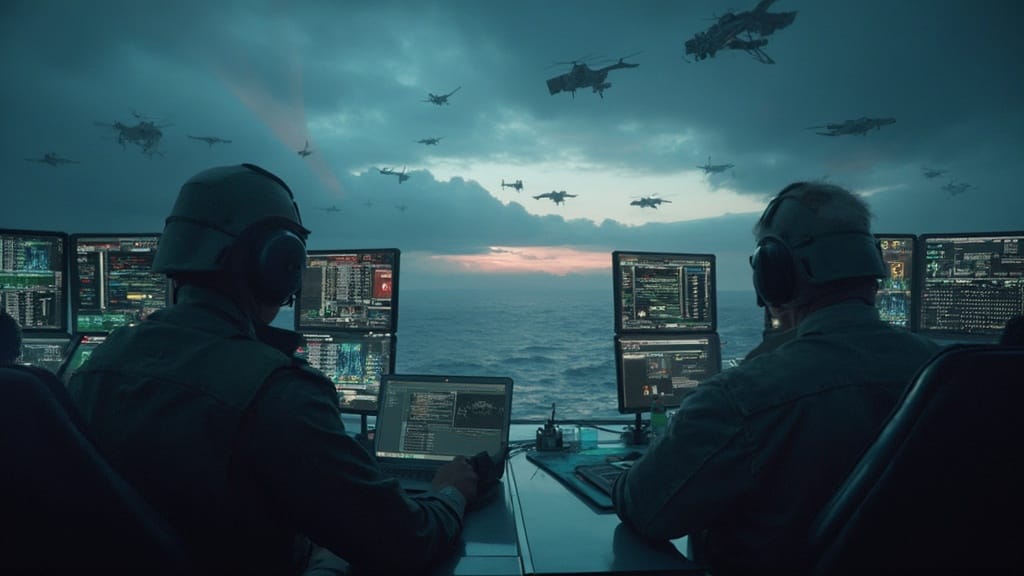
Photo: lyceumnews.com
Past 48 Hours — July 11, 2026
The Big Picture
The Iran war has stopped being a Middle East story and become a laboratory. Over the past two days, Iran fired mixed salvos of ballistic missiles, cruise missiles, and cheap drones across the Gulf — deliberately probing which layer of each country's air defense cracks first — while the U.S. answered with strikes across Iran's entire sensor-to-shooter network. Meanwhile the Space Force put a name to a satellite-blinding weapon it quietly used during last year's Iran strikes, and a Reuters investigation into a Pentagon anti-vaccine campaign resurfaced to remind everyone that information warfare leaves real bodies. The through-line: everyone is watching everyone learn, in real time.
This Week's Stories
Iran Turns the Gulf Into a Live Air Defense Experiment
Your gas just crossed $4 a gallon. The reason is a missile volley that stretched from Jordan to Kuwait.
According to CBS News, Iran dragged its Gulf neighbors back into the war on Thursday with a mixed salvo of drones and missiles. Jordan intercepted at least eight ballistic missiles; Bahrain's military reported intercepting several rounds of drones and missiles; Kuwait faced three ballistic missiles, one cruise missile, and ten drones. The variety is the point. Ballistic missiles, cruise missiles, and cheap drones in the same salvo is a deliberate stress test — Iran is measuring which threat type each country's defenses handle worst.
Then, on July 11, the U.S. military said it launched a new round of strikes after Islamic Revolutionary Guard Corps forces attacked a Cyprus-flagged container ship in the Strait of Hormuz, per Reuters and the Associated Press. U.S. targets have expanded to Iranian air defenses, coastal surveillance, surface-to-air missiles, anti-ship cruise missiles, drone launch sites, and small boats — the whole kill chain, not just the launchers.
What changes if this pattern holds: cheap maritime harassment is forcing expensive counter-network warfare. You can't just shoot down one drone; you have to degrade radar, surveillance, boats, and missiles together, or commercial shipping stays vulnerable. Watch whether the U.S. and Gulf partners start fusing Patriot, THAAD, and short-range interceptors into layered batteries — that's the doctrinal shift this conflict is forcing. Trump told CBS News he expects the war to wrap in two to three weeks; most analysts are skeptical. (Trump Delays China Trip — and the Signal Matters More Than the Visit)
The Space Force's Satellite-Blinding Weapon Finally Has a Name

Most people picture a space weapon as a missile that blows a satellite apart. The U.S. just revealed something far more elegant. (The Space Force's Secret Weapon Just Got a Name)
It's called Meadowlands, built by L3Harris Technologies, and Space Force Combat Forces Command accepted it for operational use last month, per Task & Purpose. It blasts enemy satellites with electromagnetic radiation to shut them down — designed to "detect, deny, disrupt, and degrade adversary capabilities." The clever part, as Gizmodo notes, is that it destroys nothing. The effects are "reversible": interfere with a satellite's software, silence it for the length of an operation, then walk away without leaving a debris cloud that would threaten your own satellites for decades. (The Space Force's Secret Weapon Just Got a Name)
New Atlas reports it's a wheeled, trailer-mounted system built to load aboard a Lockheed C-130 Hercules — meaning it can fly into a theater and set up in hours. It's already been used: Space.com reports these capabilities were central to Operation Midnight Hammer, the June 2025 strikes on Iranian nuclear sites, where electromagnetic warfare crews "created a silence zone" to protect bomber ingress and egress.
What changes: the Space Force is no longer just a satellite-operating service — it's fielding an offensive toolkit. If China or Russia stay publicly silent about Meadowlands, that silence tells you how seriously they take it. The failure signal is the opposite — loud denunciation and a rush to demonstrate their own reversible-effect jammers, which would mean the orbital arms race just went visible. (The Space Force's Secret Weapon Just Got a Name)
Ukraine Swarms the Sea of Azov — With Drones, Not Ships

Ukraine has no navy worth the name. Russia has one. Ukraine is winning the naval war in the Sea of Azov anyway.
According to The War Zone, Ukraine claims 28 Russian vessels were hit by aerial drones on Saturday — the latest in a campaign Kyiv says has damaged nearly 80 Russian ships. These aren't exotic anti-ship missiles. They're the same cheap, mass-produced aerial drones Ukraine has spent two years refining, now systematically degrading Russia's ability to use its own inland sea.
The logic is brutal and simple: Russia relies on the Azov to resupply its forces in southern Ukraine. Deny it, and you complicate logistics for an army already stretched thin.
What changes if this holds: a country without a conventional navy can contest maritime space with enough drones and the nerve to use them — a lesson every small navy on Earth is now studying. The path-defining signal is Russia's response. Pull the logistics fleet back and you concede the sea; surge air defense to protect it and you strip assets from the front line. Either choice costs Moscow something it can't spare.
The Pentagon Ran an Anti-Vaccine Campaign — and People Died
This is a story about information warfare with no off switch.
Reuters' investigation documents a covert Department of Defense propaganda campaign run from spring 2020 to spring 2021, out of the military's psychological operations center in Tampa, Florida. Its goal: dissuade citizens in the Philippines, Central Asia, and the Middle East from taking Sinovac Biotech's CoronaVac vaccine — part of a broader effort to undermine China. Reuters reports the Pentagon overrode strong objections from senior U.S. diplomats in Southeast Asia and disregarded the collateral harm to ordinary Filipinos.
The damage outlived the mission. Reuters reports specialists believe the campaign lowered trust in vaccine safety well beyond Sinovac, and Philippine health officials tied the resulting distrust to a real human toll during the country's 2021 vaccine rollout.
Why it matters now: the story is resurfacing as a template — both for how influence operations spiral past their original intent, and for what adversaries will cite whenever they accuse Washington of weaponizing information. Watch Congress. If lawmakers demand new legal guardrails on military psychological operations, it could reshape how the U.S. runs influence campaigns for a generation. If they don't, the precedent stands. (The Pentagon Ran a Vaccine Disinformation Campaign — and People Died)
Trump Delays His China Trip — and the Signal Beats the Visit
Sometimes the most important defense story is a meeting that didn't happen.
According to the New York Times, Trump said he wants to delay a planned visit to China because of the Middle East conflict. On the surface, scheduling. Underneath, a map of where American strategic attention is — and isn't. (Trump Delays China Trip — and the Signal Matters More Than the Visit)
Every week Washington is consumed by Iran is a week Beijing gets to watch U.S. air defenses perform under fire, study American electronic warfare, and advance its Pacific position with less scrutiny.
What changes: the Iran war is handing China a free intelligence dividend — a real-time read on U.S. strike capacity and its limits — while closing one of the diplomatic channels both sides need to manage risk. The observable signal is what China does with the window: increased pressure on Taiwan or in the South China Sea would confirm Beijing sees this as an opening, not just a scheduling gap.
⚡ What Most People Missed
Canada is quietly building a NATO-aligned defense bank: Breaking Defense reports Ottawa and eight allies announced a Defense, Security and Resilience Bank at the NATO summit, aiming to mobilize roughly $134 billion in low-interest defense loans by 2027, while Canada also joins the EU's SAFE financing instrument. NATO's "who pays for innovation?" problem is starting to look less like ad hoc national budgets and more like purpose-built development banks — which would tilt procurement toward bankable capabilities like air defense and ISR.
Ukraine's drone export pitch moved from speeches to testing: President Volodymyr Zelenskyy said on July 10 that testing is underway on major U.S. defense deals involving aerial and maritime drones, and Defense News reports several countries had already signed bilateral drone agreements with Kyiv. The moment a battlefield improviser becomes a supplier, it scrambles who gets to shape NATO's drone requirements — though this is still closer to "being tested" than "being bought at scale."
The Army is paying to make military AI behave less weird: A SAM.gov award shows the Army's Asymmetric Warfare Division is paying Battelle, via Advanced Technology International, up to about $6.3 million to identify "unpredictable behaviors" in military AI under its GUARD prototype project. The dollar figure isn't the story — it's that the Pentagon is now spending real money treating trustworthy autonomy as a failure-mode problem, which is what you do when software is moving toward the field.
The Army just remotely fired an autonomous mine-laying system for the first time. Per InsideDefense, the Army conducted its first remote live-fire of an autonomous M139 Volcano system in a May demonstration announced this week — a machine that can emplace complex minefields without exposing engineers. Autonomous mine-laying raises serious international-law questions that nobody in the policy community is answering out loud yet.
Australia is building drones designed around Ukraine's battlefield lessons. Defence Blog reports Australia's Army flew its Vector AI fixed-wing drone during Exercise Southern Jackaroo in Queensland, with an explicit design brief to incorporate lessons from Ukraine. A Five Eyes ally is now treating the Ukrainian front as a live R&D program — which is how doctrine spreads faster than procurement cycles.
📅 What to Watch
- If Iran's salvos shift from physical infrastructure to GPS and satellite uplinks, it signals a move toward electronic warfare — a far harder problem for Gulf defenders than intercepting missiles.
- If the Pentagon names a formal program of record for its AI "Agent Network" targeting platform, algorithmic targeting crosses from experiment to doctrine — and allies have to decide how their command systems trust it.
- If Meadowlands is confirmed deployed near the Strait of Hormuz, it becomes the first publicly acknowledged offensive space weapon used in an active conflict — a precedent with no governing rulebook.
- If Moscow pulls its Azov logistics fleet back, read it as a quiet concession that cheap drones have priced Russia out of its own sea.
- If Canada's defense bank and Europe's SAFE fund both convert pledges into signed startup-scale contracts, NATO procurement starts favoring bankable cash flow over prestige buys.
The Closer
A trailer full of electromagnetic radiation that mutes satellites without breaking them, a Ukrainian college kid sinking Russian ships with a hobby drone and a headset, and a Pentagon psyop that started as anti-China messaging and ended as a body count in the Philippines. The war Trump keeps promising to end in two to three weeks is meanwhile busy teaching China, for free, exactly how American air defense behaves under stress — which is a generous parting gift for a trip he just postponed.
Stay skeptical of anything that "wraps up in two to three weeks."
Forward this to the friend who still thinks space weapons are missiles.
⚡ EDGE Signals
The following signals appeared in the adversarial edge sweep but were not carried forward in the primary synthesis:
- ### Iran Starts Hitting Gulf Early Warning and Fuel Infrastructure, Not Just Ships
- In the early hours of July 9, Iranian military channels and Gulf social media reported coordinated drone strikes on Gulf defense installations, including an early warning satellite-related site, while Haaretz described Iran claiming its own fuel depot was hit as Gulf states logged ongoing missile and drone activity.
- The emerging pattern is Iran using relatively cheap drones and missiles to probe and occasionally punch holes in the expensive scaffolding of Gulf early warning and air defense, forcing the U.S. and its partners to reveal interception doctrines and sensor layouts one engagement at a time[33][36]