The Lyceum: Defense Tech Daily — Jul 14, 2026
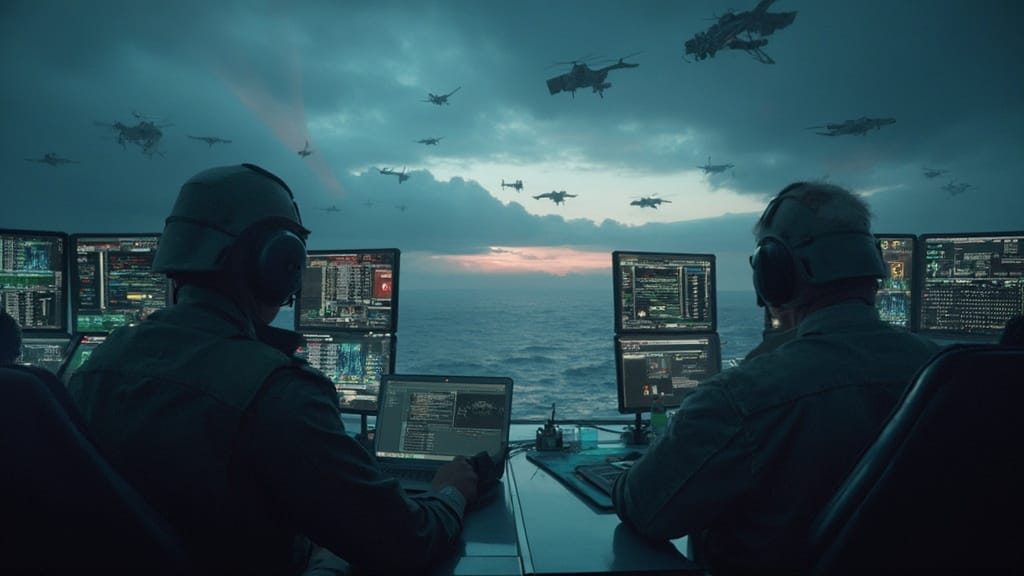
Photo: lyceumnews.com
Past 48 Hours — July 14, 2026
The Big Picture
The past two days were the moment robot warfare stopped being a slideshow. The U.S. sent kamikaze drone boats into an Iranian harbor for the first time, Ukraine used a sea drone as a landing craft for an armed ground robot, and the Strait of Hormuz turned into a live testbed where every layer of the kill chain is being stress-tested at once. If you want to know what the next decade of naval warfare looks like, it's happening right now in the Persian Gulf and the Black Sea — and none of it needs a human in the water.
This Week's Stories
America's First Drone Boat Goes to War
Picture a torpedo that drives itself, films the target on the way in, and costs a fraction of the ship it's trying to sink. On July 12, the U.S. military used one in combat for the first time in its history.
U.S. Central Command sent three Saronic Corsair unmanned surface vessels — 24-foot autonomous boats with a range over 1,000 nautical miles, a 1,000-pound payload, and a top speed of 35 knots — against a submarine and ship-maintenance facility at Iran's Bandar Abbas naval base near the Strait of Hormuz. In a 25-second CENTCOM video, the Corsairs approach a pier where what appears to be a Ghadir-class midget submarine hangs from a gantry, then explode. Saronic has built at least 300 of these boats as of May. That's not a prototype. That's a production line. (CENTCOM Deploys Saronic Corsair USV Against Iranian Submarine At Bandar Abbas - )
What makes this matter: Ukraine wrote this exact playbook against Russia's Black Sea Fleet, and the Pentagon just proved it works for a superpower too. If the Corsair becomes a standard CENTCOM tool rather than a one-off, every contested waterway on earth — Hormuz, the Taiwan Strait, the Baltic — gets cheaper to attack and harder to defend. The tell to watch: whether the Corsair shows up again the next time Iran fires on a tanker. If it does, this crosses from experiment to doctrine. (CENTCOM Deploys Saronic Corsair USV Against Iranian Submarine At Bandar Abbas - )
Ukraine Invents the Robot Amphibious Assault
No soldier crossed the water. A drone boat glided to a Russian-held beach on the occupied Kinburn Spit, dropped off an armed ground robot, and retreated. The robot rolled inland and went to work.
This is the world's first known combat mission where a sea drone delivered an armed ground vehicle behind enemy lines. Operators from Ukraine's 123rd Separate Territorial Defense Brigade guided the boat across the Black Sea; footage suggests the robot was a Ukrainian-made Rys, built by Roboneers and armed with a PKT machine gun. The clever part isn't the robot — Ukraine has fielded thousands. It's the delivery method: an unmanned boat used as a landing craft, turning one of the most dangerous and expensive operations in warfare, amphibious assault, into something you can attempt without risking a single life. (Ukraine launches world’s first robot assault from the sea)
One more mission like this and it's a doctrine, not a stunt — and every marine corps from Quantico to London rewrites its assumptions about what a beach landing costs. For context on scale: Ukraine's ground robots ran 16,676 logistics and evacuation runs in June alone, up 122% from January. The amphibious raid grabbed headlines; the industrial tempo underneath it is the real story.
The Ceasefire Is Dead and the Strait Is a Shooting Gallery
The pause in the U.S.–Iran war is over, and the chokepoint carrying roughly a fifth of the world's oil is back in play. President Trump notified Congress that "limited" military action had resumed. Iran said it struck and disabled two "rogue supertankers"; the UAE confirmed Iranian missiles hit two of its tankers in Omani waters, killing one crew member.
CENTCOM says it damaged 140 Iranian targets in the latest round — coastal radar, air defense, drone and missile sites. This is a systematic effort to blind Iran's ability to threaten shipping, not punitive bombing. Brent crude closed up more than 9% at $83.30 a barrel, its highest settle since June 12. The U.S. Navy-led Joint Maritime Information Center announced that a blockade of all Iranian ports and oil terminals begins Tuesday.
If the blockade holds, Iran's economy tightens — but so does the risk of retaliation against Gulf infrastructure, which would test every regional air defense system at once. Watch the oil price and watch Iran's targeting. If the salvos shift from tankers to GPS and satellite uplinks, the fight moves into electronic warfare, a far uglier problem for Gulf defenders than intercepting a missile.
France Learns to Kill Cheap Drones Cheaply
The most maddening math in modern air defense: a $400 drone gets shot down by a $100,000 missile, and the attacker wins by losing. France just took a swing at fixing it.
According to The War Zone, France live-fire tested laser-guided rockets from its Rafale fighter — a low-cost anti-drone tool that costs a fraction of a traditional air-to-air missile. The backdrop is a June incident over Latvia, where a French Rafale on NATO duty downed a drone in Baltic airspace. The U.S. and UK are chasing the same idea; France just moved it from concept toward operational reality.
If this loadout spreads across NATO, the economics of drone defense flip: a Rafale carrying a quiver of cheap guided rockets is a completely different proposition than one burning $100K interceptors on garbage targets. The signal to watch is whether allies adopt it — and whether it buys time for the real endgame, directed-energy lasers, where the per-shot cost drops to roughly the price of electricity.
The Pentagon Killed a Cybersecurity Mandate Mid-War
The Pentagon is fighting a hot war in the Middle East and just suspended a major cybersecurity requirement for its own contractors. (Trump’s China Trip Delay Tells You the Middle East Crisis Is Now Bending Pacific)
The Department of War announced the immediate suspension of CMMC Phase II — the Cybersecurity Maturity Model Certification, a standardized checklist companies must pass to prove their networks can handle sensitive military data. Phase II was due November 10 and would have hit thousands of suppliers. Officials told Breaking Defense the program as executed is "too prohibitively burdensome on the Defense Industrial Base," noting more than 100,000 businesses still need assessments and only about a hundred assessors exist to do them. (Forging the Arsenal of Freedom: Department of War Suspends CMMC Phase II Require)
The upside is real: certification drag filters out exactly the kind of nimble drone shop or autonomy startup the Pentagon claims to want. The downside is also real, and awkwardly timed. Loosening cyber standards for defense contractors during an active conflict — when adversaries are actively probing supply chains — is the kind of call that reads as pragmatism today and a breach investigation tomorrow. Watch whether CISA pushes back, or whether this quietly becomes permanent.
⚡ What Most People Missed
The Pentagon fast-tracked two laser weapon contracts before anyone noticed: The Defense Department awarded $86 million in Joint Laser Weapon Systems agreements to nLIGHT Defense and Lockheed Martin Aculight for rapidly fieldable platforms, using contracting vehicles that bypass the years-long normal process, per Inside Defense. Pairing an established prime with a smaller fiber-laser specialist is the kind of hedge that often precedes a bigger sole-source follow-on — and lasers are exactly what you want when you're shooting $50,000 drones with $2 million missiles.
The Air Force quietly bought a quantum computing program through Rome, New York: Booz Allen Hamilton won a $25.3 million AFRL contract for "quantum-accelerated technology advancement for national advantage." AFRL Rome is the Air Force's information-warfare and cryptography hub, which makes the routing the real signal — the likeliest near-term application is post-quantum cryptography, hardening military networks against a future quantum codebreaker.
Oman is quietly trying to split the Strait of Hormuz in two: As mediators race to revive diplomacy, Oman has drafted a proposal to run traffic through two separately controlled routes. Partitioning one of the world's most critical waterways has no modern parallel — and the surveillance and enforcement tech required for two independent lanes would be its own multi-billion-dollar procurement story.
The UAE just got a chip-and-weapons export upgrade — quietly: Washington loosened export controls on the UAE, easing shipments of Nvidia AI chips, military equipment, and satellites, with the Commerce Department citing the UAE's role in Operation Epic Fury. This is how alliances get paid in the tech age: not with medals, but with access to the most advanced semiconductors on earth.
The Navy's robot-ship competition is leaving PowerPoint: At-sea testing of the Medium Unmanned Surface Vessel marketplace begins next month, with seven firms — Saronic, Leidos, Sea Machines, Galliano, PacMar, Birdon, and Huntington Ingalls — competing for $15 million each and follow-on production, aiming for leasable hulls in fiscal 2027. The Navy is finally acting like a buyer of commercial hulls rather than a futurist waiting on the perfect bespoke ship.
📅 What to Watch
- If the Corsair drone boat reappears the next time Iran hits a tanker, it's confirmed doctrine — and every navy accelerates its own kamikaze-USV program in response.
- If Iran's salvos shift from tankers to GPS and satellite jamming, the war moves into electronic warfare, a far harder defensive problem than intercepting missiles.
- If Ukraine runs a second sea-drone-to-robot landing, amphibious warfare planning worldwide gets rewritten around unmanned assault.
- If the CMMC suspension draws a formal CISA or congressional response, it forces a reckoning over whether the U.S. will trade cyber standards for wartime industrial speed.
- If Oman's two-lane Hormuz proposal wins any U.S. or Iranian backing, it becomes the most consequential maritime-governance shift in decades — and triggers the surveillance procurement to enforce it.
The Closer
A 24-foot robot boat that spent June rescuing downed Apache pilots and July blowing up submarines; a Ukrainian sea drone valet-parking a machine-gun robot onto an enemy beach; and a Pentagon that started a war and cancelled a cybersecurity audit in the same news cycle. Somewhere in Rome, New York, a quantum computer is being taught to keep secrets — just as the department buying it decides secrets are too burdensome to certify.
That's the past 48 hours from the front, where the humans are increasingly optional.
Forward this to the friend who still thinks "drone warfare" means one guy with a joystick in Nevada.
⚡ EDGE Signals
The following signals appeared in the adversarial edge sweep but were not carried forward in the primary synthesis:
- Trump's earlier briefings casting an Iran strike as a "high risk, high reward" gambit are still shaping how Washington thinks about escalation versus negotiated off‑ramps[5][7]. Recent reporting has described a repeating pattern of Iranian attacks on tankers, U.S. retaliatory strikes, and Irania
- [5] Ahead of strikes, Trump was told Iran attack is high risk ...
URL:
Snippet: Trump's briefings highlighted potential risks and prospects in the Middle East
...
Iran promises retaliation, aiming at U.S. and Israeli interests
WASHINGTON, Feb 28 (Reuters) - Before the U.S.
- [7] Ahead of strikes, Trump was told Iran attack is high risk, high reward
URL:
Snippet: Ahead of the US attack on Iran, US President Donald Trump received briefings that not only delivered blunt assessments about the risk of major US casualties but also touted the prospect of a generatio
- [8] Pentagon inks $500 million deal with Perennial Autonomy for ...
URL:
Snippet: The U.S. military is using the interceptors the same way against Iran's Sheheds.
...
Perennial's contract will end in three years or whenever the Pentagon pays out the full $500 million, whichever com
- Iran strikes / Trump risk calculus (MUST_COVER): Covered above. Reuters reported that Trump was briefed the Iran strike campaign carried high risk alongside potential reward — that framing is consistent with U.S. and Iranian delegations having entered negotiations aimed at a war-ending deal base