The Lyceum: Defense Tech Daily — Jul 16, 2026
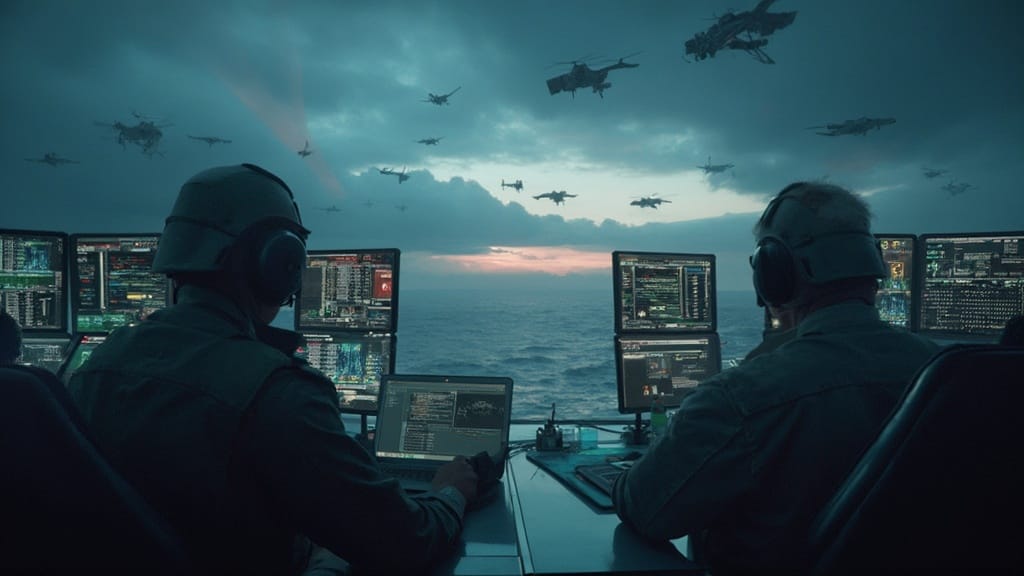
Photo: lyceumnews.com
Past 48 Hours — July 16, 2026
The Big Picture
The U.S.–Iran war just ricocheted through its third act in a month: a broken ceasefire, a reinstated naval blockade, and — as this issue goes to press — a fresh deal to stop the shooting. But the more durable story is one level down, in the plumbing. The Pentagon quietly dropped a $500 million counter-drone shopping account the same day the deal was announced, its missile-tracking satellites are launching again after a months-long stall, and an Air Force robot wingman fired a live missile for the first time. The war may be winding down on paper. The procurement machine is accelerating as if it isn't.
What Just Shipped
- Corsair unmanned surface vessels (Saronic): first-ever combat use as a strike weapon on July 12, when three of them detonated at the Bandar Abbas naval base in Iran. A 24-foot, crewless boat carrying up to 1,000 pounds of explosives across roughly 1,000 nautical miles.
- Medium-Range Intercept Capability (MRIC) (U.S. Marine Corps / Rafael): first successful live-fire on Guam during Exercise Valiant Shield. An Iron Dome–derived shield adapted for mobile expeditionary units.
- YFQ-44A Collaborative Combat Aircraft (Anduril): fired a live AMRAAM air-to-air missile in a recent Air Force test — the first live shot from an autonomous wingman, per Chief of Staff Gen. Kenneth Wilsbach.
This Week's Stories
America's Drone Boats Just Went to War — For Real This Time
Picture a 24-foot speedboat with no crew, a thousand pounds of explosives, and a one-way ticket. That's the Saronic Corsair, and on July 12, three of them drove themselves into Iran's main naval base at Bandar Abbas and detonated — the first armed sea drones the U.S. military has ever used in combat. (CENTCOM Deploys Saronic Corsair USV Against Iranian Submarine At Bandar Abbas - )
In CENTCOM's released video, the Corsairs approach a pier where a Ghadir-class midget submarine hung from a gantry. "Three Corsair unmanned surface vessels hit the port at Bandar Abbas Naval Base, marking the first time American forces have employed sea drones in combat operations," CENTCOM posted on X. (VIDEO: 3 Lethal U.S. Drones Attack Iranian Sub, Port Facility - USNI News)
The Corsair is built by Saronic, an Austin-based startup. It reaches speeds above 35 knots and can run multi-day missions solo or in networked groups steered by a single human operator. The Navy signed a $392 million production contract with Saronic in December 2025; Task Force 59 fielded the boats in the Middle East in late March. They'd been in theater roughly three and a half months — mostly doing surveillance — before this weekend turned them offensive. The same platform rescued two downed Apache pilots just weeks earlier. The drone boat went from lifeguard to kamikaze in a single month.
If this succeeds as doctrine, every navy on earth accelerates its own cheap kamikaze-USV program, and the economics of contesting a chokepoint invert: a $150,000 boat threatens a billion-dollar warship. The signal to watch is simple — a second combat use in the next round of Gulf strikes confirms this was doctrine, not improvisation.
The Ceasefire Died, the Blockade Returned, and a New Deal Is on the Table
The June deal to end the U.S.–Iran war lasted less than a month. Iran struck multiple commercial ships in the Strait of Hormuz on July 8, the truce collapsed, and Trump reinstated the naval blockade of Iranian ports — CENTCOM began enforcing it Tuesday at 20:00 GMT. Now, as this issue goes to press, the U.S. and Iran have announced a fresh deal to halt operations and lift their blockades.
The sticking point never changed: who controls the Strait, and on what terms. The June memorandum only committed Iran to "safe passage of commercial vessels, with no charge for 60 days only," followed by negotiations with Oman to "define the future administration" of the route through which roughly 20% of the world's oil flows. That phrase — "future administration" — is doing enormous work. Iran wants a new regime that eventually collects tolls; Oman opposes any fees; the U.S. calls tolls unacceptable. (U.S. Reinstates Naval Blockade in Strait of Hormuz - USNI News)
The defense-tech story lives in the enforcement gap. The Strait of Hormuz is now a surveillance-and-enforcement problem, not just a diplomatic one — and whatever monitoring architecture is supposed to police the "future administration" doesn't exist yet. Under the last blockade, CENTCOM disabled nine non-compliant ships; three Indian crew died aboard the tanker MT Settebello. Every enforcement action carries escalation risk, which is exactly why every navy that watched Iran fire on commercial vessels is now quietly accelerating maritime-domain-awareness procurement. The tell for whether this deal holds: does it include a concrete Hormuz governance mechanism, or is it another pause dressed as peace?
The Air Force's Robot Wingman Fired a Live Missile for the First Time
The question hanging over military AI has been blunt: sure, the drone can fly — but can it fight? On July 15, the Air Force delivered its clearest answer yet.
A Collaborative Combat Aircraft — a "robot wingman" designed to fly beside crewed fighters — fired a live AMRAAM air-to-air missile in a recent test. Chief of Staff Gen. Kenneth Wilsbach said it wasn't just a missile dropping off the rail; it was tracking the target. He identified the aircraft as Anduril's YFQ-44A, previously associated only with carrying an inert version.
This moves the CCA story from PowerPoint to something closer to combat credibility. The Air Force's pitch is that future pilots fly with several cheaper autonomous aircraft alongside them, extending range and absorbing risk. A successful live shot suggests it's becoming a weapons system, not a science project. But here's the harder part: an autonomous aircraft that can fire weapons is no longer a concept — it's a system that needs rules of engagement. Every allied air force now has to decide how tightly a human must stay in the loop when a U.S. wingman can independently engage. That legal-political question moves far slower than the technology. Watch whether the service reveals how much autonomy the drone actually had — that single detail will tell you how close we are to that reckoning.
The Pentagon Dropped $500M on Counter-Drones — the Same Day Everyone Was Watching Iran
Timing is its own kind of signal. The Army awarded AeroVironment — maker of Switchblade loitering munitions — a $500 million contract to procure commercial counter-drone technology over three years, on July 15, the same day the Iran deal broke, when most reporters were looking elsewhere. A July 1 DoD contract notice described it as a firm-fixed-price deal for commercial counter-unmanned-aerial-systems gear, with locations and funding set per order.
The sparse language is the signal. "Commercial counter-drone technology" is the Pentagon's way of saying it wants things that already work — not a five-year development slog. The Army is essentially opening a three-year shopping account for off-the-shelf counter-UAS gear, which is the procurement equivalent of admitting the threat is outrunning the acquisition system. AeroVironment being a drone maker rather than a drone killer suggests the contract may be a broad vehicle pulling in multiple vendors. The full terms haven't published; the tell will be whether subsequent task orders name a stable of subcontractors — confirming this is a mass-buy pipeline, not a single-source bet.
The Pentagon's Missile-Tracking Satellites Are Launching Again
After a months-long pause, the Space Development Agency is resuming Tranche 1 Transport Layer launches, according to Director GP Sandhoo. The Transport Layer is the backbone of the Pentagon's proliferated low-Earth-orbit constellation — a mesh of small satellites that relay targeting data between sensors and shooters across every branch, so the military doesn't depend on a handful of large, expensive, easily targeted legacy birds. (Space Development Agency Resumes Tranche 1 Satellite Launches After Months-Long )
The early satellites ran into trouble: thermal-modeling problems, electric-propulsion issues, and — more consequential — the agency still hasn't fully demonstrated the optical laser links that let satellites talk to one another. Those links are the foundational capability of the wider Golden Dome missile-defense vision.
The Pentagon is trying to build an orbital internet for war, and the networking is proving as hard as the rocketry. If it works, JADC2 — the effort to wire every sensor and weapon into one network — finally gets its data backbone. If it stalls again, every service planning around the constellation's availability quietly degrades. Watch the next Falcon 9 launch, but watch harder for a demonstration of satellites actually exchanging data on-orbit. Launches make headlines; the laser links decide whether the concept is real.
⚡ What Most People Missed
- Commerce opened a national-security probe into Chinese drones: On July 16, the Commerce Department launched Section 232 investigations into imports of Chinese drones and polysilicon — the same legal tool used for steel tariffs, now aimed at hardware Washington treats as strategically sensitive. Chinese-made drones just got upgraded from nuisance to strategic commodity, which could accelerate demand for NATO-friendly drone ecosystems.
- Pentagon moves to cut Chinese circuit boards out of U.S. weapons: On Wednesday, the Defense Department posted an advance notice of rulemaking to bar printed circuit boards from "covered nations" like China, Russia, Iran, and North Korea, and to stand up an Independent Hardware Assurance Framework for vetting exceptions. It's "trusted foundry" rules extended to every box on the battlefield — and it will force primes to re-architect supply chains if it survives industry comment.
- A startup is building hypersonic targets so the Pentagon can practice shooting them down: The Missile Defense Agency is evaluating Reditus's ENOS spacecraft as a hypersonic target under its SHIELD contract, with a first launch coming. You can't train to intercept something you've never tried to intercept — and a commercial, cheaper target could dramatically speed up how fast the U.S. validates defenses against Chinese and Russian hypersonics.
- The Marines built their own Iron Dome and tested it in the Pacific: The MRIC live-fire on Guam means Marine littoral units no longer wait for Army Patriot batteries or Navy Aegis ships when rockets and drones come in. It's a doctrinal shift wrapped in a hardware story — and the timing, with China watching every move, is not accidental.
- Germany wants laser cannons on its warships by 2029: Rheinmetall and MBDA Deutschland aim to field an operational naval laser, per Defense News. The story isn't "Star Wars but real" — it's cost curves: once you've paid for the system, each shot is a pulse of electricity, changing the economics of thinning out cheap drone swarms before you burn a missile.
📅 What to Watch
- If a Corsair reappears the next time Iran hits a tanker, kamikaze drone boats have crossed from experiment to standing doctrine — and the naval arms race reorients around $150,000 boats, not billion-dollar hulls.
- If the new deal ships without a concrete Hormuz governance mechanism, the 60-day clock becomes a countdown to the next blockade rather than a path to peace.
- If the Air Force reveals how much autonomy the CCA had during its live shot, that single detail tells allied air forces how urgently they need rules for a wingman that can kill on its own.
- If the SDA's next launch flies clean but the satellites still can't demonstrate laser cross-links, the bottleneck in Golden Dome is confirmed to be networking, not rockets.
- If Commerce's Section 232 probe concludes Chinese drones are a security threat, expect tariffs or restrictions that ripple from National Guard quadcopters to swarm-prototyping contractors overnight.
The Closer
A crewless speedboat that spent March rescuing pilots and July detonating against a submarine gantry; a robot wingman that finally proved it can pull the trigger without a human hand on it; and a $500 million counter-drone account the Pentagon opened on the one afternoon it was sure nobody would notice.
The war got a peace deal and a shopping spree in the same news cycle — and somewhere a lawyer is realizing that "future administration of the Strait of Hormuz" is now a sentence armed navies will spend the next 60 days trying to define with drones instead of dictionaries.
Stay skeptical of anything announced twice in a month.
Forward this to the friend who still thinks "drone boat" sounds like a toy.
⚡ EDGE Signals
The following signals appeared in the adversarial edge sweep but were not carried forward in the primary synthesis:
- On July 15, the Army disclosed new details around an autonomous launcher and a high-energy laser effort, and that lands just after the Pentagon's new July 1 memo creating a Direct Reporting Portfolio Manager for autonomy — essentially a drone-and-robotics czar with acquisition leverage across the de
- The operational lesson getting sharper this week is that Iran's campaign — against ships, Gulf infrastructure, and regional targets — keeps validating a cheaper counter-drone layer rather than reliance on high-end interceptors alone. CSIS's recent analysis of the campaign argued the U.S. lesson is a
- [1] Army reveals new details on autonomous launcher, high energy laser program - Breaking Defense
URL: https://breakingdefense.com/2026/07/army-reveals-new-details-on-autonomous-launcher-high-energy-laser-program/
- A CNBC piece this week pulls together a cluster of moves that add up to a quiet inflection point: NATO's secretary general has unveiled a "drone‑ready" initiative with allies planning more than $40 billion in drone and counter‑drone spending over five years, the U.K. has earmarked £5 billion for a "
- [8] [PDF] Secure and Accountable Military AI Act of 2026 SECTION-BY ...
URL:
Snippet: Establishes statutory definitions for Autonomous Weapon Systems (AWS), Frontier AI Models, Covered Incidents,
and High-Consequence AI Applications.
It explicitly distinguishes between semi-autonomous