The Lyceum: Defense Tech Daily — Jun 05, 2026
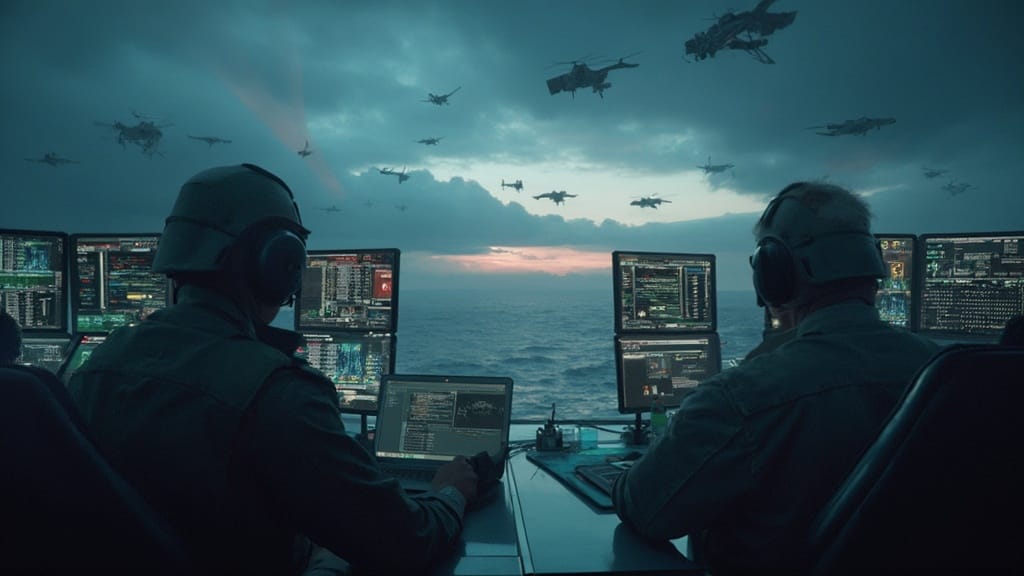
Photo: lyceumnews.com
Friday, June 5, 2026
The Big Picture
The clearest signal today isn't a weapon — it's a number. Ukraine's ground robots ran 22,000 frontline missions in just three months, and the Pentagon wants $30 billion to feed the AI behind its supply chains. Autonomy has stopped being a demo and started being a tempo. Meanwhile, a single senator is trying to put guardrails on military AI just as Palantir's targeting software gets declared operational "across the entire Department of Defense." The race and the brakes are arriving at the same time.
What Just Shipped
- T-1 Amphibious Light Tank (Vietnam MoD): The country's first homegrown tank — a 76mm autoloaded cannon, 470-hp diesel, 80 km/h, and the ability to swim across rivers.
- GRIZZLY Counter-UAS System (Lockheed Martin): Used a JAGM missile fired from a shipping container to detect, track, and damage a live Group 3 drone in a full live-fire demo.
- Obereg 2.0 Body Armor (Rostec): Claimed lightest-in-class vest capable of stopping NATO-standard rifle rounds — vendor claim, no independent testing yet.
- AI Forge (DARPA, with NSF and NIST): A program announced June 1 aimed at military AI that's reliable, predictable, and hard to fool in contested environments.
- Medium-Thrust Drone Engines (GE Aerospace, Rolls-Royce): Contracts to build propulsion for the Air Force's Collaborative Combat Aircraft — the robot wingmen that fly alongside crewed fighters.
Today's Stories
Ukraine's Robot Army Just Crossed a Milestone Nobody Saw Coming
The most important number in modern warfare right now isn't a missile count — it's 22,000. That's how many frontline missions Ukrainian ground robots ran in the first three months of 2026, according to President Zelenskyy, who in April also claimed the first capture of a Russian position by robots and drones alone, with Russian soldiers surrendering to machines.
CNN's embedded reporting makes the math brutal. Over 164 assaults, the Third Assault Brigade's "NC13" unit calculated they'd have needed 2,300 troops for the same effect — and expected to lose half their unit dead or wounded. The robots, which Russian POWs reportedly call "silent death," can only be heard at 10 meters.
If this succeeds, land warfare's casualty arithmetic gets rewritten and Ukraine becomes a doctrine exporter — it has already opened 10 weapons export offices across Europe. The failure mode is electronic: operators report constant GPS spoofing, navigating instead off recorded daytime drone feeds. The signal to watch is whether any NATO member folds Ukrainian ground-robot doctrine into its own training before the July summit.
Vietnam Built Its First Tank. It's a Bigger Deal Than It Sounds.
Most countries that want a tank buy one. Vietnam built one. The T-1 — a domestically developed amphibious light tank — is the most ambitious armored vehicle the country's defense industry has attempted.
The specs are legitimately good for a first attempt: a 76mm autoloaded cannon, a 470-horsepower diesel, 80 km/h on roads, a modern fire-control system, and reactive armor, per Russian outlet Topwar. Think of a Soviet-era PT-76 — the swimming tank Vietnam used in 1975 — rebuilt with modern electronics and twice the power. The geography explains it: with 3,200 km of coastline and the flooded channels of the Mekong Delta, armor that can cross water without engineering support is a genuine advantage.
If this works, Vietnam demonstrates a complete domestic armored-vehicle cycle without a great-power patron — and every Southeast Asian capital recalibrates. The Ministry of National Defense wants the finished tank ready for the 2026 International Defence Exhibition; whether it shows up on schedule is the tell.
The Pentagon Wants $30 Billion to Upgrade Its AI Supercomputers
This isn't a research budget — it's an infrastructure bet. The Department of Defense wants nearly $30 billion in fiscal 2027 to modernize its AI supercomputing arsenal, and the context is "contested logistics," the Pentagon's term for what happens to supply chains when an adversary starts shooting at them.
The favored answer is autonomy. "If we can go with autonomy, that means I don't have to have people on those boats or ships," said Robert Mantz, the Pentagon's senior official for contested logistics technologies. Officials are also exploring small modular nuclear reactors at forward bases — mini reactors as a budget line, not science fiction.
If Congress funds this in the NDAA, it signals acceptance that AI compute is warfighting infrastructure, not an IT upgrade — a decade-long procurement shift. If it gets cut, AI stays bolted onto the side of legacy systems. Watch the markup.
A Senate Bill Just Tried to Put the Brakes on Military AI
Sen. Kirsten Gillibrand (D-N.Y.) introduced "The Secure and Accountable Military AI Act," which would restrict the Pentagon's use of AI in operations and tightly regulate it on fully autonomous weapons, for domestic surveillance, and around nuclear weapons. "The Pentagon is moving toward deploying incredibly powerful AI technology without commonsense guardrails," she said.
No other lawmakers have co-signed, and her office confirmed she'll offer pieces as NDAA amendments instead. The timing is pointed: CNN reported the Iran war saw more U.S. military AI use than any prior conflict, with tools like Anthropic's Claude flagging targets — and congressional Democrats have pressed whether AI contributed to a February strike that hit an Iranian elementary school, killing at least 168 children per Iranian state media.
The full bill is unlikely to pass. But the amendment strategy is the real play — a single surviving provision on nuclear or surveillance AI becomes the first statutory line around military AI. Watch the Senate Armed Services Committee markup.
Palantir's Targeting Software Is Now Deployed "Across the Entire Department of Defense"
This is what military AI looks like in practice. In a March video posted to X, Cameron Stanley, the Pentagon's chief digital and AI officer, said Palantir's Maven Smart System is deployed "across the entire Department of Defense" and demonstrated how it moves potential targets into a "workflow" for leaders — what Stanley openly called "closing a kill chain."
The legal question is unresolved. "You have to have a confidence level that the system is going to operate within the bounds of what the law allows in targeting," said Gary Corn of American University's Washington College of Law.
The gap between what the AI can do and what Congress authorized keeps widening — which is exactly what makes the Gillibrand bill a referendum on it. If that gap doesn't close, expect more strikes with murky accountability. One more data point: the War Department confirmed it will add xAI for Government to its GenAI.mil platform — Elon Musk's AI is now inside the Pentagon's classified network.
Lockheed Just Shot Down a Drone With a Missile Fired From a Shipping Container
Lockheed Martin said its GRIZZLY counter-drone system used a JAGM missile launched from a containerized setup to detect, track, and damage a live Group 3 drone in a full live-fire demo, Military Times reported.
Containerized launchers are the flat-pack version of military hardware: easier to move, hide, and plug into existing logistics. Disguise missiles as freight, and ports, islands, and forward bases get a defensive layer without a giant bespoke launcher sitting in the open.
If this becomes infrastructure rather than a demo darling, air defense gets dispersed and survivable cheaply. The signal: whether containerized C-UAS shows up in actual procurement language across U.S. and allied militaries, or stays a trade-show highlight reel.
The Air Force Just Picked GE and Rolls-Royce to Build Engines for Its Robot Wingmen
Autonomy software gets headlines. The bottleneck is shifting to propulsion. The Air Force awarded GE Aerospace and Rolls-Royce contracts for medium-thrust drone engines tied to the Collaborative Combat Aircraft program — semi-autonomous aircraft that fly alongside crewed fighters, Breaking Defense reported. GE pointed to its smaller GEK800 engine; Rolls-Royce will leverage its AE family.
This is plumbing, and the plumbing matters more than the press release. Cheap, reliable engines you can build in numbers are what turn a concept into a fleet. The Air Force seeding two paths suggests it expects real demand, not a tech-demo cul-de-sac.
If either engine gets tied to a named airframe, the wingman concept is closer to fielding than concept art. If neither does, it's still a science fair. Watch which architecture gets a design attached first.
⚡ What Most People Missed
Ukraine is exporting its drone ecosystem, not just drones: Kyiv has opened 10 weapons export offices across Europe and agreed to supply Gulf states with its full air defense package — production templates and engineering know-how, not finished products. That's a defense-tech licensor, not an arms dealer, and nobody's mapping the geopolitics of it.
The Army created a dedicated AI officer career track: The new 49B specialty puts officers through graduate-level training to develop and maintain AI systems, with reclassification due by the end of fiscal 2026 in September. AI in the military just stopped being a contractor problem and became a career field.
The DIU handed the Blue UAS list to DCMA: The Pentagon's pre-vetted catalog of small drones free of Chinese parts moved from an innovation unit to a compliance agency — a sign small-drone buying is graduating to a program of record. The risk: DCMA optimizes for oversight, and the 48-to-72-hour update cycles that make Ukrainian units lethal get replaced by F-35-style qualification timelines. Single trade-press source; verify the DCMA notice.
Russia is arming Shahed drones with cluster munitions: Russia began equipping its Iranian-designed one-way attack drones with cluster submunitions and mines in early 2026, turning each from a point strike into an area-denial weapon. It's a real capability jump getting buried under the broader drone narrative.
Germany's Bundestag blocked over €1 billion in military contracts: Even as Europe pushes spending higher, rearmament runs straight into parliamentary consent — a reminder that money isn't the only constraint. [Source: Vesti.az — Russian]
📅 What to Watch
- If the Senate Armed Services Committee accepts even one Gillibrand amendment, Congress has drawn its first statutory line around military AI — and every defense AI contract after that date carries a new compliance requirement.
- If the DCMA absorbs the Blue UAS list and update cycles slow to legacy qualification timelines, the Pentagon will have industrialized Ukraine's drone model right out of the thing that made it work.
- If any CSTO member procures Rostec's Obereg 2.0 before year-end, Russia's arms-export relationships in Central Asia survived Ukraine's reputational damage intact.
- If the FY2027 NDAA preserves the $30 billion AI compute ask, Congress has formally accepted that AI infrastructure is warfighting infrastructure — a conceptual shift with decade-long procurement weight.
- If the NDAA Section 866 cybersecurity harmonization notice still hasn't hit the Federal Register by next week, mid-tier suppliers are operating blind on compliance while the primes' moat quietly widens.
The Closer
A tank that swims through rice paddies, a missile fired from a Maersk container, and Elon Musk's chatbot logging into the Pentagon's classified network. Somewhere in Ukraine, a soldier is hearing "silent death" at exactly ten meters and learning that the future of war arrives without an engine sound — while in Washington, the only person trying to write rules for any of it can't find a single co-sponsor.
Stay sharp.
Forward this to someone who still thinks the drone war is about drones.
⚡ EDGE Signals
The following signals appeared in the adversarial edge sweep but were not carried forward in the primary synthesis:
- [6] Canada Signals New Urgency With Quick AEW&C Pick
URL:
Snippet: Ottawa is trying to modernize its military, strengthen its industry and forge closer ties to Europe with its surprise airborne early warning and control pick ...
- Today's early signals suggest a quiet but meaningful pivot in defense technology, particularly around the operational credibility of new space launch capabilities and the subtle but critical policy shifts affecting defense AI and contractor compliance. We're seeing confirmation of critical milestone
- Blue Origin's New Glenn rocket successfully completed its return-to-flight mission yesterday, June 4th, carrying a significant payload of Amazon's Kuiper satellites into low Earth orbit. This success follows a prolonged development period and directly addresses critical questions about New Glenn's r
- Anthropic, a leading AI safety company, has released an open-source framework designed to help identify vulnerabilities in AI models, a development that is drawing significant attention across the security and defense tech communities today on platforms like Hacker News. This "red-teaming" framework
- ### NDAA Section 866 Cybersecurity Harmonization Notice Misses Critical "This Week" Window