The Lyceum: Defense Tech Daily — Jun 06, 2026
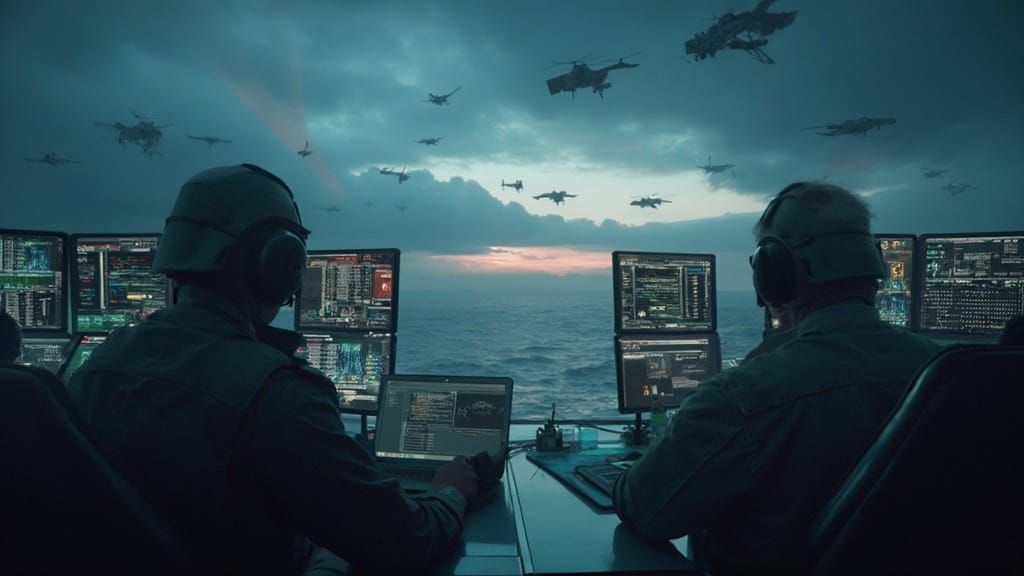
Photo: lyceumnews.com
Saturday, June 6, 2026
The Big Picture
Eighty-two years to the day after the largest amphibious landing in history, the defense world spent the anniversary arguing about whether the next war's "boots" will be unmanned. Congress dropped a $1.15 trillion defense bill that reads like a wish list for autonomy that flies itself across oceans; Ukraine quietly turned its drone industry into a continent-spanning factory network producing millions of units a year; and the Pentagon began receiving, not just promising, attack drones by the tens of thousands. The recurring theme: the gap between PowerPoint and procurement is closing fast — and not always in the direction Washington expected.
What Just Shipped
- Small one-way attack drones (Drone Dominance) (U.S. Department of Defense): The Pentagon has begun accepting deliveries of 20,000 FPV attack drones ordered from 10 vendors — procurement with unit counts, not slides.
- Counter-UAS package (Anduril): A $100M Army Other Transaction Authority award for counter-drone solutions, likely leaning on Anduril's Sentry towers and Anvil interceptors.
- Jam-resistant GPS receiver (BAE Systems): Deliveries have started on a new military GPS receiver hardened against jamming and spoofing.
- Second Arleigh Burke destroyer (DDG) (U.S. Navy / HASC): The draft FY2027 bill adds roughly $1 billion to fund a second destroyer in the year's budget.
Today's Stories
Congress Wants More Robot Wingmen — But Also Wants Them to Fly Themselves to the Fight
The House Armed Services Committee's draft FY2027 defense bill proposes cutting nearly $137 million from the Air Force's Collaborative Combat Aircraft program — the effort to build drone "wingmen" that fly alongside crewed fighters. Buried in the same text is a far more ambitious demand: future wingmen must have "sufficient range, speed, and electrical power to potentially self-deploy from the continental United States."
Congress isn't cooling on robot wingmen. It's raising the bar. A drone that needs a crewed plane to shepherd it across the Pacific isn't autonomous; it's an expensive remote-control plane. The real prize is a wingman that flies itself from California to Guam, refuels, and goes to work — a far harder engineering problem than what Anduril and Boeing are building toward now. The observable signal: whether this language survives conference with the Senate, or whether the Air Force quietly pushes back to protect the cheaper current design.
Ukraine's Drone Industry Has Gone Pan-European — and It's Producing at Wartime Scale
Russia spent much of 2025 systematically bombing Ukraine's drone factories, damaging up to half its production capacity. Ukraine's response was to move the factories. Ukrainian firms have opened production lines across NATO territory — Ukrspecsystems near the UK's Mildenhall air base, and a joint venture between Frontline Robotics and Germany's Quantum Systems aiming for up to 10,000 drones by the end of 2026.
The scale is staggering: Ukraine plans to produce more than 7 million drones in 2026. As the International Institute for Strategic Studies noted, "manufacturing these systems outside Ukraine creates extra production capacity to support Kyiv's war effort." Ukraine has turned its drone expertise into a European industrial franchise, and the lesson for every NATO planner is that dispersed, allied manufacturing is now a core resilience strategy. Watch whether any of these ventures announces an export sale to a third country — that's the moment Ukraine becomes a global arms exporter, with four years of live combat data behind every airframe.
The Pentagon's FPV Drone Push Just Crossed From Slogan to Actual Receipts
The clearest signal of the day is brutally simple. Breaking Defense reported Friday that the Department of Defense has begun accepting deliveries under its "Drone Dominance" effort: 20,000 small one-way attack drones ordered from 10 vendors, with five more companies selected in a lethality challenge for payload work.
That's short of the previously discussed 30,000 figure — so this isn't full industrial mobilization yet. But it's procurement with unit counts, which is the moment these programs stop being slideware. The tell that this is real and not a contractor victory lap: named vendors, specific quantities, and an acknowledged gap between target and current orders. If it keeps moving, the U.S. military is starting to treat cheap drones less like exquisite aircraft and more like ammunition — closer to mortar rounds than to fighter jets.
27 Nations Sign Up for a Naval Mission to Keep the World's Oil Flowing
Japan's Ministry of Defense published its own endorsement of the Strait of Hormuz multinational mission this week — a quiet sign the coalition is hardening from a Western project into a global one. The mission, convened May 12 by the UK and France, is a strictly defensive effort to escort civilian shipping and clear mines through the chokepoint where a fifth of the world's oil flows past Iran. Australia has named its contribution: its E-7A Wedgetail airborne early-warning aircraft.
The technology challenge here isn't political will — it's mine clearance. Iran seeded the strait with mines during the conflict, and clearing them safely demands underwater drones, sonar, and painstaking coordination, with warships gathering tankers into escorted convoys. If this succeeds, the insurance markets pricing risk into every Gulf tanker voyage will start adjusting. If it stalls, watch for the limiting factor to be the mine-clearance hardware, not the diplomacy. The signal to watch: a named operational commander and a clearance timeline before July.
The Pentagon's Drone Budget Is Bigger Than the Entire Marine Corps — and Congress Is Asking Hard Questions
The biggest number in defense right now isn't the F-35. It's the Defense Autonomous Warfare Group (DAWG), whose proposed FY2027 budget is $54.6 billion — a 243-fold jump from its first-year allocation of $225 million, and more than the entire Marine Corps request of $52.8 billion.
The Senate isn't rubber-stamping it. Senator Joni Ernst (R-Iowa) warned that "the policy architecture really has to scale with it — and this is where we probably lag behind." Her point isn't abstract: a joint Airwars/Independent investigation identified a 20-year-old Iraqi student as the first acknowledged civilian victim of a strike where AI-assisted targeting was publicly claimed — and Central Command later said it had "no way of knowing" whether AI was actually used. The doctrine gap is no longer theoretical. The question Congress is forcing open: will the rules on when these systems may kill be written before the money is spent, or after?
Congress Wants More F-15EXs Than the Air Force Planned
The F-15 refuses to retire. Per Defense Daily, the HASC draft bill would lift the planned ceiling of 104 of Boeing's new F-15EX fighters and explicitly allow the Air Force to buy more than 267. The EX is the "muscle truck" of fighters — big radar, huge payload, long legs, modern avionics, but no stealth.
Congress likes it because it's cheap per flight hour and can haul a lot of missiles without depending on more fragile stealth fleets. If the language survives, watch whether the Air Force quietly rebalances toward "old but upgraded" airpower instead of betting everything on next-gen stealth and autonomous wingmen — a hedge against programs that keep slipping right.
The Navy's Next Carrier Fighter Is Approaching a Contract Award on Suspiciously Thin Money
The contract for the Navy's next carrier-based fighter — the F/A-XX, the stealthy replacement for the F/A-18 — is on track for a year-end award, per Aviation Week. The funding profile tells a different story. Congress gave the Air Force's land-based F-47 program $3.45 billion this year; the F/A-XX line item in the FY2027 plan is just $140 million.
A contract award without a credible funding ramp is a program that exists on paper. The winning team — Boeing or Northrop Grumman — would be developing a carrier fighter on what looks more like a placeholder than a development budget. The comparison to the F-47 tells you exactly where carrier aviation sits in the Pentagon's priority stack right now. The signal to watch: whether the FY2027 number moves before appropriations close.
⚡ What Most People Missed
The GPS signal everyone ignored for 19 years was a military numbers station: A peer-reviewed Inside GNSS paper, picked up by 404 Media in the past 24 hours, documents that a reserved field in the GPS navigation signal has spent nearly two decades broadcasting encrypted military rekeying material — ciphertext, on a public channel, to billions of receivers worldwide. A format change on satellite PRN 8 in December 2023 remains unexplained. Every adversary GPS receiver has been passively collecting this for 20 years.
Ukraine's PRISMA platform went on camera: CNN got inside a Ukrainian military-intelligence deep-strike command post running Palantir's AI coordination system, where operators prepared roughly 200 drones for a single coordinated night launch — armed strike drones mixed with unarmed decoys to map radar coverage and deplete Russian interceptors. It's less a weapons program than a doctrine no NATO member fields at this maturity.
Washington quietly moved where arms-sale signals appear: Under Executive Order 14383, future Foreign Military Sales notified to Congress will now be published on the State Department's page rather than the Defense Security Cooperation Agency's. Procedural — but procedures decide tempo, and the whole point is to accelerate priority sales.
BIS extended an advanced-chip carve-out through year-end: The Bureau of Industry and Security extended an authorization for certain integrated-circuit designers through December 31, 2026. Dull until you remember that compute policy is now force-structure policy — who can buy advanced chips shapes every military AI, autonomy, and electronic-warfare roadmap.
Ukraine is formalizing "drone-assault troops" as a branch: Reporting summarized in Nezavisimaya Gazeta says Kyiv is building dedicated formations with drones as the primary combat arm — doctrine, promotion paths, procurement, the works. It's the organizational equivalent of air forces splitting from armies a century ago. [Source: Nezavisimaya Gazeta — Russian]
📅 What to Watch
- If the HASC's CCA wingman R&D cut survives conference, Congress is signaling it wants to skip the current increment for a longer-range, self-deploying version — which quietly rewrites Anduril's and Boeing's roadmaps.
- If any Ukrainian European drone venture announces an export sale to a third country in 60 days, battle-tested European-made Ukrainian drones hit the open market — and Chinese and Turkish exporters face their first serious competition.
- If DAWG's $54.6B reconciliation funding survives the Senate, it's the largest autonomous-weapons investment in history, and Ernst's doctrine gap becomes an urgent legislative problem rather than a hearing soundbite.
- If the December 2023 GPS format change on PRN 8 gets a technical explanation, it tells you whether the world's most ubiquitous navigation system just changed its covert protocol — and whether adversaries already noticed.
- If BALTOPS 2026 after-action reports show NATO's multinational drones actually shared targeting data in real time, the alliance's autonomous-interoperability problem has a working solution; if not, the gap just got documented in an exercise report.
The Closer
A cargo plane built during Vietnam learning to fly itself, a GPS satellite quietly humming spy ciphertext to your phone since 2007, and a Navy fighter walking toward a contract award with $140 million in its pockets while a $54.6 billion drone budget laughs next door. Somewhere in a German warehouse, a Ukrainian drone line is out-producing the entire reason it had to leave Ukraine — and the Pentagon, having just discovered that cheap drones are basically ammunition, is now ordering them by the leaderboard. The future of war is being assembled in committee rooms, dry docks, and a satellite nobody read the fine print on.
Forward this to the friend who still thinks "numbers station" is a Cold War thing.
⚡ EDGE Signals
The following signals appeared in the adversarial edge sweep but were not carried forward in the primary synthesis:
- The pattern to look for is a handful of $1–10 million awards mentioning:
- autonomous target classification,
- low-cost interceptors,
- or integration with existing radar/EO (electro-optical) sensors.
- What you'd look for right now:
- an interim doctrinal publication that explicitly accepts high drone attrition as normal and optimizes around mass and cheapness instead of survivability;
- formal guidance that units must assume GPS degradation as default and use AI-assisted navigation, targeting, or