The Lyceum: Defense Tech Daily — Jun 09, 2026
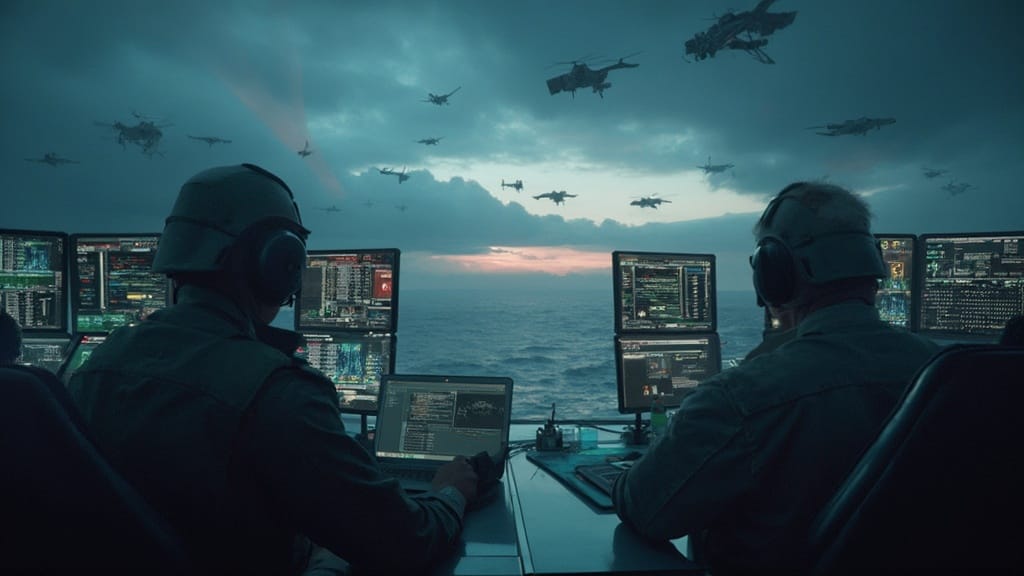
Photo: lyceumnews.com
Tuesday, June 9, 2026
The Big Picture
The drone threat finished its migration from battlefield curiosity to homeland infrastructure overnight — the Pentagon certified its first non-kinetic counter-drone system for use across the entire force, and Kuwait is now trying to buy anti-drone gear the way you'd buy a regular air-defense layer. Underneath that, the U.S. is quietly trying to build its way out of two problems at once: too few robot warships, and too little shipyard capacity to make them. It's a substantive day, but the through-line is industrial, not explosive — this is what it looks like when yesterday's experiments become this year's procurement.
What Just Shipped
- SkyValor C-UAS (CACI International): The Pentagon's first non-kinetic counter-drone system validated for operational use across the joint force, evaluated at Marine Corps Air Station Yuma.
- ROMULUS USV production line (HII / Bayou Metal): A dedicated factory line in Slidell, Louisiana now cuts, welds, and assembles structural modules for HII's autonomous surface vessels.
- Joint Strike Missile Lot 2 (Kongsberg): A nearly $241 million award for the stealthy anti-ship missile designed to fire from inside an F-35's weapons bay; operational test set for October 2027.
- GlobalEye AEW&C (Saab): Selected by Canada as preferred solution for six early-warning aircraft, a program valued at more than C$5 billion — Boeing's second AEW&C loss in eleven days.
Today's Stories
The Pentagon Just Certified Its First Non-Kinetic Counter-Drone System for Operational Use
CACI International's SkyValor system can now be bought and deployed across the entire joint force — the Pentagon's counter-drone task force announced Sunday that validation is complete, following an evaluation at Marine Corps Air Station Yuma, Arizona. "Non-kinetic" is the whole point: instead of firing a missile at every $500 quadcopter, SkyValor uses electronic means — jamming, spoofing, signal disruption — to bring drones down without firing a shot.
The validation matters because it opens the door to force-wide procurement, not just single-base testing. "Countering drones is not just a battlefield problem — it's a homeland defense imperative," said Army Brig. Gen. Matt Ross, director of JIATF-401, the Pentagon's dedicated drone-defense office. Recent task-force guidance has paired the tech with privacy rules and testing standards for homeland installations — a tell that this is now a policy problem, not a demo.
If SkyValor appears at nuclear sites or major ports within 90 days, the Pentagon has moved from validation to urgency. If it lingers in catalogs, this was a checkbox.
America's Robot Navy Is Moving From Blueprint to Assembly Line
A car factory doesn't wait for the dealer to place an order before building the supply chain. HII isn't waiting either. America's largest military shipbuilder announced Monday that Bayou Metal Supply & Manufacturing has launched a dedicated production line in Slidell, Louisiana, to accelerate construction of its ROMULUS unmanned surface vessels. Bayou Metal cuts and welds the structural modules; Breaux Brothers Enterprises handles final assembly.
ROMULUS is a modular family of AI-enabled crewless boats built for surveillance, mine-hunting, strike, and launching other drones — with speeds over 25 knots and a range of 2,500 nautical miles, per HII. The company plans four ROMULUS 151 vessels at Breaux Brothers on top of one already under construction. What makes this more than a press release: just last week the U.S. Navy advanced ROMULUS to the at-sea testing phase of its Medium Unmanned Surface Vessel program. Production ramp and Navy evaluation are now running in parallel.
If ROMULUS clears its at-sea evaluation, the robot fleet becomes a funded line item. If it stumbles, HII has built a factory for a boat the Navy didn't buy.
India Just Armed Vietnam With One of the World's Fastest Anti-Ship Missiles
India signed a deal to equip Vietnam with the BrahMos supersonic cruise missile at the Shangri-La Dialogue, Asia's premier defense summit — and a similar Indonesia agreement is in its "final stages," India's defense secretary said. Reuters reported the agreement was signed in March and valued at $629 million, enough for roughly six coastal batteries.
The BrahMos flies at Mach 2.8, skims the sea surface, and is extremely hard to intercept. Almost every Chinese-occupied island or base in the South China Sea falls within its range if fired from Vietnamese-held positions. The signal isn't just one sale: the Philippines, Vietnam, and Indonesia — three of Southeast Asia's largest militaries — are now all acquiring the same missile, pointed at the same water.
If Beijing lodges a formal protest or freezes trade talks with Hanoi, the deterrent has already landed. If China stays quiet, watch whether Thailand and Malaysia sign next.
The Pentagon Wants Autonomous Mine-Hunters — and It Wants Them to Think for Themselves
Mines are the IEDs of the ocean: cheap, hard to find, and capable of halting an entire fleet. With the Strait of Hormuz back in the picture, U.S. Navy officials said last week they want future mine-hunting systems to be self-contained, with onboard data analysis — meaning the robot does the thinking, not a sailor on a ship miles away.
That's a real doctrinal shift. Traditional mine-hunting sends a vehicle to investigate, then radios a human for the call. In a contested strait, that radio link is a vulnerability and the delay costs lives. The Navy wants systems that can detect, classify, and neutralize a mine on their own.
If these requirements show up in the FY2027 defense bill, autonomous underwater vehicles become priority procurement rather than research. If they don't, the Navy is still talking about a capability it can't yet field — exactly the gap Foreign Policy is warning about (more below).
The House Defense Bill Just Expanded the Multi-Year Contract List
This sounds like procurement bureaucracy. It's really a bet on which weapons the U.S. is committing to for the next decade. The House Armed Services Committee's FY2027 authorization bill would expand the list of systems eligible for multi-year contracts — locking in production rates, lowering per-unit costs, and signaling that Congress thinks a program is mature enough to fund for years.
The new additions: LTAMDS (the Army's new air-defense radar replacing the aging Patriot radar), IBCS (the software brain wiring all the Army's air-defense weapons into one picture), and ARRW (the Air Force's much-troubled hypersonic missile). IBCS is the standout — putting it on the list says Congress thinks the Army's networked air-defense architecture is finally ready to scale.
If the Senate keeps ARRW on the list, the hypersonic program's rocky test history is officially behind it. If the Senate cuts it, the U.S. hypersonic strike timeline slips again.
Taiwan Practices Turning Its Beaches into a Kill Zone
Everyone discusses a Chinese amphibious invasion in the abstract. Taiwan's military spent a coastal drill in Taichung gaming out, very concretely, how to shred landing forces before they reach the sand, the Straits Times reports. The mix: domestically built, truck-mounted Thunderbolt-2000 rocket launchers, U.S.-made Paladin howitzers, anti-tank missiles, and mortars — all aimed at creating an overlapping "kill zone" against landing craft.
The Thunderbolt-2000 is a wheeled rack of rockets that saturates an area from inland and is far harder to hit than fixed coastal guns. Notably, the drill used less prep time than in past years, deliberately rehearsing a surprise scenario.
If future exercises fold in drones and coastal anti-ship missiles, Taipei is committing fully to the "porcupine" strategy — making every meter of coastline expensive. If they stay artillery-only, the concept is still aspirational.
Canada Picks Saab's GlobalEye — Boeing's Second AEW&C Loss in 11 Days
The headline from CANSEC was Canada selecting Saab's GlobalEye over Boeing's E-7 Wedgetail for the Royal Canadian Air Force — six aircraft, more than C$5 billion, now in formal negotiations. The real story is that this is the second time in eleven days Boeing lost an early-warning competition to Saab; NATO chose GlobalEye for its alliance-wide replacement on May 19.
Here's the uncomfortable part: the U.S. Air Force canceled procurement of 26 planned E-7s in June 2025, shifting toward satellite-based surveillance. The platform Canada and NATO just walked away from was already being abandoned by its home customer.
If Prime Minister Mark Carney's parallel F-35 review produces a similar outcome, this stops being a Boeing problem and becomes a question about U.S. defense industrial leverage with its closest allies. Nothing is signed yet — "preferred supplier" is real, a contract is not.
⚡ What Most People Missed
A Gulf state is buying counter-drone systems like a standard air-defense layer: The State Department approved a possible $2 billion counter-UAS sale to Kuwait, with Anduril named as builder, Defense News reported late June 8 — days after Iran's June 3 attack damaged Kuwait International Airport. Approved-for-notification isn't contracted, but the speed is the signal.
BrahMos is now Russian-co-developed IP deterring China — held by U.S. partners: India's defense secretary revealed the Vietnam deal was actually signed last fiscal year and kept quiet — meaning the announcement is a political signal, not a procurement event. The missile is built by a DRDO–NPO Mashinostroeyenia joint venture, the footnote nobody is saying loudly.
Norway launched an €80M fund for Ukrainian defense tech: Sandwater's "Gardar" fund targets Ukrainian startups whose tech is already operating at the front, from Seed to Series B. It turns front-line experiments into a pipeline of exportable European-standard capability — and pressures the old primes to partner or compete.
ParaZero landed its first major U.S. defense order for DefendAir: The Israeli firm's kinetic counter-drone system moves from pilots into a paid U.S. military deployment, per a market disclosure. A niche vendor muscling into a space owned by Raytheon, Lockheed, and Anduril.
The Coast Guard is turning counter-drone into a homeland mission: The service is scaling counter-drone systems for the FIFA World Cup and America250 events. Drone defense is becoming everyday infrastructure, not battlefield gear.
📅 What to Watch
- If Carney's F-35 review echoes the GlobalEye decision, it stops being a Boeing story and becomes a referendum on whether allies still default to American hardware.
- If counter-UAS items like DRAKE keep getting slotted into DSCA's fee-and-recoupment architecture, the Pentagon has quietly turned counter-drone gear into a cataloged export category — and the deal volume follows the paperwork.
- If a NATO ally formally requests SkyValor, the Pentagon's domestic validation process just became an export pipeline, with CACI holding first-mover advantage.
- If Ukraine Security Assistance Initiative obligations for drones and EW start landing faster after the new cross-fiscal-year authority, a dull accounting tweak just unclogged the wartime checkout lane.
The Closer
Today: a robot mine-hunter the Navy wants to think for itself, a Louisiana welding line cranking out warships nobody crews, and a Mach-2.8 Russian missile being handed out by India to deter China on behalf of America's friends. Somewhere in Slidell, a guy is bending steel for a boat with better situational awareness than the geopolitics that ordered it.
That's the scan.
If you know someone who'd appreciate watching the drone war quietly become a zoning issue, forward this along.
⚡ EDGE Signals
The following signals appeared in the adversarial edge sweep but were not carried forward in the primary synthesis:
- [1] Meet Gardar, Norway's New €80M Defense Fund
URL: https://www.tectonicdefense.com/meet-gardar-norways-new-e80m-defense-fund/
Snippet: This morning, Norwegian VC Sandwater announced the launch of a new €80M ($92M) fund called Gardar, which will "[invest] in Ukrainian defence tech startups
- [3] Hacking for Defense @ Stanford 2026 - Steve Blank
URL: https://steveblank.substack.com/p/hacking-for-defense-stanford-2026
Snippet: They ended up understanding that a larger problem was, "Dismounted troops and base defenders lack a passive means to provide early warning detection of all
- [4] What Does Saronic's Massive Funding Round Signify for Defense ...
URL:
Snippet: Saronic's $1.75B funding round at a $9.25B valuation highlights a major shift to autonomous maritime systems in defense. Escalating conflicts underscore the ...
- [6] India Finalizes $629 Million BrahMos Block 3 Missile Deal With Vietnam at Shangri-La Dialogue
URL: https://www.thedefensenews.com/India-Finalizes-629-Million-BrahMos-Block-3-Missile-Deal-With-Vietnam-at-Shangri-La-Dialogue/
- [16] MDA Awards 340 Additional Spots on Potential $151B SHIELD Contract - GovCon Wire
URL: https://www.govconwire.com/articles/mda-340-spots-shield-contract