The Lyceum: Defense Tech Daily — Jun 11, 2026

Photo: lyceumnews.com
Thursday, June 11, 2026
The Big Picture
Congress released a $1.07 trillion defense bill Wednesday that reads less like a budget and more like a confession of fears: it rescues a radar plane the Air Force tried to kill twice, hands autonomous combat drones their first real production money, and floods the zone with cheap munitions. The same theme keeps surfacing underneath the spreadsheet — things that were always there are finally becoming visible. A researcher just proved your phone's GPS has been quietly broadcasting encrypted military codes for nineteen years, and Taiwan fired its first live rockets into the Strait. The hardware is loud today, but the real story is in what got catalogued.
What Just Shipped
- E-7 Wedgetail funding (House Appropriations Committee markup, Wednesday): nearly $1.6 billion restored for the flying-radar program the Air Force wanted dead.
- Collaborative Combat Aircraft procurement (House Appropriations Committee markup, Wednesday): $977 million — the first buying-things money for autonomous wingman drones.
- Scout-S mobile radar (LeoLabs): a containerized space-surveillance radar, now operational in Hawaii and headed to Valiant Shield.
- Protected Tactical SATCOM–Global satellites (Viasat, Intelsat): $437.7 million for the first two operational jam-resistant comms satellites.
- Lift Challenge first wave (DARPA): competition opened to build aircraft that carry four times their own weight.
Today's Stories
Congress Just Rescued the Radar Plane the Air Force Keeps Trying to Kill
The Air Force has tried to cancel the E-7 Wedgetail twice. Congress has said no twice. On Wednesday, House appropriators said it again — louder, with nearly $1.6 billion in development funding inside their $1.07 trillion FY27 defense bill, per Breaking Defense.
The Wedgetail is a Boeing 737 stuffed with sensors — a flying radar station that tracks hundreds of aircraft at once and coordinates an entire air battle from above. The air-traffic-control tower for a war. The bill also reverses Army aviation cuts and pumps $10.6 billion into legacy munitions like PAC-3, THAAD, and Tomahawk, plus $836 million for low-cost munitions for the first time, according to Defense Daily.
Here's the awkward part: Canada just picked Sweden's Saab GlobalEye over the E-7, so the only customer keeping this program alive is the U.S. Congress — over the objections of the U.S. Air Force. If the Senate restores the same funding, it means lawmakers no longer trust the Pentagon's promise that satellites will replace airborne radar on schedule. The bill goes to closed markup Thursday and full committee June 24; watch for amendments there.
The Autonomous Wingman Just Got Its First Real Budget Line
For years the Pentagon's Collaborative Combat Aircraft program — autonomous drones designed to fly alongside human-piloted fighters — was mostly a PowerPoint. Wednesday it became a line item: $977 million for procurement, per Breaking Defense.
That's buying-things money. The math is simple: instead of risking a $100 million F-35 in defended airspace, you send a $3–5 million autonomous drone first. It absorbs radar hits, fires missiles, and if it's shot down, no pilot dies. The Air Force has been running Anduril's Fury against General Atomics' Gambit for exactly this role.
If this converts into a production contract, the program stops being a concept and becomes a fleet — and China, already showing off its FH-97 loyal wingman, gets an American answer it can measure. If it stalls in committee, the autonomous-weapons debate surfaces as amendments on June 24. Watch which company wins first; that tells you which design philosophy the Air Force actually believes.
Your GPS Has Been Secretly Broadcasting Military Codes for 19 Years
This sounds like a conspiracy theory until you read the math — then it sounds like genius. A "numbers station" is Cold War tradecraft: a broadcast of seemingly random numbers that only the right codebook can decode. The U.S. military appears to have been running one inside the GPS signal your phone receives every day.
Steven Murdoch, professor of security engineering and head of the Information Security Research Group at University College London, analyzed over 12 million GPS packets from 2007 to 2026, according to Hackaday. His finding, published in Inside GNSS: a 176-bit field called "Subframe 4, Page 17," broadcast every 12.5 minutes, carries encrypted material from the Pentagon's Over-the-Air Distribution network — the system that rekeys military GPS receivers worldwide without anyone plugging in a cable. They hid the key updates inside the civilian signal you use to find a coffee shop.
Near-global reach, passive reception at massive scale, no way to identify who's listening — the perfect covert channel. No U.S. agency has confirmed or denied it. The open question, per 404 Media's reporting on the paper: in December 2023, a distinctive "TEXT" prefix appeared and spread across the constellation. Something changed recently, and nobody outside the Pentagon knows what. Adversaries have had the same nineteen years to notice.
Taiwan Just Showed the Scariest Feature of HIMARS Isn't the Rocket — It's the Getaway
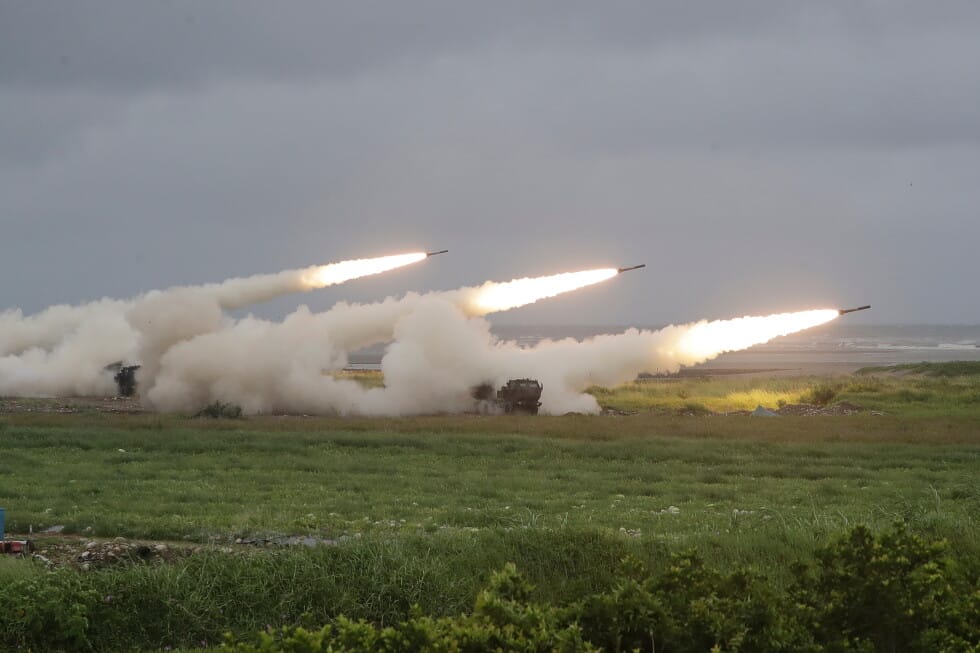
On Tuesday, June 10, Taiwan fired rockets from its U.S.-supplied HIMARS launchers into the Taiwan Strait — its first west-coast live-fire of the system — in what officials called a realistic anti-invasion drill, according to the Associated Press. Forces also tracked at least five Chinese military aircraft and six naval vessels operating around the island during the exercise.
HIMARS is a truck that launches precision rockets and then drives away before anyone can shoot back — soldiers call it "shoot and scoot." The deeper point isn't the rocket; it's the doctrine. Taiwan is shifting toward mobile firepower over fixed targets: fewer vulnerable big bases, more hard-to-find launchers that survive long enough to keep fighting.
If Taiwan folds HIMARS into its annual war games and command-and-control exercises, this becomes a core invasion-denial tool rather than a showpiece. If it stays a once-a-year demonstration shot, China's planners can discount it. Watch which way the next Han Kuang exercise leans.
China's "Drone Over Taipei 101" Video Was a Psyop — and It Worked Anyway
China released aerial footage appearing to show a military drone passing Taipei's tallest skyscraper. Taiwan's military said it was fake. It went viral anyway. Who won?
The black-and-white clip, released by the PLA Eastern Theatre Command during an exercise, was titled "So close, so beautiful, ready to visit Taipei anytime," per the South China Morning Post. Taiwan's Ministry of National Defense denied any large Chinese drone entered the island's 24-nautical-mile restricted zone, calling it cognitive warfare, according to Taiwan News. The China Military Bugle then posted footage of a TB-001 strike drone — a twin-boom aircraft roughly comparable to a Predator — taxiing just before the Taipei clip.
Whether or not it overflew the city, the PLA demonstrated it can make Taiwan's public believe it did — achieving the psychological objective without the military risk. The story is recirculating on Chinese social media now, which tells you the fact-checks are getting traction and Beijing wants the ambiguity alive. Every PLA exercise since August 2022 has paired military and information operations. This is the playbook, not an anomaly.
LeoLabs Put a Space-Surveillance Radar in a Box and Sent It to the Pacific
Space is crowded and contested enough that the military now needs orbital air-traffic control that can move with the fight. LeoLabs' Scout-S radar became operational in Hawaii in June 2026 and will take part in the Valiant Shield exercise, per Breaking Defense — and it fits inside a standard 20-foot shipping container.
That's the whole story. Instead of spending years building a fixed radar site, you ship one. LeoLabs says the system uses 3D scanning and an S-band electronically steered design to track objects in low and very low Earth orbit. Space surveillance just became portable.
If the exercise goes well, transportable commercial sensors become routine Pacific kit — and the U.S. can track satellites and debris in a crisis without relying on a handful of permanent installations. If Scout-S underperforms in a real exercise environment, it stays a science project. Watch whether Valiant Shield produces public performance detail.
The Space Force Is Buying Anti-Jam Satellites Because the First Target in a War May Be Your Connection
The glamorous part of war is missiles. The essential part is whether anyone can still talk after they fly. On June 9, Space Systems Command awarded Viasat and Intelsat a combined $437.7 million for the first two operational satellites in the Protected Tactical SATCOM–Global program, per Breaking Defense.
These satellites sit in geosynchronous orbit and provide jam-resistant communications in X-band and military Ka-band. If an enemy tries to drown out military comms, these are much harder to silence. A force that can coordinate under electronic attack keeps its advantage; one that goes deaf loses.
If the Space Force quickly orders more, anti-jam comms are being treated as urgent wartime infrastructure. If these two stay a boutique pair, survivable communications never reach war scale — which is the only scale that matters. Watch the follow-on order count.
⚡ What Most People Missed
Japan moved from destroyer framework to transfer talks in under seven weeks: Japan and Indonesia agreed June 6 to begin working-level talks on exporting Asagiri-class destroyers to Jakarta, per the Japan Times — just weeks after Tokyo scrapped its rule limiting arms exports to non-lethal categories. That pace suggests both sides were pre-negotiating. Japan is now a live competitor in Southeast Asia's naval market, not a future one. [Source: The Japan Times — Japanese outlet, English edition]
Canada quietly became the only non-European supplier with near-domestic access to the EU's €150B rearmament fund: It negotiated an 80% Canadian-content exemption against the standard 35% cap for third countries, per Geopolitical Monitor. With Poland alone receiving €43.7 billion in SAFE pre-financing, that's a structural advantage that compounds as eastern-flank states start issuing contracts.
DSCA turned another counter-drone system into an exportable line item: Policy Memo 25-46 establishes cost-recoupment charges for the DRAKE C-UAS, meaning the U.S. has done the pricing work to sell it through foreign military sales. Counter-drone is quietly becoming a normal export category rather than an emergency exception.
The FAA's fixed-site drone rule is starting to look like a homeland-defense map: The May rule implementing Section 2209 gives fixed-site owners a formal process to request drone flight restrictions — systematizing what used to be ad hoc. With the World Cup near, counter-drone is migrating from battlefield kit to domestic infrastructure governance.
FMS packages now ship networks as the real weapon: New Zealand's $1.5B June 8 package was framed as MH-60R Seahawks, but the interesting part is the Link 16 data-sharing radios bundled in — wiring another navy into the U.S.-allied sensing mesh. The airframe is increasingly just the delivery vehicle for interoperability.
📅 What to Watch
- If the Senate restores E-7 funding too, Congress has formally decided it won't let the Pentagon retire airborne radar before space-based alternatives actually work.
- If the Philippines or Vietnam accelerate their own Japanese-hardware talks after watching Jakarta move, Tokyo's export pivot becomes a regional shift, not a single deal.
- If DARPA's Lift Challenge teams show real hardware rather than concept art, the next drone breakthrough is cargo and resupply — not strike.
- If anyone outside the Pentagon decodes what the December 2023 "TEXT" prefix change means, the GPS key-distribution channel becomes an open-source intelligence target in real time.
- If the first CCA production contract names Anduril or General Atomics before year-end, the Air Force has chosen a design philosophy in public — a rare thing for an autonomous-weapons program.
The Closer
Today: a radar plane resurrected by Congress over its own Air Force's protests, a Predator-class drone that may or may not have buzzed a skyscraper but won anyway, and nineteen years of secret military codes hiding inside the same signal that finds your nearest coffee shop. The Pentagon spent two decades broadcasting encrypted keys to billions of phones and the only people who never noticed were the ones holding the phones — which is either flawless tradecraft or the most patient open secret in the history of cryptography. Stay sharp out there.
Know someone who'd lose an afternoon to the GPS numbers-station story? Forward this — they'll thank you and then never trust their dashboard nav again.
⚡ EDGE Signals
The following signals appeared in the adversarial edge sweep but were not carried forward in the primary synthesis:
- The through-line today is alliances quietly rewiring how they buy and task tech, especially in space and the Indo-Pacific. Commercial space players are being pulled straight into missile-warning missions, Japan is edging from "aid donor" to arms partner in Southeast Asia, and the Pentagon is open
- Spire Global and Germany's Diehl Defence just signed an agreement to collaborate on satellite-based intelligence, early warning, and reconnaissance, focused on detecting and tracking missile launches and other threats from low-Earth orbit.[1] The press release frames this as a deepening partners
- If this matures into an actual product, it effectively gives European customers a "commercial SBIRS-lite" — space-based missile warning without waiting for a national billion‑dollar constellation. For Diehl, plugging commercial LEO data into ground-based systems like IRIS-T or future interceptors is
- If Tokyo starts moving actual hardware — maritime patrol aircraft, radars, or eventually anti-ship missiles — into Indonesia, it reshapes the deterrence map from the East China Sea down to the choke points around the Natuna and Sunda straits. Japan shifting from a cautious donor to an exporter in So