The Lyceum: Defense Tech Daily — Jun 12, 2026
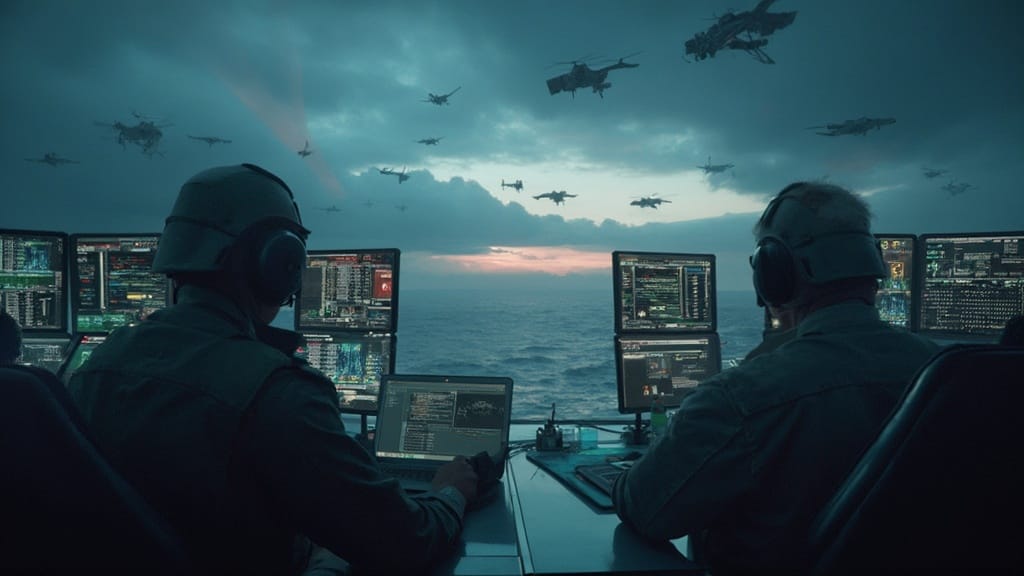
Photo: lyceumnews.com
Friday, June 12, 2026
The Big Picture
Today's defense story has a single throughline: the software is catching up to the hardware. China is encircling Taiwan again — routine now, which is exactly the point. The U.S. Senate wants to give drones their own four-star military command. And the most-forwarded story of the week is about Pokémon Go players who spent years scanning sidewalks for a mobile game and may have accidentally trained the navigation system that lets military drones fly when GPS goes dark. The weapons aren't the news anymore. The brains inside them are.
What Just Shipped
- Scout-S radar (LeoLabs): A space-surveillance radar that fits inside a standard 20-foot shipping container, now operational with its first unit in Hawaii — it can stretch a satellite observation window from seconds to several minutes.
- RAID Taskforce (UK Ministry of Defence): A Rapid AI Delivery unit stood up June 10 to push battlefield AI tools into British forces, paired with a doctrine paper putting AI at the center of UK defence modernization.
- Visual Positioning System (Niantic Spatial): Achieved "Awardable" status on the Pentagon's CDAO Tradewinds marketplace in May 2026 — meaning the U.S. military can now buy the camera-based navigation tech off the shelf.
- Gambit CCA (General Atomics / INTEC Group): Entered Germany's competition for autonomous "loyal wingman" aircraft, with the Bundeswehr aiming to field the capability by 2029.
Today's Stories
China Rings Taiwan — Again. This Time It's Different.
The PLA's Eastern Theater Command launched fresh exercises around Taiwan overnight, warning what it called "Taiwan independence separatist forces." The timing is the tell — it comes days after Taiwan's own west-coast HIMARS live-fire into the Strait this week.
Here's what makes the "routine" framing dangerous. According to Reuters, citing a Taiwanese military study, China's drills and related operations cost an estimated $21.25 billion in 2024 — roughly 40 percent more than the year before, and about 9 percent of Beijing's publicly stated defense budget. Coercion around Taiwan is now a standing budget line, not a seasonal surge.
Beijing's win condition is psychological: each encroachment trains forces for an invasion while blurring where peace ends and conflict begins, so the threshold for "normal" keeps creeping upward. The signal that tells you which way this is heading — watch whether these drills add live-fire or declared exclusion zones, and whether Japan's Self-Defense Forces respond with any visible counter-deployment. Tokyo's reaction is now as telling as Taipei's.
Congress Just Decided Drones Need Their Own Military Branch
Buried inside a $1.14 trillion defense bill that the Senate Armed Services Committee advanced this week is a provision that would reorganize how America fights with machines: a Robotic and Autonomous Systems Combatant Command, the same organizational tier as Indo-Pacific Command or Special Operations Command.
Right now every branch runs its own drone programs, often incompatibly. A dedicated command would put autonomous systems on equal footing with geography and mission type — and hand drone advocates a four-star general with a budget and a seat at the table. It would be the first new combatant command since Cyber Command was elevated in 2018.
If it survives conference, the Pentagon's robot future gets an org chart and a checkbook. If it dies, autonomy stays fragmented across services that can't talk to each other. The committee also adopted "right to repair" reform and a restriction on defense-firm stock buybacks — quietly pointed, given that contractors have returned billions to shareholders while the Pentagon screams about production bottlenecks. The committee approved the bill 18-9, a wider "no" margin than usual for what's normally bipartisan, reflecting the Iran war's shadow over the whole debate.
Pokémon Go's Scans Are Now a GPS-Denied Navigation System for Military Drones
This sounds like a conspiracy theory until you read the sourcing. Then it sounds like the most logical thing in the world.
Hundreds of millions of Pokémon Go players spent years filming streets, parks, and buildings to earn in-game rewards. Those roughly 30 billion environmental scans, first reported by Dutch newspaper Trouw, are now owned by Niantic Spatial and helped train a camera-based navigation model. Here's why it matters: GPS works by triangulating satellite signals, and in a war zone those signals get jammed — Russia does it constantly in Ukraine. A Visual Positioning System lets a drone navigate by what its camera sees, matching live images against a 3D model of the world. No satellite required.
In December 2025, Niantic Spatial announced a partnership with Vantor — the defense firm formerly known as Maxar Intelligence — to fuse that ground-level system with Vantor's aerial Raptor software, targeting GPS "unavailability, spoofing, interference, and jamming." In May 2026, the VPS reached "Awardable" status on the Pentagon's Tradewinds marketplace.
The consent fight is real but secondary to the procurement signal. Vantor denies Pokémon Go data was used in its model, and Niantic Spatial has denied its scans are being shared with a drone company. One caveat worth flagging: the half-dozen outlets covering this all trace back to the single Trouw investigation. That's amplification, not independent confirmation. What's not in dispute: 30 billion civilian scans, collected for a game, now sit one procurement order away from military drones.
Germany's Robot-Wingman Race Just Got Real
If Europe is serious about a high-end war, it needs more than fighters it can't afford to lose. It needs cheaper aircraft that fly alongside those jets — scouting, jamming, or taking the dangerous first punch.
Defense Daily reported June 11 that General Atomics and Germany's INTEC Group are teaming to offer the Gambit family for Germany's Collaborative Combat Aircraft competition, with the Bundeswehr aiming to field by 2029. Other contenders reportedly include Airbus, Kratos, Rheinmetall with Boeing's MQ-28 Ghost Bat, and Anduril. The shift underneath it all: air power moving from "one exquisite jet, one pilot" to "one pilot managing a small team of machines."
If Berlin picks fast, autonomous airpower leaves the concept phase across Europe. The signal to watch is who wins — a foreign design means urgency carried the day; a European-only solution means sovereignty did, and the transatlantic defense relationship gets a fresh stress fracture.
The Senate Wants More MQ-9 Reapers — Which Means Old Drones Aren't Dead Yet
There's a running fight inside the Pentagon over whether the MQ-9 Reaper — the large, slow, propeller-driven drone that defined 20 years of American counterterrorism — belongs in a modern war. The Air Force keeps trying to retire it. Congress keeps saying no.
The Senate's FY27 NDAA directs the Air Force to boost its MQ-9 numbers, made by General Atomics, "through production or other means." The Air Force's case: it's too slow and vulnerable to survive against China or Russia. Congress's counter: you still need persistent surveillance and strike, and nothing cheap enough to replace it at scale is ready.
This is a proxy for a bigger question — do you retire legacy systems before replacements are proven, or keep them until the gap closes? Ukraine showed both answers carry risk: old systems get killed, but capability gaps get exploited. Whichever side wins shapes drone procurement for the rest of the decade.
Britain Just Created an AI Task Force for the Battlefield
Most military AI talk is PowerPoint with better fonts. Britain is trying to turn it into an operating unit.
The UK Ministry of Defence said June 10 it stood up the Rapid AI Delivery Taskforce — RAID — to push AI tools to forces faster, alongside a policy paper arguing AI should sit at the center of defence modernization. This isn't pure branding: it lands the same week as £35 million in counter-drone prison spending and months after London doubled planned investment in autonomous platforms. Software, autonomy, and procurement are being wired together rather than treated as separate press releases.
The win is institutional acceleration — getting useful autonomy out of the lab and into units. Failure looks like another coordination layer with a logo. The observable signal: whether RAID gets actual budget authority and contract pathways, or just meetings.
Russia Just Signed a Military Deal With the Taliban
Russia has signed a military cooperation agreement with Afghanistan's Taliban government — unthinkable a decade ago, when Moscow was quietly undermining the same NATO forces the Taliban fought.
The deal formalizes a relationship of convenience: Russia wants to prove it can build security partnerships outside the Western order; the Taliban wants legitimacy and access to Russian equipment and training. The concern for U.S. planners isn't a Taliban-as-proxy scenario. It's that Russian advisers and potentially hardware now sit on Central Asia's border — adjacent to China's western flank, within reach of Pakistan's nuclear infrastructure, in a region where the U.S. has almost no remaining intelligence presence.
Watch whether the deal moves Russian electronic-warfare gear, drones, or air defenses — the exact kit defining Ukraine — into that vacuum. If it does, the Ukraine playbook gets a new theater no one's watching.
⚡ What Most People Missed
The Niantic story has a Saudi subplot nobody's covering: Scopely bought Niantic's games business — including Pokémon Go — for $3.5 billion. Scopely is owned by Saudi Arabia's Savvy Games Group, ultimately the kingdom's sovereign wealth fund. The games went to a Saudi fund; the map and its 30 billion scans were spun out separately and went to defense. Washington has blocked other foreign acquisitions of sensitive data. This one sailed through.
The Iran war is shaping the NDAA vote count: Senator Tim Kaine said he couldn't vote to advance a bill clearing "$1.5 trillion in Pentagon funding" while the administration wages "an illegal and foolish war in the Middle East." The Senate has passed the NDAA with overwhelming margins for 62 straight years. A war-authorization fight could break that streak.
The Army is commissioning Silicon Valley CTOs as lieutenant colonels: Cloudflare CTO Dane Knecht, Sutter Hill's Sam Pullara, and Facebook AI founder Serkan Piantino joined Detachment 201, the Army's part-time reserve unit for tech advisers. It's the second cohort. If they embed in real programs, the Army starts treating tech founders as operational enablers, not vendors.
Japan's destroyer talks are testing its new export rules: Tokyo and Jakarta opened working-level talks June 5 on transferring Asagiri-class destroyers — the first real hardware test of Japan's April 2026 decision to scrap its ban on lethal-equipment exports. Indonesia is shopping everywhere at once, even eyeing China's J-10 fighter, so interoperability is the prize. [Source: The Japan Times — Japanese]
Britain is fitting steel grilles on 13,000 prison cell windows: A £35 million counter-drone push across 17 prisons, explicitly drawing on Ukraine battlefield lessons. Once anti-drone money flows through prison and airport budgets, the customer base for cheap detection systems gets far bigger than the armed forces alone.
📅 What to Watch
- If the full Senate floor debate includes an Iran war-authorization amendment, the defense bill becomes the vehicle for the biggest war-powers fight in a generation — and the amendment may come from both parties.
- If Niantic Spatial or Vantor clarify the exact data lineage of the deployed model, consumer tech faces a consent reckoning that makes Cambridge Analytica look narrow — every app collecting environmental scans becomes a potential defense supplier.
- If China's exercises add live-fire or exclusion zones, the threshold for "routine" has moved up another rung, and each shift makes the next one easier to ignore.
- If the Philippines or Vietnam accelerate their own Japanese-hardware talks after watching Jakarta, Tokyo's export pivot becomes a regional realignment, not a single deal.
The Closer
A nation of Pokémon trainers unknowingly teaching missiles to read sidewalks, a slow propeller drone refusing to die because Congress won't sign the death certificate, and Russian advisers setting up shop in the one country that buried their last empire. Somewhere in a Saudi sovereign fund's portfolio sits a mobile game whose street scans now help drones find their way home — the consent box everyone tapped through in 2016 turned out to have fine print written in three dimensions. Mind the airspace.
Forward this to the friend who still plays Pokémon Go on their lunch walk — they've earned the right to know.
⚡ EDGE Signals
The following signals appeared in the adversarial edge sweep but were not carried forward in the primary synthesis:
- DefenseScoop reports that the U.S. Army has commissioned three high‑profile tech leaders — Dane Knecht (Cloudflare CTO), Sam Pullara (Sutter Hill Ventures CTO), and Serkan Piantino (who founded Facebook's AI research arm) — as lieutenant colonels in a special reserve unit called Detachment 201.[
- AFCEA's Signal magazine highlights how Germany's Cyber Innovation Agency is using recurring defense‑tech competitions to attract non‑traditional cyber talent and accelerate projects that would otherwise die in procurement bureaucracy.[8] The next challenge is set to kick off soon, with the agency ex
- [3] Is ICEYE really worth $10B? () - New Market Pitch
URL: https://newmarketpitch.com/blogs/news/defense-tech-iceye-overvalued
Snippet: ICEYE is turning radar satellites into real-time intelligence infrastructure. Here's whether defense demand, climate monitoring, and space data growth ...