The Lyceum: Defense Tech Daily — Jun 13, 2026
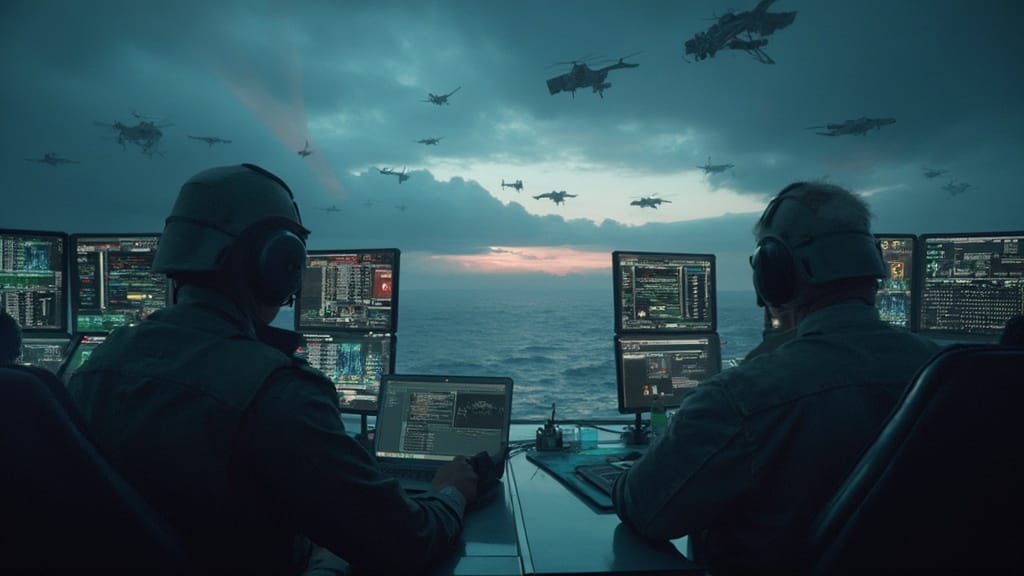
Photo: lyceumnews.com
Saturday, June 13, 2026
The Big Picture
A peace deal with Iran exists on paper — and Iranian drones are still falling out of the sky over the Strait of Hormuz. That gap between what diplomats signed and what soldiers are still shooting is the whole story today. Underneath it, two quieter currents matter just as much: the Navy is betting that hypersonic missiles can be cheap enough to buy by the dozen, and a sharp new argument out of Washington says the Pentagon's AI advantage can be copied without anyone ever hacking a server.
What Just Shipped
- Blackbeard hypersonic prototype order (Castelion): The Navy ordered 50 prototypes of a low-cost hypersonic weapon, with flight testing and early fielding on the docket.
- F-35 sustainment contract — $2.3B (Lockheed Martin): Funds new operating and sustainment sites for the F-35 fleet.
- Hivemind autonomy on LUCAS (Shield AI): Integration of AI-pilot software onto a CENTCOM-deployed one-way attack drone squadron.
- CH-53K upgrade program — $525M (Sikorsky): Modernization for the Marines' heaviest-lift helicopter.
- AN/SPY-6(V)1 recoupment memo (DSCA 26-87) (Defense Security Cooperation Agency): New cost-recoupment charges that make the Navy's top air-and-missile-defense radar easier to export.
Today's Stories
The Iran "Peace Deal" and the Drones That Didn't Get the Memo
There is a peace agreement on paper. There are also Iranian attack drones in the air over the Strait of Hormuz — and U.S. forces are still shooting them down.
On Friday, Pakistan's prime minister announced that a final agreed text had been reached, and Reuters reported that Washington and Tehran both signaled an end to the war was close, with a senior U.S. administration official saying the two sides expected to sign an initial deal within days. The agreement calls for Iran's nuclear material to be destroyed and removed and its program dismantled. But within the same news cycle, U.S. forces downed two more Iranian one-way attack drones in the Strait — and Trump said the naval blockade stays in place until the deal is finalized.
If Iranian launches stop in the next 72 hours, the text is real. If the drones keep flying, it's a negotiating prop — and the political track is running on a different clock than the war.
Israel Strikes Lebanon — and the U.S. Sends More Marines
Lebanon is no longer a sideshow to the Iran war. It's the second front, and the U.S. is repositioning accordingly. France 24 reported Israel pounding Hezbollah positions while Washington moved additional Marines into the region; specific troop numbers remain unconfirmed in open sources. Marines are the force most likely to run embassy defense or evacuations if the conflict widens, so the move reads as contingency planning, not symbolism.
The technology angle is air defense. Every Israeli strike and every Iranian drone intercepted over the Strait is generating real-world data on how layered systems — Iron Dome, David's Sling, U.S. Navy shipboard interceptors — hold up under sustained, multi-axis pressure. The lessons being written right now will shape procurement for a decade. Watch whether Iranian launch tempo drops after the peace text — that's the clearest signal Tehran's military is actually standing down.
The Navy Wants Cheap Hypersonics — and It's Ordering 50 to Prove It
Hypersonic missiles — weapons that fly faster than Mach 5 and maneuver mid-flight, making them nearly impossible to intercept — have historically cost tens of millions of dollars apiece. The Navy just decided that's unacceptable.
It awarded roughly $50 million to Castelion, a California startup founded in 2022, to develop and prototype the Blackbeard weapon, confirming Blackbeard as the first candidate under its Multi-mission Affordable Capacity Effector (MACE) program. Per Army Recognition, Blackbeard is designed for air-launch from the F/A-18 and future F-35, with a ground-launched variant for HIMARS. After the FY2026 Defense Appropriations Act passed, MACE picked up an extra $140 million — more than doubling its base funding, per Defense Archives.
The real test is whether "affordable hypersonic" is engineering or marketing. The F/A-18 flight test will be the first honest answer. If Blackbeard flies and hits, the era of hypersonics as a niche, ultra-expensive capability is over.
The Pentagon's AI Edge May Be Getting Copied — Without Anyone Breaking In
You don't need to hack the Pentagon to steal its AI advantage. You just need to study its publicly released models.
The Defense Department's most advanced systems — from Project Maven's intelligence fusion to Anduril's Lattice targeting platform — are tethered to frontier models built by Anthropic, Google, and OpenAI. The threat is a technique called distillation, which lets a rival cheaply imitate a model's behavior without the expensive training. War on the Rocks cited the 2026 Stanford AI Index: on the "Arena" leaderboard, the gap between top U.S. and Chinese models has shrunk to 2.7 percent in 2026, down from 17 percent in 2023.
Think of it as owning the fanciest smartphone — which matters less if everyone can duplicate the software tricks in six months. The chip export controls were supposed to starve rivals; distillation routes around them. Watch whether the Pentagon starts restricting which models contractors can build on — that would mean Washington has accepted that public AI releases are now a national-security liability.
In 28 Hours, Industry Built an Autonomous "Drone-Killer" Robot for the Army
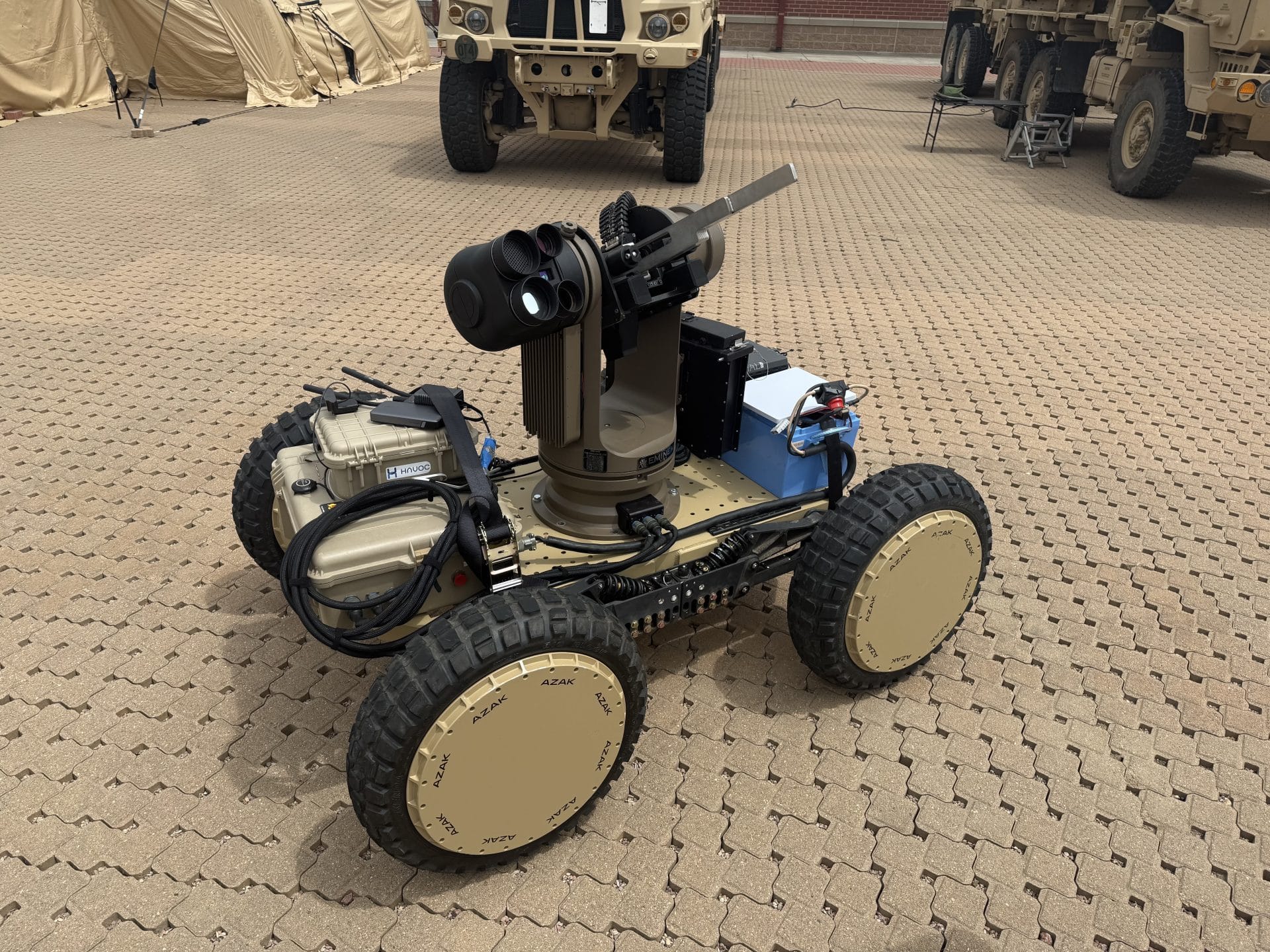
Twenty-eight hours. That's how long it took multiple defense companies to assemble an autonomous, wheeled, drone-killing ground vehicle during the Army's first "Operation Jailbreak" sprint — using the service's emerging unified network as the backbone, DefenseScoop reported Friday. Vendors showed up with modular parts — sensors, autonomy stacks, weapons — and were told to plug into the network and produce a working counter-drone robot by the end of the exercise.
If you can bolt together a drone-hunter in the time it takes to run a hackathon, the underlying autonomy and open-architecture standards may finally be mature enough for Lego-style combat systems instead of one-off demos. That's a different procurement world: sensors and AI as swappable apps riding a common chassis, rather than monolithic vehicles bought a decade at a time. The signal to watch is whether anything from this sprint survives into a real program of record — or stays a clever drill.
Berlin Air Show's Smallest Drones May Be the Most Important Thing on the Runway
The flashiest thing at an air show is usually a fighter jet. This week, per Breaking Defense, the most important hardware might be the gear you could carry in a backpack — one-way attack drones and small autonomous platforms drawing serious attention on the tarmac.
That matters because militaries are accepting a truth Ukraine and the Middle East already proved: mass beats majesty. A handful of exquisite aircraft can't solve being swarmed by cheap, expendable drones. The real shift is industrial, not just tactical — once air shows treat tiny drones as headline hardware, procurement logic follows the budget toward software, autonomy, and low-cost manufacturing. Watch whether European governments move from admiring these systems on the tarmac to actually buying them at scale.
DARPA's Lift Challenge Turns Cargo Drones Into a Real Military Problem
Everybody loves a strike-drone story. The unglamorous revolution is the one that moves stuff. DARPA announced on June 8 it had invited the first wave of teams into its Lift Challenge, built around drones that can haul four times their own weight.
Translate that into battlefield reality: armies burn through batteries, ammunition, food, and spare parts constantly, and getting supplies forward is often more dangerous than the fighting. A drone that hauls real loads without a vulnerable convoy changes the math — especially for islands, urban fights, and dispersed units trying not to be seen. Autonomy is coming for the supply truck, not just the trigger. The tell will be field demos that survive wind, clutter, and jammed comms — not slick renderings.
⚡ What Most People Missed
The Strait of Hormuz is now a crypto toll road: Iran's IRGC is reportedly running a "Persian Gulf Strait Authority" charging up to $2 million per vessel — payable in Chinese yuan, Bitcoin, or USDT — to skirt the dollar banking system entirely. A modest drone-and-mine inventory has become a revenue-generating geopolitical sorting machine, and every sanctioned state is taking notes.
The Navy is running a second affordable-hypersonic bet: The Office of Naval Research launched FLASH — a surface-launched hypersonic weapon for the Navy's Vertical Launch System — with awards expected by January 2027, per MILMAG. Two parallel programs isn't redundancy; it's a hedge against one failing.
Aerospace primes can't live their own "digital thread": An EY–Aerospace Industries Association survey found most defense firms back the idea of a continuous design-to-sustainment data model but few have scaled it — leaving them "in the danger zone" on speed. The bottleneck in fielding AI weapons may be industrial plumbing, not algorithms. [Source: Manufacturing Dive coverage of EY–AIA survey]
Counter-drone is becoming a software patch: Per Breaking Defense, L3Harris is turning Falcon IV handheld radios into drone jammers via a software update called Wraith Shield — hinting at a future where ordinary troops carry their own electronic-warfare bubble instead of waiting for a specialist team.
The Pentagon's anti-vax psyop, revisited: Today's Reuters-sourced flurry traces back to a June 2024 investigation into a clandestine U.S. military campaign — begun in 2020, run into 2021 — that used fake social accounts to sow doubt about China's Sinovac vaccine in the Philippines. No fresh 2026 development surfaced; flagging it as the cautionary tale it is for an AI-content era, where synthetic influence escapes its target even faster.
📅 What to Watch
- If Iranian drone launches continue after the peace text is formally signed, the deal is performative and the war is running on a separate track from the diplomacy — the defining binary of the next 72 hours.
- If the Pentagon restricts which frontier AI models contractors can build on, Washington has quietly conceded that public model releases are a national-security liability, and the entire defense-AI vendor map reshuffles.
- If the Hormuz toll regime survives a peace agreement intact, Iran will have proven a crypto-denominated maritime access system can outlast the war that birthed it — a template every sanctioned state will copy.
- If anything from Operation Jailbreak's 28-hour sprint becomes a program of record, the Army has validated Lego-style procurement and the monolithic-vehicle era starts ending.
The Closer
Picture a peace treaty being initialed while a Navy gunner downs an Iranian drone over the same water, a startup promising to mass-produce Mach-5 missiles like socks, and a robot drone-hunter welded together over a single weekend with the network treated as duct tape. The most durable thing to come out of this war may not be the deal or the missiles — it may be Iran's crypto toll booth, the one piece of infrastructure built to outlive the conflict that created it.
Stay sharp out there.
Forward this to the friend who keeps asking whether the Iran "deal" is real — now you can tell them: ask the drones.
⚡ EDGE Signals
The following signals appeared in the adversarial edge sweep but were not carried forward in the primary synthesis:
- The interesting stuff today isn't a shiny new prototype; it's the paperwork and force moves that tell you where the machine is turning next. I'm seeing three quiet signals in parallel: the U.S. is hardening the Middle East with more Marines while Iran-linked pressure keeps spilling into shipping and
- A PRNewswire filing details a staged deal where VisionWave, a small‑cap defense‑tech platform focused on counter‑UAS and sensing, will invest up to $17.5 million in Israel's Foresight Autonomous Holdings, an automotive‑vision company, for a path to a **52% controlling stake tied to a counter‑drone "
- [3] Anduril raises $5B at $61B valuation in biggest defence tech deal of ...
URL:
Snippet: Defence startup Anduril Industries has pulled in a $5 billion Series H round at a $61 billion valuation, marking the largest defence tech raise of the year ...
- [7] US sinks Iranian ship on the high seas, hammering Tehran's navy
URL: https://www.aol.com/articles/pentagon-says-us-hit-20-225708942.html