The Lyceum: Defense Tech Daily — Jun 15, 2026
Photo: lyceumnews.com
Monday, June 15, 2026
The Big Picture
Three power plays collided this weekend. China ran its most provocative Taiwan Strait exercises in years — coming within nine kilometers of the island and rolling out an amphibious assault ship for the first time. Washington discovered that export controls built for chips don't translate cleanly to software when it ordered Anthropic to lock down its top AI models and accidentally shut them off for everyone on Earth. And America's next stealth bomber quietly jumped a testing milestone that says one thing clearly: the Air Force is in a hurry. The connective thread is everyone testing limits — geographic, legal, technical — and getting back ambiguous answers.
What Just Shipped
- B-21 Raider operational test flight (U.S. Air Force / Northrop Grumman): An operational test pilot flew the stealth bomber alongside a developmental tester at Edwards AFB — the earliest such integration in modern test history.
- Portable field DNA sequencer (U.S. Navy): Microbiologists and corpsmen can now identify harmful pathogens in under an hour from a desert, Arctic camp, or ship.
- Project Spectrum Strike (Defense Innovation Unit): A live counter-drone prize challenge framing UAS defense as a spectrum-and-network problem, with initial pitch decks due today, June 15.
- France's "kill web" (French Army): A sensor-to-shooter network modeled directly on Ukraine's Delta system, now moving into development.
Today's Stories
China's Taiwan Exercises Just Got Uncomfortably Close
For years, China's Taiwan drills followed a script: loud, provocative, but with enough buffer to preserve deniability. This week's exercises broke the script in a measurable way.
According to Chinese-language reporting from Phoenix TV, the PLA's Eastern Theater Command operated within less than nine kilometers of Taiwan — a buffer long treated as a de facto red line. The new element is hardware: Chinese outlets confirmed the Type 075 amphibious assault ship — a smaller carrier built to land troops on beaches — made its first appearance in a Strait exercise. [Source: Phoenix TV / Sin Chew Daily — Chinese]
An amphibious assault ship isn't a deterrence prop. It's an invasion tool. Its presence signals Beijing is rehearsing the full operational sequence, not just the air and missile theater. Taiwan stood up an emergency operations center and deployed coastal missile systems; the U.S. urged restraint. The drills are the message — and the message is that the geographic buffers keeping the Strait stable are being erased one exercise at a time.
Watch whether the Type 075 becomes a routine fixture. That's the signal Beijing has moved from rehearsal to normalization.
America's Next Stealth Bomber Just Crossed a Major Threshold
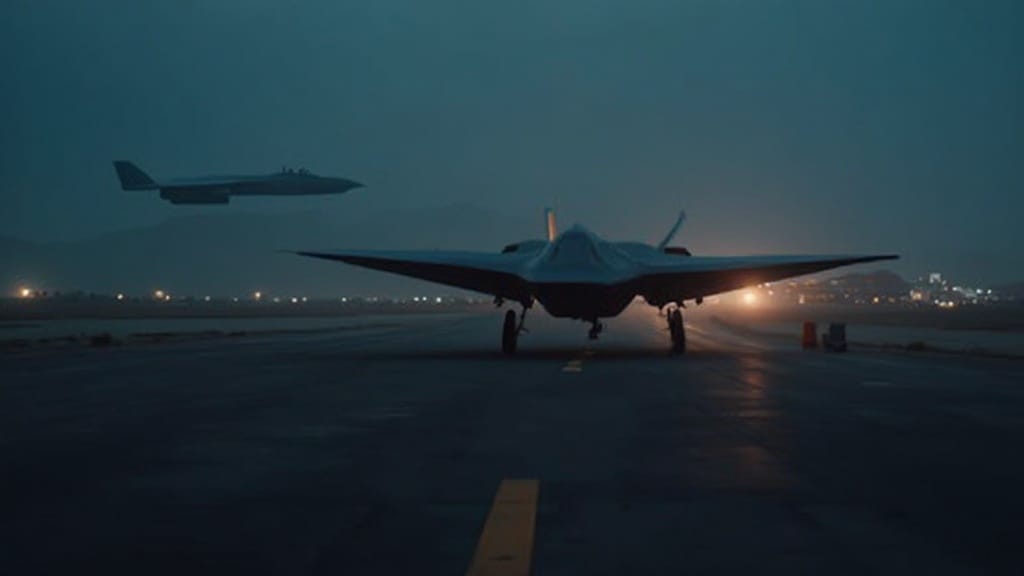
Most weapons programs spend years proving the thing won't crash. The B-21 Raider — America's next nuclear-capable stealth bomber — just skipped ahead to proving it can actually fight.
An operational test pilot flew the B-21 alongside a developmental test pilot at Edwards Air Force Base. The distinction matters: developmental testers check whether a plane meets its specs; operational testers check whether a real warfighter can use it in combat. "In the history of modern test, we've never done that so early in a program," said Col. Matt Guasco, AFOTEC Detachment 5 Commander. Lt. Col. Matthew Gray added that bringing operational testers in early "means we can evaluate the bomber's true combat utility, not just its flying characteristics," per Aerotime.
The accelerated timeline is the real story. The B-2 Spirit just proved its value over Iran, and its successor needs to be ready for deployment to Ellsworth AFB in 2027. The first weapons-integration test results are what to watch: that's when we learn whether the B-21 can do what it's built for, not just fly.
The U.S. Government Just Weaponized Export Controls Against an AI Company — and It Got Messy

The U.S. has spent years using export controls to keep advanced chips out of China's hands. This month it tried the same playbook on software — and discovered AI models don't behave like semiconductors.
Commerce Secretary Howard Lutnick sent Anthropic CEO Dario Amodei a letter on June 1 requiring government approval before any transfer of the Mythos 5 and Fable 5 models to non-U.S. persons, per Crypto Briefing. Anthropic can't reliably distinguish foreign nationals from U.S. persons in real time across hundreds of millions of users, so the practical result was a hard global shutoff of both models for everyone, according to Nextgov. Officials reportedly acted after another company claimed it had jailbroken Mythos.
Here's why chips and models are different: a chip has to be manufactured, shipped, and physically delivered. A model can be reached through an API from anywhere on Earth — so the only enforcement lever is binary: on or off. Washington just established it can shut down a frontier AI model worldwide with a single letter. Watch whether Anthropic's negotiations restore access, and on what terms — any carve-out for "trusted" partners will reveal which countries Washington considers safe recipients of frontier AI.
Iran Deal, Hormuz Blockade Lifted — But the Drones Didn't Get the Memo
There is now, officially, a peace agreement between the United States and Iran. The Navy is lifting its two-month blockade of the Strait of Hormuz — the chokepoint through which roughly a fifth of the world's oil flows. President Trump announced it on social media.
And yet: per CBS News, Iranian drone and missile attacks on shipping continued even as the diplomatic text was being finalized, and the toll on U.S. forces is only now becoming public. The gap between the deal on paper and the battlefield reality is the defining tension of this moment.
The technology angle is significant. The conflict became a live laboratory for missile and drone defense at scale — interceptors like THAAD (Terminal High Altitude Area Defense) were stress-tested in ways no peacetime exercise can replicate. What worked, what ran out of ammunition, and what failed will quietly reshape procurement for the next decade. Watch whether Iran's crypto-denominated Hormuz toll regime survives the peace deal — if it does, it becomes a template every sanctioned state copies.
France Is Building Ukraine's Battlefield Internet — for Itself
Ukraine built something remarkable under fire: a system called Delta that fuses every sensor — drones, satellites, ground observers — into one picture any commander can pull up on a tablet. France watched. Now it's building its own version.
Per Defense News, the head of France's land forces confirmed the Army is developing a "kill web" — a network linking sensors and weapons for faster targeting, explicitly modeled on Delta. Instead of information crawling up a chain of command before a decision crawls back down, every shooter sees the same picture and acts.
This is the operational lesson of Ukraine distilled into a procurement line. The U.S. pursues the same idea under JADC2 (Joint All-Domain Command and Control); Germany and the UK are building national variants. Watch whether France's version is built to interoperate with NATO or to stand alone — that architectural choice tells you how seriously Europe takes defense autonomy.
The Pentagon Ran a Secret Anti-Vax Campaign — and It Was a Psyop
This one takes a moment to absorb. Reuters reported that U.S. military information operations ran a covert campaign in the Philippines designed to incite fear of Chinese-made COVID vaccines — fake social media accounts and fabricated content spreading distrust of Sinovac among Filipinos.
It's not primarily a technology story, but it belongs here as a case study in how information operations actually work. The same toolkit aimed at vaccine confidence can target elections, alliances, or trust in institutions. It also lands awkwardly: the U.S. has spent years accusing Beijing and Moscow of exactly this. Watch for whether the House and Senate Armed Services Committees demand a full accounting of active influence programs — that's when we learn how widespread this really is.
The Pentagon's Press Policy Just Lost Fox News
When Fox News and most of the rest of the press corps agree on something, pay attention. An overwhelming coalition of major outlets — Fox News among them — has rejected the Pentagon's press credentialing policy, which critics say lets the Defense Department revoke access from journalists whose coverage it dislikes, per the Washington Post and Straight Arrow News. On June 1, the Pentagon went further, redesignating its press office as a classified space and barring journalists from entering.
For defense tech specifically, this matters: the Pentagon press office is a primary source for contract awards, test results, and program updates — the raw material of this newsletter. The performance data that tells you what's actually being jammed and what intercept rates really look like flows through the same channel now being restricted. The Department says it plans to appeal a court ruling that restored credentials, so the legal fight is live.
⚡ What Most People Missed
- Section 702 is lapsing for the first time in its history: Per Defense One, the surveillance authority letting U.S. intelligence collect foreign communications passing through American servers is set to statutorily expire Friday after Congress failed to reauthorize it. A gap in the NSA's most powerful collection tool — at the exact moment the Taiwan Strait and the Persian Gulf both demand maximum coverage.
- U.S. troops now carry portable DNA sequencers in the field: Navy microbiologists can identify pathogens in under an hour in the desert, Arctic, or at sea. The longer-term implication is decentralized battlefield forensics — verifying biological threats, casualties, and outbreaks far faster.
- The Hormuz toll booth is starting to look permanent: The IRGC's "Persian Gulf Strait Authority" is documented charging per-vessel fees up to $2 million in yuan, Bitcoin, or USDT — and it's surviving a declared peace process. (Lloyd's List underlying data is solid; treat the "deal is close" framing skeptically given Iran's non-confirmation.)
- Canada is quietly shopping for drone early-warning: Per Vanguard's June 14 report, Canada's DND is treating base- and city-scale drone detection as an urgent operational requirement, not a research project — favoring networked commercial sensors over a single exquisite system. The missing layer of air defense, going mainstream.
📅 What to Watch
- If the Type 075 reappears in the next Taiwan exercise, Beijing has normalized invasion-rehearsal hardware in routine pressure — a qualitative escalation beyond air-and-missile theater.
- If Anthropic gets a carve-out for "trusted" foreign partners, the deal terms will quietly map which nations Washington trusts with frontier AI — and which it doesn't.
- If Section 702 isn't reauthorized within days, intelligence agencies operate with degraded foreign collection precisely when two simultaneous crises demand more, not less — a self-inflicted blind spot.
- If Israel's June 22 Lebanon talks survive this week's Beirut strikes, it proves how much kinetic punishment a negotiating framework can absorb — a doctrine data point for every future war run in parallel with diplomacy.
The Closer
A bomber learning to fight before it's finished, a chatbot bricked worldwide by a single letter from the Commerce Department, and an amphibious assault ship loitering nine kilometers off Taiwan like it forgot where the parking lot was. Somewhere a Filipino who skipped his Sinovac shot because of a Pentagon sock-puppet account is reading that the U.S. spent the weekend lecturing China about restraint — and the only people who can't enter the Pentagon to ask about it are the reporters.
Stay sharp.
Forward this to someone who still thinks export controls are about hardware.
⚡ EDGE Signals
The following signals appeared in the adversarial edge sweep but were not carried forward in the primary synthesis:
- The freshest signals today are about quiet rewiring of air defense and surveillance, not big-ticket platforms. Canada is quietly shopping for better drone early-warning, South Korea is rolling out AI-based detection kits it wants to show the world, and Japan is locking in new defense ties with I
- ### Canada quietly moves to upgrade early warning against drones
- Vanguard reports that Canada's Department of National Defence has launched a new effort to obtain "better early warning against drone threats," framed as an urgent requirement rather than a long-term science project.[10] The piece, dated June 14, describes DND seeking solutions that can detect, clas
- What makes this interesting is that base- and city-scale drone detection is being treated as a missing layer of air defense, similar to how counter-IED sensors were treated in Iraq. If Canada is formalizing this now, expect NATO partners to compare notes on multi-sensor stacks (radar, radio-freq
- The Diplomat reports that Indonesia and Japan have signed a new defense agreement that, beyond high-level security cooperation, explicitly "eyes possible arms transfers" as part of the framework.[The Diplomat – Asia-Pacific Current Affairs Magazine] The deal reportedly covers information sharing, jo