The Lyceum: Defense Tech Daily — Jun 16, 2026
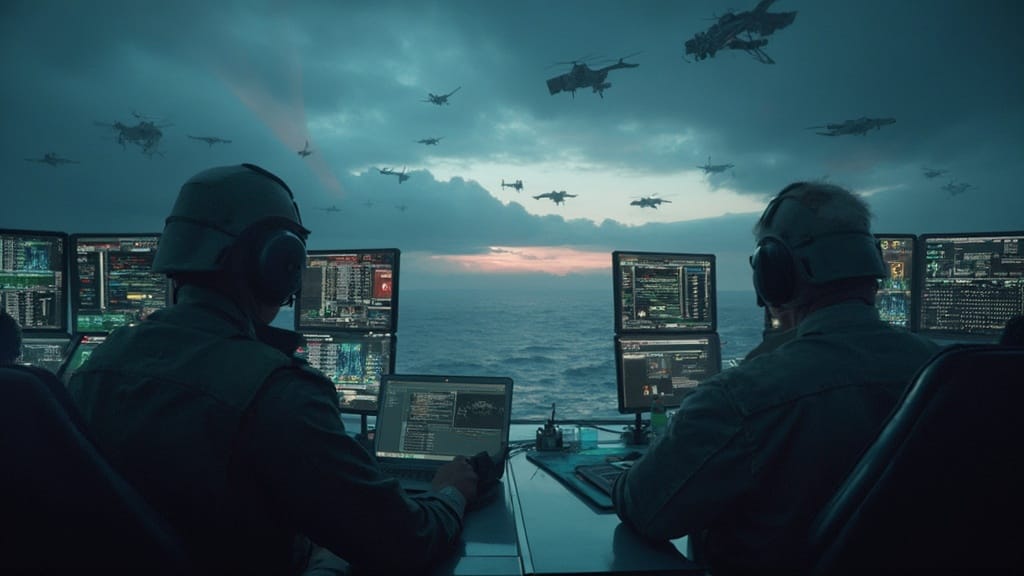
Photo: lyceumnews.com
Tuesday, June 16, 2026
The Big Picture
The defining story today is loss: eight people died when a B-52 — one that received an upgraded radar hours earlier — went down in flames at Edwards Air Force Base on a routine test flight. Meanwhile the Iran "peace deal" keeps colliding with a war that hasn't agreed to stop: Israel struck Beirut again, Netanyahu has pledged to occupy southern Lebanon, and an Iranian missile was shot down near Turkey. Underneath it all, the war is quietly rewriting procurement math — and the bill is coming due in places nobody expected.
What Just Shipped
- Extended Range Artillery Projectile (ERAP) (General Atomics Electromagnetic Systems): won a contract to validate a maneuvering 155mm round designed to strike beyond conventional artillery range.
- Counter-drone systems (Perennial Autonomy): a $500M Pentagon contract awarded in May for anti-drone capability — looking less like a one-off as the drone fight intensifies.
- B-52 radar modernization upgrade (Boeing): a new radar system fitted at Port San Antonio, the very payload being tested when the aircraft crashed.
Today's Stories
America's Most Iconic Bomber Just Killed Eight People on a Test Flight
The B-52 Stratofortress has flown since 1952, outlasting every aircraft meant to replace it. On Monday, one crashed on a routine test mission and killed eight people.
The bomber went down shortly after takeoff at Edwards Air Force Base in California around 11:20 a.m. local time and burst into flames. Edwards said initial indications were the crash was "not survivable." The crew was a mix of uniformed military, government civilians, and contractors; Boeing confirmed two of its employees were among them, CBS Los Angeles reported. This wasn't combat — it was a modernization test. ABC News reported the jet had flown in after receiving an upgraded radar system and was assigned to the 412th Test Wing.
If the investigation links the new radar to the crash, the Air Force's plan to keep the B-52 flying into the 2050s wobbles — and the argument to accelerate the B-21 Raider gets louder. The signal to watch: whether the radar program gets paused pending findings, a process likely to take months.
The Iran Peace Deal Has a Lebanon Problem
There is, technically, a peace agreement between the United States and Iran, and a ceasefire between Israel and Hezbollah. Neither is stopping anyone from shooting.
At least three people were killed in Israeli strikes on Beirut's southern suburbs on Sunday, Al Jazeera reported. Netanyahu's office said the military damaged "Hezbollah targets" in Dahiyeh after Hezbollah launched three projectiles toward northern Israel — what the IDF called a blatant ceasefire violation. Al Jazeera also reported Netanyahu announced Israeli troops will occupy southern Lebanon, a significant escalation of stated aims.
The operational logic is straightforward: Israel is pressing its advantage in Lebanon while U.S.-Iran diplomacy keeps Tehran from escalating in response. The question for the next 72 hours is whether Iran's negotiators can hold a deal together while their Lebanese proxy takes sustained hits — and whether Washington pushes Israel to stop. Watch whether the framework absorbs the punishment or splinters under it.
The Drone Laser Gap — and the Companies Racing to Fill It
Here's a problem that sounds simple until you try to solve it: a small drone needs to "paint" a target with a laser so a missile can home in on it. Laser designators — the painting devices — have historically been heavy, expensive gear built for manned aircraft. Drones are neither heavy nor expensive. Mismatch.
Ukraine's war turned that mismatch into a crisis. Defense News reports several European firms are pitching miniaturized laser solutions for drones at the Eurosatory exhibition in Paris, racing to fill the gap. The companies that crack this define how precision strike works in the next decade — cheap drones guiding high-end munitions.
Failure looks like systems still too big and power-hungry for a sub-5kg frame. Success looks like a designator that fits a commercial quadcopter. Watch which systems get announced at Eurosatory this week, and whether any are small enough to bolt onto an off-the-shelf drone.
The Army Wants Artillery That Can Chase a Moving Target
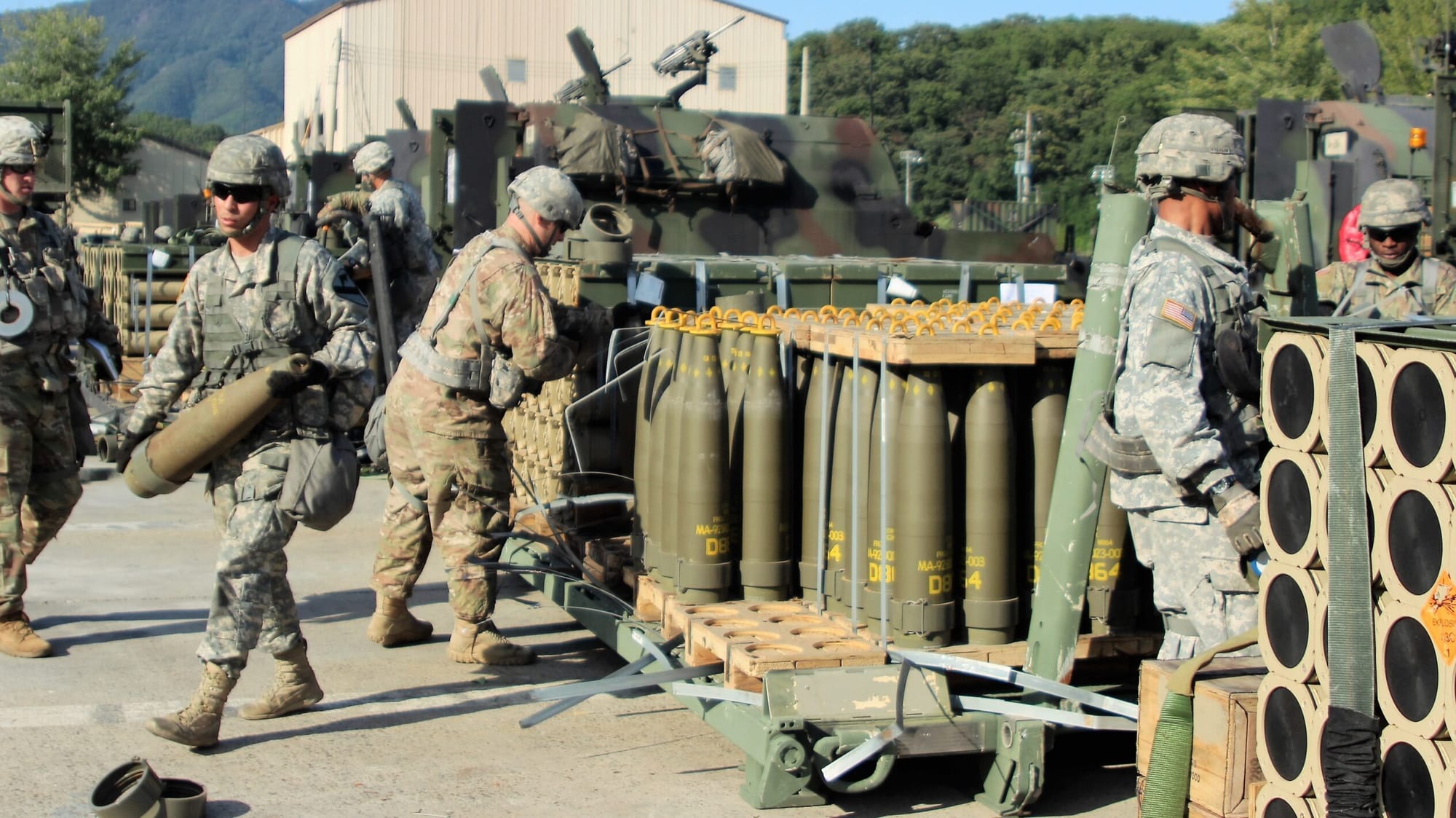
A standard 155mm shell — the backbone of ground combat for a century — is essentially a very precise rock. Aim, fire, physics. If the target moves, you miss.
The Army wants to fix that. Breaking Defense reports General Atomics Electromagnetic Systems won a contract to validate a maneuvering 155mm round, joining General Dynamics Ordnance and Tactical Systems and BAE Systems in the Extended Range Artillery Projectile competition — a shell that maneuvers mid-flight to chase targets that move or sit beyond conventional range.
Russian forces in Ukraine learned to move vehicles the instant they fired, exploiting time-of-flight. A maneuvering shell closes that escape window — using existing howitzers, no new launchers required. Three vendors means real price pressure. Watch which design survives validation; if it stays affordable, the cost equation of long-range fires changes in every future land war.
GAO Tells the Navy: Your Drone Bureaucracy Is Holding You Back
If you've ever watched a big organization try to build software the way it builds ships, you know how this ends. The Government Accountability Office has reiterated recommendations that the Navy reorganize how it manages robotic and autonomous systems and adopt a "build-test-learn" approach. The Navy has made some changes since last year, but not enough to satisfy GAO, which wants clearer authority and portfolio-level management across surface, underwater, and aerial drones.
If the Navy embraces this, expect faster, smaller unmanned projects instead of one giant "next-gen" drone ship. If it doesn't, the service risks getting outpaced by commercial robotics and by other U.S. services already running spiral development. The observable signal: whether the next unmanned program ships a small capability early, or vanishes into a decade-long requirements document.
DARPA Wants to Rebuild Satellites — In Space, On the Fly
The most vulnerable moment for a satellite constellation isn't when it's operating — it's when you've lost satellites and need replacements. Right now that means building one on the ground, launching it, and waiting years. In a war, years is forever.
DARPA is soliciting industry ideas for "rapid reconstitution" of space systems, Breaking Defense reports, flagging on-orbit manufacturing and very-low-Earth-orbit operations as areas of interest. The idea: assemble or repair satellites already in orbit instead of launching complete replacements.
This is early — an RFI, not a contract — but the fact that DARPA is asking publicly means the Pentagon now treats wartime satellite attrition as a normal planning condition, not an edge case. That's a doctrinal shift. Watch whether commercial in-space servicing firms like Northrop Grumman's SpaceLogistics or Astroscale show up in the responses.
The Pentagon's Anti-Vax Psyop Is Now a Case Study in Information Warfare
The most important "weapon" story this week might be about memes, not missiles. Reuters reported the Pentagon ran a covert online campaign in the Philippines during COVID, using fake social-media accounts to undermine trust in China's Sinovac vaccine — and continued it even after vaccines became a global public-health lifeline.
Why revisit it? The diplomatic fallout is turning this into a doctrine case study: proof the military will run influence campaigns that blur strategic competition with public health, turning information-war tools on a civilian population's medical choices. Allies are already asking what else is fair game. Watch whether Congress or the Pentagon issues new peacetime psyop rules — those decisions quietly define the playbook for every future info-war campaign.
⚡ What Most People Missed
Pakistan's first Chinese-built submarine just docked in Karachi: PNS Hangor arrived June 11, six weeks after commissioning at Sanya, China. Defence Security Asia reports India's P-8I patrol aircraft are already hunting it near Karachi — treat that specific operational claim with skepticism, but the broader signal is real: China delivered a working air-independent-propulsion submarine, on schedule, with technology transfer baked in. That's a template. [Source: Quwa / Defence Security Asia — English]
The Iran war's missile burn rate is now a Taiwan problem: Defence Security Asia claims the conflict burned through roughly 1,000 Tomahawks and 2,000 interceptors — a single-source figure to treat cautiously. But the logic holds: every interceptor spent killing a cheap Iranian drone is one not on the shelf for a Pacific contingency. The magazine-depth problem theorists warned about is now a live accounting exercise.
Defense tech funding hit $14.6 billion in five months: Per a TechTimes report, private capital has already blown past 2025's full-year record of $9.6 billion, flooding into autonomy, sensing, and counter-drone — the exact categories the war is exposing as weak points.
More than 20 companies remain eligible for CCA Increment 2: Defense Daily reports the Air Force's autonomous-wingman competition stays wide open even after nine were picked in February. That's not indecision — it's the shape of a future ecosystem of specialized autonomous aircraft rather than one "winner" drone.
The ShinyHunters deadline for the Council of Europe data dump expires this evening: European defense-policy staff working on Ukraine, sanctions, and Iran are in that 297 GB dataset. If it publishes, the resulting phishing will be nearly indistinguishable from real HR correspondence — the Cyber Intel desk is watching closely.
📅 What to Watch
- If the B-52 investigation links the new radar to the crash, the entire bomber modernization timeline faces a stand-down and the case to accelerate the B-21 Raider becomes urgent.
- If Netanyahu's announced occupation of southern Lebanon holds, the U.S.-Iran framework gets harder to deliver — Iran has insisted Lebanon be part of any final deal, and Israeli ground forces make that nearly impossible.
- If a GCAP fighter contract is signed in the coming weeks, it becomes the first sixth-generation program to move from political declaration to funded reality — pressuring the competing FCAS to show it can do the same.
- If Eurosatory designators arrive small enough for sub-5kg drones, the precision-strike gap Ukraine has fought around for two years closes, and the economics of guided munitions change permanently.
- If SASC markup language touches munitions replenishment timelines, the Iran war's burn rate has officially become a Pacific planning constraint, not a footnote.
The Closer
A 74-year-old bomber felled by the radar meant to keep it young; a peace deal getting outvoted by the missiles still in flight; and a Chinese submarine slipping into Karachi while Indian patrol planes circle overhead like it's a stakeout. Somewhere in a Paris convention hall, a sales rep is explaining why his laser is finally small enough for a drone you could buy on Amazon — which is either the future of warfare or the last sentence of a very strange decade. Stay sharp.
Forward this to the friend who still thinks the B-52 is indestructible — they'll want to sit down first.
⚡ EDGE Signals
The following signals appeared in the adversarial edge sweep but were not carried forward in the primary synthesis:
- This one is slightly older as a contract event, so I'm not presenting it as "today's award." The fresh angle today is that, against the backdrop of renewed drone-and-missile fighting, the Pentagon's May contract with Perennial Autonomy looks less like an isolated buy and more like an early glimpse o
- [1] Pentagon awards $500 million contract to Perennial Autonomy for counter-drone systems | DefenseScoop
URL: https://defensescoop.com/2026/05/19/pentagon-awards-500-million-contract-to-perennial-autonomy-for-counter-drone-systems/
- [3] Defense Tech Funding Smashes Records: Autonomous Weapons ...
URL: http://www.techtimes.com/articles/318372/20260615/defense-tech-funding-smashes-records-autonomous-weapons-startups-raise-146b.htm
Snippet: Defense tech funding reached $14.6 billion in just the first five months of 2026, b
- [6] How Japan Could Co-Produce the Navy's Future Fleet
URL:
Snippet: Decades of industry consolidation, persistent resource shortages, and inconsistent demand signals have delayed the production of critical vessels and munitions.
- [8] Work With Us - Open Solicitations - Commercial
URL:
Snippet: Project Spectrum Strike is the high-demand signal to industry to move proven, high technology readiness level (TRL) software technologies from live ...