The Lyceum: Defense Tech Daily — Jun 17, 2026
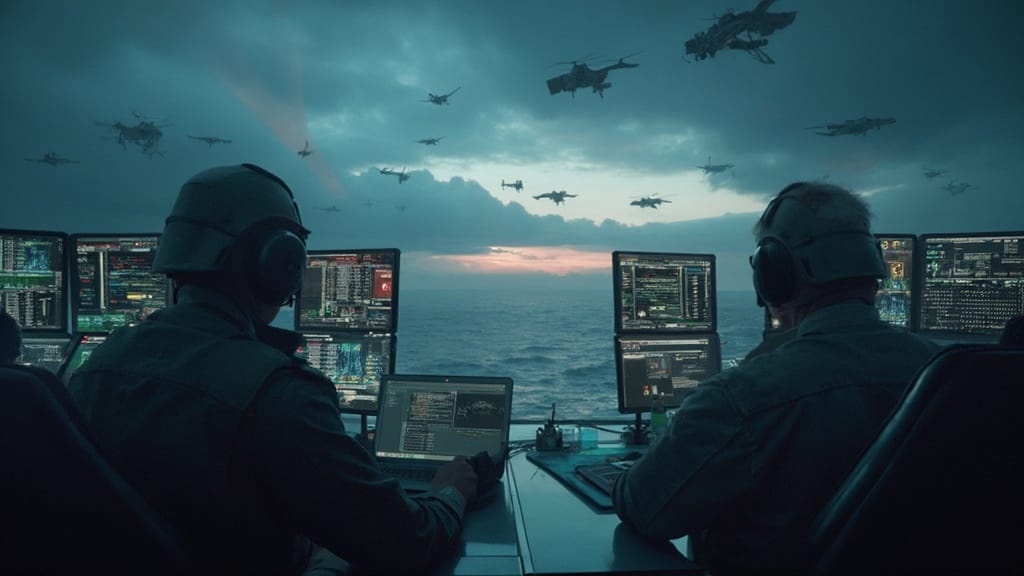
Photo: lyceumnews.com
Wednesday, June 17, 2026
The Big Picture
Today is a split screen. On one side, the Iran war is stuck in its "peace on paper, missiles in the air" phase — Trump promising it'll wrap in two to three weeks while Iran keeps hitting ships and threatening banks. On the other, the world's militaries are quietly rewiring how they make war: Renault turning a car line into a kamikaze-drone factory, the Navy buying drones that don't need runways, Europe stretching artillery barrels toward 60 kilometers. The connective thread is speed — in diplomacy, in production, and in how fast cheap autonomous systems are crowding everyone else off the battlefield.
What Just Shipped
- Toutatis loitering munition (Thales / Renault): A remotely operated kamikaze drone, slated for production on a Renault car line at up to 1,000 units a month.
- Atlas runway-independent drone (Mach Industries / Whisper Aero): JetFoil-propelled aircraft built to launch and recover without a runway, under a new Defense Innovation Unit contract.
- KNDS long-barreled 155mm howitzer (KNDS): A gun with a barrel longer than any NATO production artillery, pitched for a 60 km base range with unguided shells.
- SIPER-2 layered air defense system (Türkiye): Completed a successful live-fire test of its long-range, high-altitude interceptor.
- One-way attack drone munitions list (US DoD): Pentagon published preferred low-cost warheads from Northrop Grumman and several startups, compatible across drone airframes.
Today's Stories
Trump says the Iran war could be over in "2–3 weeks" — as the costs finally surface
The war has been "almost over" for weeks now, and the timeline keeps sliding. CBS News reports that Donald Trump is telling Americans the conflict could wrap in two to three weeks — even as he acknowledges gas above $4 a gallon and a mounting toll on U.S. forces and shipping. Iran is still hitting commercial ships and threatening U.S.-linked banks, pushing the story beyond ship attacks into pressure on financial infrastructure itself.
Here's what changes if the optimism is real: markets calm, escort operations wind down, the Pentagon's surge ebbs. Here's what changes if it isn't: commanders get told to dial back force protection before the threat recedes, leaving sailors and bases exposed during the most dangerous lull there is. The signal is simple — watch whether strike tempo and naval escort operations around the Strait of Hormuz actually drop in the next two weeks. If they don't, "war almost over" is a campaign line, not an operational fact.
An Iranian missile toward Turkey was shot down — and the war brushed NATO's border
Missiles drifting toward NATO territory are the kind of thing that keeps defense ministers awake at night. Deutsche Welle reports that an Iranian missile headed toward Turkey was destroyed before impact, described by officials as spillover from ongoing regional strikes. Nobody calls it a deliberate attack on Turkey — but geography cares more about physics than intent.
For NATO this is a stress test of air-defense integration, not a casus belli. The alliance has spent years stitching U.S., European, and Turkish sensors and interceptors into a single web that can engage a fast-moving track in seconds — and that web just got a real exam. If it works smoothly, the case for distributed sensing and tighter NATO missile-warning integration hardens into requirements. If it fumbles, every future stray track becomes a fresh argument over whose radars and red lines failed. Watch how often Iranian weapons stray toward alliance airspace — frequency is the tell.
Renault turns a car plant into a kamikaze-drone factory with Thales
The civilian supply chain is the new arsenal. Reuters reports that Renault is teaming with Thales to mass-produce the Toutatis loitering munition — a remotely operated kamikaze drone, essentially a small guided bomb with wings — on a Renault production line, with output potentially reaching 1,000 units a month starting as early as 2027.
France already had the designs. What it lacked was the industrial muscle to churn them out without building a defense factory from scratch — and that's exactly what an automaker's just-in-time logistics and robotics provide. If it works, expect other governments to tap their own car and electronics plants, blurring "civilian industry" and "war reserve" until they're nearly the same thing. If it stalls — automotive quality processes don't always survive contact with military fuzing — the monthly production numbers will quietly disappear from the press releases. Watch whether Renault hits that 1,000-a-month figure or just announces it.
The Navy's next drones won't need runways — Mach Industries wins a key DIU deal
Warships don't come with spare runways, which is awkward when half your new concepts depend on unmanned aircraft. Defense Daily reports that startup Mach Industries has won a Defense Innovation Unit contract to serve as aircraft integrator for a Navy program built around runway-independent drones — aircraft you can launch from ships, rough fields, or improvised pads. Mach is pairing with Whisper Aero on an aircraft called Atlas, using a JetFoil propulsion system designed to take off without a runway.
Why this matters: China, Iran, and others now target big fixed airbases first. A drone you can toss off a destroyer is far harder to preempt than one parked on a known concrete strip. If the prototypes fly, runway-free autonomy gets baked into future Navy and Marine concepts rather than bolted on. If they don't, Atlas joins the long graveyard of clever launch schemes that never survived sea state and salt. The signal to watch: flight test results, not contract awards.
Europe's new "super-howitzer" reaches for 60 km — and the drone war is why
Artillery is having a mid-life crisis: shoot farther, or become target practice for drones. At Eurosatory, Defense News reports that Franco-German manufacturer KNDS is pitching a 155mm howitzer with a barrel longer than any current NATO production gun, aiming for a 60-kilometer base range with unguided rounds — a significant jump over the 30–40 km most Western systems manage today.
A longer barrel and optimized ammunition let the shell build velocity without tearing itself apart. The why is Ukraine, where both sides hunt guns the instant they fire. The farther your gun shoots, the farther it sits from the front, and the more room it has to hide. If European armies buy in, artillery shifts toward being a long-range sniper rifle guided by drones rather than a blunt instrument. The thing to watch is a launch customer — until someone signs, this is a barrel and a brochure.
DeepSeek's military ties put AI export controls back in the spotlight
AI export controls just got a live case study. Reuters, via Yahoo Finance, reports that the U.S. has held off blacklisting Chinese AI company DeepSeek, even though U.S. officials say its low-cost frontier model has supported Chinese military and intelligence operations. The hesitation isn't about innocence — it's about not detonating a broader U.S.–China tech escalation before Washington is ready.
The deeper question is whether to treat a general-purpose AI firm like a defense contractor under export rules, especially when its model weights and APIs may already be everywhere. If DeepSeek lands on a blacklist, it marks a new phase: export controls targeting AI services, not just the chips they run on — and every Western AI startup starts auditing who uses its models for what. If Washington keeps holding off, that itself signals frontier-model controls are unenforceable once weights leak. Watch the Commerce Department's entity list.
China's latest Taiwan drills look more like a rehearsal than a tantrum
China's drills around Taiwan are starting to look less like protest and more like repetition. Chinese and Western outlets report the People's Liberation Army conducting live-fire air and sea exercises encircling the island, with state media framing them explicitly as a "warning" to pro-independence leaders. [Source: DW / People's Daily / VOA — Chinese]
The detail that matters isn't the rhetoric — it's the engineering. Every encirclement is a lab for joint operations, long-range strike coordination, and blockade logistics, and a chance to see how China's command systems hold up at scale while forcing Taiwan and the U.S. to burn readiness scrambling fighters and lighting radars. The signal worth watching: if future drills add amphibious assault ships and logistics vessels, Beijing isn't rehearsing pressure anymore — it's rehearsing the plumbing of an actual landing.
⚡ What Most People Missed
The Strait of Hormuz is still effectively closed to Western shipping: While the political messaging turns optimistic, the lane underneath it hasn't normalized — and the IRGC's toll regime keeps squeezing maritime access regardless of what the peace text says.
The PCB supply chain is secretly a drone and AI problem: A U.S. official told Congress the domestic printed-circuit-board supply chain is "less than 20% self-sufficient." That means critical components in missiles, drones, and AI data centers still run through China-linked suppliers — a hidden vulnerability in any high-tech war.
A US "war-ready" weapons stockpile is quietly going into Australia: Asharq Al-Awsat obtained documents showing a permanent pre-positioned weapons depot for Marine forces on Australia's southeast coast, beyond most Chinese missile range. Watch what goes in: long-range anti-ship and anti-air missiles would reveal exactly how Washington expects a Pacific war to be fought. [Source: Asharq Al-Awsat — Arabic/English]
Japan is building the machinery to become a real arms exporter: Per The Diplomat, Tokyo is weighing a centralized "Japanese-style Foreign Military Sales" body, and per the Indian Council of World Affairs, it has already loosened export rules to allow lethal platform transfers to 17 countries — moving from "no export" toward Washington's model.
Trump's delayed China trip is a small calendar story with a big strategic smell: The New York Times reports he wants to push the visit because of the Middle East. The defense-tech tell: when one theater monopolizes the Situation Room, the other doesn't pause — it just accumulates unattended risk in export-control coordination and allied tech programs.
📅 What to Watch
- If the formal Iran peace text publishes while drone and missile launches continue at current levels, the war has split into diplomatic and kinetic tracks — and U.S. forces are most exposed precisely when leadership stops paying attention.
- If Renault and Thales hit 1,000 Toutatis a month, European drone firepower scales on a Ukraine-style curve, and NATO planning shifts toward high-volume attrition rather than precision scarcity.
- If the U.S. blacklists DeepSeek, AI services move to the center of export-control fights — forcing every Western AI firm to treat its customer list as a compliance liability.
- If China's next drill adds amphibious and logistics vessels, the qualitative line from "coercion theater" to "invasion rehearsal" has been crossed.
- If long-range anti-ship missiles turn up in the Australian depot manifest, that's Washington telegraphing a first-week-of-war Pacific plan, not just resilient logistics.
The Closer
A French hatchback line spitting out a thousand suicide drones a month, a Navy aircraft that launches off a destroyer because someone forgot to pack a runway, and a Chinese fleet practicing the world's most aggressive parking job around Taiwan. Somewhere in all this, a congressman quietly admitted that the circuit boards inside America's missiles are 80% sourced from the country those missiles might be aimed at — which is the kind of detail you really hope someone in procurement reads before the shooting starts.
Stay sharp out there.
Forward this to the friend who keeps asking what "loitering munition" actually means — now you can tell them it's a flying bomb built by Renault.
⚡ EDGE Signals
The following signals appeared in the adversarial edge sweep but were not carried forward in the primary synthesis:
- The operational picture underneath that headline is worth unpacking. The Strait of Hormuz remains effectively closed to Western-allied commercial shipping, with Lloyd's List Intelligence assessing no Western-allied transits since May 4, and the IRGC's "Persian Gulf Strait Authority" toll regime now
- The timing is notable. Japan's defense budget is now on a trajectory toward 2% of GDP, it has loosened export rules to allow lethal equipment transfers, and it just signed a new defense agreement with Indonesia days after the USNI News Fleet Tracker showed Ottawa announced plans to procure over two
- Global Defense Corp reports that Türkiye's SIPER 2 layered air‑defense system has completed a successful live‑fire test, described as a key milestone in the program's development.[12] The SIPER family is intended to give Ankara its own long‑range, high‑altitude air and missile defense umbrella above