The Lyceum: Defense Tech Daily — Jun 19, 2026

Photo: lyceumnews.com
Friday, June 19, 2026
The Big Picture
Today's pattern is a paradox you can hold in one hand: the United States is trying to end one war while building the factory floor for the next one. Israel and Hezbollah keep trading fire under a "partial" truce, Trump is selling a fast finish to the Iran war even as U.S. warships stay busy in the Gulf, and underneath all of it the Pentagon is quietly buying drones by the tens of thousands and teaching swarms to think for themselves. The connective tissue is scale — who can build useful military hardware fast enough, cheap enough, and in enough volume to matter.
What Just Shipped
- LUCAS + Hivemind (Shield AI / SpektreWorks): Swarm-autonomy software is being integrated onto the U.S. military's Shahed-style one-way attack drone, with a single-operator swarm demo planned for this fall.
- Gauntlet II / Drone Dominance (Department of War): First batch accepted and nearly 2,000 small drones shipped to units, with a 60,000-unit buy underway.
- MQ-25A Stingray (Boeing / U.S. Navy): The Navy's carrier-launched refueling drone completed its historic first flight.
- Abrams modernization (General Dynamics Land Systems): A $43.5 million contract modification, awarded June 18, boosts Abrams production and upgrades.
- P-8A Poseidon training systems (Boeing / U.S. Navy): An $880 million ceiling contract, signed June 18, to build training systems for the Navy's maritime patrol workhorse.
Today's Stories
Israel keeps hitting Hezbollah as the "partial truce" frays
Southern Lebanon is the uncomfortable counterexample to anyone hoping the Iran deal would calm the region. The BBC reports Israel carried out fresh strikes across southern Lebanon even as a partial truce with Hezbollah technically holds — a day after the Lebanese army said it had finished the first phase of disarming the group. Israel has kept troops in five areas it deems strategic. The danger is the gap between script and reality: the U.S.–Iran memorandum explicitly calls for hostilities to stop between Israel and Iran's partners, but neither side will blink first. Watch whether talks later this month can survive ongoing airstrikes — if Israel pushes back into Beirut's suburbs, the Lebanon front has overtaken the Iran deal as the engine of escalation.
Trump promises a quick end to the Iran war as the hidden costs surface
Listen to the speeches and the war sounds nearly wrapped; look at the operational details and it's messier. CBS News reports Trump telling Americans the conflict could finish "pretty quickly" — and separately calling any U.S.–Iran understanding "not final," threatening to resume bombing "if they don't behave." Meanwhile Iran keeps striking commercial shipping, threatening foreign banks, and bleeding U.S. forces through missile and drone attacks; at least seven U.S. combat deaths are reported so far. The 60-day Hormuz negotiating window is open, but both sides keep probing for leverage at sea. If Iran's tempo of attacks doesn't drop in the next week, the war has effectively split into a public peace track and a quiet shadow conflict — with U.S. forces most exposed precisely when leadership declares the job nearly done.
Hormuz reopens — the U.S. lifts its blockade but keeps a close watch
If your job touches energy prices, this is the piece that hits your spreadsheet first. Military Times reports the U.S. military has lifted its two-month naval blockade of the Strait of Hormuz, with Trump saying mine-hunting operations are underway and the passage will be fully open Friday. Washington has traded a very visible coercive tool for a more routine "escort and monitor" posture, betting Iran restrains its proxies in exchange for economic relief. The tell will be whether shipping insurance rates and tanker routings normalize over the next two weeks — or whether under-the-radar attacks keep premiums high and reveal the risk picture never really improved.
The U.S. military's Shahed-style kamikaze drone is getting a brain
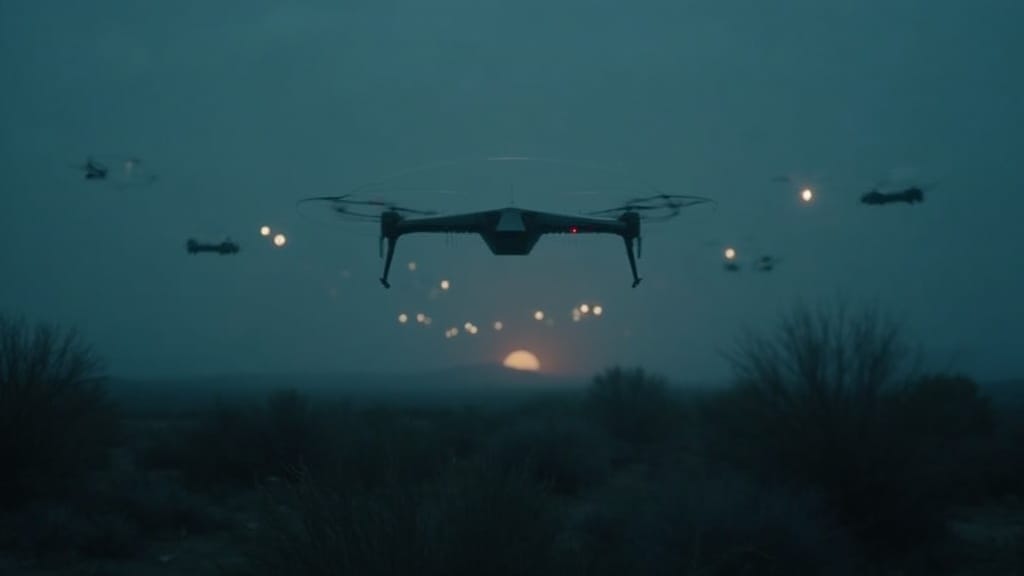
The Pentagon's cheap-attack-drone push just got a major software upgrade. The Office of the Under Secretary of War for Research and Engineering selected Shield AI to put its Hivemind autonomy software onto LUCAS — the Low-Cost Uncrewed Combat Attack System, America's answer to Iran's Shahed. Built by Arizona's SpektreWorks from a Shahed-136 variant, LUCAS is roughly ten feet long with a 444-nautical-mile range and a 40-pound payload, and has already flown in the Middle East during Operation Epic Fury. Hivemind lets groups of drones coordinate and adapt in real time; a fall demonstration will have one operator command an entire swarm. That ratio — one human, many drones — is the whole game. If the demo works, the U.S. closes the mass-production gap with Russia and China without needing a proportional army of trained crews. If it stumbles, "swarm autonomy" stays a slide, and America keeps fielding expensive drones one operator at a time.
The Pentagon quietly orders 60,000 more small combat drones
Behind the headline wars, the U.S. is buying enough small drones to change how its infantry fights. The Department of War says its Drone Dominance Program took its first order and is preparing to purchase 60,000 more — the quadcopters and fixed-wing systems platoons use for scouting, targeting, and kamikaze strikes. Military-grade DJI on steroids. It follows the second Gauntlet competition at Camp Grayling, where vendors flew live-fire trials to prove endurance and jamming resistance; nearly 2,000 units have already shipped to units. For anyone watching Ukraine's FPV tactics, this is the U.S. moving from experiment to mass adoption — small drones becoming as standard as radios. The signal to watch: whether Congress locks in multi-year funding in the FY27–28 budget, which would prove this is a permanent shift and not a one-off surge.
Ukraine's long-range drones start cutting into Russia's war machine

Ukraine's drone war has gone from newsworthy to structural. New Atlantic Council analysis argues Ukrainian drones are increasingly hitting Russian logistics — fuel depots, rail hubs, refineries hundreds of kilometers from the front — forcing Russia to reshuffle air defenses and supply routes. The Associated Press reported that a June 18 strike damaged the Gazprom Neft refinery in Moscow and disrupted flights, one of the biggest attacks on the capital in years. The logic is brutal arithmetic: refineries are hard to defend at scale, and every diverted air-defense battery is one less covering Russian forces in Ukraine. The lesson for everyone else is that long-range drones have become a poor man's cruise missile — a tool of economic warfare. Watch whether NATO states accelerate their own long-range programs in response.
The U.S. bankrolls a rare-earths pivot with a $725M loan to Energy Fuels
Modern weapons run on rare-earth magnets, and Washington is tired of buying them from Beijing. The Department of War's Office of Strategic Capital announced a $725 million conditional loan to Energy Fuels Inc., a uranium producer, to scale domestic rare-earth processing. Right now China dominates refining and magnet manufacturing — a strategic chokepoint if Taiwan tensions spike. By using a loan rather than a grant, the Office of Strategic Capital is signaling it wants a commercially viable business, not a one-off stockpile. The open question: can Energy Fuels move from pilot-scale separation to reliable, cost-competitive production before the next crisis tests rare-earth supply lines? The tell is whether the loan converts from "conditional" to executed alongside actual plant-build announcements.
The U.S. leans into "NATO 3.0" — and wants Europe to carry more
While missiles fly in the Middle East, Washington is recalibrating what NATO should look like in the 2030s. The Department of War is launching a review of its posture and footprint in Europe to make "NATO 3.0" a Europe-led alliance, with U.S. forces acting more as backstop than first responder. The review covers where American troops, logistics hubs, and missile defenses sit, and how that matches European investment since Russia's invasion. The thing to track: whether this produces measurable shifts in U.S. bases and pre-positioned equipment — or stays aspirational language while Washington remains the de facto backbone. If the review yields more pre-positioned gear but fewer permanent combat units, the alliance is betting on rapid reinforcement over forward garrisons.
⚡ What Most People Missed
A White House memo is turning munitions bottlenecks into a wartime-management problem: Breaking Defense reported June 16 that Pentagon officials are using a June 11 presidential action to enable "voluntary agreements" under the Defense Production Act — legal cover for firms to coordinate on missile-production bottlenecks without antitrust fears. It treats the industrial base less like a market and more like a mobilization system.
The UK opened what it calls Europe's largest drone test centre: Defence Secretary Dan Jarvis presided over the Swindon facility's launch, built for beyond-line-of-sight trials and using Robin Radar Systems' IRIS detection tech. A permanent hub, not a funding pledge — Europe betting drone integration is a long haul.
The Army is jamming its own troops to prep for a China fight: Breaking Defense reported the Army deliberately stressed friendly forces with heavy jamming, including the MAMBA-E high-powered jammer, porting Ukraine's spectrum lessons into Pacific planning. Lesson one, straight from Ukraine: units that stay concentrated get found faster.
Pakistan's first Chinese-built AIP submarine arrived in Karachi: PNS Hangor, first of eight Hangor-class boats, reached Karachi June 11. The sleeper detail isn't the hull — it's the technology-transfer deal letting Pakistan build the next four at home, acquiring submarine-building know-how that compounds over decades. India's P-8I patrol aircraft are reportedly already watching.
Congress thinks the Army's drone fleet is a mess: The Senate Armed Services Committee called the Army's small-drone approach "fragmented and insufficient," pressing for a unified fielding plan. Unglamorous but critical — the precondition for fielding thousands of drones that actually talk to each other.
📅 What to Watch
- If Iranian attacks on shipping and banks don't drop in the next 7–10 days, the U.S.–Iran memorandum is functioning as a political shield, not a real ceasefire.
- If Israeli strikes push from southern Lebanon back into Beirut's suburbs, the Lebanon front has overtaken the Iran deal as the main escalation driver — and Tehran tied the two together.
- If Congress ties Army drone funding to a unified fielding plan in the FY27 bill, lawmakers are ready to force a coherent "drone stack" on a service that's been improvising.
- If the Energy Fuels loan converts from conditional to executed with plant-build announcements, Washington believes domestic rare-earth processing can scale fast enough to blunt Chinese leverage.
- If the LUCAS fall demo proves one operator can credibly run a swarm, the economics of drone warfare change permanently — mass without proportional manpower.
The Closer
A kamikaze drone learning to think in flocks, a Moscow refinery damaged under a thousand-dollar quadcopter's cousin, and a uranium company getting $725 million to learn the magnet business. The Pentagon spent the day teaching drones to swarm and the Army spent it jamming its own soldiers — which means somewhere a budget official is calmly explaining that paying firms to not compete is the patriotic option now. Sleep when the spectrum's quiet.
Forward this to the friend who still thinks the next war will be fought by people.
⚡ EDGE Signals
The following signals appeared in the adversarial edge sweep but were not carried forward in the primary synthesis:
- [1] Pakistan Unleashes Massive 18% Defence Procurement Surge as J-35 Stealth Fighter, Hangor Submarine Programs Accelerate - Defence Security Asia
URL: https://defencesecurityasia.com/en/pakistan-defence-budget-2026-j35-stealth-fighter-hangor-submarine-hq19-missile-shield/
- [3] Pakistan's $10.76 Billion Defence Budget, PNS Hangor, and the FCAS Collapse - Quwa
URL: https://quwa.org/podcasts/defence-uncut/pakistans-10-76-billion-defence-budget-pns-hangor-and-the-fcas-collapse/
- [4] Pakistan to Induct First Hangor-Class Submarine in 2026 — A US$5 Billion Naval Game-Changer in the Arabian Sea and Indian Ocean - Defence Security Asia
URL:
- The early signals today point to institutionalization of war-tested unmanned tech: Ukrainian drone know-how is starting to flow into Asia, the UK is standing up what is billed as Europe's largest drone test site, and a Middle Eastern buyer has quietly signed a $124 million counter-drone package